


 |
市場調查報告書
商品編碼
1998821
工業閥門市場機會、成長要素、產業趨勢分析及2026-2035年預測Industrial Valve Market Opportunity, Growth Drivers, Industry Trend Analysis, and Forecast 2026 - 2035 |
||||||

預計到 2025 年,全球工業閥門市場規模將達到 739 億美元,並以 6.7% 的複合年成長率成長,到 2035 年將達到 1,491 億美元。
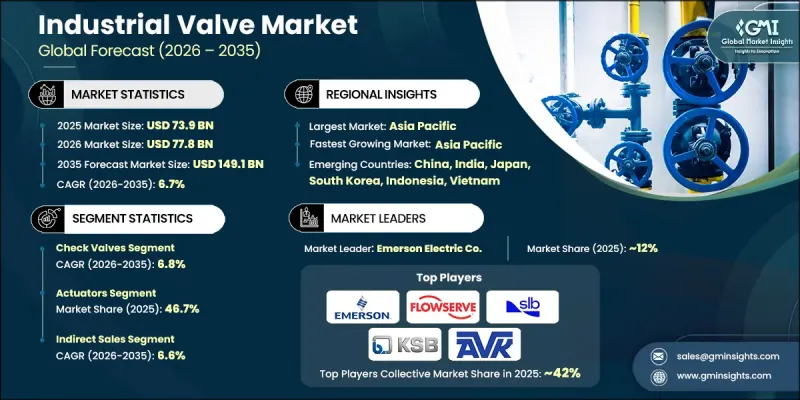
隨著全球電力生產和大型基礎設施建設投資的加速,工業閥門市場持續成長。公共和私營部門都在增加對發電廠、公共產業系統和工業加工設施的資本投入,顯著提升了對先進閥門技術的需求。閥門在工業系統中,尤其是在能源生產和資源開採活動中,對流量控制和壓力穩定性起著至關重要的作用。隨著全球可再生能源設施的擴張,現代能源系統中使用的複雜管道網路需要可靠的閥門來高效調節流體流動。都市區的基礎設施現代化也促進了市場成長,特別是為滿足不斷成長的人口需求而進行的供水和污水處理系統的擴張。工業閥門仍然是眾多工業環境中維持管路安全、運作可靠性和高效製程控制的關鍵組件。石化產能的擴張進一步推動了需求,因為加工設施需要大規模的閥門安裝來支援連續運作。此外,在大規模工程建設計劃中,閥門系統擴大從設計和規劃階段就被納入考量,以確保長期運作效率並符合安全標準。
| 市場範圍 | |
|---|---|
| 開始年份 | 2025 |
| 預測期 | 2026-2035 |
| 初始市場規模 | 739億美元 |
| 預測金額 | 1491億美元 |
| 複合年成長率 | 6.7% |
預計到2025年,止回閥市場規模將達到144億美元,並預計在2026年至2035年間以6.8%的複合年成長率成長。止回閥是應用最廣泛的閥門之一,在防止管道系統回流方面發揮著至關重要的作用。透過維持流體單向流動,這些閥門有助於保護泵浦、管道和製程設備免受運作中損壞。其相對簡單的機械設計確保了系統的可靠性能,同時減少了維護需求。在嚴苛的壓力條件下仍能維持高耐久性,進一步增強了其在工業環境中的適用性。管道基礎設施和工業設施的持續擴張正在推動全球對這類閥門系統的持續需求。
預計到2025年,執行器市佔率將達到46.7%,並在2026年至2035年間以7.2%的複合年成長率成長。隨著工業營運中自動化程度的不斷提高,執行器正成為關鍵組件類別。自動化閥門系統顯著提高了製程精度、運作可靠性和整體系統效率。在複雜的加工環境中運行的行業越來越依賴執行器驅動的閥門來實現遠端操作和集中式流程管理。先進的執行器技術提高了系統反應速度,同時最大限度地減少了手動調節的需求。與數位控制系統的整合還可以實現即時效能監控和運行最佳化。隨著各行業不斷推進設施現代化以提高生產效率和安全標準,預計執行器的全球應用將保持強勁勢頭。
預計到2025年,中國工業閥門市場規模將達92億美元。這一市場成長主要得益於強大的工業製造能力和大規模的能源基礎設施建設。電力設施的大量投資推動了各行業對工業閥門的需求成長。此外,石化生產基礎設施的擴展也帶動了對能夠應對嚴苛運作況的高性能閥門的需求。旨在改善水資源管理系統的大規模城市基礎設施項目,也為閥門技術的穩定供應提供了保障。國內製造商持續擴大產能,以支持重大工業和基礎設施計劃。出口導向設備製造進一步支撐了全球市場的穩定替換需求。
目錄
第1章:調查方法和範圍
第2章執行摘要
第3章業界考察
- 生態系分析
- 供應商情況
- 利潤率
- 每個階段增加的價值
- 影響價值鏈的因素
- 影響產業的因素
- 促進因素
- 擴大能源和基礎設施投資
- 智慧閥門和物聯網閥門技術的應用
- 工業自動化和工業4.0的引入
- 陷阱與挑戰
- 原物料價格波動和供應鏈不穩定
- 嚴格的監管合規和認證要求
- 機會
- 進入可再生能源和清潔能源基礎設施市場
- 開發耐腐蝕和性能增強材料
- 促進因素
- 成長潛力分析
- 未來市場趨勢
- 科技與創新趨勢
- 當前技術趨勢
- 新興技術
- 價格趨勢
- 按地區
- 依產品
- 監理情勢
- 標準和合規要求
- 區域法律規範
- 認證標準
- 貿易統計(HS編碼 - 8481)
- 主要進口國
- 主要出口國
- 波特五力分析
- PESTEL 分析
第4章 競爭情勢
- 介紹
- 企業市佔率分析
- 按地區
- 北美洲
- 歐洲
- 亞太地區
- 拉丁美洲
- 中東和非洲
- 按地區
- 企業矩陣分析
- 主要市場公司的競爭分析
- 競爭定位矩陣
- 主要進展
- 併購
- 夥伴關係與合作
- 新產品發布
- 業務拓展計劃
第5章 市場估計與預測:依類型分類,2022-2035年
- 球閥
- 單向閥
- 蝶閥
- 閘閥
- 球閥
- 塞閥
- 隔膜閥
- 安全閥
第6章 市場估計與預測:依材料分類,2022-2035年
- 鋼
- 塑膠
- 鑄鐵
- 合金基體
- 其他
第7章 市場估計與預測:依組件分類,2022-2035年
- 執行器
- 閥體
- 其他
第8章 市場規模估算與預測(2022-2035年)
- <1"
- 1英寸至6英寸
- 7英寸至25英寸
- 26英寸至50英寸
- 50吋或更大
第9章 市場估計與預測:依最終用途分類,2022-2035年
- 化學
- 能源與公共產業
- 建造
- 金屬和採礦
- 農業
- 製藥
- 食品/飲料
- 紙漿和造紙
- 其他
第10章 市場估價與預測:依通路分類,2022-2035年
- 直銷
- 間接銷售
第11章 市場估價與預測:按地區分類,2022-2035年
- 北美洲
- 美國
- 加拿大
- 歐洲
- 德國
- 英國
- 法國
- 義大利
- 西班牙
- 亞太地區
- 中國
- 印度
- 日本
- 韓國
- 澳洲
- 拉丁美洲
- 巴西
- 墨西哥
- 阿根廷
- 中東和非洲(MEA)
- 沙烏地阿拉伯
- 阿拉伯聯合大公國
- 南非
第12章:公司簡介
- ALFA LAVAL
- AVK Holding A/S
- Baker Hughes Company
- Crane Company
- Danfoss
- Emerson Electric Co.
- Georg Fischer Ltd.
- Hitachi, Ltd.
- ITT INC.
- KITZ Corporation
- KSB SE &Co. KGaA
- Mueller Co. LLC.
- SLB(Schlumberger Limited.)
- TechnipFMC plc
- The Weir Group PLC
The Global Industrial Valve Market was valued at USD 73.9 billion in 2025 and is estimated to grow at a CAGR of 6.7% to reach USD 149.1 billion by 2035.
The industrial valve market continues to gain momentum as global investment in energy generation and large-scale infrastructure development accelerates. Both public and private sector organizations are increasing capital spending on power plants, utility systems, and industrial processing facilities, which significantly boosts the demand for advanced valve technologies. Valves play a fundamental role in managing flow control and pressure stability across industrial systems, particularly in energy production and resource extraction activities. As renewable energy installations expand globally, complex piping networks used in modern energy systems require highly reliable valves to regulate fluid movement efficiently. Infrastructure upgrades across urban regions are also contributing to market growth, particularly as water distribution and wastewater treatment systems expand to meet rising population demands. Industrial valves remain essential components in maintaining pipeline safety, operational reliability, and efficient process control across numerous industrial environments. Growing petrochemical production capacity further contributes to demand, as processing facilities require extensive valve installations to support continuous operations. Additionally, large engineering and construction projects increasingly incorporate valve systems during the design and planning stages to ensure long-term operational efficiency and safety compliance.
| Market Scope | |
|---|---|
| Start Year | 2025 |
| Forecast Year | 2026-2035 |
| Start Value | $73.9 Billion |
| Forecast Value | $149.1 Billion |
| CAGR | 6.7% |
The check valves segment generated USD 14.4 billion in 2025 and is expected to grow at a CAGR of 6.8% from 2026 through 2035. Check valves represent one of the most widely used valve types because they play a critical role in preventing reverse flow within pipeline systems. By maintaining one-directional fluid movement, these valves help protect pumps, pipelines, and process equipment from operational damage. Their relatively simple mechanical design reduces maintenance requirements while ensuring dependable system performance. High durability under demanding pressure conditions further strengthens their suitability for industrial environments. Ongoing expansion of pipeline infrastructure and industrial facilities continues to reinforce global demand for these valve systems.
The actuators segment held 46.7% share in 2025 and is forecast to grow at a CAGR of 7.2% between 2026 and 2035. Actuators have emerged as the leading component category due to the increasing adoption of automation across industrial operations. Automated valve systems significantly enhance process precision, operational reliability, and overall system efficiency. Industries operating complex processing environments increasingly rely on actuator-driven valves to enable remote operation and centralized process management. Advanced actuator technologies improve system responsiveness while minimizing the need for manual adjustments. Integration with digital control systems also allows real-time performance monitoring and operational optimization. As industries continue modernizing facilities to improve productivity and safety standards, actuator adoption is expected to remain strong worldwide.
China Industrial Valve Market accounted for USD 9.20 billion in 2025. The country's market growth is supported by extensive industrial manufacturing capacity and large-scale energy infrastructure development. Significant investments in power generation facilities are contributing to higher demand for industrial valve installations across multiple industrial segments. Expansion of petrochemical production infrastructure is also increasing the need for high-performance valves capable of handling demanding operational conditions. In addition, large urban infrastructure programs aimed at improving water management systems are generating consistent procurement demand for valve technologies. Domestic manufacturers continue expanding production capacity to support major industrial and infrastructure projects. Export-oriented equipment manufacturing further sustains steady replacement demand in global markets.
Major companies participating in the Global Industrial Valve Market include Emerson Electric Co., Crane Company, Danfoss, Baker Hughes Company, SLB, TechnipFMC plc, The Weir Group PLC, ITT Inc., KITZ Corporation, KSB SE & Co. KGaA, Hitachi Ltd., Georg Fischer Ltd., Mueller Co. LLC., AVK Holding A/S, and Alfa Laval. Companies operating in the Industrial Valve Market are strengthening their competitive position by focusing on innovation, strategic partnerships, and global expansion initiatives. Many manufacturers are investing in advanced valve technologies that support automation, digital monitoring, and predictive maintenance capabilities. Continuous research and development efforts are helping companies improve valve durability, operational efficiency, and compatibility with complex industrial systems. Strategic acquisitions and collaborations allow firms to expand their product portfolios and gain access to specialized technologies and regional markets. Manufacturers are also increasing investments in production facilities and supply chain networks to support growing infrastructure and energy projects worldwide.
Table of Contents
Chapter 1 Methodology & Scope
- 1.1 Market scope and definition
- 1.2 Research design
- 1.2.1 Research approach
- 1.2.2 Data collection methods
- 1.3 Data mining sources
- 1.3.1 Global
- 1.3.2 Regional/Country
- 1.4 Base estimates and calculations
- 1.4.1 Base year calculation
- 1.4.2 Key trends for market estimation
- 1.5 Primary research and validation
- 1.5.1 Primary sources
- 1.6 Forecast model
- 1.7 Research assumptions and limitations
Chapter 2 Executive Summary
- 2.1 Industry 360° synopsis
- 2.2 Key market trends
- 2.2.1 Type
- 2.2.2 Material
- 2.2.3 Component
- 2.2.4 Size
- 2.2.5 End Use
- 2.2.6 Distribution channel
- 2.3 CXO perspectives: Strategic imperatives
- 2.3.1 Key decision points for industry executives
- 2.3.2 Critical success factors for market players
- 2.4 Future outlook and strategic recommendations
Chapter 3 Industry Insights
- 3.1 Industry ecosystem analysis
- 3.1.1 Supplier landscape
- 3.1.2 Profit margin
- 3.1.3 Value addition at each stage
- 3.1.4 Factor affecting the value chain
- 3.2 Industry impact forces
- 3.2.1 Growth drivers
- 3.2.1.1 Expanding energy and infrastructure investments
- 3.2.1.2 Adoption of smart and IoT-enabled valve technologies
- 3.2.1.3 Industrial automation and Industry 4.0 implementation
- 3.2.2 Pitfalls & Challenges
- 3.2.2.1 Raw material price volatility and supply chain instability
- 3.2.2.2 Stringent regulatory compliance and certification demands
- 3.2.3 Opportunities
- 3.2.3.1 Expansion into renewable and clean energy infrastructure
- 3.2.3.2 Development of corrosion-resistant and performance-enhancing materials
- 3.2.1 Growth drivers
- 3.3 Growth potential analysis
- 3.4 Future market trends
- 3.5 Technology and innovation landscape
- 3.5.1 Current technological trends
- 3.5.2 Emerging technologies
- 3.6 Price trends
- 3.6.1 By region
- 3.6.2 By product
- 3.7 Regulatory landscape
- 3.7.1 Standards and compliance requirements
- 3.7.2 Regional regulatory frameworks
- 3.7.3 Certification standards
- 3.8 Trade statistics (HS Code - 8481)
- 3.8.1 Major importing countries
- 3.8.2 Major exporting countries
- 3.9 Porter's analysis
- 3.10 PESTEL analysis
Chapter 4 Competitive Landscape, 2025
- 4.1 Introduction
- 4.2 Company market share analysis
- 4.2.1 By Region
- 4.2.1.1 North America
- 4.2.1.2 Europe
- 4.2.1.3 Asia Pacific
- 4.2.1.4 Latin America
- 4.2.1.5 Middle East & Africa
- 4.2.1 By Region
- 4.3 Company matrix analysis
- 4.4 Competitive analysis of major market players
- 4.5 Competitive positioning matrix
- 4.6 Key developments
- 4.6.1 Mergers & acquisitions
- 4.6.2 Partnerships & collaborations
- 4.6.3 New product launches
- 4.6.4 Expansion plans
Chapter 5 Market Estimates & Forecast, By Type, 2022 - 2035, (USD Billion) (Thousand Units)
- 5.1 Key trends
- 5.2 Ball Valves
- 5.3 Check Valves
- 5.4 Butterfly Valves
- 5.5 Gate Valves
- 5.6 Globe Valves
- 5.7 Plug Valves
- 5.8 Diaphragm Valves
- 5.9 Safety Valves
Chapter 6 Market Estimates & Forecast, By Material, 2022 - 2035, (USD Billion) (Thousand Units)
- 6.1 Key trends
- 6.2 Steel
- 6.3 Plastic
- 6.4 Cast Iron
- 6.5 Alloy Based
- 6.6 Others
Chapter 7 Market Estimates & Forecast, By Component, 2022 - 2035, (USD Billion) (Thousand Units)
- 7.1 Key trends
- 7.2 Actuators
- 7.3 Valve Body
- 7.4 Others
Chapter 8 Market Estimates & Forecast, By Size, 2022 - 2035, (USD Billion) (Thousand Units)
- 8.1 Key trends
- 8.2 <1"
- 8.3 1" to 6"
- 8.4 7" to 25"
- 8.5 26" to 50"
- 8.6 >50"
Chapter 9 Market Estimates & Forecast, By End Use, 2022 - 2035, (USD Billion) (Thousand Units)
- 9.1 Key trends
- 9.2 Chemical
- 9.3 Energy & Utilities
- 9.4 Construction
- 9.5 Metal & Mining
- 9.6 Agriculture
- 9.7 Pharmaceutical
- 9.8 Food & Beverage
- 9.9 Pulp & Paper
- 9.10 Others
Chapter 10 Market Estimates & Forecast, By Distribution Channel, 2022 - 2035, (USD Billion) (Thousand Units)
- 10.1 Key trends
- 10.2 Direct Sales
- 10.3 Indirect Sales
Chapter 11 Market Estimates & Forecast, By Region, 2022 - 2035, (USD Billion) (Thousand Units)
- 11.1 Key trends
- 11.2 North America
- 11.2.1 U.S.
- 11.2.2 Canada
- 11.3 Europe
- 11.3.1 Germany
- 11.3.2 UK
- 11.3.3 France
- 11.3.4 Italy
- 11.3.5 Spain
- 11.4 Asia Pacific
- 11.4.1 China
- 11.4.2 India
- 11.4.3 Japan
- 11.4.4 South Korea
- 11.4.5 Australia
- 11.5 Latin America
- 11.5.1 Brazil
- 11.5.2 Mexico
- 11.5.3 Argentina
- 11.6 MEA
- 11.6.1 Saudi Arabia
- 11.6.2 UAE
- 11.6.3 South Africa
Chapter 12 Company Profiles
- 12.1 ALFA LAVAL
- 12.2 AVK Holding A/S
- 12.3 Baker Hughes Company
- 12.4 Crane Company
- 12.5 Danfoss
- 12.6 Emerson Electric Co.
- 12.7 Georg Fischer Ltd.
- 12.8 Hitachi, Ltd.
- 12.9 ITT INC.
- 12.10 KITZ Corporation
- 12.11 KSB SE & Co. KGaA
- 12.12 Mueller Co. LLC.
- 12.13 SLB (Schlumberger Limited.)
- 12.14 TechnipFMC plc
- 12.15 The Weir Group PLC

 工業閥門市場:依產品類型、材料、尺寸、驅動方式、最終用途產業和銷售管道-全球預測,2026-2032年
 全球工業閥門市場(至 2032 年):依閥門類型(截止閥、球閥、蝶閥、電磁閥、旋塞閥、彈簧閥、儲槽排氣閥、夾管閥、閘閥、隔膜閥、先導閥、止回閥、安全閥、針閥、洩壓閥)、尺寸(小於 1 英吋、先導閥、止回閥、安全閥、針閥、洩壓閥)、尺寸(小於 1 英吋、1-6 英吋、25 英吋大於英吋)和介質(液體、氣體、漿料)分類
 石油和天然氣行業閥門:市場佔有率分析、行業趨勢和統計數據以及成長預測(2026-2031 年)
 工業閥門市場分析及預測(至2035年):類型、產品類型、技術、應用、材質、製程、最終用戶、功能、安裝配置、解決方案
 工業閥門市場規模及預測(2021-2034),全球及區域佔有率、趨勢和成長機會分析報告:按類型、尺寸、等級和行業分類
 工業閥門市場規模、佔有率、趨勢和預測:按產品類型、功能、材質、尺寸、最終用途行業和地區分類(2026-2034 年)拍擊閥市場:材質、尺寸、壓力等級、驅動方式、應用及通路分類-2026-2032年全球市場預測
 工業閥門市場規模、佔有率和趨勢分析報告:按產品、應用、地區和細分市場預測(2026-2033 年)工業噴霧閥市場:2026-2032年全球市場預測(依產品類型、操作機構、材質、噴霧模式、應用及最終用戶產業分類)
 2026-2030年全球石油天然氣工業閥門市場