


 |
市場調查報告書
商品編碼
1998814
混合微電網市場機會、成長要素、產業趨勢分析及2026-2035年預測Hybrid Microgrid Market Opportunity, Growth Drivers, Industry Trend Analysis, and Forecast 2026 - 2035 |
||||||

全球混合微電網市場預計到 2025 年將價值 40 億美元,預計到 2035 年將以 18.8% 的複合年成長率成長至 242 億美元。
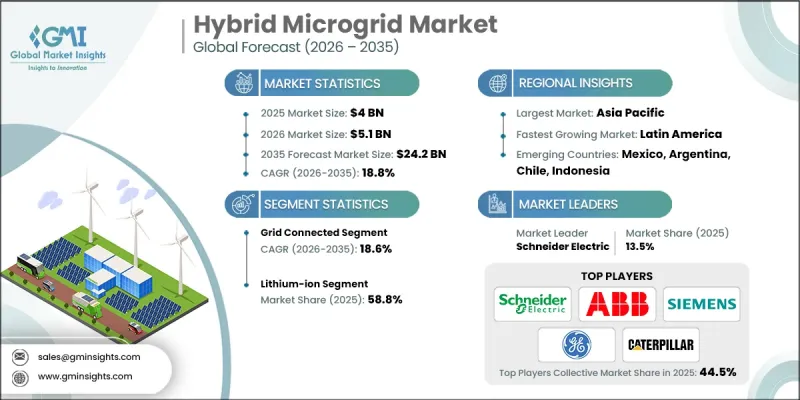
混合微電網整合了再生能源來源、儲能和高效備用電源,能夠最佳化商業、工業和偏遠地區設施的電力使用,最大限度地降低燃料消耗,並減少長期能源成本。極端天氣、自然災害和頻繁的停電加劇了關鍵基礎設施和離網地區對可靠且具彈性的電力解決方案的需求。政府的獎勵、補貼和可再生能源計畫正在加速混合微電網的普及應用,而數位化、智慧電網技術、預測分析和先進控制系統則提高了運作效率。此外,持續的研發投入以及偏遠地區對能源獨立日益成長的需求,正在拓展混合微電網的部署機遇,使其成為全球永續能源管理的重要策略解決方案。
| 市場範圍 | |
|---|---|
| 開始年份 | 2025 |
| 預測期 | 2026-2035 |
| 上市時的市場規模 | 40億美元 |
| 預測金額 | 242億美元 |
| 複合年成長率 | 18.8% |
併網系統市佔率佔比高達71.8%,預計2035年將以18.6%的複合年成長率成長。與智慧電網技術、電網邊緣解決方案和先進數位控制技術的整合,使得更複雜的部署成為可能。這些系統在易受停電、極端天氣和自然災害影響的地區尤其重要,能夠為關鍵設施提供可靠的備用電源和持續供電。
預計到2035年,液流電池市場將以20.3%的複合年成長率成長,這主要得益於其模組化設計、擴充性以及從數小時到數天的儲能容量。這些電池能夠平滑電力波動,從而支持可再生能源的併網;其高能量效率和長循環壽命使其能夠頻繁充放電,且性能衰減極小。
預計到2025年,北美混合微電網市佔率將達到81.6%,到2035年市場規模將達到13億美元。推動這一市場成長的因素包括:美國向清潔能源轉型、應對氣候變遷的努力、可再生能源成本的下降以及對具有韌性和永續的電力解決方案日益成長的需求。專注於利用可再生能源、確保可靠性和降低營運成本的混合解決方案提供者正在推動市場成長。這一趨勢反映了人們對能源獨立、永續性和先進能源管理技術的需求。
目錄
第1章:調查方法和範圍
第2章執行摘要
第3章業界考察
- 產業生態系統
- 原物料供應及採購分析
- 生產能力評估
- 供應鏈韌性與風險因素
- 配電網路分析
- 監理情勢
- 影響產業的因素
- 促進因素
- 產業潛在風險與挑戰
- 成長潛力分析
- 波特五力分析
- PESTEL 分析
- 成本結構分析
- 價格趨勢分析(美元/兆瓦)
- 連結性別
- 按地區
- 新機會和趨勢
- 數位化和物聯網整合
- 進入新興市場
- 投資分析及未來展望
第4章 競爭情勢
- 介紹
- 企業市佔率分析:按地區分類
- 競爭性標竿分析
- 主要進展
- 併購
- 夥伴關係與合作
- 新產品發布
- 業務拓展計劃及資金籌措
第5章 市場規模及預測:依連結類型分類,2022-2035年
- 並網型
- 離網
第6章 市場規模及預測:依電源類型分類,2022-2035年
- 柴油發電機
- 天然氣
- 太陽能
- CHP
- 其他
第7章 市場規模及預測:依儲能設備分類,2022-2035年
- 鋰離子
- 鉛酸電池
- 液流電池
- 飛輪
- 其他
第8章 市場規模及預測:依應用領域分類,2022-2035年
- 衛生保健
- 教育機構
- 軍隊
- 公共產業
- 工商
- 偏僻的
- 其他
第9章 市場規模及預測:依地區分類,2022-2035年
- 北美洲
- 美國
- 加拿大
- 墨西哥
- 歐洲
- 德國
- 法國
- 英國
- 俄羅斯
- 西班牙
- 義大利
- 丹麥
- 亞太地區
- 中國
- 日本
- 韓國
- 印度
- 澳洲
- 馬來西亞
- 印尼
- 中東和非洲
- 沙烏地阿拉伯
- 阿拉伯聯合大公國
- 南非
- 伊朗
- 奈及利亞
- 拉丁美洲
- 巴西
- 阿根廷
- 智利
第10章:公司簡介
- ABB
- Ameresco
- BoxPower Inc
- Caterpillar Inc.
- Clarke Energy
- EnSync Energy Systems
- Elum
- FlexGen Power Systems
- General Electric Company
- Gridscape
- HOMER Energy
- Jakson
- MTU Solution
- Piller Power Systems
- S&C Electric Company
- Saft
- Schneider Electric
- Siemens
- Tesla Energy
- Yanmar Holdings Co., Ltd
The Global Hybrid Microgrid Market was valued at USD 4 billion in 2025 and is estimated to grow at a CAGR of 18.8% to reach USD 24.2 billion by 2035.
Hybrid microgrids, which integrate renewable energy sources, storage, and efficient backup generation, enable commercial, industrial, and remote facilities to optimize power usage, minimize fuel consumption, and reduce long-term energy costs. Rising frequency of extreme weather events, natural disasters, and grid outages has heightened the need for dependable, resilient power solutions for critical infrastructure and off-grid locations. Government incentives, subsidies, and renewable energy programs are accelerating adoption, while digitalization, smart grid technologies, predictive analytics, and advanced control systems enhance operational efficiency. Additionally, ongoing R&D efforts and the growing demand for energy autonomy in remote regions are expanding deployment opportunities, making hybrid microgrids a strategic solution for sustainable energy management worldwide.
| Market Scope | |
|---|---|
| Start Year | 2025 |
| Forecast Year | 2026-2035 |
| Start Value | $4 Billion |
| Forecast Value | $24.2 Billion |
| CAGR | 18.8% |
The grid-connected systems segment held 71.8% share and is expected to grow at a CAGR of 18.6% through 2035. Integration with smart grid technologies, grid-edge solutions, and advanced digital controls is enabling more sophisticated deployments. These systems are especially valuable in regions prone to outages, extreme weather, and natural disasters, providing reliable backup power and continuous electricity supply to essential facilities.
The flow battery segment is projected to grow at a CAGR of 20.3% by 2035, owing to its modular design, scalability, and ability to store energy for hours or even days. These batteries support renewable energy integration by leveling fluctuations, while their high energy efficiency and long cycle life allow frequent charge-discharge operations with minimal performance degradation.
North America Hybrid Microgrid Market held 81.6% share in 2025, generating USD 1.3 billion by 2035. The market is fueled by the country's transition to clean energy, climate change mitigation efforts, declining renewable energy costs, and rising demand for resilient, sustainable power solutions. Companies focusing on hybrid solutions to harness renewable energy, ensure reliability, and reduce operational costs are shaping the growth of the market. The trend reflects the need for energy autonomy, sustainability, and advanced energy management technologies.
Key players operating in the Global Hybrid Microgrid Market include ABB, Ameresco, BoxPower Inc., Caterpillar Inc., Clarke Energy, EnSync Energy Systems, Elum, FlexGen Power Systems, General Electric Company, Gridscape, HOMER Energy, Jakson, MTU Solution, Piller Power Systems, S&C Electric Company, Saft, Schneider Electric, Siemens, Tesla Energy, and Yanmar Holdings Co., Ltd. Companies in the Global Hybrid Microgrid Market are adopting multiple strategies to strengthen market presence and competitive positioning. Many are investing heavily in R&D to improve energy storage efficiency, system reliability, and integration with renewable energy sources. Strategic partnerships and joint ventures with industrial, commercial, and utility clients are expanding deployment opportunities and creating long-term contracts. Firms are also pursuing geographic expansion to enter emerging markets with high energy vulnerability, while developing modular and scalable solutions to cater to diverse customer needs.
Table of Contents
Chapter 1 Methodology & Scope
- 1.1 Research design
- 1.2 Quality commitment
- 1.2.1 GMI AI policy & data integrity commitment
- 1.2.1.1 Source consistency protocol
- 1.2.1 GMI AI policy & data integrity commitment
- 1.3 Research trail & confidence scoring
- 1.3.1 Research trail components
- 1.3.2 Scoring components
- 1.4 Data Collection
- 1.4.1 Partial list of primary sources
- 1.5 Data mining sources
- 1.5.1 Paid sources
- 1.5.1.1 Sources, by region
- 1.5.1 Paid sources
- 1.6 Base estimates and calculations
- 1.6.1 Base year calculation for any one approach
- 1.7 Forecast model
- 1.8 Research transparency addendum
- 1.8.1 Source attribution framework
- 1.8.2 Quality assurance metrics
- 1.8.3 Our commitment to trust
- 1.9 Market definitions
Chapter 2 Executive Summary
- 2.1 Industry synopsis, 2022 - 2035
- 2.2 Business trends
- 2.3 Connectivity trends
- 2.4 Power source trends
- 2.5 Storage device trends
- 2.6 Application trends
- 2.7 Regional trends
Chapter 3 Industry Insights
- 3.1 Industry ecosystem
- 3.1.1 Raw material availability & sourcing analysis
- 3.1.2 Manufacturing capacity assessment
- 3.1.3 Supply chain resilience & risk factors
- 3.1.4 Distribution network analysis
- 3.2 Regulatory landscape
- 3.3 Industry impact forces
- 3.3.1 Growth drivers
- 3.3.2 Industry pitfalls & challenges
- 3.4 Growth potential analysis
- 3.5 Porter's analysis
- 3.5.1 Bargaining power of suppliers
- 3.5.2 Bargaining power of buyers
- 3.5.3 Threat of new entrants
- 3.5.4 Threat of substitutes
- 3.6 PESTEL analysis
- 3.6.1 Political factors
- 3.6.2 Economic factors
- 3.6.3 Social factors
- 3.6.4 Technological factors
- 3.6.5 Legal factors
- 3.6.6 Environmental factors
- 3.7 Cost structure analysis
- 3.8 Price trend analysis (USD/MW)
- 3.8.1 By connectivity
- 3.8.2 By region
- 3.9 Emerging opportunities & trends
- 3.9.1 Digitalization & IoT integration
- 3.9.2 Emerging market penetration
- 3.10 Investment analysis and future outlook
Chapter 4 Competitive landscape, 2026
- 4.1 Introduction
- 4.2 Company market share analysis, by region, 2025
- 4.2.1 North America
- 4.2.2 Europe
- 4.2.3 Asia Pacific
- 4.2.4 Latin America
- 4.2.5 Middle East & Africa
- 4.3 Competitive benchmarking
- 4.4 Key developments
- 4.4.1 Mergers & acquisitions
- 4.4.2 Partnerships & collaborations
- 4.4.3 New product launches
- 4.4.4 Expansion plans and funding
Chapter 5 Market Size and Forecast, By Connectivity, 2022 - 2035 (USD Billion & MW)
- 5.1 Key trends
- 5.2 Grid connected
- 5.3 Off grid
Chapter 6 Market Size and Forecast, By Power Source, 2022 - 2035 (USD Billion & MW)
- 6.1 Key trends
- 6.2 Diesel generators
- 6.3 Natural gas
- 6.4 Solar PV
- 6.5 CHP
- 6.6 Others
Chapter 7 Market Size and Forecast, By Storage Device, 2022 - 2035 (USD Billion & MW)
- 7.1 Key trends
- 7.2 Lithium-ion
- 7.3 Lead acid
- 7.4 Flow battery
- 7.5 Flywheels
- 7.6 Others
Chapter 8 Market Size and Forecast, By Application, 2022 - 2035 (USD Billion & MW)
- 8.1 Key trends
- 8.2 Healthcare
- 8.3 Educational institutes
- 8.4 Military
- 8.5 Utility
- 8.6 Industrial/ commercial
- 8.7 Remote
- 8.8 Others
Chapter 9 Market Size and Forecast, By Region, 2022 - 2035 (USD Billion & MW)
- 9.1 Key trends
- 9.2 North America
- 9.2.1 U.S.
- 9.2.2 Canada
- 9.2.3 Mexico
- 9.3 Europe
- 9.3.1 Germany
- 9.3.2 France
- 9.3.3 UK
- 9.3.4 Russia
- 9.3.5 Spain
- 9.3.6 Italy
- 9.3.7 Denmark
- 9.4 Asia Pacific
- 9.4.1 China
- 9.4.2 Japan
- 9.4.3 South Korea
- 9.4.4 India
- 9.4.5 Australia
- 9.4.6 Malaysia
- 9.4.7 Indonesia
- 9.5 Middle East and Africa
- 9.5.1 Saudi Arabia
- 9.5.2 UAE
- 9.5.3 South Africa
- 9.5.4 Iran
- 9.5.5 Nigeria
- 9.6 Latin America
- 9.6.1 Brazil
- 9.6.2 Argentina
- 9.6.3 Chile
Chapter 10 Company Profiles
- 10.1 ABB
- 10.2 Ameresco
- 10.3 BoxPower Inc
- 10.4 Caterpillar Inc.
- 10.5 Clarke Energy
- 10.6 EnSync Energy Systems
- 10.7 Elum
- 10.8 FlexGen Power Systems
- 10.9 General Electric Company
- 10.10 Gridscape
- 10.11 HOMER Energy
- 10.12 Jakson
- 10.13 MTU Solution
- 10.14 Piller Power Systems
- 10.15 S&C Electric Company
- 10.16 Saft
- 10.17 Schneider Electric
- 10.18 Siemens
- 10.19 Tesla Energy
- 10.20 Yanmar Holdings Co., Ltd

 微電網市場:按組件、技術、動力來源、額定功率、自有型號和應用分類-2026-2032年全球市場預測
 微電網市場機會、成長要素、產業趨勢分析及2026-2035年預測。
 微電網市場-全球產業規模、佔有率、趨勢、機會、預測:按類型、消費模式、電源、終端用戶產業、地區、競爭格局分類,2021-2031年直流微電網市場-全球產業規模、佔有率、趨勢、機會與預測:依連接方式、電源、儲能設備、應用、地區、競爭格局分類,2021-2031年
 微電網市場分析及預測(至2035年):類型、服務、技術、組件、應用、部署、最終用戶、功能、解決方案
 微電網市場分析:按能源來源、應用和地區分類(2026-2034 年)
 2026年全球並聯型安裝市場報告2026年全球微電網控制器軟體市場報告
 微電網市場(至 2035 年):依組件、電源、容量範圍、連接方式、技術、終端用戶產業和地區劃分:產業趨勢和全球預測
 2026-2030年全球微電網市場