

 |
市場調查報告書
商品編碼
1998796
2026 年至 2035 年超豪華家庭自動化市場的商業機會、成長要素、產業趨勢與預測。Ultra-Luxury Home Automation Market Opportunity, Growth Drivers, Industry Trend Analysis, and Forecast 2026 - 2035 |
||||||

全球超豪華家庭自動化市場預計到 2025 年將價值 104 億美元,預計到 2035 年將以 7.3% 的複合年成長率成長至 209 億美元。
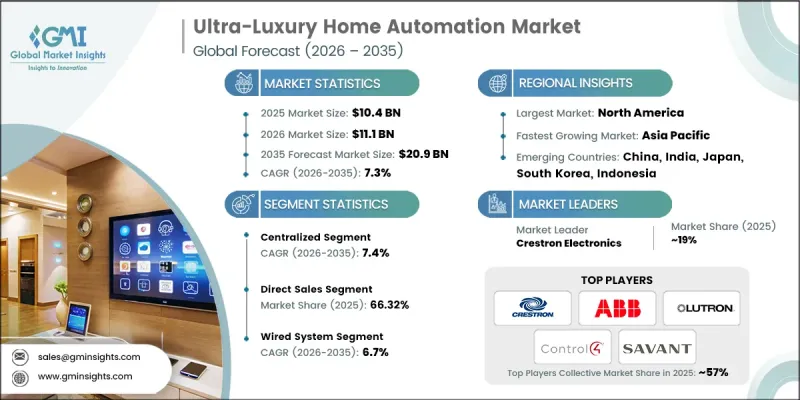
該行業的成長源於富裕住宅對高度個人化、智慧化居住環境日益成長的需求。住宅業主越來越傾向於透過客製化的自動化平台,對照明、溫控、安防系統和多媒體基礎設施等關鍵住宅功能進行整合控制。客製化的自動化解決方案使住宅能夠根據自身的生活節奏、喜好和生活方式需求來配置生活空間。此外,最新的自動化技術能夠將多個智慧型裝置整合到一個集中式的管理介面中,使複雜的住宅管理更加便捷有效率。超豪華住宅正在演變為精心打造的數位生態系統,科技提升了舒適度、專屬感和易用性。業主期望自動化平台能夠與建築風格、空間佈局和日常使用習慣相協調。基於場景的自動化透過智慧編程協調多種功能,進一步提升了居住體驗。豪華住宅開發案正擴大融入先進的自動化功能,以提供彰顯個人身分和地位的精緻生活體驗。為了滿足這些不斷變化的期望,超豪華住宅自動化市場的供應商正致力於提供複雜的硬體基礎設施和智慧軟體平台組合,旨在滿足客戶最具體的需求。
| 市場範圍 | |
|---|---|
| 開始年份 | 2025 |
| 預測期 | 2026-2035 |
| 上市時的市場規模 | 104億美元 |
| 預計金額 | 209億美元 |
| 複合年成長率 | 7.3% |
預計到2025年,集中式自動化市場規模將達到50億美元,並在2026年至2035年間以7.4%的複合年成長率成長。該細分市場在超豪華智慧住宅市場中佔據主導地位,因為它透過統一的控制框架實現了全面的系統整合。集中式平台使住宅能夠透過單一介面高效管理多個住宅系統,從而提高大型住宅的營運效率。富裕的住宅偏好這種架構,因為它確保了互聯技術之間的可靠通訊,並降低了系統不相容的可能性。此外,先進的控制系統支援開發高度客製化的自動化程序和日程安排功能,從而打造個人化的住宅體驗。
預計到2025年,有線技術市佔率將達到63.22%,並在2035年之前以6.7%的複合年成長率成長。該系統憑藉其可靠的性能和穩定的數據傳輸能力,持續引領市場。實體基礎設施確保了在龐大的住宅環境中實現持續穩定的連接,而設備間不間斷的通訊至關重要。高頻寬容量支援先進的自動化流程,避免干擾或連線波動。高階住宅住宅往往更傾向於選擇有線安裝,因為其可靠性高、網路安全潛力強,且系統長期穩定。多種住宅技術的深度整合進一步提升了集中式自動化框架的效率和反應速度。
美國超豪華智慧住宅市場預計到2025年將達到33億美元,並在2026年至2035年間以7.4%的複合年成長率成長。推動美國市場需求成長的主要因素是越來越多的富裕住宅投資於技術先進的住宅環境。新建的豪華住宅項目擴大採用完全客製化的自動化基礎設施,以提升生活水準和營運效率。消費者對先進數位科技的認知不斷提高,也加速了智慧住宅系統在豪華住宅開發案的應用。對豪華房地產的持續投資也促進了超豪華住宅領域對先進自動化平台的穩定需求。
目錄
第1章:調查方法和範圍
第2章執行摘要
第3章業界考察
- 生態系分析
- 供應商情況
- 利潤率
- 每個階段增加的價值
- 影響價值鏈的因素
- 影響產業的因素
- 促進因素
- 個人化智慧生活體驗的需求日益成長
- 人工智慧和物聯網等先進技術的融合
- 豪華房地產開發成長
- 陷阱與挑戰
- 高階系統和較高的初始安裝成本
- 資料安全和隱私問題
- 機會
- 與高階房地產開發商和建築師建立合作關係
- 生物識別技術與下一代安全技術的融合
- 促進因素
- 成長潛力分析
- 未來市場趨勢
- 科技與創新趨勢
- 當前技術趨勢
- 新興技術
- 價格趨勢
- 按地區
- 依產品
- 監理情勢
- 標準和合規要求
- 區域法規結構
- 認證標準
- 波特五力分析
- PESTEL 分析
第4章 競爭情勢
- 介紹
- 企業市佔率分析
- 按地區
- 企業矩陣分析
- 主要市場公司的競爭分析
- 競爭定位矩陣
- 主要進展
- 併購
- 夥伴關係與合作
- 新產品發布
- 業務拓展計劃
第5章 市場估算與預測:依產品類型分類,2022-2035年
- 照明設備
- 壁掛式模組/智慧燈泡
- 智慧開關
- 智慧插頭
- 其他(智慧型調光器等)
- 智慧安防設備
- 人體存在/接近感測器
- 門窗感應器
- 警報
- 智慧無線門鈴
- 智慧門鎖
- 其他(監視器等)
- 娛樂裝置
- 揚聲器/音訊分配
- 影像佈線
- 其他(例如虛擬個人助理)
- 保護感測器
- 漏水和火災感測器
- 紫外線感測器
- 其他(濕度感測器等)
- 其他
第6章 市場估算與預測:依自動化類型分類,2022-2035年
- 去中心化
- 集中
- 混合
第7章 市場估計與預測:依技術分類,2022-2035年
- 有線系統
- 無線系統
第8章 市場估算與預測:依通路分類,2022-2035年
- 直銷
- 間接銷售
第9章 市場估計與預測:依地區分類,2022-2035年
- 北美洲
- 美國
- 加拿大
- 歐洲
- 德國
- 英國
- 法國
- 義大利
- 西班牙
- 亞太地區
- 中國
- 印度
- 日本
- 韓國
- 澳洲
- 拉丁美洲
- 巴西
- 墨西哥
- 阿根廷
- 中東和非洲(MEA)
- 沙烏地阿拉伯
- 阿拉伯聯合大公國
- 南非
第10章:公司簡介
- ABB
- Aurum HomeTech
- Bang & Olufsen
- Control4
- Crestron Electronics
- Ecobee
- Heyo Smart
- Honeywell International
- Johnson Controls
- Legrand
- Lutron Electronics
- Savant Systems
- Schneider Electric
- Siemens
- Vivint
The Global Ultra-Luxury Home Automation Market was valued at USD 10.4 billion in 2025 and is estimated to grow at a CAGR of 7.3% to reach USD 20.9 billion by 2035.
Growth in the industry is driven by the rising preference among affluent homeowners for highly personalized smart living environments. Property owners in the premium residential segment increasingly seek integrated control over essential home functions, including lighting, climate management, safety systems, and multimedia infrastructure through customized automation platforms. Tailored automation solutions allow homeowners to configure their living spaces according to personal routines, preferences, and lifestyle requirements. In addition, modern automation technologies enable the integration of multiple smart devices into a single centralized management interface, making complex residential operations more convenient and efficient. Ultra-luxury residences are evolving toward highly curated digital ecosystems where technology enhances comfort, exclusivity, and ease of use. Property owners expect automation platforms that align with architectural design, spatial layout, and daily usage behavior. Scenario-based automation further enhances living experiences by coordinating multiple functions through intelligent programming. Premium residential developments increasingly incorporate advanced automation capabilities to deliver a refined lifestyle experience that reflects personal identity and status. To address these evolving expectations, providers in the ultra-luxury home automation market are focusing on delivering sophisticated combinations of hardware infrastructure and intelligent software platforms designed to meet the highly specific requirements of their clientele.
| Market Scope | |
|---|---|
| Start Year | 2025 |
| Forecast Year | 2026-2035 |
| Start Value | $10.4 Billion |
| Forecast Value | $20.9 Billion |
| CAGR | 7.3% |
The centralized automation segment generated USD 5 billion in 2025 and is forecast to grow at a CAGR of 7.4% between 2026 and 2035. This segment holds a dominant position in the ultra-luxury home automation market because it enables comprehensive system coordination through a unified control framework. Centralized platforms allow homeowners to efficiently oversee multiple residential systems from a single interface, improving operational efficiency across large properties. Affluent homeowners prefer this architecture because it ensures reliable communication between connected technologies and reduces the likelihood of system incompatibility. Advanced control systems also enable the development of highly customized automation routines and scheduling capabilities that support personalized residential experiences.
The wired technology segment accounted for 63.22% share in 2025 and is anticipated to grow at a CAGR of 6.7% through 2035. This system type continues to lead the market because of its dependable performance and stable data transmission capabilities. Physical infrastructure ensures consistent connectivity across extensive residential environments where uninterrupted communication between devices is essential. High bandwidth capacity supports sophisticated automation processes without interference or connectivity fluctuations. Homeowners in the luxury residential segment often favor wired installations due to their reliability, enhanced cybersecurity potential, and long-term system stability. Strong integration across multiple residential technologies further improves the efficiency and responsiveness of centralized automation frameworks.
United States Ultra-Luxury Home Automation Market was valued at USD 3.3 billion in 2025 and is expected to grow at a CAGR of 7.4% from 2026 to 2035. Demand in the country is supported by a growing population of affluent homeowners investing in technologically advanced residential environments. Newly developed luxury properties increasingly incorporate fully customized automation infrastructure to enhance living standards and operational efficiency. Rising consumer awareness of advanced digital technologies is accelerating the adoption of intelligent residential systems across premium housing developments. Continued investment in high-end real estate is also contributing to consistent demand for advanced automation platforms within the ultra-luxury residential segment.
Prominent participants operating in the Global Ultra-Luxury Home Automation Market include Crestron Electronics, Savant Systems, Control4, Lutron Electronics, Legrand, Schneider Electric, ABB, Siemens, Johnson Controls, Honeywell International, Vivint, Ecobee, Bang & Olufsen, Aurum HomeTech, and Heyo Smart. Companies operating in the Ultra-Luxury Home Automation Market are strengthening their market presence through a combination of technology innovation, strategic collaborations, and premium service offerings. Leading players are investing in advanced software platforms that enable seamless integration between multiple home automation technologies while maintaining high system reliability. Firms are also developing customized automation ecosystems designed specifically for luxury residential environments, allowing them to address highly specialized homeowner requirements. Partnerships with luxury real estate developers, architects, and interior designers are becoming an important strategy to secure early involvement in high-end construction projects.
Table of Contents
Chapter 1 Methodology & Scope
- 1.1 Market scope and definition
- 1.2 Research design
- 1.2.1 Research approach
- 1.2.2 Data collection methods
- 1.3 Data mining sources
- 1.3.1 Global
- 1.3.2 Regional/Country
- 1.4 Base estimates and calculations
- 1.4.1 Base year calculation
- 1.4.2 Key trends for market estimation
- 1.5 Primary research and validation
- 1.5.1 Primary sources
- 1.6 Forecast model
- 1.7 Research assumptions and limitations
Chapter 2 Executive Summary
- 2.1 Industry 360° synopsis
- 2.2 Key market trends
- 2.2.1 Regional
- 2.2.2 Product type
- 2.2.3 Automation Type
- 2.2.4 Technology Type
- 2.2.5 Distribution channel
- 2.3 CXO perspectives: Strategic imperatives
- 2.3.1 Key decision points for industry executives
- 2.3.2 Critical success factors for market players
- 2.4 Future outlook and strategic recommendations
Chapter 3 Industry Insights
- 3.1 Industry ecosystem analysis
- 3.1.1 Supplier landscape
- 3.1.2 Profit margin
- 3.1.3 Value addition at each stage
- 3.1.4 Factor affecting the value chain
- 3.2 Industry impact forces
- 3.2.1 Growth drivers
- 3.2.1.1 Rising demand for personalized smart living experiences
- 3.2.1.2 Integration of advanced technologies such as AI and IoT
- 3.2.1.3 Growth in luxury real estate development
- 3.2.2 Pitfalls & Challenges
- 3.2.2.1 High upfront costs of premium systems and installation
- 3.2.2.2 Data security and privacy concerns
- 3.2.3 Opportunities
- 3.2.3.1 Partnerships with luxury real estate developers and architects
- 3.2.3.2 Integration of biometric and next-gen security technologies
- 3.2.1 Growth drivers
- 3.3 Growth potential analysis
- 3.4 Future market trends
- 3.5 Technology and innovation landscape
- 3.5.1 Current technological trends
- 3.5.2 Emerging technologies
- 3.6 Price trends
- 3.6.1 By region
- 3.6.2 By product
- 3.7 Regulatory landscape
- 3.7.1 Standards and compliance requirements
- 3.7.2 Regional regulatory frameworks
- 3.7.3 Certification standards
- 3.8 Porter's analysis
- 3.9 PESTEL analysis
Chapter 4 Competitive Landscape, 2025
- 4.1 Introduction
- 4.2 Company market share analysis
- 4.2.1 By Region
- 4.2.1.1 North America
- 4.2.1.2 Europe
- 4.2.1.3 Asia Pacific
- 4.2.1.4 Latin America
- 4.2.1.5 Middle East & Africa
- 4.2.1 By Region
- 4.3 Company matrix analysis
- 4.4 Competitive analysis of major market players
- 4.5 Competitive positioning matrix
- 4.6 Key developments
- 4.6.1 Mergers & acquisitions
- 4.6.2 Partnerships & collaborations
- 4.6.3 New product launches
- 4.6.4 Expansion plans
Chapter 5 Market Estimates & Forecast, By Product Type, 2022 - 2035, (USD Million) (Thousand Units)
- 5.1 Key trends
- 5.2 Lighting devices
- 5.2.1 In-wall modules/ smart bulbs
- 5.2.2 Smart switches
- 5.2.3 Smart plugs
- 5.2.4 Others (smart dimmer etc.)
- 5.3 Smart security devices
- 5.3.1 Motion/arrival sensor
- 5.3.2 Door/window sensor
- 5.3.3 Alarms
- 5.3.4 Smart wireless bells
- 5.3.5 Smart door locks
- 5.3.6 Others (security cameras etc.)
- 5.4 Entertainment devices
- 5.4.1 Speakers/ audio distribution
- 5.4.2 Video distribution
- 5.4.3 Others (virtual personal assistant etc.)
- 5.5 Protection sensors
- 5.5.1 Flood/fire sensors
- 5.5.2 UV sensors
- 5.5.3 Others (humidity sensors etc.)
- 5.6 Others
Chapter 6 Market Estimates & Forecast, By Automation Type, 2022 - 2035, (USD Million) (Thousand Units)
- 6.1 Key trends
- 6.2 Distributed
- 6.3 Centralized
- 6.4 Hybrid
Chapter 7 Market Estimates & Forecast, By Technology, 2022 - 2035, (USD Million) (Thousand Units)
- 7.1 Key trends
- 7.2 Wired system
- 7.3 Wireless system
Chapter 8 Market Estimates & Forecast, By Distribution Channel, 2022 - 2035, (USD Million) (Thousand Units)
- 8.1 Key trends
- 8.2 Direct sales
- 8.3 Indirect sales
Chapter 9 Market Estimates & Forecast, By Region, 2022 - 2035, (USD Million) (Thousand Units)
- 9.1 Key trends
- 9.2 North America
- 9.2.1 U.S.
- 9.2.2 Canada
- 9.3 Europe
- 9.3.1 Germany
- 9.3.2 UK
- 9.3.3 France
- 9.3.4 Italy
- 9.3.5 Spain
- 9.4 Asia Pacific
- 9.4.1 China
- 9.4.2 India
- 9.4.3 Japan
- 9.4.4 South Korea
- 9.4.5 Australia
- 9.5 Latin America
- 9.5.1 Brazil
- 9.5.2 Mexico
- 9.5.3 Argentina
- 9.6 MEA
- 9.6.1 Saudi Arabia
- 9.6.2 UAE
- 9.6.3 South Africa
Chapter 10 Company Profiles
- 10.1 ABB
- 10.2 Aurum HomeTech
- 10.3 Bang & Olufsen
- 10.4 Control4
- 10.5 Crestron Electronics
- 10.6 Ecobee
- 10.7 Heyo Smart
- 10.8 Honeywell International
- 10.9 Johnson Controls
- 10.10 Legrand
- 10.11 Lutron Electronics
- 10.12 Savant Systems
- 10.13 Schneider Electric
- 10.14 Siemens
- 10.15 Vivint

 語音控制智慧家庭設備市場預測至2034年-全球分析(按組件、設備類型、連接技術、分銷管道、應用、最終用戶和地區分類)
 家庭自動化市場報告:趨勢、預測與競爭分析(至2035年)
 智慧家居系統市場-2026-2032年全球市場預測
 全球DIY智慧家庭市場規模、佔有率、趨勢及成長分析報告(2026-2034年)
 智慧家居系統市場規模、佔有率、趨勢和預測:按應用、類型和地區分類,2026-2034年汽車個人化和使用者體驗平台市場預測:至 2034 年—按組件、車輛類型、應用和區域分類的全球分析
 2026年全球智慧家庭市場報告家庭自動化市場規模、佔有率、成長及全球產業分析:按類型、應用和地區分類的洞察,2026-2034 年預測
 全球智慧家居系統市場(至2032年):依產品類型、協定、系統類型及住宅類型分類
 家庭自動化市場分析及預測(至2035年):依類型、產品類型、服務、技術、組件、應用、設備、部署類型及最終用戶分類