


 |
市場調查報告書
商品編碼
1998795
遙控武器站市場機會、成長要素、產業趨勢分析及2026-2035年預測Remote Weapon Station Market Opportunity, Growth Drivers, Industry Trend Analysis, and Forecast 2026 - 2035 |
||||||

全球遙控武器站市場預計到 2025 年將價值 131 億美元,以 9.9% 的複合年成長率成長,到 2035 年將達到 338 億美元。
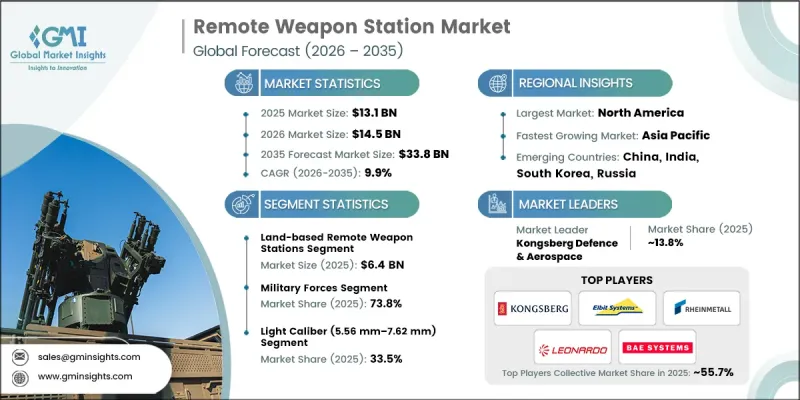
市場成長的促進因素包括全球國防現代化預算的增加、非對稱威脅場景的擴大以及陸海空平台對部隊防護解決方案日益成長的需求。無人和自主平台的部署,以及人工智慧驅動的目標獲取和先進感測器融合系統的應用,正在改變作戰能力,使現代戰場上的反應更加精準迅速。其他促進因素,包括跨境安全投資、海軍和海岸防禦現代化以及政府支持國內國防生產的舉措,共同加速了遠程武器站在全球範圍內的部署。國防費用的增加,加上技術創新和戰略採購政策,持續擴大了遠程武器站在全球多個軍事領域和作戰區域的部署。
| 市場範圍 | |
|---|---|
| 開始年份 | 2025 |
| 預測期 | 2026-2035 |
| 上市時的市場規模 | 131億美元 |
| 預測金額 | 338億美元 |
| 複合年成長率 | 9.9% |
該市場深受政府投資的影響,這些投資旨在實現武器系統現代化、提升艦隊戰備水平,並將遙控武器站(RWS)整合到無人駕駛車輛中。非對稱威脅的日益普遍、海軍和邊防安全採購的擴大以及政府支持的本地製造項目,都顯著推動了市場成長。人工智慧驅動的目標捕獲和感測器融合技術使操作人員能夠更快、更準確地做出決策,從而進一步促進了遙控武器站的應用。
陸基遙控武器站(RWS)市場預計到2025年將達64億美元。這些系統廣泛部署在裝甲車、步兵戰車和作戰卡車上,能夠實現持續的戰場監視、精確目標定位以及與先進感測器的整合。其作戰的多功能性和可靠性使其成為現代軍隊尋求增強防護和遠程打擊能力的核心裝備。
到2025年,小口徑(5.56毫米至7.62毫米)遙控武器站的市佔率將達到33.5%。小口徑遙控武器站因其精度高、後座力小以及可手動/自動射擊而備受青睞。這些系統能夠支援都市區和衝突地區的戰術行動,同時也保障平民安全。得益於人工智慧驅動的追蹤技術和光電感測器的整合,小口徑遙控武器站的任務效率顯著提升,正成為世界各國軍隊的理想選擇。
預計2025年,北美遙控武器站(RWS)市佔率將達33%。該地區的成長主要得益於大規模國防現代化項目、不斷成長的國防費用以及對無人系統和部隊防護的戰略重點。美國國防部對人工智慧驅動的目標獲取和感測器融合技術的投入,加上該地區成熟的國防工業基礎,正在鞏固北美在遙控武器站部署領域的領先地位。邊防安全、反恐和聯合行動將在2035年前進一步推動市場擴張。
目錄
第1章:調查方法和範圍
第2章執行摘要
第3章業界考察
- 生態系分析
- 供應商情況
- 利潤率
- 成本結構
- 每個階段增加的價值
- 影響價值鏈的因素
- 中斷
- 影響產業的因素
- 促進因素
- 全球國防現代化支出增加
- 非對稱戰爭的興起和對部隊保護日益成長的需求。
- 無人系統整合擴展
- 擴大海軍在海岸防禦中遙控武器站的部署
- 與邊防安全和國防安全保障相關的採購
- 產業潛在風險與挑戰
- 與傳統平台的複雜整合
- 網路安全與電子戰的漏洞
- 市場機遇
- 人工智慧驅動的自主作戰系統
- 無人地面和空中平台中的RWS
- 促進因素
- 成長潛力分析
- 監理情勢
- 北美洲
- 歐洲
- 亞太地區
- 拉丁美洲
- 中東和非洲
- 波特五力分析
- PESTEL 分析
- 科技與創新趨勢
- 當前技術趨勢
- 新興技術
- 價格趨勢
- 按地區
- 依產品
- 定價策略
- 新興經營模式
- 合規要求
- 專利和智慧財產權分析
- 地緣政治和貿易趨勢
第4章 競爭情勢
- 介紹
- 企業市佔率分析
- 按地區
- 北美洲
- 歐洲
- 亞太地區
- 拉丁美洲
- 中東和非洲
- 市場集中度分析
- 按地區
- 主要企業的競爭標竿分析
- 財務績效比較
- 銷售量
- 利潤率
- 研究與開發
- 產品系列比較
- 產品線寬度
- 科技
- 創新
- 區域擴張比較
- 全球擴張分析
- 服務網路覆蓋
- 按地區分類的市場滲透率
- 競爭定位矩陣
- 領導者
- 挑戰者
- 追蹤者
- 小眾玩家
- 戰略展望矩陣
- 財務績效比較
- 主要進展
- 併購
- 夥伴關係與合作
- 技術進步
- 擴張和投資策略
- 數位轉型計劃
- 新興競爭對手和Start-Ups競爭對手的發展趨勢
第5章 市場估算與預測:依平台類型分類,2022-2035年
- 地面遙控武器站
- 輕型戰術車輛
- 防地雷反伏擊車和裝甲車輛(裝甲運兵車+步兵戰車+主戰坦克)
- 無人地面車輛(UGV)
- 海軍遙控武器站
- 小型船隻(巡邏艇、海岸防衛隊/邊境隊)
- 克爾維特
- 大型軍艦(巡防艦、驅逐艦、兩棲攻擊艦)
- 固定/靜止設施
- 機載遙控武器站
- 直升機
- 無人駕駛飛行器(UAV)
第6章 市場估價與預測:依武器類型分類,2022-2035年
- 小直徑(5.56毫米至7.62毫米)
- 中口徑(12.7毫米/.50口徑)
- 粗徑(14.5毫米至20毫米)
- 火砲(25毫米至40毫米)
第7章 市場估計與預測:依行程類型分類,2022-2035年
- 移動RWS
- 靜止RWS
第8章 市場估計與預測:依最高自主等級分類,2022-2035年
- 限手動遙控器
- 半自主
- 自主參與是可能的。
第9章 市場估算與預測:感測器套件配置,2022-2035年
- 基本型(僅限白天拍攝)
- 標準(日間+熱感)
- 高級(日間+熱感+LiDAR)
- 進階版(頻譜+雷射雷達+自動追蹤+人工智慧)
第10章 市場估價與預測:依最終用戶分類,2022-2035年
- 軍隊
- 國防安全保障/邊防安全
- 執法機關及國內安全
- 商業和關鍵基礎設施
第11章 市場估價與預測:按地區分類,2022-2035年
- 北美洲
- 美國
- 加拿大
- 歐洲
- 德國
- 英國
- 法國
- 西班牙
- 義大利
- 俄羅斯
- 亞太地區
- 中國
- 印度
- 日本
- 澳洲
- 韓國
- 拉丁美洲
- 巴西
- 墨西哥
- 阿根廷
- 中東和非洲
- 南非
- 沙烏地阿拉伯
- 阿拉伯聯合大公國
第12章:公司簡介
- 主要企業
- BAE Systems plc
- Rheinmetall AG
- Leonardo SpA
- Thales Group
- Saab AB
- 按地區分類的主要企業
- 北美洲
- General Dynamics Corporation
- 亞太地區
- ASELSAN AS
- Norinco
- ST Engineering
- 歐洲
- FN Herstal
- KNDS Group
- 北美洲
- 特殊玩家/干擾者
- Kongsberg Defence &Aerospace
- Elbit Systems Ltd.
- Electro Optic Systems
- Rafael Advanced Defense Systems
- Pro Optica
The Global Remote Weapon Station Market was valued at USD 13.1 billion in 2025 and is estimated to grow at a CAGR of 9.9% to reach USD 33.8 billion in 2035.
Market growth is fueled by rising global defense modernization budgets, expanding asymmetric threat scenarios, and increasing demand for force protection solutions across land, sea, and air platforms. The adoption of unmanned and autonomous platforms, along with AI-enabled targeting and advanced sensor fusion systems, is transforming operational capabilities, enabling more precise and rapid responses on modern battlefields. Additional drivers include cross-border security investments, naval and coastal defense upgrades, and government initiatives supporting indigenous defense production, which together accelerate the deployment of remote weapon stations worldwide. Rising defense expenditures, coupled with technological innovation and strategic procurement policies, continue to strengthen adoption across multiple military domains and operational theaters.
| Market Scope | |
|---|---|
| Start Year | 2025 |
| Forecast Year | 2026-2035 |
| Start Value | $13.1 Billion |
| Forecast Value | $33.8 Billion |
| CAGR | 9.9% |
The market is strongly influenced by government investment in modernizing weapons systems, enhancing fleet readiness, and integrating RWS into unmanned vehicles. Rising asymmetric threats, increased naval and border security acquisitions, and government-backed local manufacturing programs are significant contributors to market expansion. AI-driven targeting and sensor fusion technologies allow operators to make faster, more accurate decisions, which further boosts adoption of remote weapon stations.
The land-based remote weapon stations segment reached USD 6.4 billion in 2025. These systems are widely deployed on armored vehicles, infantry fighting vehicles, and combat trucks, offering continuous battlefield surveillance, precise target engagement, and integration with advanced sensors. Their operational versatility and reliability make them a cornerstone for modern armies seeking enhanced protection and remote engagement capabilities.
The light-caliber (5.56 mm-7.62 mm) segment held 33.5% share in 2025. Light-caliber RWS are favored for their precision, minimal recoil, and dual manual and automatic operation. These systems support tactical operations in urban environments and conflict zones while ensuring civilian safety. AI-assisted tracking and electro-optical sensor integration enhance mission efficiency, making light-caliber RWS a preferred choice for militaries worldwide.
North America Remote Weapon Station Market held a 33% share in 2025. Growth in this region is driven by large-scale defense modernization programs, elevated defense spending, and strategic focus on unmanned systems and force protection. Funding from the U.S. Department of Defense for AI-enabled targeting and sensor fusion technologies, combined with the region's mature defense industrial base, strengthens North America's position as a leader in RWS adoption. Border security, counter-terrorism initiatives, and coalition operations further reinforce market expansion through 2035.
Prominent players in the Global Remote Weapon Station Market include Kongsberg Defence & Aerospace, Rheinmetall AG, Rafael Advanced Defense Systems, KNDS Group, BAE Systems plc, FN Herstal, Leonardo S.p.A., Elbit Systems Ltd., ST Engineering, Electro Optic Systems, Pro Optica, Norinco, Thales Group, ASELSAN A.S, General Dynamics Corporation, and Saab AB. Companies in the Global Remote Weapon Station Market are adopting multiple strategies to consolidate their presence and expand market share. These include investing heavily in R&D to develop AI-assisted targeting, sensor fusion, and modular platforms adaptable to multiple vehicles and environments. Strategic partnerships with defense ministries, technology firms, and OEMs help integrate advanced systems into operational fleets. Firms are also focusing on localized production and technology transfer initiatives to meet government requirements and reduce supply chain dependency. Expansion of regional service centers, training programs, and rapid upgrade capabilities ensures operational readiness while enhancing customer engagement.
Table of Contents
Chapter 1 Methodology and Scope
- 1.1 Market scope and definition
- 1.2 Research design
- 1.2.1 Research approach
- 1.2.2 Data collection methods
- 1.3 Data mining sources
- 1.3.1 Global
- 1.3.2 Regional/Country
- 1.4 Base estimates and calculations
- 1.4.1 Base year calculation
- 1.4.2 Key trends for market estimation
- 1.5 Primary research and validation
- 1.5.1 Primary sources
- 1.6 Forecast model
- 1.7 Research assumptions and limitations
Chapter 2 Executive Summary
- 2.1 Industry 360° synopsis, 2022 - 2035
- 2.2 Key market trends
- 2.2.1 Platform type trends
- 2.2.2 Weapon type trends
- 2.2.3 Mobility type trends
- 2.2.4 Highest autonomy level trends
- 2.2.5 Sensor suite configuration trends
- 2.2.6 End-user trends
- 2.2.7 Regional trends
- 2.3 TAM Analysis, 2026-2035
- 2.4 CXO perspectives: Strategic imperatives
- 2.4.1 Executive decision points
- 2.4.2 critical success factors
- 2.5 Future outlook and strategic recommendations
Chapter 3 Industry Insights
- 3.1 Industry ecosystem analysis
- 3.1.1 Supplier Landscape
- 3.1.2 Profit Margin
- 3.1.3 Cost structure
- 3.1.4 Value addition at each stage
- 3.1.5 Factor affecting the value chain
- 3.1.6 Disruptions
- 3.2 Industry impact forces
- 3.2.1 Growth drivers
- 3.2.1.1 Rising global defense modernization spending
- 3.2.1.2 Increased asymmetric warfare and force-protection needs
- 3.2.1.3 Expansion of unmanned systems integration
- 3.2.1.4 Growing naval RWS deployments for coastal defense
- 3.2.1.5 Border security and homeland security procurements
- 3.2.2 Industry pitfalls and challenges
- 3.2.2.1 Complex integration with legacy platforms
- 3.2.2.2 Cybersecurity and electronic warfare vulnerabilities
- 3.2.3 Market opportunities
- 3.2.3.1 AI-driven autonomous engagement systems
- 3.2.3.2 RWS on unmanned ground and aerial platforms
- 3.2.1 Growth drivers
- 3.3 Growth potential analysis
- 3.4 Regulatory landscape
- 3.4.1 North America
- 3.4.2 Europe
- 3.4.3 Asia Pacific
- 3.4.4 Latin America
- 3.4.5 Middle East & Africa
- 3.5 Porter's analysis
- 3.6 PESTEL analysis
- 3.7 Technology and Innovation landscape
- 3.7.1 Current technological trends
- 3.7.2 Emerging technologies
- 3.8 Price trends
- 3.8.1 By region
- 3.8.2 By product
- 3.9 Pricing Strategies
- 3.10 Emerging Business Models
- 3.11 Compliance Requirements
- 3.12 Patent and IP analysis
- 3.13 Geopolitical and trade dynamics
Chapter 4 Competitive Landscape, 2025
- 4.1 Introduction
- 4.2 Company market share analysis
- 4.2.1 By region
- 4.2.1.1 North America
- 4.2.1.2 Europe
- 4.2.1.3 Asia Pacific
- 4.2.1.4 Latin America
- 4.2.1.5 Middle East & Africa
- 4.2.2 Market concentration analysis
- 4.2.1 By region
- 4.3 Competitive benchmarking of key players
- 4.3.1 Financial performance comparison
- 4.3.1.1 Revenue
- 4.3.1.2 Profit margin
- 4.3.1.3 R&D
- 4.3.2 Product portfolio comparison
- 4.3.2.1 Product range breadth
- 4.3.2.2 Technology
- 4.3.2.3 Innovation
- 4.3.3 Geographic presence comparison
- 4.3.3.1 Global footprint analysis
- 4.3.3.2 Service network coverage
- 4.3.3.3 Market penetration by region
- 4.3.4 Competitive positioning matrix
- 4.3.4.1 Leaders
- 4.3.4.2 Challengers
- 4.3.4.3 Followers
- 4.3.4.4 Niche players
- 4.3.5 Strategic outlook matrix
- 4.3.1 Financial performance comparison
- 4.4 Key developments
- 4.4.1 Mergers and acquisitions
- 4.4.2 Partnerships and collaborations
- 4.4.3 Technological advancements
- 4.4.4 Expansion and investment strategies
- 4.4.5 Digital transformation initiatives
- 4.5 Emerging/ startup competitors landscape
Chapter 5 Market Estimates and Forecast, By Platform Type, 2022 - 2035 (USD Million)
- 5.1 Key trends
- 5.2 Land-based remote weapon stations
- 5.2.1 Light tactical vehicles
- 5.2.2 MRAP & armored vehicles (APCs + IFVs + MBTs)
- 5.2.3 Unmanned ground vehicles (UGVs)
- 5.3 Naval remote weapon stations
- 5.3.1 Small naval vessels (patrol boats, coast guard / border patrol)
- 5.3.2 Corvettes
- 5.3.3 Large naval vessels (frigates, destroyers, amphibious assault vessels)
- 5.4 Fixed / stationary installations
- 5.5 Airborne remote weapon stations
- 5.5.1 Helicopters
- 5.5.2 Unmanned aerial vehicles (UAVs)
Chapter 6 Market Estimates and Forecast, By Weapon Type, 2022 - 2035 (USD Million)
- 6.1 Key trends
- 6.2 Light caliber (5.56mm - 7.62mm)
- 6.3 Medium caliber (12.7mm / .50 cal)
- 6.4 Heavy caliber (14.5mm - 20mm)
- 6.5 Cannon (25mm - 40mm)
Chapter 7 Market Estimates and Forecast, By Mobility Type, 2022 - 2035 (USD Million)
- 7.1 Key trends
- 7.2 Mobile RWS
- 7.3 Stationary RWS
Chapter 8 Market Estimates and Forecast, By Highest Autonomy Level, 2022 - 2035 (USD Million)
- 8.1 Key trends
- 8.2 Manual remote operation only
- 8.3 Semi-autonomous
- 8.4 Autonomous engagement capable
Chapter 9 Market Estimates and Forecast, By Sensor Suite Configuration, 2022 - 2035 (USD Million)
- 9.1 Key trends
- 9.2 Basic (day camera only)
- 9.3 Standard (day + thermal)
- 9.4 Advanced (day + thermal + LRF)
- 9.5 Premium (Multi-Spectral + LRF + auto-tracking + AI)
Chapter 10 Market Estimates and Forecast, By End-User, 2022 - 2035 (USD Million)
- 10.1 Key trends
- 10.2 Military forces
- 10.3 Homeland security & border protection
- 10.4 Law enforcement & internal security
- 10.5 Commercial & critical infrastructure
Chapter 11 Market Estimates and Forecast, By Region, 2022 - 2035 (USD Million)
- 11.1 Key trends
- 11.2 North America
- 11.2.1 U.S.
- 11.2.2 Canada
- 11.3 Europe
- 11.3.1 Germany
- 11.3.2 UK
- 11.3.3 France
- 11.3.4 Spain
- 11.3.5 Italy
- 11.3.6 Russia
- 11.4 Asia Pacific
- 11.4.1 China
- 11.4.2 India
- 11.4.3 Japan
- 11.4.4 Australia
- 11.4.5 South Korea
- 11.5 Latin America
- 11.5.1 Brazil
- 11.5.2 Mexico
- 11.5.3 Argentina
- 11.6 Middle East and Africa
- 11.6.1 South Africa
- 11.6.2 Saudi Arabia
- 11.6.3 UAE
Chapter 12 Company Profiles
- 12.1 Global Key Players
- 12.1.1 BAE Systems plc
- 12.1.2 Rheinmetall AG
- 12.1.3 Leonardo S.p.A
- 12.1.4 Thales Group
- 12.1.5 Saab AB
- 12.2 Regional key players
- 12.2.1 North America
- 12.2.1.1 General Dynamics Corporation
- 12.2.2 Asia Pacific
- 12.2.2.1 ASELSAN A.S
- 12.2.2.2 Norinco
- 12.2.2.3 ST Engineering
- 12.2.3 Europe
- 12.2.3.1 FN Herstal
- 12.2.3.2 KNDS Group
- 12.2.1 North America
- 12.3 Niche Players/Disruptors
- 12.3.1 Kongsberg Defence & Aerospace
- 12.3.2 Elbit Systems Ltd.
- 12.3.3 Electro Optic Systems
- 12.3.4 Rafael Advanced Defense Systems
- 12.3.5 Pro Optica

 2026-2030年全球遙控武器系統市場
 2026年全球遙控武器系統市場報告
 遙控武器站市場:依武器類型、平台類型、組件類型、射程能力、機動性和最終用戶分類-2026-2032年全球市場預測
 遙控武器站市場 - 全球產業規模、佔有率、趨勢、機會、預測:按組件、平台、武器類型、行動裝置類型、地區和競爭對手分類,2021-2031年
 遙控武器站市場報告:趨勢、預測與競爭分析(至2035年)
 遠程武器系統市場規模、佔有率和趨勢分析報告:按組件、平台、武器類型、技術、應用、地區和細分市場預測(2026-2033 年)2026年全球海軍遙控武器系統(RWS)市場報告2026年全球遙控武器系統市場報告2026年全球遙控武器系統(RWS)市場報告
 海軍遙控武器站市場機會、成長促進因素、產業趨勢分析及預測(2026-2035年)