


 |
市場調查報告書
商品編碼
1998781
羊膜穿刺針市場機會、成長要素、產業趨勢分析及2026-2035年預測Amniocentesis Needle Market Opportunity, Growth Drivers, Industry Trend Analysis, and Forecast 2026 - 2035 |
||||||

全球羊膜穿刺針市場預計到 2025 年將價值 1.942 億美元,預計到 2035 年將以 5% 的複合年成長率成長至 3.169 億美元。
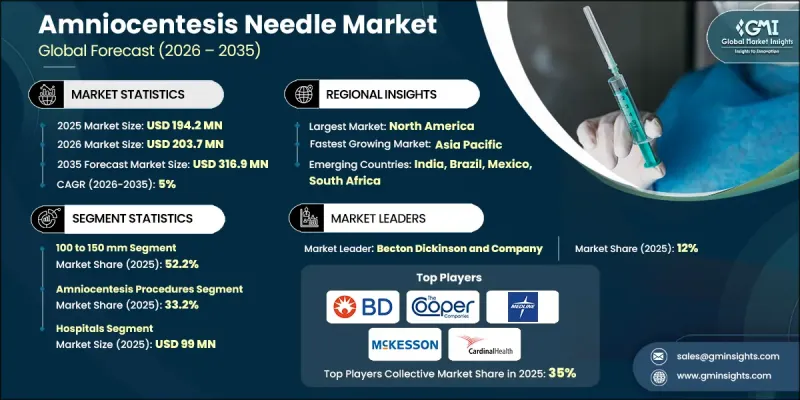
市場成長主要受孕婦老化、高風險妊娠增多、孕婦慢性病盛行率上升的驅動。羊膜穿刺針設計和技術的進步也促進了此技術的普及,使操作更加安全、精準。先天性異常仍然是一個主要問題,凸顯了早期檢測的重要性,尤其是在中低收入地區,這些地區十分之九的兒童出生時患有嚴重的先天性異常。羊膜穿刺針能夠準確地採集羊水樣本,用於基因、染色體和生化分析,從而實現及時干預。高齡生產、高風險妊娠以及對早期產前診斷的需求共同推動了市場的持續擴張。醫療專業人員越來越依賴先進的穿刺針設計來提高操作效率,改善母嬰結局,這進一步促進了市場成長。
| 市場範圍 | |
|---|---|
| 開始年份 | 2025 |
| 預測期 | 2026-2035 |
| 上市時的市場規模 | 1.942億美元 |
| 預計金額 | 3.169億美元 |
| 複合年成長率 | 5% |
到2025年,長度在100毫米至150毫米之間的穿刺針將佔據52.2%的市場佔有率。這些長度的穿刺針非常適合懷孕中晚期的手術,既能安全地抽取羊水,又能考慮到到達羊膜囊的距離較長。側孔設計、螺旋形針尖切口和超音波造影標記等特性,即使在解剖結構複雜的情況下,也能提高羊水抽取的效率、超音波的清晰度和穿刺的精準度。
到2025年,羊膜穿刺術將佔據33.2%的市場。這種微創診斷方法通常在懷孕15至20週之間進行,能夠進行詳細的染色體和基因分析。針頭設計的創新,例如鋒利且不會造成組織損傷的針尖以及超音波反射率,正在提高手術的準確性和安全性,同時減少組織損傷。
美國羊膜穿刺針市場預計將從2025年的6,830萬美元成長到2035年的1.069億美元。出生缺陷率的上升以及先進針頭技術(例如彩色編碼針座、非穿孔設計和超音波造影針尖)的日益普及是推動市場需求的主要因素。醫院和診所正在投資購買能夠提高產前診斷準確性、安全性和效率的設備。
目錄
第1章:調查方法和範圍
第2章執行摘要
第3章業界考察
- 生態系分析
- 影響產業的因素
- 促進因素
- 高齡生產及高危險妊娠人數增加
- 先天性疾病負擔日益加重
- 孕婦慢性病盛行率增加
- 羊膜穿刺針的技術進步
- 產業潛在風險與挑戰
- 替代方法的可用性
- 熟練專業人員短缺
- 市場機遇
- 新興市場的區域擴張
- 促進因素
- 成長潛力分析
- 監理情勢(基於初步調查)
- 技術趨勢(基於初步調查)
- 當前技術趨勢
- 新興技術
- 未來市場趨勢(基於初步研究)
- 人工智慧和生成式人工智慧對市場的影響
- 波特五力分析
- PESTEL 分析
第4章 競爭情勢
- 介紹
- 企業市佔率分析
- 企業矩陣分析
- 主要市場公司的競爭分析
- 競爭定位矩陣
- 主要進展
- 併購
- 夥伴關係與合作
- 新產品發布
- 業務拓展計劃
第5章 市場估算與預測:依產品類型分類,2022-2035年
- 100~150 mm
- 小於100毫米
- 超過 150 毫米
第6章 市場估計與預測:依治療方法分類,2022-2035年
- 羊膜穿刺術
- 羊水減重手術
- 胎兒輸血
- 羊膜腔灌注
- 臍帶穿刺
第7章 市場估計與預測:依最終用途分類,2022-2035年
- 醫院
- 診斷中心
- 診所
- 其他最終用戶
第8章 市場估計與預測:依地區分類,2022-2035年
- 北美洲
- 美國
- 加拿大
- 歐洲
- 德國
- 英國
- 法國
- 義大利
- 西班牙
- 荷蘭
- 亞太地區
- 中國
- 印度
- 日本
- 澳洲
- 韓國
- 拉丁美洲
- 巴西
- 墨西哥
- 阿根廷
- 中東和非洲
- 沙烏地阿拉伯
- 南非
- 阿拉伯聯合大公國
第9章:公司簡介
- Becton, Dickinson and Company
- Biopsybell
- Cardinal Health
- Eurosurgical
- Laboratoire
- MDL SRL
- McKesson Corporation
- Medax S
- Medline Industries
- Moller Medical GmbH
- RI.MOS
- Roko AB
- Suzhou Leapmed Healthcare Corporation
- 庫柏公司
- Vigeo srl
The Global Amniocentesis Needle Market was valued at USD 194.2 million in 2025 and is estimated to grow at a CAGR of 5% to reach USD 316.9 million by 2035.
Market growth is driven by the rising maternal age, increasing high-risk pregnancies, and the growing prevalence of chronic conditions among expectant mothers. Advances in amniocentesis needle design and technology are also supporting adoption, enabling safer and more precise procedures. Congenital disorders remain a major concern, particularly in low- and middle-income regions where nine out of ten children with serious birth defects are born, highlighting the importance of early detection. Amniocentesis needles allow accurate sampling of amniotic fluid for genetic, chromosomal, and biochemical analysis, facilitating timely interventions. The combination of rising maternal age, high-risk pregnancies, and the need for early prenatal diagnosis continues to boost the market. Healthcare providers increasingly rely on advanced needle designs to improve procedural efficiency and maternal-fetal outcomes, further reinforcing market expansion.
| Market Scope | |
|---|---|
| Start Year | 2025 |
| Forecast Year | 2026-2035 |
| Start Value | $194.2 Million |
| Forecast Value | $316.9 Million |
| CAGR | 5% |
The needles ranging from 100 mm to 150 mm segment held a 52.2% share in 2025. These lengths are ideal for mid- to late-gestation procedures, accommodating the increased distance to the amniotic sac while ensuring safe fluid collection. Features such as side-port designs, spiral tip engravings, and echogenic markings enhance fluid aspiration, ultrasound visibility, and precise placement, even in challenging anatomical conditions.
The amniocentesis procedures segment accounted for 33.2% share in 2025. This minimally invasive diagnostic method, typically performed between 15 and 20 weeks of gestation, allows for detailed chromosomal and genetic analysis. Innovations in needle design, including sharp non-coring tips and enhanced ultrasound reflectivity, reduce tissue trauma while improving procedural accuracy and safety.
U.S. Amniocentesis Needle Market is projected to grow from USD 68.3 million in 2025 to USD 106.9 million by 2035. Rising rates of congenital disorders and the increasing adoption of advanced needle technologies, such as color-coded hubs, non-coring designs, and echogenic tips, are driving demand. Hospitals and clinics are investing in devices that enhance accuracy, safety, and efficiency in prenatal diagnostics.
Key players in the Global Amniocentesis Needle Market include Becton, Dickinson and Company, Cardinal Health, Biopsybell, Medline Industries, McKesson Corporation, Roko AB, Medax S, M.D.L S.R.L., The Cooper Companies, Moller Medical GmbH, Suzhou Leapmed Healthcare Corporation, Eurosurgical, Laboratoire, RI.MOS, and Vigeo srl. Companies in the Global Amniocentesis Needle Market strengthen their presence by investing in R&D to develop safer and more precise needle designs, including echogenic tips and non-coring shafts. Strategic partnerships with hospitals and clinics enable wider adoption of their products. They focus on regulatory compliance and quality certifications to gain trust in healthcare systems. Additionally, targeted marketing and training programs for clinicians help build brand loyalty and improve procedural efficiency. Geographic expansion, particularly into emerging markets, combined with innovations in needle materials and ultrasound visibility, ensures sustained growth and a competitive edge.
Table of Contents
Chapter 1 Methodology and Scope
- 1.1 Market scope and definitions
- 1.2 Research design
- 1.2.1 Research approach
- 1.2.2 Data collection methods
- 1.3 Data mining sources
- 1.3.1 Global
- 1.3.2 Regional/country
- 1.4 Base estimates and calculations
- 1.4.1 Base year calculation
- 1.4.2 Key trends for market estimation
- 1.5 Primary research and validation
- 1.5.1 Primary sources
- 1.6 Forecast model
- 1.7 Research assumptions and limitations
Chapter 2 Executive Summary
- 2.1 Industry 360º synopsis
- 2.2 Key market trends
- 2.2.1 Regional trends
- 2.2.2 Product type trends
- 2.2.3 Procedure trends
- 2.2.4 End use trends
- 2.3 CXO perspectives: Strategic imperatives
Chapter 3 Industry Insights
- 3.1 Industry ecosystem analysis
- 3.2 Industry impact forces
- 3.2.1 Growth drivers
- 3.2.1.1 Increasing maternal age and high- risk pregnancies
- 3.2.1.2 Growing burden of congenital disorders
- 3.2.1.3 Rising prevalence of chronic diseases among expectant mothers
- 3.2.1.4 Technological advancements in amniocentesis needles
- 3.2.2 Industry pitfalls and challenges
- 3.2.2.1 Availability of alternative methods
- 3.2.2.2 Dearth of skilled professionals
- 3.2.3 Market opportunities
- 3.2.3.1 Regional expansion in emerging markets
- 3.2.1 Growth drivers
- 3.3 Growth potential analysis
- 3.4 Regulatory landscape (Driven by Primary Research)
- 3.5 Technology landscape (Driven by Primary Research)
- 3.5.1 Current technological trends
- 3.5.2 Emerging technologies
- 3.6 Future market trends (Driven by Primary Research)
- 3.7 Impact of AI and generative AI on the market
- 3.8 Porter's analysis
- 3.9 PESTEL analysis
Chapter 4 Competitive Landscape, 2025
- 4.1 Introduction
- 4.2 Company market share analysis
- 4.3 Company matrix analysis
- 4.4 Competitive analysis of major market players
- 4.5 Competitive positioning matrix
- 4.6 Key developments
- 4.6.1 Mergers and acquisitions
- 4.6.2 Partnerships and collaborations
- 4.6.3 New product launches
- 4.6.4 Expansion plans
Chapter 5 Market Estimates and Forecast, By Product Type, 2022 - 2035 ($ Mn)
- 5.1 Key trends
- 5.2 100 to 150 mm
- 5.3 Smaller than 100 mm
- 5.4 Larger than 150 mm
Chapter 6 Market Estimates and Forecast, By Procedure, 2022 - 2035 ($ Mn)
- 6.1 Key trends
- 6.2 Amniocentesis procedures
- 6.3 Amnioreduction procedures
- 6.4 Fetal blood transfusion
- 6.5 Amnioinfusion procedure
- 6.6 Cordocentesis procedure
Chapter 7 Market Estimates and Forecast, By End Use, 2022 - 2035 ($ Mn)
- 7.1 Key trends
- 7.2 Hospitals
- 7.3 Diagnostics centers
- 7.4 Clinics
- 7.5 Other end users
Chapter 8 Market Estimates and Forecast, By Region, 2022 - 2035 ($ Mn)
- 8.1 Key trends
- 8.2 North America
- 8.2.1 U.S.
- 8.2.2 Canada
- 8.3 Europe
- 8.3.1 Germany
- 8.3.2 UK
- 8.3.3 France
- 8.3.4 Italy
- 8.3.5 Spain
- 8.3.6 Netherlands
- 8.4 Asia Pacific
- 8.4.1 China
- 8.4.2 India
- 8.4.3 Japan
- 8.4.4 Australia
- 8.4.5 South Korea
- 8.5 Latin America
- 8.5.1 Brazil
- 8.5.2 Mexico
- 8.5.3 Argentina
- 8.6 Middle East and Africa
- 8.6.1 Saudi Arabia
- 8.6.2 South Africa
- 8.6.3 UAE
Chapter 9 Company Profiles
- 9.1 Becton, Dickinson and Company
- 9.2 Biopsybell
- 9.3 Cardinal Health
- 9.4 Eurosurgical
- 9.5 Laboratoire
- 9.6 M.D.L S.R.L.
- 9.7 McKesson Corporation
- 9.8 Medax S
- 9.9 Medline Industries
- 9.10 Moller Medical GmbH
- 9.11 RI.MOS
- 9.12 Roko AB
- 9.13 Suzhou Leapmed Healthcare Corporation
- 9.14 The Cooper Companies
- 9.15 Vigeo srl

 羊膜穿刺針市場:2026-2032年全球市場預測(依產品類型、材質、針頭規格、通路、應用及最終用戶分類)
 全球羊膜穿刺針市場規模、佔有率、趨勢和成長分析報告(2026-2034年)
 羊膜穿刺針市場按產品類型、應用、最終用戶和地區分類全球羊膜穿刺針市場規模:依類型、程序、最終用戶、地區、範圍和預測
 羊膜穿刺針市場-全球產業規模、佔有率、趨勢、機會及預測,按類型、按程序、按地區及競爭細分,2020-2030 年預測
 羊膜穿刺針市場(按類型、按程序、按最終用戶、按國家和地區)- 2025 年至 2032 年的行業分析、市場規模、市場佔有率和預測全球羊膜穿刺針市場:2024年至2029年預測