


 |
市場調查報告書
商品編碼
1998746
自測市場商機、成長要素、產業趨勢分析及2026-2035年預測Self-testing Market Opportunity, Growth Drivers, Industry Trend Analysis, and Forecast 2026 - 2035 |
||||||

預計到 2025 年,全球自測市場規模將達到 219 億美元,並預計以 7.7% 的複合年成長率成長,到 2035 年達到 461 億美元。
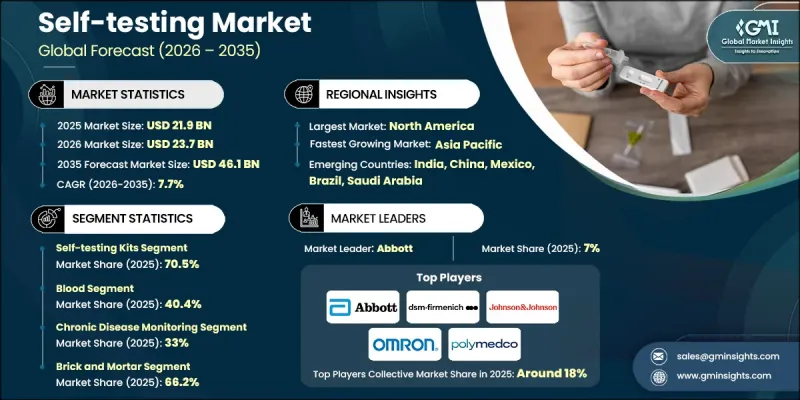
自測市場成長的主要驅動力是慢性病發病率上升、預防醫學意識增強以及便捷的居家診斷解決方案的普及。自測是指個人無需前往醫療機構,即可透過自行在家進行檢測或採集檢體並寄送至檢測實驗室,獨立評估自身健康狀況的診斷工具。市場擴張與慢性病和感染疾病負擔的加重以及社會對預防性健康管理意識的轉變密切相關。消費者越來越積極主動監測關鍵健康指標,並採取預防措施來維持自身健康。同時,數位健康科技和公共衛生措施也提高了人們對自測工具價值和便利性的認知。對傳統醫療機構之外的快速、可靠且私密的檢測解決方案的需求不斷成長,進一步推動了市場發展,尤其是在患者尋求更多自主權來管理自身健康決策和監測實踐的情況下。
| 市場範圍 | |
|---|---|
| 開始年份 | 2025 |
| 預測期 | 2026-2035 |
| 上市時的市場規模 | 219億美元 |
| 預測金額 | 461億美元 |
| 複合年成長率 | 7.7% |
截至2025年,自測檢測套組市佔率將達到70.5%。該細分市場持續保持強勁勢頭,主要得益於其便利性、廣泛的普及性以及消費者對快速居家診斷解決方案日益成長的偏好。自測檢測套組有助於早期發現和定期監測健康狀況,並受到希望更好地掌控自身健康的人們的廣泛支持。持續的產品研發和技術進步正在拓展這些試劑盒可檢測的健康狀況範圍。此外,藥局、電商平台和醫療保健零售商等管道的完善分銷網路也提高了消費者的獲取便利性。同時,許多國家有利的法規環境正在加速產品核准,使新的自測解決方案更有效率地進入市場。
預計到2025年,血液檢測市場將佔據40.4%的市場佔有率,並在2026年至2035年間達到190億美元。該市場之所以能保持主導地位,是因為血液檢測在檢測和監測關鍵健康指標方面具有很高的可靠性。血液樣本在日常健康監測和疾病管理中發揮著極其重要的作用,因為它們能夠實現精準的生物標記測量。微創採血技術的進步提高了使用者的舒適度和接受度,使人們能夠在保持診斷可靠性的同時輕鬆在家採集檢體。需要持續監測的慢性病病例不斷增加,推動了對基於血液的自測解決方案的持續需求。此外,快速檢測技術的不斷創新預計將在整個預測期內進一步提升該市場的重要性。
預計到2025年,美國自測市場規模將達77億美元。美國在該領域的主導地位得益於其完善的醫療保健生態系統和消費者對預防醫學的高度重視。家用診斷工具的廣泛普及正在推動市場成長,尤其是在人們越來越傾向於採用便捷的檢測方案進行持續健康監測的推動下。支持產品核准和促進創新的法律規範也促進了診斷技術的穩定發展。此外,遠端醫療服務和數位醫療平台的擴展提升了自測在分散式醫療服務模式中的作用。特定診斷測試的醫保覆蓋範圍擴大以及透過藥局和線上零售管道的廣泛分銷,進一步提高了自測的可及性,使美國得以保持其在全球自測市場的主導地位。
目錄
第1章:調查方法
- 研究途徑
- 品質改進計劃
- GMI人工智慧政策和資料完整性計劃
- 資訊來源一致性通訊協定
- GMI人工智慧政策和資料完整性計劃
- 調查過程和可靠性評分
- 調查過程的組成部分
- 評分組成部分
- 數據收集
- 主要來源部分列表
- 資料探勘資訊來源
- 付費資訊來源
- 區域資訊來源
- 付費資訊來源
- 基本估算和計算方法
- 每種方法中基準年的計算
- 預測模型
- 量化市場影響分析
- 生長參數對預測的數學影響
- 量化市場影響分析
- 關於調查透明度的補充信息
- 資訊來源歸屬框架
- 品質保證指標
- 對信任的承諾
第2章執行摘要
第3章業界考察
- 生態系分析
- 影響產業的因素
- 促進因素
- 開發一種技術先進的自測檢測套組
- 檢測套組的廣泛普及和便捷獲取
- 人們對預防醫學的認知不斷提高
- 慢性病盛行率增加
- 產業潛在風險與挑戰
- 缺乏準確性和可靠性
- 與測試相關的成本效益和複雜性問題
- 市場機遇
- 消費者對兼顧便利性和隱私性的診斷方法的需求日益成長。
- 加強監管支持,簡化核准流程。
- 促進因素
- 成長潛力分析
- 監理情勢
- 北美洲
- 歐洲
- 亞太地區
- 科技趨勢
- 當前技術趨勢
- 新興技術
- 未來市場趨勢
- 管道分析
- 專利分析
- 2025年價格分析
- 客戶洞察
- 波特五力分析
- PESTEL 分析
- 差距分析
第4章 競爭情勢
- 介紹
- 企業矩陣分析
- 企業市佔率分析
- 世界
- 北美洲
- 歐洲
- 亞太地區
- LAMEA
- 競爭定位矩陣
- 主要市場公司的競爭分析
- 主要進展
- 併購
- 夥伴關係與合作
- 新產品類型發布
- 業務拓展計劃
第5章 市場估算與預測:依產品類型分類,2022-2035年
- 自測檢測套組
- 自採集檢測套組
第6章 市場估計與預測:依檢體類型分類,2022-2035年
- 血
- 尿
- 唾液
- 航班
- 其他檢體類型
第7章 市場估計與預測:依應用領域分類,2022-2035年
- 慢性病監測
- 血糖值測試
- 血壓監測
- 膽固醇和三酸甘油酯
- 其他慢性病監測
- 生殖和荷爾蒙健康
- 妊娠測試
- 排卵和生育力檢測
- 其他生殖和荷爾蒙健康檢查
- 傳染病檢查
- 尿道感染檢測
- 性行為感染(STD/STI)檢測
- 其他傳染病檢查
- 預防和健康管理檢查
- 早期發現嚴重
- 行為/法醫學
- 其他用途
第8章 市場估算與預測:依通路分類,2022-2035年
- 店鋪
- 電子商務
第9章 市場估計與預測:依地區分類,2022-2035年
- 北美洲
- 美國
- 加拿大
- 歐洲
- 德國
- 英國
- 法國
- 西班牙
- 義大利
- 荷蘭
- 亞太地區
- 中國
- 日本
- 印度
- 澳洲
- 韓國
- 拉丁美洲
- 巴西
- 墨西哥
- 阿根廷
- 中東和非洲
- 南非
- 沙烏地阿拉伯
- 阿拉伯聯合大公國
第10章:公司簡介
- Abbott
- ACON
- Clearblue
- dsm-firmenich
- everlywell
- FIRST RESPONSE
- FORA
- Johnson &Johnson
- myLAB Box
- Omron Healthcare
- Patris Health
- polymedco
- pts Diagnostics
- Roche
- wisp TBD
- yorktest
The Global Self-testing Market was valued at USD 21.9 billion in 2025 and is estimated to grow at a CAGR of 7.7% to reach USD 46.1 billion by 2035.
Growth within the self-testing market is largely driven by the rising incidence of chronic health conditions, greater awareness regarding preventive healthcare practices, and the increasing accessibility of convenient at-home diagnostic solutions. Self-testing refers to diagnostic tools that enable individuals to evaluate health conditions independently without the need to visit a medical facility, either by performing the test themselves or by collecting a specimen for laboratory analysis from home. Market expansion is closely connected to the increasing burden of long-term and infectious health conditions, combined with a broader societal shift toward proactive health management. Consumers are becoming more engaged in monitoring important health indicators and taking a preventative approach to personal wellness. At the same time, digital health technologies and public health initiatives have helped improve awareness regarding the value and convenience of self-administered diagnostic tools. Growing demand for fast, reliable, and discreet testing solutions outside conventional healthcare facilities is further supporting market development, particularly as patients seek greater control over their healthcare decisions and monitoring practices.
| Market Scope | |
|---|---|
| Start Year | 2025 |
| Forecast Year | 2026-2035 |
| Start Value | $21.9 Billion |
| Forecast Value | $46.1 Billion |
| CAGR | 7.7% |
The self-testing kits segment held a 70.5% share in 2025. This segment continues to maintain a strong position due to its convenience, broad availability, and increasing consumer preference for quick at-home diagnostic solutions. Self-testing kits support early health detection and regular monitoring, which has significantly increased their acceptance among individuals seeking more control over personal health management. Ongoing product development and technological advancements are expanding the range of health conditions that can be assessed using these kits. In addition, stronger distribution networks across pharmacies, digital marketplaces, and healthcare retail outlets have improved accessibility for consumers. Supportive regulatory environments in multiple countries have also facilitated faster product approvals, allowing new self-testing solutions to enter the market more efficiently.
The blood segment accounted for 40.4% share in 2025 and is projected to reach USD 19 billion during 2026-2035. This segment maintains its leading position due to the reliability of blood-based diagnostics for detecting and monitoring key health indicators. Blood samples provide accurate biomarker measurements, making them highly valuable for routine health monitoring and disease management. Advancements in minimally invasive sampling technologies have improved user comfort and acceptance, enabling individuals to collect samples conveniently at home while maintaining diagnostic reliability. Increasing cases of chronic health conditions that require consistent monitoring continue to strengthen demand for blood-based self-testing solutions. Furthermore, ongoing innovation in rapid testing technologies is expected to further reinforce the importance of this segment throughout the forecast timeline.
U.S. Self-testing Market generated USD 7.7 billion in 2025. The country's leadership is supported by a well-developed healthcare ecosystem and strong consumer awareness regarding preventive health practices. Widespread acceptance of at-home diagnostic tools has strengthened the market, particularly as individuals increasingly adopt convenient testing solutions for ongoing health monitoring. Regulatory frameworks that support product approvals and encourage innovation have also contributed to consistent advancements in diagnostic technologies. Additionally, the expansion of telehealth services and digital healthcare platforms has strengthened the role of self-testing within decentralized healthcare delivery models. Broader insurance coverage for certain diagnostic tests and extensive distribution through pharmacies and online retail channels have further enhanced accessibility, allowing the United States to maintain a dominant share of the global self-testing market.
Major companies operating in the Global Self-testing Market include Abbott, Roche, Johnson & Johnson, Omron Healthcare, Clearblue, Everlywell, ACON, PTS Diagnostics, Polymedco, FORA, YorkTest, myLAB Box, First Response, DSM-Firmenich, Patris Health, and Wisp TBD. Companies participating in the Self-Testing Market are strengthening their competitive position through innovation, digital integration, and strategic partnerships. Many firms are investing heavily in research and development to design advanced testing kits that deliver faster results, improved accuracy, and simplified user experiences. Companies are also expanding product portfolios to address a wider range of health monitoring needs. Partnerships with digital health platforms and telemedicine providers allow organizations to integrate self-testing with remote healthcare services, creating more comprehensive care solutions. In addition, manufacturers are strengthening global distribution networks by collaborating with pharmacies, online retailers, and healthcare providers.
Table of Contents
Chapter 1 Research Methodology
- 1.1 Research approach
- 1.2 Quality commitments
- 1.2.1 GMI AI policy & data integrity commitment
- 1.2.1.1 Source consistency protocol
- 1.2.1 GMI AI policy & data integrity commitment
- 1.3 Research trail & confidence scoring
- 1.3.1 Research trail components
- 1.3.2 Scoring components
- 1.4 Data collection
- 1.4.1 Partial list of primary sources
- 1.5 Data mining sources
- 1.5.1 Paid sources
- 1.5.1.1 Sources, by region
- 1.5.1 Paid sources
- 1.6 Base estimates and calculations
- 1.6.1 Base year calculation for any one approach
- 1.7 Forecast model
- 1.7.1 Quantified market impact analysis
- 1.7.1.1 Mathematical impact of growth parameters on forecast
- 1.7.1 Quantified market impact analysis
- 1.8 Research transparency addendum
- 1.8.1 Source attribution framework
- 1.8.2 Quality assurance metrics
- 1.8.3 Our commitment to trust
Chapter 2 Executive Summary
- 2.1 Industry 3600 synopsis
- 2.2 Key market trends
- 2.2.1 Regional trends
- 2.2.2 Product type trends
- 2.2.3 Sample type trends
- 2.2.4 Application trends
- 2.2.5 Distribution channel trends
- 2.3 CXO perspectives: Strategic imperatives
Chapter 3 Industry Insights
- 3.1 Industry ecosystem analysis
- 3.2 Industry impact forces
- 3.2.1 Growth drivers
- 3.2.1.1 Development of technologically advanced self-test kits
- 3.2.1.2 Growing adoption and easy availability of self-testing kits
- 3.2.1.3 Rising awareness of preventive healthcare
- 3.2.1.4 Increasing prevalence of chronic diseases
- 3.2.2 Industry pitfalls and challenges
- 3.2.2.1 Lack of accuracy and reliability
- 3.2.2.2 Affordability and complexity issues associated with tests
- 3.2.3 Market opportunities
- 3.2.3.1 Rising demand for convenient, privacy-focused diagnostics
- 3.2.3.2 Increased regulatory support and streamlined approval pathways
- 3.2.1 Growth drivers
- 3.3 Growth potential analysis
- 3.4 Regulatory landscape
- 3.4.1 North America
- 3.4.2 Europe
- 3.4.3 Asia Pacific
- 3.5 Technology landscape
- 3.5.1 Current technological trends
- 3.5.2 Emerging technologies
- 3.6 Future market trends
- 3.7 Pipeline analysis
- 3.8 Patent analysis
- 3.9 Pricing analysis, 2025
- 3.10 Customer insights
- 3.11 Porter's analysis
- 3.12 PESTEL analysis
- 3.13 Gap analysis
Chapter 4 Competitive Landscape, 2025
- 4.1 Introduction
- 4.2 Company matrix analysis
- 4.3 Company market share analysis
- 4.3.1 Global
- 4.3.2 North America
- 4.3.3 Europe
- 4.3.4 Asia Pacific
- 4.3.5 LAMEA
- 4.4 Competitive positioning matrix
- 4.5 Competitive analysis of major market players
- 4.6 Key developments
- 4.6.1 Mergers & acquisitions
- 4.6.2 Partnerships & collaborations
- 4.6.3 New product type launches
- 4.6.4 Expansion plans
Chapter 5 Market Estimates and Forecast, By Product Type, 2022 - 2035 ($ Mn)
- 5.1 Key trends
- 5.2 Self-testing kits
- 5.3 Self-collection test kits
Chapter 6 Market Estimates and Forecast, By Sample Type, 2022 - 2035 ($ Mn)
- 6.1 Key trends
- 6.2 Blood
- 6.3 Urine
- 6.4 Saliva
- 6.5 Stool
- 6.6 Other sample types
Chapter 7 Market Estimates and Forecast, By Application, 2022 - 2035 ($ Mn)
- 7.1 Key trends
- 7.2 Chronic disease monitoring
- 7.2.1 Blood glucose testing
- 7.2.2 Blood pressure monitoring
- 7.2.3 Cholesterol & triglycerides
- 7.2.4 Other chronic disease monitoring
- 7.3 Reproductive & hormonal health
- 7.3.1 Pregnancy test
- 7.3.2 Ovulation/Fertility tests
- 7.3.3 Other reproductive & hormonal health tests
- 7.4 Infectious disease testing
- 7.4.1 UTI testing
- 7.4.2 STD/STI tests
- 7.4.3 Other infectious disease tests
- 7.5 Preventive & wellness testing
- 7.6 Serious disease early detection
- 7.7 Behavioral/Forensic
- 7.8 Other applications
Chapter 8 Market Estimates and Forecast, By Distribution Channel, 2022 - 2035 ($ Mn)
- 8.1 Key trends
- 8.2 Brick and mortar
- 8.3 E-commerce
Chapter 9 Market Estimates and Forecast, By Region, 2022 - 2035 ($ Mn)
- 9.1 Key trends
- 9.2 North America
- 9.2.1 U.S.
- 9.2.2 Canada
- 9.3 Europe
- 9.3.1 Germany
- 9.3.2 UK
- 9.3.3 France
- 9.3.4 Spain
- 9.3.5 Italy
- 9.3.6 Netherlands
- 9.4 Asia Pacific
- 9.4.1 China
- 9.4.2 Japan
- 9.4.3 India
- 9.4.4 Australia
- 9.4.5 South Korea
- 9.5 Latin America
- 9.5.1 Brazil
- 9.5.2 Mexico
- 9.5.3 Argentina
- 9.6 Middle East and Africa
- 9.6.1 South Africa
- 9.6.2 Saudi Arabia
- 9.6.3 UAE
Chapter 10 Company Profiles
- 10.1 Abbott
- 10.2 ACON
- 10.3 Clearblue
- 10.4 dsm-firmenich
- 10.5 everlywell
- 10.6 FIRST RESPONSE
- 10.7 FORA
- 10.8 Johnson & Johnson
- 10.9 myLAB Box
- 10.10 Omron Healthcare
- 10.11 Patris Health
- 10.12 polymedco
- 10.13 pts Diagnostics
- 10.14 Roche
- 10.15 wisp TBD
- 10.16 yorktest

 全球愛滋病毒自檢檢測套組市場規模、佔有率、趨勢和成長分析報告(2026-2034年)
 全球愛滋病毒自檢試劑盒市場(按產品類型、技術、愛滋病毒類型、性別、分銷管道和最終用戶分類)預測(2026-2032年)
 2025年直接面對消費者測試全球市場報告2025年自我測驗全球市場報告
 全球自我檢測市場
 自我測試市場,按產品、按用途、按樣本、按應用、按配銷通路、按國家和地區 - 行業分析、市場規模、市場佔有率及預測(2024 年至 2032 年)2025年全球商店點測試市場報告2026 年至 2032 年直接面對消費者的測試市場(按測試類型、技術、應用和地區分類)全球愛滋病毒自檢檢測套組市場規模(按檢測類型、樣本類型、應用、區域覆蓋範圍和預測)按產品類型、技術、收集方法、產品形式、分銷管道和應用分類的家庭尿液檢查市場 - 2025 年至 2030 年全球預測