


 |
市場調查報告書
商品編碼
1998743
飛機透明薄膜市場機會、成長促進因素、產業趨勢分析及預測(2026-2035年)Aircraft Transparencies Market Opportunity, Growth Drivers, Industry Trend Analysis, and Forecast 2026 - 2035 |
||||||

預計到 2025 年,全球飛機透明薄膜市場價值將達到 19 億美元,並預計以 8.1% 的複合年成長率成長,到 2035 年達到 40 億美元。
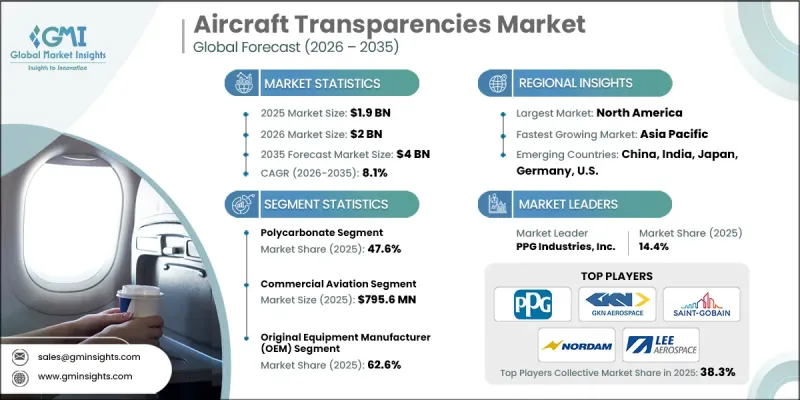
市場擴張的驅動力包括民航機產量增加、售後更換週期縮短、軍用飛機現代化以及聚碳酸酯和壓克力層壓板等尖端材料的應用。隨著航空公司逐步清除交付積壓訂單,原始設備製造商(OEM)正在擴大生產規模,而全球國防項目也不斷提升飛機性能。新一代民航機擴大採用電動調光客艙窗戶,從而改善乘客體驗並減少對機械簾子的依賴。技術創新以及對輕質、耐用且高隔熱玻璃日益成長的需求正在推動市場發展。對安全性的日益重視、對美國聯邦航空管理局(FAA)和歐洲航空安全局(EASA)認證標準的遵守以及對維護、修理和大修(MRO)服務的要求,進一步促進了民用和軍用航空領域的長期成長。
| 市場範圍 | |
|---|---|
| 開始年份 | 2025 |
| 預測年份 | 2026-2035 |
| 起始金額 | 19億美元 |
| 預測金額 | 40億美元 |
| 複合年成長率 | 8.1% |
到2025年,聚碳酸酯材料將佔據47.6%的市場。這主要歸功於其卓越的抗衝擊性、輕量化結構以及與加熱和除冰系統的兼容性。聚碳酸酯材料符合監管安全、光學性能和熱性能標準,使其成為駕駛座擋風玻璃、客艙窗戶和側板的理想選擇。其耐用性降低了原始設備製造商 (OEM) 和維修服務商 (MRO) 的更換頻率,並廣泛應用於民航機、公務和軍用飛機。
預計到2025年,商用航空市場規模將達到7.956億美元,主要促進因素包括飛機數量的成長、交付率的提高以及對駕駛座和客艙玻璃的嚴格監管。此外,飛機機身生產和更換週期的增加也進一步推高了市場需求。
預計2025年,北美飛機透明薄膜市佔率將達到38.5%。這得歸功於北美強大的航太製造業基礎、大規模的民航機生產以及不斷擴大的國防計畫。此外,強大的原始設備製造商(OEM)網路、成熟的維護、修理和大修(MRO)生態系統以及先進的聚碳酸酯、丙烯酸和智慧嵌裝玻璃技術的普及,將推動該地區市場在2035年之前持續成長。
目錄
第1章:調查方法和範圍
第2章執行摘要
第3章業界考察
- 產業生態系分析
- 供應商情況
- 利潤率
- 成本結構
- 每個階段增加的價值
- 影響價值鏈的因素
- 中斷
- 影響產業的因素
- 成長促進因素
- 商用飛機交付和訂單積壓量不斷增加
- 縮短駕駛座車窗的更換週期
- 擴大軍用飛機現代化計劃
- 對輕質聚碳酸酯層壓板的需求
- 嚴格的抗鳥擊衝擊要求
- 產業潛在風險與挑戰
- 高昂的認證成本(FAA/EASA 合規性)
- 複雜的多層層壓製造程序
- 市場機遇
- 電動可調光智慧艙窗
- 輕質複合材料整合透明組件
- 成長促進因素
- 成長潛力分析
- 監理情勢
- 波特五力分析
- PESTEL 分析
- 科技與創新趨勢
- 當前技術趨勢
- 新興技術
- 價格趨勢
- 按地區
- 依產品
- 定價策略
- 新興經營模式
- 合規要求
- 專利和智慧財產權分析
第4章 競爭情勢
- 介紹
- 企業市佔率分析
- 按地區
- 市場集中度分析
- 主要企業的競爭標竿分析
- 財務績效比較
- 銷售量
- 利潤率
- 研究與發展(R&D)
- 產品系列比較
- 產品線寬度
- 科技
- 創新
- 區域擴張比較
- 全球擴張分析
- 服務網路覆蓋
- 按地區分類的市場滲透率
- 競爭定位矩陣
- 領導者
- 挑戰者
- 追蹤者
- 小眾玩家
- 戰略展望矩陣
- 財務績效比較
- 主要進展
- 併購
- 夥伴關係與合作
- 技術進步
- 業務拓展與投資策略
- 數位轉型計劃
- 新興/Start-Ups競爭對手的發展趨勢
第5章 市場估計與預測:依材料分類,2022-2035年
- 玻璃
- 丙烯酸纖維
- 聚碳酸酯
- 其他
第6章 市場估算與預測:依飛機類型分類,2022-2035年
- 商業航空
- 窄體
- 寬體
- 支線運輸機
- 商用直升機
- 商務及通用航空
- 公務機
- 通用飛機
- 軍事航空
- 戰鬥機
- 運輸/特種任務飛機
- 軍用直升機
第7章 市場估計與預測:依應用領域分類,2022-2035年
- 擋風玻璃
- 窗戶
- 座艙罩
- 下巴泡泡
- 著陸燈和翼尖透鏡
- 客房內部
- 其他
第8章 市場估算與預測:依銷售管道分類,2022-2035年
- OEM
- 售後市場
第9章 市場估計與預測:依地區分類,2022-2035年
- 北美洲
- 美國
- 加拿大
- 歐洲
- 德國
- 英國
- 法國
- 西班牙
- 義大利
- 亞太地區
- 中國
- 印度
- 日本
- 澳洲
- 韓國
- 拉丁美洲
- 巴西
- 墨西哥
- 阿根廷
- 中東和非洲
- 南非
- 沙烏地阿拉伯
- 阿拉伯聯合大公國
第10章:公司簡介
- 主要企業
- PPG Industries, Inc.
- GKN Aerospace
- Saint-Gobain
- Lee Aerospace
- Lockheed Martin
- 該地區的主要企業
- 北美洲
- LP Aero Plastics Inc.
- Mecaplex Ltd.
- Tech-Tool Plastics, Inc.
- Perkins Aircraft Windows
- Spartech
- 亞太地區
- Aeropair Ltd.
- 歐洲
- Aviationglass & Technology BV
- The Nordam Group LLC
- 北美洲
- 特殊玩家/干擾者
- Llamas Plastics Inc.
- Control Logistics Inc.
The Global Aircraft Transparencies Market was valued at USD 1.9 billion in 2025 and is estimated to grow at a CAGR of 8.1% to reach USD 4 billion by 2035.
The expansion of the market is driven by rising commercial aircraft production rates, increasing aftermarket replacement cycles, military aircraft modernization, and the adoption of advanced materials such as polycarbonate and acrylic laminates. Airlines are fulfilling delivery backlogs, prompting OEMs to ramp up production, while defense programs worldwide are upgrading aircraft capabilities. Electrically dimmable cabin windows are gaining traction in next-generation commercial aircraft, improving passenger experience and reducing reliance on mechanical shades. Technological innovations, combined with growing demand for lightweight, durable, and thermally efficient glazing, are propelling the market forward. Increasing focus on safety, FAA and EASA certification compliance, and MRO service requirements further support long-term growth in both commercial and military aviation segments.
| Market Scope | |
|---|---|
| Start Year | 2025 |
| Forecast Year | 2026-2035 |
| Start Value | $1.9 Billion |
| Forecast Value | $4 Billion |
| CAGR | 8.1% |
The polycarbonate segment held a 47.6% share in 2025, attributed to its superior impact resistance, lightweight structure, and compatibility with heating and anti-icing systems. Polycarbonate materials meet regulatory safety, optical, and thermal performance standards, making them ideal for cockpit windshields, cabin windows, and side panels. Their durability reduces replacement frequency for OEMs and MRO providers, ensuring widespread adoption across commercial, business, and military aircraft.
The commercial aviation segment reached USD 795.6 million in 2025, driven by fleet expansion, high delivery rates, and stringent cockpit and cabin glazing regulations. Rising production and replacement cycles of aircraft fleets further enhance demand.
North America Aircraft Transparencies Market held 38.5% share in 2025, fueled by a robust aerospace manufacturing base, extensive commercial aircraft production, and growing defense programs. Strong OEM presence, a mature MRO ecosystem, and high adoption of advanced polycarbonate, acrylic, and smart glazing technologies underpin regional growth through 2035.
Prominent players operating in the Global Aircraft Transparencies Market include Aeropair Ltd., Aviationglass & Technology B.V., Control Logistics Inc., GKN Aerospace, Lee Aerospace, Llamas Plastics Inc., Lockheed Martin, LP Aero Plastics Inc., Mecaplex Ltd., Perkins Aircraft Windows, PPG Industries, Inc., Saint-Gobain, Spartech, Tech-Tool Plastics, Inc., and The Nordam Group LLC. Key strategies adopted by companies to strengthen their market presence include investing in R&D for advanced materials and smart glazing solutions, forming strategic partnerships with aircraft OEMs and MRO providers, expanding production capacities to meet growing demand, offering custom-engineered solutions for commercial and military applications, and maintaining regulatory compliance across global markets. Firms also focus on aftersales support, lifecycle services, and retrofitting programs to enhance customer loyalty while optimizing supply chains for cost efficiency and faster delivery.
Table of Contents
Chapter 1 Methodology and Scope
- 1.1 Market scope and definition
- 1.2 Research design
- 1.2.1 Research approach
- 1.2.2 Data collection methods
- 1.3 Data mining sources
- 1.3.1 Global
- 1.3.2 Regional/Country
- 1.4 Base estimates and calculations
- 1.4.1 Base year calculation
- 1.4.2 Key trends for market estimation
- 1.5 Primary research and validation
- 1.5.1 Primary sources
- 1.6 Forecast model
- 1.7 Research assumptions and limitations
Chapter 2 Executive Summary
- 2.1 Industry 360° synopsis, 2022 - 2035
- 2.2 Key market trends
- 2.2.1 Material trends
- 2.2.2 Aircraft type trends
- 2.2.3 Application trends
- 2.2.4 Point of sales trends
- 2.2.5 Regional trends
- 2.3 TAM Analysis, 2026-2035
- 2.4 CXO perspectives: Strategic imperatives
Chapter 3 Industry Insights
- 3.1 Industry ecosystem analysis
- 3.1.1 Supplier Landscape
- 3.1.2 Profit Margin
- 3.1.3 Cost structure
- 3.1.4 Value addition at each stage
- 3.1.5 Factor affecting the value chain
- 3.1.6 Disruptions
- 3.2 Industry impact forces
- 3.2.1 Growth drivers
- 3.2.1.1 Rising commercial aircraft deliveries backlog fulfillment
- 3.2.1.2 Increasing cockpit window replacement cycles
- 3.2.1.3 Growth in military aircraft modernization programs
- 3.2.1.4 Demand for lightweight polycarbonate laminates
- 3.2.1.5 Stringent bird-strike impact resistance requirements
- 3.2.2 Industry pitfalls and challenges
- 3.2.2.1 High certification costs (FAA/EASA compliance)
- 3.2.2.2 Complex multi-layer lamination manufacturing process
- 3.2.3 Market opportunities
- 3.2.3.1 Electrically dimmable smart cabin windows
- 3.2.3.2 Lightweight composite frame-integrated transparencies
- 3.2.1 Growth drivers
- 3.3 Growth potential analysis
- 3.4 Regulatory landscape
- 3.4.1 North America
- 3.4.2 Europe
- 3.4.3 Asia Pacific
- 3.4.4 Latin America
- 3.4.5 Middle East & Africa
- 3.5 Porter's analysis
- 3.6 PESTEL analysis
- 3.7 Technology and Innovation landscape
- 3.7.1 Current technological trends
- 3.7.2 Emerging technologies
- 3.8 Price trends
- 3.8.1 By region
- 3.8.2 By product
- 3.9 Pricing Strategies
- 3.10 Emerging Business Models
- 3.11 Compliance Requirements
- 3.12 Patent and IP analysis
Chapter 4 Competitive Landscape, 2025
- 4.1 Introduction
- 4.2 Company market share analysis
- 4.2.1 By region
- 4.2.1.1 North America
- 4.2.1.2 Europe
- 4.2.1.3 Asia Pacific
- 4.2.1.4 Latin America
- 4.2.1.5 Middle East & Africa
- 4.2.2 Market concentration analysis
- 4.2.1 By region
- 4.3 Competitive benchmarking of key players
- 4.3.1 Financial performance comparison
- 4.3.1.1 Revenue
- 4.3.1.2 Profit margin
- 4.3.1.3 R&D
- 4.3.2 Product portfolio comparison
- 4.3.2.1 Product range breadth
- 4.3.2.2 Technology
- 4.3.2.3 Innovation
- 4.3.3 Geographic presence comparison
- 4.3.3.1 Global footprint analysis
- 4.3.3.2 Service network coverage
- 4.3.3.3 Market penetration by region
- 4.3.4 Competitive positioning matrix
- 4.3.4.1 Leaders
- 4.3.4.2 Challengers
- 4.3.4.3 Followers
- 4.3.4.4 Niche players
- 4.3.5 Strategic outlook matrix
- 4.3.1 Financial performance comparison
- 4.4 Key developments
- 4.4.1 Mergers and acquisitions
- 4.4.2 Partnerships and collaborations
- 4.4.3 Technological advancements
- 4.4.4 Expansion and investment strategies
- 4.4.5 Digital transformation initiatives
- 4.5 Emerging/ startup competitors landscape
Chapter 5 Market Estimates and Forecast, By Material, 2022 - 2035 (USD Million)
- 5.1 Key trends
- 5.2 Glass
- 5.3 Acrylic
- 5.4 Polycarbonate
- 5.5 Others
Chapter 6 Market Estimates and Forecast, By Aircraft Type, 2022 - 2035 (USD Million)
- 6.1 Key trends
- 6.2 Commercial aviation
- 6.2.1 Narrow-body
- 6.2.2 Wide-body
- 6.2.3 Regional transport
- 6.2.4 Commercial helicopter
- 6.3 Business & general aviation
- 6.3.1 Business jets
- 6.3.2 General aviation aircraft
- 6.4 Military aviation
- 6.4.1 Fighter aircraft
- 6.4.2 Transport & special mission aircraft
- 6.4.3 Military helicopter
Chapter 7 Market Estimates and Forecast, By Application, 2022 - 2035 (USD Million)
- 7.1 Key trends
- 7.2 Windshields
- 7.3 Windows
- 7.4 Canopies
- 7.5 Chin bubbles
- 7.6 Landing lights & wingtip lenses
- 7.7 Cabin interiors
- 7.8 Others
Chapter 8 Market Estimates and Forecast, By Point of Sales, 2022 - 2035 (USD Million)
- 8.1 Key trends
- 8.2 Original equipment manufacturer (OEM)
- 8.3 Aftermarket
Chapter 9 Market Estimates and Forecast, By Region, 2022 - 2035 (USD Million)
- 9.1 Key trends
- 9.2 North America
- 9.2.1 U.S.
- 9.2.2 Canada
- 9.3 Europe
- 9.3.1 Germany
- 9.3.2 UK
- 9.3.3 France
- 9.3.4 Spain
- 9.3.5 Italy
- 9.4 Asia Pacific
- 9.4.1 China
- 9.4.2 India
- 9.4.3 Japan
- 9.4.4 Australia
- 9.4.5 South Korea
- 9.5 Latin America
- 9.5.1 Brazil
- 9.5.2 Mexico
- 9.5.3 Argentina
- 9.6 Middle East and Africa
- 9.6.1 South Africa
- 9.6.2 Saudi Arabia
- 9.6.3 UAE
Chapter 10 Company Profiles
- 10.1 Global Key Players
- 10.1.1 PPG Industries, Inc.
- 10.1.2 GKN Aerospace
- 10.1.3 Saint-Gobain
- 10.1.4 Lee Aerospace
- 10.1.5 Lockheed Martin
- 10.2 Regional key players
- 10.2.1 North America
- 10.2.1.1 LP Aero Plastics Inc.
- 10.2.1.2 Mecaplex Ltd.
- 10.2.1.3 Tech-Tool Plastics, Inc.
- 10.2.1.4 Perkins Aircraft Windows
- 10.2.1.5 Spartech
- 10.2.2 Asia Pacific
- 10.2.2.1 Aeropair Ltd.
- 10.2.3 Europe
- 10.2.3.1 Aviationglass & Technology B.V.
- 10.2.3.2 The Nordam Group LLC
- 10.2.1 North America
- 10.3 Niche Players/Disruptors
- 10.3.1 Llamas Plastics Inc.
- 10.3.2 Control Logistics Inc.


