


 |
市場調查報告書
商品編碼
1998736
潰瘍性大腸炎市場商機、成長要素、產業趨勢分析及2026-2035年預測Ulcerative Colitis Market Opportunity, Growth Drivers, Industry Trend Analysis, and Forecast 2026 - 2035 |
||||||

全球潰瘍性大腸炎市場預計到 2025 年將價值 83 億美元,預計到 2035 年將以 5.8% 的複合年成長率成長至 145 億美元。
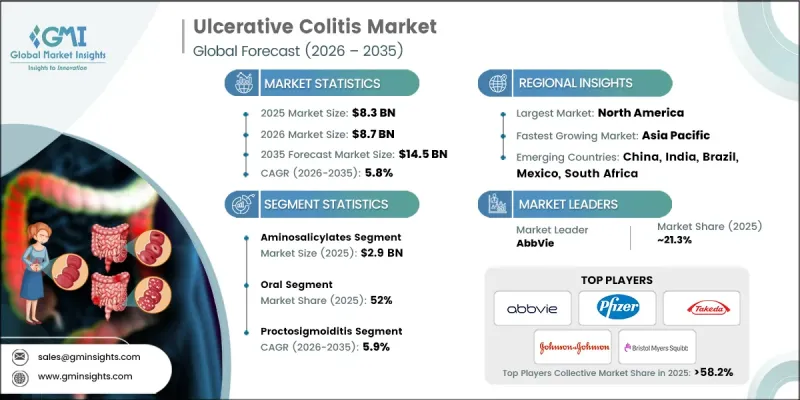
由於潰瘍性大腸炎在全球範圍內的盛行率持續上升,市場正在不斷擴張。快速的都市化、生活方式的改變、飲食習慣的改變以及環境因素都導致了包括潰瘍性大腸炎在內的發炎性腸道疾病病例的增加。除了盛行率的上升之外,醫護人員和患者對該疾病的認知不斷提高,也促進了早期發現和及時治療。早期診斷使醫護人員能夠儘早啟動適當的治療,從而更好地管理疾病並增加對藥物治療的需求。治療方法創新方面的不斷進步也透過引入更有效的治療方法而重塑市場格局。診斷技術的進步,例如最新的影像技術、內視鏡檢查和改進的生物標記識別技術,正在加強臨床評估和疾病監測。此外,已開發國家和新興國家醫療保健支出的增加也提高了先進醫療服務的機會。這些發展使醫療保健系統能夠納入新的治療方案,並為更多患者提供支持,從而持續推動潰瘍性大腸炎市場的長期成長。
| 市場範圍 | |
|---|---|
| 開始年份 | 2025 |
| 預測期 | 2026-2035 |
| 上市時的市場規模 | 83億美元 |
| 預測金額 | 145億美元 |
| 複合年成長率 | 5.8% |
先進治療方法的研發在改變潰瘍性大腸炎的治療策略方面發揮了重要作用。標靶治療的引入極大地拓展了中重度患者的治療選擇。這些創新治療方法旨在比傳統藥物更有效地調節免疫系統活性並減輕發炎。同時,診斷技術的進步也提高了疾病的早期檢測和臨床監測能力。改進的診斷工具使醫護人員能夠更準確地評估疾病進展,並在疾病早期階段啟動治療。因此,傳統藥物與先進治療方法的結合改善了疾病的長期管理,並促進了全球潰瘍性大腸炎治療的普及。
預計到2025年,口服藥物市佔率將達到52%。由於口服藥物的便利性和可近性,該細分市場持續保持強勁成長。許多患者更傾向於口服治療,因為它服用方便,無需侵入性操作。這些藥物通常用於疾病的長期管理,並被認為是疾病各階段的實用治療選擇。製劑技術的不斷進步進一步提升了口服藥物的療效。緩釋和標靶遞送等創新技術在提高治療效果的同時,也增強了患者的耐受性和依從性,從而促進了口服治療的廣泛應用。
預計2026年至2035年間,醫院藥局市場將以5.6%的複合年成長率成長。醫院藥局在提供複雜的治療方法和確保安全用藥方面發揮著至關重要的作用。醫院的醫護人員密切監測接受高階治療的患者,管理潛在的副作用,並最佳化治療效果。潰瘍性大腸炎併發症住院人數的增加進一步凸顯了醫院藥局在治療服務中的重要性。此外,醫院藥房與醫療服務提供者之間的合作有助於支持協調護理,改善治療管理和患者預後。保險覆蓋範圍和報銷計劃的擴大也使醫院藥房能夠為患者提供高成本的治療方法,從而鞏固了其市場主導地位。
北美潰瘍性大腸炎市場佔41.2%的市場佔有率,預計到2035年將以5.6%的複合年成長率成長。該地區受益於完善的醫療基礎設施、便捷的先進治療方案以及廣泛的保險覆蓋,這些都為現代治療方法的應用提供了支持。早期診斷以及醫護人員和患者對潰瘍性結腸炎意識提升也促進了治療方法的採納率。此外,北美是重要的醫藥創新中心,新的治療方法和治療技術層出不窮。大型製藥企業持續進行的研究活動、臨床試驗和患者支持計畫進一步鞏固了市場,並支持全部區域的永續成長。
目錄
第1章:調查方法
- 市場範圍和定義
- 研究途徑
- 品質改進計劃
- GMI人工智慧政策和資料完整性計劃
- 資訊來源一致性通訊協定
- GMI人工智慧政策和資料完整性計劃
- 調查過程和可靠性評分
- 調查過程的組成部分
- 評分組成部分
- 數據收集
- 主要來源部分列表
- 資料探勘資訊來源
- 付費資訊來源
- 區域資訊來源
- 付費資訊來源
- 基本估算和計算方法
- 每種方法中基準年的計算
- 預測模型
- 量化市場影響分析
- 生長參數對預測的數學影響
- 量化市場影響分析
- 關於調查透明度的補充信息
- 資訊來源歸屬框架
- 品質保證指標
- 對信任的承諾
第2章執行摘要
第3章業界考察
- 生態系分析
- 影響產業的因素
- 促進因素
- 潰瘍性大腸炎盛行率增加
- 擴大治療選擇範圍
- 提高公眾意識和診斷數量
- 產業潛在風險與挑戰
- 高昂的醫療費用
- 對副作用和安全性的擔憂
- 市場機遇
- 聯合治療的需求和使用增加
- 開發一種用於治療兒童潰瘍性大腸炎的藥物
- 促進因素
- 成長潛力分析
- 監理情勢(基於初步調查)
- 北美洲
- 美國
- 加拿大
- 歐洲
- 亞太地區
- 北美洲
- 價格分析(基於初步調查)
- 研發管線和臨床試驗趨勢
- 人工智慧和生成式人工智慧對市場的影響
- 未來市場趨勢
- 波特五力分析
- PESTEL 分析
第4章 競爭情勢
- 介紹
- 企業市佔率分析
- 北美洲
- 歐洲
- 亞太地區
- 企業矩陣分析
- 主要市場公司的競爭分析
- 競爭定位矩陣
- 主要進展
- 併購
- 夥伴關係與合作
- 新產品發布
- 業務拓展計劃
第5章 市場估計與預測:依藥物類型分類,2022-2035年
- 氨基水楊酸類藥物
- 生物製藥
- 皮質類固醇
- Janus激酶(JAK)抑制劑
- 免疫抑制劑
- 其他藥物類型
第6章 市場估計與預測:依疾病類型分類,2022-2035年
- 直腸乙狀結腸炎
- 潰瘍性直腸炎
- 左側結腸炎
- 全結腸炎或全結腸炎
- 暴發性結腸炎
第7章 市場估計與預測:依給藥途徑分類,2022-2035年
- 口服
- 注射藥物
第8章 市場估算與預測:依通路分類,2022-2035年
- 醫院藥房
- 零售藥房
- 網路藥房
第9章 市場估計與預測:依地區分類,2022-2035年
- 北美洲
- 美國
- 加拿大
- 歐洲
- 德國
- 英國
- 法國
- 義大利
- 西班牙
- 荷蘭
- 亞太地區
- 中國
- 日本
- 印度
- 澳洲
- 韓國
- 拉丁美洲
- 巴西
- 墨西哥
- 阿根廷
- 中東和非洲
- 南非
- 沙烏地阿拉伯
- 阿拉伯聯合大公國
第10章:公司簡介
- AbbVie
- 博士倫健康公司
- Bristol Myers Squibb
- Eli Lilly and Company
- Johnson & Johnson
- Merck
- Mitsubishi Tanabe Pharma Corporation
- Novartis
- Pfizer
- Sun Pharmaceutical Industries
- Takeda Pharmaceutical Company Limited
- Teva Pharmaceutical Industries
The Global Ulcerative Colitis Market was valued at USD 8.3 billion in 2025 and is estimated to grow at a CAGR of 5.8% to reach USD 14.5 billion by 2035.
The market is expanding as the prevalence of ulcerative colitis continues to rise worldwide. Factors such as rapid urban development, lifestyle shifts, dietary changes, and environmental influences are contributing to a growing number of inflammatory bowel disease cases, including ulcerative colitis. Alongside this rising incidence, improved disease awareness among both healthcare professionals and patients is encouraging earlier detection and timely treatment. Early diagnosis allows healthcare providers to initiate appropriate therapies sooner, which supports better disease management and increases demand for pharmaceutical treatments. Continuous progress in treatment innovation is also shaping the market landscape by introducing more effective therapeutic approaches. Advances in diagnostic technologies, including modern imaging techniques, endoscopic procedures, and improved biomarker identification, have strengthened clinical evaluation and disease monitoring. In addition, the expansion of healthcare funding across both developed and emerging economies is improving access to advanced medical therapies. These developments are enabling healthcare systems to adopt newer treatment options and support broader patient access, which continues to drive the long-term growth of the ulcerative colitis market.
| Market Scope | |
|---|---|
| Start Year | 2025 |
| Forecast Year | 2026-2035 |
| Start Value | $8.3 Billion |
| Forecast Value | $14.5 Billion |
| CAGR | 5.8% |
The development of advanced therapeutic options has played a major role in transforming ulcerative colitis treatment strategies. The introduction of targeted therapies has significantly expanded available treatment choices for patients experiencing moderate to severe disease conditions. These innovative therapies are designed to regulate immune system activity and reduce inflammation more effectively than traditional medications. At the same time, improvements in diagnostic technologies have strengthened early disease detection and clinical monitoring. Enhanced diagnostic tools allow healthcare providers to assess disease progression more accurately and initiate treatment earlier in the disease cycle. As a result, the combined use of conventional medications and advanced treatment approaches is improving long-term disease management while contributing to increased utilization of ulcerative colitis therapies worldwide.
The oral segment accounted for 52% share in 2025. This segment continues to demonstrate strong growth due to the convenience and accessibility associated with oral medications. Many patients prefer oral therapies because they are easier to administer and do not require invasive procedures. These medications are commonly used for long-term disease management and are considered a practical treatment option across different stages of the condition. Continuous improvements in drug formulation technologies have further enhanced the effectiveness of oral medications. Innovations such as controlled-release and targeted delivery mechanisms are improving treatment performance while also increasing patient tolerance and adherence, which supports the growing adoption of oral therapies.
The hospital pharmacies segment is projected to grow at a CAGR of 5.6% during 2026-2035. Hospital pharmacies play a vital role in distributing complex treatment regimens and ensuring safe medication administration. Healthcare professionals within hospital settings closely monitor patients receiving advanced therapies to manage potential side effects and optimize treatment outcomes. The increasing number of hospital admissions related to ulcerative colitis complications is further strengthening the importance of hospital pharmacies in treatment delivery. In addition, integration between hospital pharmacies and healthcare providers helps support coordinated care, improving treatment management and patient outcomes. Greater access to insurance coverage and reimbursement programs also enables hospital pharmacies to provide patients with access to high-cost therapies, contributing to their leading position in the market.
North America Ulcerative Colitis Market accounted for 41.2% share and is expected to grow at a CAGR of 5.6% throughout 2035. The region benefits from a well-developed healthcare infrastructure, strong accessibility to advanced treatment options, and widespread insurance coverage that supports the use of modern therapies. Early diagnosis and increased awareness among healthcare professionals and patients also contribute to higher treatment adoption rates. Furthermore, North America serves as a major center for pharmaceutical innovation, where new therapies and treatment technologies are frequently introduced. Ongoing research activities, clinical studies, and patient support initiatives conducted by major pharmaceutical companies are further strengthening the market and supporting continued growth across the region.
Major companies operating in the Global Ulcerative Colitis Market include Pfizer, AbbVie, Takeda Pharmaceutical Company Limited, Johnson & Johnson, Bristol Myers Squibb, Novartis, Eli Lilly and Company, Merck, Sun Pharmaceutical Industries, Mitsubishi Tanabe Pharma Corporation, Bausch Health Companies, and Teva Pharmaceutical Industries. Companies competing in the Global Ulcerative Colitis Market are implementing a range of strategies to strengthen their competitive positions and expand their global presence. Leading pharmaceutical organizations are investing heavily in research and development to introduce innovative therapies that improve disease management and patient outcomes. Many companies are also focusing on expanding their product pipelines through clinical trials and regulatory approvals for advanced treatment options. Strategic collaborations with biotechnology firms, research institutions, and healthcare providers are helping accelerate drug discovery and development processes. In addition, companies are expanding their geographic reach through global distribution networks and market entry strategies in emerging healthcare markets.
Table of Contents
Chapter 1 Research Methodology
- 1.1 Market scope and definition
- 1.2 Research approach
- 1.3 Quality commitments
- 1.3.1 GMI AI policy & data integrity commitment
- 1.3.1.1 Source consistency protocol
- 1.3.1 GMI AI policy & data integrity commitment
- 1.4 Research trail & confidence scoring
- 1.4.1 Research trail components
- 1.4.2 Scoring components
- 1.5 Data collection
- 1.5.1 Partial list of primary sources
- 1.6 Data mining sources
- 1.6.1 Paid sources
- 1.6.1.1 Sources, by region
- 1.6.1 Paid sources
- 1.7 Base estimates and calculations
- 1.7.1 Base year calculation for any one approach
- 1.8 Forecast model
- 1.8.1 Quantified market impact analysis
- 1.8.1.1 Mathematical impact of growth parameters on forecast
- 1.8.1 Quantified market impact analysis
- 1.9 Research transparency addendum
- 1.9.1 Source attribution framework
- 1.9.2 Quality assurance metrics
- 1.9.3 Our commitment to trust
Chapter 2 Executive Summary
- 2.1 Industry 360° synopsis
- 2.2 Key market trends
- 2.2.1 Drug type trends
- 2.2.2 Disease type trends
- 2.2.3 Route of administration trends
- 2.2.4 Distribution channel trends
- 2.3 CXO perspectives: Strategic imperatives
Chapter 3 Industry Insights
- 3.1 Industry ecosystem analysis
- 3.2 Industry impact forces
- 3.2.1 Growth drivers
- 3.2.1.1 Increasing prevalence of ulcerative colitis
- 3.2.1.2 Expanding treatment options
- 3.2.1.3 Increasing awareness and diagnosis
- 3.2.2 Industry pitfalls and challenges
- 3.2.2.1 High treatment costs
- 3.2.2.2 Side effects and safety concerns
- 3.2.3 Market opportunities
- 3.2.3.1 Growing demand and utilization of combination therapies
- 3.2.3.2 Development of pediatric ulcerative colitis treatment
- 3.2.1 Growth drivers
- 3.3 Growth potential analysis
- 3.4 Regulatory landscape (Driven by primary research)
- 3.4.1 North America
- 3.4.1.1 U.S.
- 3.4.1.2 Canada
- 3.4.2 Europe
- 3.4.3 Asia Pacific
- 3.4.1 North America
- 3.5 Pricing analysis (Driven by primary research)
- 3.6 Pipeline and clinical trials landscape
- 3.7 Impact of AI and generative AI on the market
- 3.8 Future market trends
- 3.9 Porter's analysis
- 3.10 PESTEL analysis
Chapter 4 Competitive Landscape, 2025
- 4.1 Introduction
- 4.2 Company market share analysis
- 4.2.1 North America
- 4.2.2 Europe
- 4.2.3 Asia Pacific
- 4.3 Company matrix analysis
- 4.4 Competitive analysis of major market players
- 4.5 Competitive positioning matrix
- 4.6 Key developments
- 4.6.1 Merger and acquisition
- 4.6.2 Partnership and collaboration
- 4.6.3 New product launches
- 4.6.4 Expansion plans
Chapter 5 Market Estimates and Forecast, By Drug Type, 2022 - 2035 ($ Mn)
- 5.1 Key trends
- 5.2 Aminosalicylates
- 5.3 Biologics
- 5.4 Corticosteroids
- 5.5 Janus kinase (JAK) inhibitors
- 5.6 Immunosuppressants
- 5.7 Other drug types
Chapter 6 Market Estimates and Forecast, By Disease Type, 2022 - 2035 ($ Mn)
- 6.1 Key trends
- 6.2 Proctosigmoiditis
- 6.3 Ulcerative proctitis
- 6.4 Left-sided colitis
- 6.5 Pancolitis or universal colitis
- 6.6 Fulminant colitis
Chapter 7 Market Estimates and Forecast, By Route of Administration, 2022 - 2035 ($ Mn)
- 7.1 Key trends
- 7.2 Oral
- 7.3 Injectable
Chapter 8 Market Estimates and Forecast, By Distribution Channel, 2022 - 2035 ($ Mn)
- 8.1 Key trends
- 8.2 Hospital pharmacies
- 8.3 Retail pharmacies
- 8.4 Online pharmacies
Chapter 9 Market Estimates and Forecast, By Region, 2022 - 2035 ($ Mn)
- 9.1 Key trends
- 9.2 North America
- 9.2.1 U.S.
- 9.2.2 Canada
- 9.3 Europe
- 9.3.1 Germany
- 9.3.2 UK
- 9.3.3 France
- 9.3.4 Italy
- 9.3.5 Spain
- 9.3.6 Netherlands
- 9.4 Asia Pacific
- 9.4.1 China
- 9.4.2 Japan
- 9.4.3 India
- 9.4.4 Australia
- 9.4.5 South Korea
- 9.5 Latin America
- 9.5.1 Brazil
- 9.5.2 Mexico
- 9.5.3 Argentina
- 9.6 Middle East and Africa
- 9.6.1 South Africa
- 9.6.2 Saudi Arabia
- 9.6.3 UAE
Chapter 10 Company Profiles
- 10.1 AbbVie
- 10.2 Bausch Health Companies
- 10.3 Bristol Myers Squibb
- 10.4 Eli Lilly and Company
- 10.5 Johnson & Johnson
- 10.6 Merck
- 10.7 Mitsubishi Tanabe Pharma Corporation
- 10.8 Novartis
- 10.9 Pfizer
- 10.10 Sun Pharmaceutical Industries
- 10.11 Takeda Pharmaceutical Company Limited
- 10.12 Teva Pharmaceutical Industries

 潰瘍性大腸炎市場:2026-2032年全球市場預測(依治療方法、給藥途徑、類型、治療階段、疾病嚴重程度、病患類型及通路分類)
 潰瘍性大腸炎市場規模、佔有率和成長分析:按藥物類別、疾病嚴重程度、分銷管道和地區分類-2026-2033年產業預測
 潰瘍性大腸炎市場報告:按類型、疾病類型、分子類型、藥物類型、給藥途徑、分銷管道和地區分類(2026-2034 年)
 潰瘍性大腸炎治療市場:依分子類型、藥物類別、疾病類型、疾病嚴重程度、給藥途徑、年齡層、性別、通路、最終用戶和地區分類美沙拉嗪原料藥市場按製劑類型、治療領域、給藥途徑、銷售管道和最終用戶分類-2026-2032年全球預測美沙拉嗪市場:按劑型、配方、給藥途徑、強度、給藥頻率、適應症、最終用戶和分銷管道分類-全球預測(2026-2032 年)
 潰瘍性結腸炎市場-全球產業規模、佔有率、趨勢、機會和預測,依藥物類型、疾病類型、地區和競爭格局分類。 2021-2031年預測日本潰瘍性大腸炎市場報告:按類型、疾病類型、分子類型、藥物類型、給藥途徑、分銷管道和地區分類(2026-2034年)
 潰瘍性大腸炎市場 - 全球和區域分析:依藥物類別和地區 - 分析和預測(2025年至2035年)