


 |
市場調查報告書
商品編碼
1998707
對 2026 年至 2035 年女性醫療保健設備市場的商業機會、成長要素、產業趨勢和預測進行分析。Women Health Devices Market Opportunity, Growth Drivers, Industry Trend Analysis, and Forecast 2026 - 2035 |
||||||

2025 年全球女性醫療保健設備市場價值 1,504 億美元,預計到 2035 年將達到 3,898 億美元,年複合成長率為 10.2%。
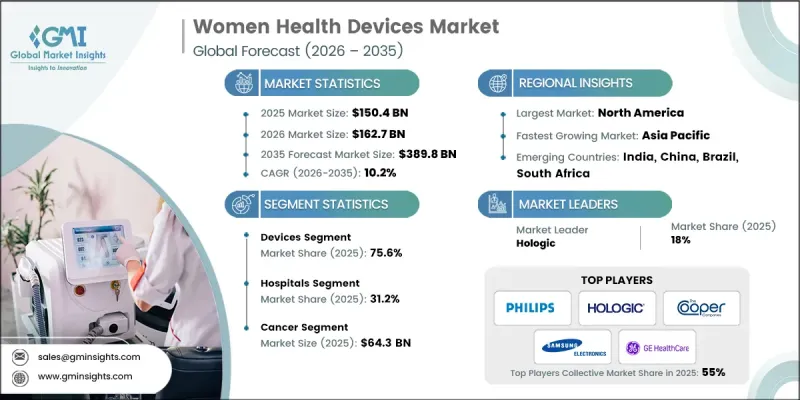
女性健康醫療器材市場的成長主要得益於人們普遍轉向積極主動的預防性醫療保健,以及女性盛行率不斷上升等因素。醫療服務提供者和消費者越來越重視早期診斷、定期監測和長期疾病管理,加速了專業醫療技術的應用。數位醫療、智慧監測工具和診斷影像設備的持續進步也促進了市場擴張。用於生殖健康、荷爾蒙監測、孕產婦保健和長期健康管理的現代化設備在臨床和居家照護環境中都變得更加普及。此外,人們對生殖健康、篩檢計畫和健康管理的認知不斷提高,使得更多女性能夠利用針對自身特定健康需求的醫療技術。女性人口老化也是一個重要的成長要素,因為老齡化會增加需要持續監測和治療的長期疾病的風險。總而言之,女性健康醫療器材市場是醫療設備業的專業細分市場,專注於開發滿足女性獨特的診斷、治療和健康需求的技術。
| 市場範圍 | |
|---|---|
| 開始年份 | 2025 |
| 預測期 | 2026-2035 |
| 上市時的市場規模 | 1504億美元 |
| 預測金額 | 3898億美元 |
| 複合年成長率 | 10.2% |
預計到2025年,醫療器材市場銷售額將達到1,137億美元,佔市場佔有率的75.6%。此類別包括避孕器材、生育監測器材、月經衛生用品、乳房健康器材、骨盆底健康器材、孕產婦健康產品、一般健康監測器材、婦科疾病醫療設備等專業技術。女性對預防醫學和日常健康管理重要性的認知不斷提高,是推動該領域成長的主要動力。能夠幫助個人更有效地監測和管理自身健康的專用器械的普及,也促進了其更廣泛的應用。此外,器械精度、易用性和便攜性的不斷提升,也推動了醫院、診所和居家照護機構的需求成長。
按應用領域分類,預計2025年,醫院領域將佔據31.2%的市場。醫院仍然是診斷、治療和手術各種女性健康問題的主要場所,這顯著推動了對醫療器材的需求。龐大的病患數量、專科科室的存在以及先進治療基礎設施的建設,持續推動醫院環境中先進醫療技術的應用。這些機構依靠整合診斷系統、監測設備和治療性醫療設備來滿足與婦產科護理相關的複雜醫療需求。此外,醫院在嚴格的監管和品質保證標準下運營,要求採用已通過核准的醫療技術,以改善患者預後並確保安全。因此,與女性健康相關的診療和臨床干預措施的不斷增加,進一步加劇了醫院環境中對先進醫療設備的需求。
預計到2025年,北美女性醫療設備市場佔有率將達到32.1%。該地區憑藉其完善的醫療基礎設施、高水準的醫療支出以及對女性健康意識的高度重視,持續保持著強勁的市場領導地位。先進的診斷技術、專業的醫療機構以及完善的法規結構也進一步推動了該地區的成長。北美地區的醫療服務提供者正日益將創新醫療技術融入日常診療,以改善疾病的檢測、監測和治療效果。此外,對研發、臨床開發和數位化醫療平台的持續投入,正在加速新一代女性健康醫療設備的普及應用。這些因素共同鞏固了北美在預測期內作為女性健康相關醫療器材市場持續成長的主要貢獻者的地位。
包括Allengers、Ava Women、Caldera Medical、Carestream Health、Garmin Ltd.、GE Healthcare Technologies、HeraMED、Hologic、Koninklijke Philips NV、Mankind Pharma Limited、Pregnabit、三星電子和The Cooper Companies在內的許多主要企業正積極進軍全球女性健康醫療器材市場。這些企業正採取多項策略措施來提升自身競爭力並擴大全球影響力。主要企業正大力投入研發,推出技術先進的產品,以提高診斷的精準度、連結性和病患便利性。他們也積極尋求與醫療服務提供者、科技公司和研究機構建立策略合作夥伴關係,以加速創新並拓展產品功能。許多企業正在投資數位化健康整合,包括連網型設備和數據驅動的醫療平台,以增強病患監測和個人化照護。透過夥伴關係、分銷協議和區域性生產設施進行地理擴張,也是進入新興市場的重要途徑。
目錄
第1章:調查方法和範圍
第2章執行摘要
第3章業界考察
- 生態系分析
- 影響產業的因素
- 促進因素
- 女性疾病負擔加重
- 老年女性人口增加
- 醫療保健領域的技術進步
- 開發中國家對婦女健康的認知不斷提高
- 產業潛在風險與挑戰
- 設備和手術高成本
- 對新設備制定嚴格的監管準則
- 市場機遇
- 女性健康領域對居家和遠端監測解決方案的需求日益成長
- 穿戴式裝置在追蹤月經和荷爾蒙健康方面越來越受歡迎。
- 促進因素
- 成長潛力分析
- 監理情勢
- 北美洲
- 歐洲
- 亞太地區
- 技術進步
- 當前技術趨勢
- 新興技術
- 2024年價格分析
- 未來市場趨勢
- 人工智慧和生成式人工智慧對市場的影響
- 波特五力分析
- PESTEL 分析
第4章 競爭情勢
- 介紹
- 企業市佔率分析
- 企業矩陣分析
- 主要市場公司的競爭分析
- 競爭定位矩陣
- 主要進展
- 併購
- 夥伴關係與合作
- 新產品發布
- 業務拓展計劃
第5章 市場估價與預測:依產品分類,2022-2035年
- 醫療設備
- 避孕裝置
- 生殖功能監測設備
- 月經護理產品
- 乳房保健設備
- 骨盆底健康設備
- 孕婦及產後婦女適用產品
- 通用健康監測設備
- 婦科疾病醫療設備
- 其他設備
- 消耗品
第6章 市場估計與預測:依應用領域分類,2022-2035年
- 癌症
- 骨質疏鬆症
- 感染疾病
- 子宮肌瘤
- 懷孕
- 女性節育手術
- 月經紊亂
- 其他用途
第7章 市場估計與預測:依最終用途分類,2022-2035年
- 醫院
- 婦產科診所
- 診斷檢查室
- 門診手術中心
- 其他最終用戶
第8章 市場估計與預測:依地區分類,2022-2035年
- 北美洲
- 美國
- 加拿大
- 歐洲
- 德國
- 英國
- 法國
- 西班牙
- 義大利
- 荷蘭
- 亞太地區
- 中國
- 印度
- 日本
- 澳洲
- 韓國
- 拉丁美洲
- 巴西
- 墨西哥
- 阿根廷
- 中東和非洲
- 沙烏地阿拉伯
- 南非
- 阿拉伯聯合大公國
第9章:公司簡介
- Allengers
- Ava Women
- Caldera Medical
- Carestream Health
- Garmin Ltd.
- GE Healthcare Technologies
- HeraMED
- Hologic
- Koninklijke Philips NV
- Mankind Pharma Limited
- Pregnabit
- Samsung Electronics
- 庫柏公司
The Global Women Health Devices Market was valued at USD 150.4 billion in 2025 and is estimated to grow at a CAGR of 10.2% to reach USD 389.8 billion by 2035.
Growth in the women health devices market is fueled by the increasing incidence of health conditions that disproportionately affect women, along with a broader shift toward proactive and preventive healthcare practices. Healthcare providers and consumers are placing greater emphasis on early diagnosis, routine monitoring, and long-term disease management, which is accelerating the adoption of specialized medical technologies. Continuous progress in digital health, smart monitoring tools, and diagnostic imaging equipment is also contributing to market expansion. Modern devices designed for reproductive health, hormonal monitoring, maternal care, and long-term wellness are becoming more accessible across both clinical environments and home-care settings. In addition, improved awareness regarding reproductive health, screening programs, and wellness management is encouraging more women to utilize medical technologies tailored to their specific health needs. The expanding elderly female population is another important growth factor, as aging increases susceptibility to long-term medical conditions that require ongoing monitoring and treatment. Overall, the women health devices market represents a dedicated segment of the medical device industry focused on technologies developed to address diagnostic, therapeutic, and wellness requirements that are unique to women.
| Market Scope | |
|---|---|
| Start Year | 2025 |
| Forecast Year | 2026-2035 |
| Start Value | $150.4 Billion |
| Forecast Value | $389.8 Billion |
| CAGR | 10.2% |
The devices segment generated USD 113.7 billion in 2025 and accounted for 75.6% share. This category includes contraceptive devices, fertility monitoring devices, menstrual health products, breast health devices, pelvic health devices, maternal health products, general health monitoring devices, medical devices used in gynecological conditions, and other specialized technologies. Expansion of this segment is supported by increasing awareness among women about the importance of preventive care and routine health tracking. The availability of dedicated devices that allow individuals to monitor and manage health conditions more effectively is encouraging wider adoption. Continuous improvements in device accuracy, ease of use, and portability are also supporting demand across hospitals, clinics, and home-care environments.
Based on end use, the hospitals segment held 31.2% share in 2025. Hospitals remain a key setting for diagnosis, treatment, and surgical management of a wide range of women-specific health conditions, which contributes significantly to device demand. High patient inflow, the presence of specialized departments, and the availability of advanced treatment infrastructure continue to support the use of sophisticated medical technologies within hospital environments. These facilities rely on integrated diagnostic systems, monitoring equipment, and therapeutic devices to manage complex healthcare requirements associated with obstetric and gynecological care. In addition, hospitals operate under strict regulatory and quality-assurance standards that require the adoption of approved medical technologies designed to improve patient outcomes and ensure safety. The growing number of procedures and clinical interventions related to women's health is therefore reinforcing the demand for advanced devices within hospital settings.
North America Women Health Devices Market accounted for 32.1% share in 2025. The region continues to demonstrate strong market leadership due to its well-established healthcare infrastructure, high levels of healthcare expenditure, and a strong focus on women's health awareness initiatives. The availability of advanced diagnostic technologies, specialized healthcare facilities, and supportive regulatory frameworks further contributes to regional growth. Healthcare providers across the region are increasingly integrating innovative medical technologies into routine care to improve disease detection, monitoring, and treatment outcomes. In addition, continued investments in research, clinical development, and digital healthcare platforms are accelerating the adoption of next-generation medical devices tailored for women's health. These factors collectively position North America as a key contributor to the ongoing expansion of the women health devices market over the forecast period.
Several major companies are actively participating in the Global Women Health Devices Market, including Allengers, Ava Women, Caldera Medical, Carestream Health, Garmin Ltd., GE Healthcare Technologies, HeraMED, Hologic, Koninklijke Philips N.V., Mankind Pharma Limited, Pregnabit, Samsung Electronics, and The Cooper Companies. Companies operating in the Global Women Health Devices Market are adopting multiple strategic initiatives to strengthen their competitive position and expand global presence. Leading players are focusing heavily on research and development to introduce technologically advanced products with improved accuracy, connectivity, and patient usability. Strategic collaborations with healthcare providers, technology firms, and research institutions are also being pursued to accelerate innovation and expand product capabilities. Many companies are investing in digital health integration, including connected devices and data-driven healthcare platforms that enhance patient monitoring and personalized care. Geographic expansion through partnerships, distribution agreements, and regional manufacturing facilities is another key approach used to reach emerging markets.
Table of Contents
Chapter 1 Methodology and Scope
- 1.1 Market scope and definition
- 1.2 Research design
- 1.2.1 Research approach
- 1.2.2 Data collection methods
- 1.3 Data mining sources
- 1.3.1 Global
- 1.3.2 Regional/Country
- 1.4 Base estimates and calculations
- 1.4.1 Base year calculation
- 1.4.2 Key trends for market estimation
- 1.5 Primary research and validation
- 1.5.1 Primary sources
- 1.6 Forecast model
- 1.7 Research assumptions and limitations
Chapter 2 Executive Summary
- 2.1 Industry 360° synopsis
- 2.2 Key market trends
- 2.2.1 Regional trends
- 2.2.2 Product trends
- 2.2.3 Application trends
- 2.2.4 End use trends
- 2.3 CXO perspectives: Strategic imperatives
Chapter 3 Industry Insights
- 3.1 Industry ecosystem analysis
- 3.2 Industry impact forces
- 3.2.1 Growth drivers
- 3.2.1.1 Increasing disease burden among women
- 3.2.1.2 Rising elderly female population
- 3.2.1.3 Technological advancements in healthcare
- 3.2.1.4 Increasing awareness regarding women’s health in developing countries
- 3.2.2 Industry pitfalls and challenges
- 3.2.2.1 High cost of devices and procedures
- 3.2.2.2 Stringent regulatory guidelines for new devices
- 3.2.3 Market opportunities
- 3.2.3.1 Growing demand for home-based and remote monitoring solutions for women’s health
- 3.2.3.2 Rising adoption of wearable devices for menstrual and hormonal health tracking
- 3.2.1 Growth drivers
- 3.3 Growth potential analysis
- 3.4 Regulatory landscape
- 3.4.1 North America
- 3.4.2 Europe
- 3.4.3 Asia Pacific
- 3.5 Technological advancements
- 3.5.1 Current technological trends
- 3.5.2 Emerging technologies
- 3.6 Pricing analysis, 2024
- 3.7 Future market trends
- 3.8 Impact of AI and generative AI on the market
- 3.9 Porter's analysis
- 3.10 PESTEL analysis
Chapter 4 Competitive Landscape, 2024
- 4.1 Introduction
- 4.2 Company market share analysis
- 4.3 Company matrix analysis
- 4.4 Competitive analysis of major market players
- 4.5 Competitive positioning matrix
- 4.6 Key developments
- 4.6.1 Mergers and acquisitions
- 4.6.2 Partnerships and collaborations
- 4.6.3 New product launches
- 4.6.4 Expansion plans
Chapter 5 Market Estimates and Forecast, By Product, 2022 - 2035 ($ Mn)
- 5.1 Key trends
- 5.2 Devices
- 5.2.1 Contraceptive devices
- 5.2.2 Fertility monitoring devices
- 5.2.3 Menstrual health products
- 5.2.4 Breast health devices
- 5.2.5 Pelvic health devices
- 5.2.6 Maternal health products
- 5.2.7 General health monitoring devices
- 5.2.8 Medical devices for gynecological conditions
- 5.2.9 Other devices
- 5.3 Consumables
Chapter 6 Market Estimates and Forecast, By Application, 2022 - 2035 ($ Mn)
- 6.1 Key trends
- 6.2 Cancer
- 6.3 Osteoporosis
- 6.4 Infectious disease
- 6.5 Uterine fibroids
- 6.6 Pregnancy
- 6.7 Female sterilization
- 6.8 Menstrual disorders
- 6.9 Other applications
Chapter 7 Market Estimates and Forecast, By End Use, 2022 - 2035 ($ Mn)
- 7.1 Key trends
- 7.2 Hospitals
- 7.3 Obstetrics and gynecology clinics
- 7.4 Diagnostic laboratories
- 7.5 Ambulatory surgical centers
- 7.6 Other end users
Chapter 8 Market Estimates and Forecast, By Region, 2022 - 2035 ($ Mn)
- 8.1 Key trends
- 8.2 North America
- 8.2.1 U.S.
- 8.2.2 Canada
- 8.3 Europe
- 8.3.1 Germany
- 8.3.2 UK
- 8.3.3 France
- 8.3.4 Spain
- 8.3.5 Italy
- 8.3.6 Netherlands
- 8.4 Asia Pacific
- 8.4.1 China
- 8.4.2 India
- 8.4.3 Japan
- 8.4.4 Australia
- 8.4.5 South Korea
- 8.5 Latin America
- 8.5.1 Brazil
- 8.5.2 Mexico
- 8.5.3 Argentina
- 8.6 Middle East and Africa
- 8.6.1 Saudi Arabia
- 8.6.2 South Africa
- 8.6.3 UAE
Chapter 9 Company Profiles
- 9.1 Allengers
- 9.2 Ava Women
- 9.3 Caldera Medical
- 9.4 Carestream Health
- 9.5 Garmin Ltd.
- 9.6 GE Healthcare Technologies
- 9.7 HeraMED
- 9.8 Hologic
- 9.9 Koninklijke Philips N.V.
- 9.10 Mankind Pharma Limited
- 9.11 Pregnabit
- 9.12 Samsung Electronics
- 9.13 The Cooper Companies

 足科保健服務市場:依服務類型、足科保健產品類型及最終用戶分類-2026-2032年全球市場預測
 全球婦科醫療設備市場規模、佔有率、趨勢和成長分析報告(2026-2034年)全球分娩椅市場規模、佔有率、趨勢和成長分析報告(2026-2034年)全球婦科檢查椅市場規模、佔有率、趨勢和成長分析報告(2026-2034)
 子宮測壓儀市場 - 全球產業規模、佔有率、趨勢、機會及按類型、最終用戶、地區和競爭格局分類的預測(2021-2031年)足病治療服務市場-全球產業規模、佔有率、趨勢、機會及預測(依治療狀況、服務、應用、地區及競爭格局分類,2021-2031年)婦產科檢查椅市場按類型、應用程式、最終用戶和銷售管道,全球預測(2026-2032年)全球女性健康醫療器材市場:市場規模、佔有率、成長率、產業分析、依類型、應用和地區劃分的考量因素以及未來預測(2026-2034)女性健康設備市場-2026-2031年預測
 2025 年至 2033 年婦科設備市場規模、佔有率、趨勢及預測(依產品、最終用途及地區)