


 |
市場調查報告書
商品編碼
1998706
航太鈦市場機會、成長要素、產業趨勢分析及2026-2035年預測Aerospace Titanium Market Opportunity, Growth Drivers, Industry Trend Analysis, and Forecast 2026 - 2035 |
||||||

預計到 2025 年,全球航太鈦市場價值將達到 31 億美元,並有望以 8.6% 的複合年成長率成長,到 2035 年達到 72 億美元。
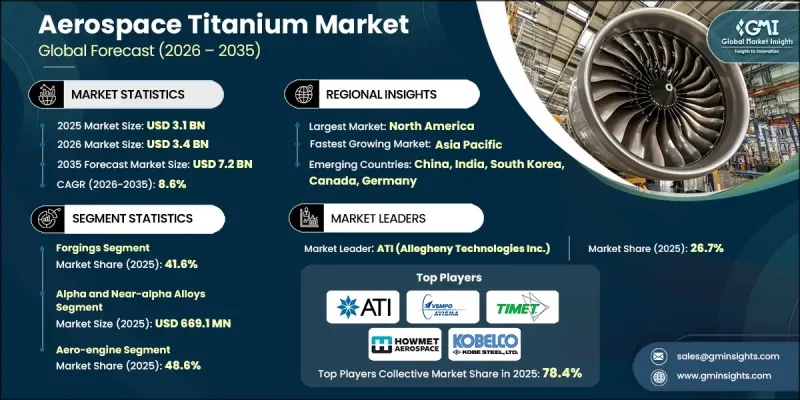
全球飛機產量的成長以及鈦材料因其卓越的強度重量比而在航太製造領域日益普及,推動了鈦市場的擴張。鈦材料因其兼具耐久性、耐腐蝕性和結構可靠性,同時又保持輕量化,而被廣泛應用於航太領域。軍用航空的不斷拓展以及對下一代飛機研發項目的持續投入,也促進了市場的發展。此外,積層製造技術在複雜鈦零件生產中的應用,透過實現精密製造和減少材料浪費,正在改變航太生產方式。全球對太空探勘和衛星研發計畫的日益關注,也增加了對先進鈦材料的需求。這些因素共同作用,推動了市場的發展,因為航太製造商正在尋求能夠支撐高性能飛機結構、同時提高營運效率並降低飛機整體重量的材料。
| 市場範圍 | |
|---|---|
| 開始年份 | 2025 |
| 預測期 | 2026-2035 |
| 上市時的市場規模 | 31億美元 |
| 預測金額 | 72億美元 |
| 複合年成長率 | 8.6% |
隨著民航機製造商擴大產能以應對現有的交付延誤,全球飛機產量的成長對航太鈦市場產生了顯著影響。鈦在飛機結構中的應用日益廣泛,旨在提升性能和結構可靠性,同時保持輕量化優勢。隨著製造商致力於提高永續性和降低材料成本,經認證的航太製造製程中再生鈦的使用量也逐漸增加。鈦回收利用的不斷推進,減少了對原生原料的依賴,支持了環保生產實踐,並有助於提升航太領域的供應鏈效率。
預計到2025年,鍛造產品市佔率將達到41.6%。鈦鍛件因其卓越的機械強度、結構均勻性和長期耐久性,在航太製造領域被廣泛應用,尤其適用於承受嚴苛工況的關鍵零件。鈦鍛件能夠承受高應力、疲勞負荷和溫度波動,因此對於高可靠性至關重要的航太結構而言,鈦鍛件必不可少。鈦鍛件一直是航太領域眾多結構和機械應用的首選材料。民用航空計畫和國防飛機生產的持續需求,推動著鈦鍛件在全球航太供應鏈中的廣泛應用。
預計到2025年,α型和近α型鈦合金市場規模將達到6.691億美元。這些合金因其優異的耐高溫、耐腐蝕和抗疲勞性能而被廣泛應用於航太工程領域。其機械穩定性以及在嚴苛工作環境下的出色表現,使其成為關鍵航太零件的理想選擇。此外,這些合金也展現出優異的加工性能,並與現代航太製造技術親和性,從而在民用航空和國防飛機項目中得到廣泛應用。其可靠性和材料效率確保了α型和近α型鈦合金在更廣泛的航太航太鈦市場中繼續保持其關鍵材料的地位。
預計到2025年,北美將佔據航太鈦市場45%的佔有率。該地區市場成長的驅動力包括飛機產量增加、國防現代化項目持續推進以及飛機製造領域對先進輕量材料日益成長的需求。該地區的航太製造商和一級供應商正在擴大先進鈦合金、鈦鍛造和積層製造技術的應用,以提高飛機的性能和效率。各國政府和航太機構正在投資建造先進的製造設施並加強供應鏈,以支持產量的成長。這些投資有助於該地區保持其在全球航太鈦市場的領先地位,並支持航太製造業的未來擴張。
目錄
第1章:調查方法和範圍
第2章執行摘要
第3章業界考察
- 生態系分析
- 供應商情況
- 利潤率
- 成本結構
- 每個階段增加的價值
- 影響價值鏈的因素
- 中斷
- 影響產業的因素
- 促進因素
- 全球飛機產量增加
- 鈦具有優異的強度重量比
- 國防航空項目的發展
- 採用積層製造技術製造複雜零件
- 擴大太空探勘任務
- 產業潛在風險與挑戰
- 供應鏈波動性和依賴性
- 航太認證的嚴格門檻
- 市場機遇
- 高超音速和可重複使用系統正在推動對優質鈦的需求。
- 高性能合金的創新與回收利用
- 促進因素
- 成長潛力分析
- 監理情勢
- 北美洲
- 歐洲
- 亞太地區
- 拉丁美洲
- 中東和非洲
- 波特五力分析
- PESTEL 分析
- 科技與創新趨勢
- 當前技術趨勢
- 新興技術
- 價格趨勢
- 按地區
- 依產品
- 定價策略
- 新興經營模式
- 合規要求
- 專利和智慧財產權分析
- 地緣政治和貿易趨勢
第4章 競爭情勢
- 介紹
- 企業市佔率分析
- 按地區
- 北美洲
- 歐洲
- 亞太地區
- 拉丁美洲
- 中東和非洲
- 市場集中度分析
- 按地區
- 主要企業的競爭標竿分析
- 財務績效比較
- 銷售量
- 利潤率
- 研究與開發
- 產品系列比較
- 產品線寬度
- 科技
- 創新
- 區域擴張比較
- 全球擴張分析
- 服務網路覆蓋
- 按地區分類的市場滲透率
- 競爭定位矩陣
- 領導者
- 挑戰者
- 追蹤者
- 小眾玩家
- 戰略展望矩陣
- 財務績效比較
- 主要進展
- 併購
- 夥伴關係與合作
- 技術進步
- 擴張和投資策略
- 數位轉型計劃
- 新興競爭對手和Start-Ups競爭對手的發展趨勢
第5章 市場估算與預測:依形狀分類,2022-2035年
- 鍛件
- 鋼板
- 片材帶
- 鋼筋和鋼坯
- 管材和擠壓產品
- 其他產品(線材、鑄件、電阻火花焊接環、異形件/擠壓製品)
第6章 市場估價與預測:依合金類型分類,2022-2035年
- 商用級純鈦(CP鈦)(等級:1-4、7、11、16、17、26、27)
- α合金和近α合金
- Ti-5Al-2.5Sn
- Ti-6242(Ti-6Al-2Sn-4Zr-2Mo)
- α-BETA合金
- Ti-6Al-4V
- Ti-6Al-4V ELI
- 其他α-BETA合金(Ti-3Al-2.5V、Ti-6Al-7Nb、Ti-6-22-22)
- BETA和亞穩態BETA合金(Ti-10V-2Fe-3Al、Ti-15V-3Al-3Cr-3Sn、Ti-17、Beta-21S)
- 鈦鋁(γ-TiAl)
第7章 市場估計與預測:依應用領域分類,2022-2035年
- 航空航太引擎應用
- 旋轉部件(風扇葉片、壓縮機葉片、圓盤、轉子)
- 引擎靜態部件(機殼、機架、葉片)
- 引擎短艙和推力反向器
- 飛機結構應用
- 主結構(機翼鍛造件、隔板、框架)
- 安裝和介面部件
- 起落架系統(起落架、支柱、致動器)
- 緊固件、彈簧和液壓系統
- 航太和火箭應用
- 壓力容器和COPV襯裡
- 低溫系統(液態氧、液態氫和液甲烷的硬體)
- 火箭和衛星結構
第8章 市場估算與預測:依最終用途產業分類,2022-2035年
- 商業的
- 政府/國防
第9章 市場估計與預測:依地區分類,2022-2035年
- 北美洲
- 美國
- 加拿大
- 歐洲
- 德國
- 英國
- 法國
- 西班牙
- 義大利
- 俄羅斯
- 亞太地區
- 中國
- 印度
- 日本
- 澳洲
- 韓國
- 拉丁美洲
- 巴西
- 墨西哥
- 阿根廷
- 中東和非洲
- 南非
- 沙烏地阿拉伯
- 阿拉伯聯合大公國
第10章:公司簡介
- 主要企業
- PJSC VSMPO AVISMA Corporation
- Titanium Metals Corporation(TIMET)
- Kobe Steel, Ltd.
- Howmet
- 按地區分類的主要企業
- 北美洲
- ATI(Allegheny Technologies Inc.)
- Plymouth Tube Company USA
- Carpenter Technology Corporation
- 亞太地區
- Shaanxi Dongyu Titanium Industry Co., Ltd.
- Nippon Steel Corporation
- 歐洲
- Aubert &Duval
- Supra Alloys
- AEM Metal
- 北美洲
- 特殊玩家/干擾者
- Dynamic Metals Ltd.
- Acnis International
- Gould Alloys
The Global Aerospace Titanium Market was valued at USD 3.1 billion in 2025 and is estimated to grow at a CAGR of 8.6% to reach USD 7.2 billion by 2035.
Market expansion is driven by increasing aircraft production worldwide and the growing adoption of titanium in aerospace manufacturing due to its exceptional strength-to-weight ratio. Titanium materials are widely utilized in aerospace applications because they offer durability, corrosion resistance, and structural reliability while maintaining lightweight performance. The market is also benefiting from the expansion of military aviation initiatives and increasing investments in next-generation aircraft development programs. In addition, the integration of additive manufacturing technologies for complex titanium components is transforming the aerospace production landscape by enabling precise fabrication and reducing material waste. Growing global interest in space exploration and satellite development programs is further contributing to the rising demand for advanced titanium materials. These factors collectively strengthen the market outlook as aerospace manufacturers seek materials capable of supporting high-performance aircraft structures while improving operational efficiency and reducing overall aircraft weight.
| Market Scope | |
|---|---|
| Start Year | 2025 |
| Forecast Year | 2026-2035 |
| Start Value | $3.1 Billion |
| Forecast Value | $7.2 Billion |
| CAGR | 8.6% |
Increasing aircraft production rates globally are significantly influencing the aerospace titanium market as commercial aircraft manufacturers expand manufacturing capacities to address existing delivery backlogs. Titanium materials are increasingly incorporated into aircraft structures to enhance performance and structural reliability while maintaining weight efficiency. The use of recycled titanium in certified aerospace manufacturing processes is also gradually increasing as manufacturers focus on improving sustainability and reducing material costs. The expansion of titanium recycling practices helps reduce reliance on primary raw materials, supports environmentally responsible manufacturing practices, and contributes to improved supply chain efficiency within the aerospace sector.
The forgings segment accounted for 41.6% share in 2025. Titanium forgings are widely preferred in aerospace manufacturing because they deliver superior mechanical strength, structural consistency, and long-term durability for critical components subjected to demanding operating conditions. Their ability to tolerate high stress, fatigue loads, and temperature fluctuations makes them essential for aerospace structures requiring high reliability. Titanium forgings remain a key material solution for various structural and mechanical applications in the aerospace industry. Sustained demand from both commercial aviation programs and defense-related aircraft production continues to drive consistent utilization of titanium forgings across global aerospace supply chains.
The alpha and near-alpha titanium alloys segment generated USD 669.1 million in 2025. These alloys are widely used in aerospace engineering because they provide excellent resistance to high temperatures, corrosion, and fatigue stress. Their mechanical stability and strong performance under demanding operating environments make them highly suitable for critical aerospace components. In addition, these alloys demonstrate strong machinability and compatibility with modern aerospace manufacturing technologies, supporting their widespread adoption across commercial aviation and defense aircraft programs. Their reliability and material efficiency continue to position alpha and near-alpha titanium alloys as important materials within the broader aerospace titanium market.
North America Aerospace Titanium Market accounted for 45% share in 2025. Market growth in this region is supported by increasing aircraft production activities, continuous defense modernization programs, and rising demand for advanced lightweight materials in aviation manufacturing. Aerospace manufacturers and Tier-1 suppliers across the region are expanding the use of advanced titanium alloys, titanium forgings, and additive manufacturing technologies to enhance aircraft performance and efficiency. Governments and aerospace organizations are investing in advanced manufacturing facilities and strengthening supply chains to support higher production rates. These investments are helping the region maintain a strong position in the global aerospace titanium market while supporting future aerospace manufacturing expansion.
Major companies operating in the Global Aerospace Titanium Market include Carpenter Technology Corporation, Allegheny Technologies Inc. (ATI), Kobe Steel, Ltd., Nippon Steel Corporation, Titanium Metals Corporation (TIMET), PJSC VSMPO-AVISMA Corporation, Howmet, Aubert & Duval, Acnis International, Dynamic Metals Ltd., Plymouth Tube Company USA, Gould Alloys, Supra Alloys, AEM Metal, and Shaanxi Dongyu Titanium Industry Co., Ltd. Companies operating in the aerospace titanium market are adopting multiple strategic initiatives to strengthen their competitive position and expand their global presence. Industry participants are investing heavily in research and development to improve titanium alloy performance and develop advanced manufacturing techniques such as additive manufacturing and precision forging. Strategic collaborations with aerospace manufacturers and supply chain partners are helping companies secure long-term supply agreements and expand production capabilities. Firms are also focusing on sustainability initiatives by increasing the use of recycled titanium and implementing efficient material recovery systems.
Table of Contents
Chapter 1 Methodology and Scope
- 1.1 Market scope and definition
- 1.2 Research design
- 1.2.1 Research approach
- 1.2.2 Data collection methods
- 1.3 Data mining sources
- 1.3.1 Global
- 1.3.2 Regional/Country
- 1.4 Base estimates and calculations
- 1.4.1 Base year calculation
- 1.4.2 Key trends for market estimation
- 1.5 Primary research and validation
- 1.5.1 Primary sources
- 1.6 Forecast model
- 1.7 Research assumptions and limitations
Chapter 2 Executive Summary
- 2.1 Industry 360° synopsis, 2022 - 2035
- 2.2 Key market trends
- 2.2.1 Physical form trends
- 2.2.2 Alloy type trends
- 2.2.3 Application trends
- 2.2.4 End-use industry trends
- 2.2.5 Regional trends
- 2.3 TAM Analysis, 2026-2035
- 2.4 CXO perspectives: Strategic imperatives
- 2.4.1 Executive decision points
- 2.4.2 critical success factors
- 2.5 Future outlook and strategic recommendations
Chapter 3 Industry Insights
- 3.1 Industry ecosystem analysis
- 3.1.1 Supplier Landscape
- 3.1.2 Profit Margin
- 3.1.3 Cost structure
- 3.1.4 Value addition at each stage
- 3.1.5 Factor affecting the value chain
- 3.1.6 Disruptions
- 3.2 Industry impact forces
- 3.2.1 Growth drivers
- 3.2.1.1 Rising global aircraft production rates
- 3.2.1.2 Titanium’s superior strength-to-weight ratio
- 3.2.1.3 Growth in defense aviation programs
- 3.2.1.4 Adoption of additive manufacturing for complex parts
- 3.2.1.5 Expansion of space exploration missions
- 3.2.2 Industry pitfalls and challenges
- 3.2.2.1 Supply-chain volatility and dependency
- 3.2.2.2 Stringent aerospace certification hurdles
- 3.2.3 Market opportunities
- 3.2.3.1 Hypersonic & reusable systems boost premium titanium use
- 3.2.3.2 High performance alloy innovation and recycling
- 3.2.1 Growth drivers
- 3.3 Growth potential analysis
- 3.4 Regulatory landscape
- 3.4.1 North America
- 3.4.2 Europe
- 3.4.3 Asia Pacific
- 3.4.4 Latin America
- 3.4.5 Middle East & Africa
- 3.5 Porter's analysis
- 3.6 PESTEL analysis
- 3.7 Technology and Innovation landscape
- 3.7.1 Current technological trends
- 3.7.2 Emerging technologies
- 3.8 Price trends
- 3.8.1 By region
- 3.8.2 By product
- 3.9 Pricing Strategies
- 3.10 Emerging Business Models
- 3.11 Compliance Requirements
- 3.12 Patent and IP analysis
- 3.13 Geopolitical and trade dynamics
Chapter 4 Competitive Landscape, 2025
- 4.1 Introduction
- 4.2 Company market share analysis
- 4.2.1 By region
- 4.2.1.1 North America
- 4.2.1.2 Europe
- 4.2.1.3 Asia Pacific
- 4.2.1.4 Latin America
- 4.2.1.5 Middle East & Africa
- 4.2.2 Market concentration analysis
- 4.2.1 By region
- 4.3 Competitive benchmarking of key players
- 4.3.1 Financial performance comparison
- 4.3.1.1 Revenue
- 4.3.1.2 Profit margin
- 4.3.1.3 R&D
- 4.3.2 Product portfolio comparison
- 4.3.2.1 Product range breadth
- 4.3.2.2 Technology
- 4.3.2.3 Innovation
- 4.3.3 Geographic presence comparison
- 4.3.3.1 Global footprint analysis
- 4.3.3.2 Service network coverage
- 4.3.3.3 Market penetration by region
- 4.3.4 Competitive positioning matrix
- 4.3.4.1 Leaders
- 4.3.4.2 Challengers
- 4.3.4.3 Followers
- 4.3.4.4 Niche players
- 4.3.5 Strategic outlook matrix
- 4.3.1 Financial performance comparison
- 4.4 Key developments
- 4.4.1 Mergers and acquisitions
- 4.4.2 Partnerships and collaborations
- 4.4.3 Technological advancements
- 4.4.4 Expansion and investment strategies
- 4.4.5 Digital transformation initiatives
- 4.5 Emerging/ startup competitors landscape
Chapter 5 Market Estimates and Forecast, By Physical Form, 2022 - 2035 (USD Million)
- 5.1 Key trends
- 5.2 Forgings
- 5.3 Plate
- 5.4 Sheet & strip
- 5.5 Bar & billet
- 5.6 Tubes & extrusions
- 5.7 Others (wire, casting, flash-welded rings, specialty forms / extrusions)
Chapter 6 Market Estimates and Forecast, By Alloy Type, 2022 - 2035 (USD Million)
- 6.1 Key trends
- 6.2 Commercially pure (CP) titanium (Grades: 1-4, 7, 11, 16, 17, 26, 27)
- 6.3 Alpha & near-alpha alloys
- 6.3.1 Ti-5Al-2.5Sn
- 6.3.2 Ti-6242 (Ti-6Al-2Sn-4Zr-2Mo)
- 6.4 Alpha-beta alloys
- 6.4.1 Ti-6Al-4V
- 6.4.2 Ti-6Al-4V ELI
- 6.4.3 Other alpha-beta alloys (Ti-3Al-2.5V, Ti-6Al-7Nb, Ti-6-22-22)
- 6.5 Beta & metastable beta alloys (Ti-10V-2Fe-3Al, Ti-15V-3Al-3Cr-3Sn, Ti-17, Beta-21S)
- 6.6 Titanium aluminides (gamma-TiAl)
Chapter 7 Market Estimates and Forecast, By Application, 2022 - 2035 (USD Million)
- 7.1 Key trends
- 7.2 Aero-engine applications
- 7.2.1 Rotating components (fan blades, compressor blades, discs, rotors)
- 7.2.2 Static engine components (casings, frames, vanes)
- 7.2.3 Engine nacelles & thrust reversers
- 7.3 Airframe structural applications
- 7.3.1 Primary structures (wing forgings, bulkheads, frames)
- 7.3.2 Attachment & interface components
- 7.3.3 Landing systems (landing gear, struts, actuators)
- 7.4 Fasteners, springs & hydraulic systems
- 7.5 Space & launch vehicle applications
- 7.5.1 Pressure vessels & COPV liners
- 7.5.2 Cryogenic systems (LOX, LH2, LCH4 hardware)
- 7.5.3 Rocket & satellite structures
Chapter 8 Market Estimates and Forecast, By End-use Industry, 2022 - 2035 (USD Million)
- 8.1 Key trends
- 8.2 Commercial
- 8.3 Government and defense
Chapter 9 Market Estimates and Forecast, By Region, 2022 - 2035 (USD Million)
- 9.1 Key trends
- 9.2 North America
- 9.2.1 U.S.
- 9.2.2 Canada
- 9.3 Europe
- 9.3.1 Germany
- 9.3.2 UK
- 9.3.3 France
- 9.3.4 Spain
- 9.3.5 Italy
- 9.3.6 Russia
- 9.4 Asia Pacific
- 9.4.1 China
- 9.4.2 India
- 9.4.3 Japan
- 9.4.4 Australia
- 9.4.5 South Korea
- 9.5 Latin America
- 9.5.1 Brazil
- 9.5.2 Mexico
- 9.5.3 Argentina
- 9.6 Middle East and Africa
- 9.6.1 South Africa
- 9.6.2 Saudi Arabia
- 9.6.3 UAE
Chapter 10 Company Profiles
- 10.1 Global Key Players
- 10.1.1 PJSC VSMPO AVISMA Corporation
- 10.1.2 Titanium Metals Corporation (TIMET)
- 10.1.3 Kobe Steel, Ltd.
- 10.1.4 Howmet
- 10.2 Regional key players
- 10.2.1 North America
- 10.2.1.1 ATI (Allegheny Technologies Inc.)
- 10.2.1.2 Plymouth Tube Company USA
- 10.2.1.3 Carpenter Technology Corporation
- 10.2.2 Asia Pacific
- 10.2.2.1 Shaanxi Dongyu Titanium Industry Co., Ltd.
- 10.2.2.2 Nippon Steel Corporation
- 10.2.3 Europe
- 10.2.3.1 Aubert & Duval
- 10.2.3.2 Supra Alloys
- 10.2.3.3 AEM Metal
- 10.2.1 North America
- 10.3 Niche Players/Disruptors
- 10.3.1 Dynamic Metals Ltd.
- 10.3.2 Acnis International
- 10.3.3 Gould Alloys

 全球航空航太鈦市場規模、佔有率、趨勢和成長分析報告(2026-2034)
 航太鈦市場規模、佔有率和成長分析:按合金類型、產品形式、應用、關鍵零件和地區分類-2026-2033年產業預測
 2026-2030年全球海綿擦拭巾市場
 2026年全球航太和國防用海綿鈦市場報告2026年全球航太鈦市場報告全球航太鈦市場規模、佔有率、趨勢和成長分析報告(2026-2034年)
 航太鈦市場-全球產業規模、佔有率、趨勢、機會和預測,按類型(商業純鈦、鈦合金)、應用(結構機身、引擎、其他)、地區和競爭格局分類,2020-2030年預測
 海綿鈦:全球市佔率及排名、總收入及需求預測(2025-2031年)
 航太級氦氣市場-全球及區域分析:按類型、應用和區域-分析與預測(2025-2034)
 2025年全球航太級氦氣市場