

 |
市場調查報告書
商品編碼
1998705
酒窖市場機會、成長要素、產業趨勢分析及 2026-2035 年預測。Wine Cellar Market Opportunity, Growth Drivers, Industry Trend Analysis, and Forecast 2026 - 2035 |
||||||

預計到 2025 年,全球葡萄酒窖市場價值將達到 13.4 億美元,年複合成長率為 5.1%,到 2035 年將達到 22.1 億美元。
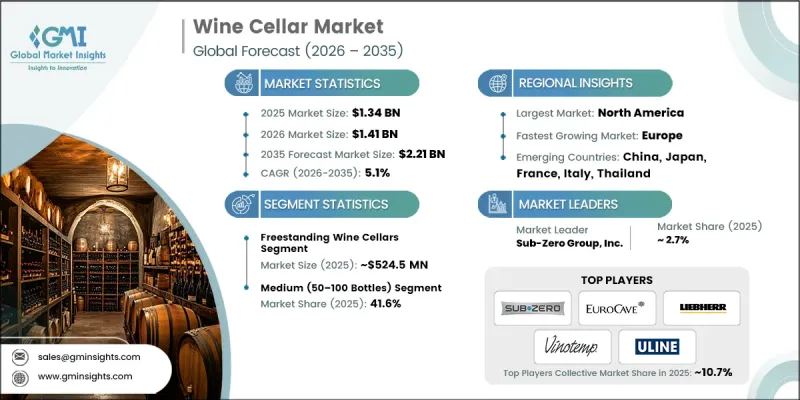
隨著葡萄酒在全球日益普及,對能夠維持最佳溫度、濕度和整體儲存條件的專業葡萄酒儲存解決方案的需求也隨之成長。消費者和企業都在尋求專業的酒窖,以便長期保存優質陳年葡萄酒。飯店、餐廳和私人住宅都在增加對葡萄酒儲存空間的投資,以滿足商業和個人需求。電子商務和直銷管道的興起,使得優質葡萄酒的供應更加充足,也提高了人們對正確儲存方法的認知。溫濕度控制酒窖、節能冷卻系統和模組化設計的進步,正在吸引新的買家。可支配收入的增加和葡萄酒文化的蓬勃發展,推動了住宅和豪華酒窖的普及,使得妥善儲存成為葡萄酒愛好者和酒店餐飲企業都必須考慮的關鍵因素。
| 市場規模 | |
|---|---|
| 開始年份 | 2025 |
| 預測期 | 2026-2035 |
| 上市時的市場規模 | 13.4億美元 |
| 預測金額 | 22.1億美元 |
| 複合年成長率 | 5.1% |
預計2025年,獨立式酒窖市場規模將達到5.245億美元,並將以5.5%的複合年成長率成長至2035年。獨立式酒窖因其多功能性和易於安裝而廣受歡迎,只需足夠的通風和電源。它們可安裝在住宅、公寓或小規模企業中,並配備可調節的層架、溫濕度控制和節能冷卻系統。這種適應性,加上家庭娛樂、葡萄酒收藏和精品住宿設施等日益成長的趨勢,使得獨立式酒窖成為全球市場成長的主要動力。
到2025年,商用葡萄酒儲存系統將佔據最大的市場佔有率。這些解決方案對於需要對大規模藏酒進行精確溫控的餐廳、飯店、酒吧、酒莊和專業葡萄酒零售商至關重要。商業機構正在投資建造高容量、結構有序、具備長期儲存能力的先進儲酒單元,以保持葡萄酒品質並提升顧客體驗。隨著企業在提供優質飲品服務的同時,力求保護其珍貴藏酒,對更大、技術更先進的酒窖的需求也日益成長。
美國酒窖市場預計到2025年將達到4.653億美元,並在2035年之前以5.1%的複合年成長率成長。市場擴張的驅動力主要來自消費者對高階葡萄酒收藏和家庭娛樂文化的日益成長的興趣。富裕的消費者和葡萄酒愛好者正在投資模組化和客製化的解決方案,以確保最佳的溫度、濕度和光照條件。住宅翻新和建築趨勢推動了對整合式酒窖、地下室和廚房酒櫃的需求。專業零售商和高階住宅解決方案供應商透過提供現成和客製化選項,提高了產品的可及性。高級餐飲和酒店業也進一步推動了對商用酒櫃的需求,以保護其龐大的藏酒並維持服務品質。
目錄
第1章:調查方法和範圍
第2章執行摘要
第3章業界考察
- 生態系分析
- 供應商情況
- 利潤率
- 每個階段增加的價值
- 影響價值鏈的因素
- 影響產業的因素
- 促進因素
- 全球葡萄酒消費量不斷成長,人們對優質葡萄酒的鑑賞力也在提高。
- 擴大葡萄酒儲存解決方案在住宅和豪華住宅的應用。
- 透過提供精心挑選的葡萄酒,拓展旅館和餐飲業。
- 陷阱與挑戰
- 定製酒窖的安裝和維護成本很高
- 都市區住宅儲物空間有限
- 機會
- 對模組化和緊湊型葡萄酒儲藏單元的需求日益成長
- 與智慧家庭和物聯網技術的整合
- 促進因素
- 成長潛力分析
- 未來市場趨勢
- 科技與創新趨勢
- 當前技術趨勢
- 新興技術
- 價格趨勢
- 按地區
- 依產品
- 監理情勢
- 標準和合規要求
- 區域法規結構
- 認證標準
- 波特五力分析
- PESTEL 分析
- 專利趨勢(基於初步調查)
- 按技術類型分類的專利申請趨勢
- 領先的專利擁有者和創新領導者
- 新興專利領域(智慧技術、冷凍技術創新)
- 貿易數據分析(基於付費資料庫)
- 進出口量和進口額趨勢(基於付費資料庫)
- 主要貿易走廊和關稅的影響(基於付費資料庫)
- 主要進口國分析
- 主要出口國分析
- 分銷基礎設施和銷售管道滲透現狀(基於初步調查)
- 按地區和類型(現代零售與傳統零售)分類的分銷網路覆蓋率(基於初步調查)
- 最後一公里基礎設施差異和新分銷管道的變化(基於初步研究)
第4章 競爭情勢
- 介紹
- 企業市佔率分析
- 按地區
- 企業矩陣分析
- 主要市場公司的競爭分析
- 競爭定位矩陣
- 主要進展
- 併購
- 夥伴關係與合作
- 新產品發布
- 業務拓展計劃
第5章 市場估算與預測:依產品類型分類,2022-2035年
- 獨立式酒窖
- 內置酒窖
- 步入式酒窖
- 酒牆
- 酒櫃
- 其他
第6章 市場估計與預測:依產能分類,2022-2035年
- 小規模(少於50瓶)
- 中等規模(50-100件)
- 大號(100-200 件)
- 超大(超過200件)
第7章 市場估計與預測:依冷凍技術分類,2022-2035年
- 壓縮機式冷卻
- 熱電冷卻
- 混合冷卻系統
第8章 市場估算與預測:依價格區間分類,2022-2035年
- 經濟
- 大眾市場
- 優質的
第9章 市場估計與預測:依應用領域分類,2022-2035年
- 住宅
- 商業的
- 餐廳和酒吧
- 飯店和度假村
- 葡萄酒商店和品酒室
- 其他
第10章 市場估價與預測:依通路分類,2022-2035年
- B2B
- B2C
- 專賣店
- 家居建材商店
- 線上零售
- 百貨公司
- 其他
第11章 市場估價與預測:按地區分類,2022-2035年
- 北美洲
- 美國
- 加拿大
- 歐洲
- 德國
- 英國
- 法國
- 義大利
- 西班牙
- 亞太地區
- 中國
- 印度
- 日本
- 韓國
- 澳洲
- 拉丁美洲
- 巴西
- 墨西哥
- 阿根廷
- 中東和非洲(MEA)
- 沙烏地阿拉伯
- 阿拉伯聯合大公國
- 南非
第12章:公司簡介
- Sub-Zero Group, Inc.
- EuroCave
- Liebherr Group
- Vinotemp International
- U-Line Corporation
- Haier Group
- Samsung Electronics
- LG Electronics
- Whirlpool(KitchenAid)
- Miele
- Bosch Home Appliances
- Perlick Corporation
- Smeg
- Marvel Refrigeration
- TRUE Manufacturing
The Global Wine Cellar Market was valued at USD 1.34 billion in 2025 and is estimated to grow at a CAGR of 5.1% to reach USD 2.21 billion by 2035.
The increasing popularity of wine across the globe has created a rising demand for dedicated wine storage solutions that maintain optimal temperature, humidity, and overall storage conditions. Consumers and businesses are seeking specialized cellars to preserve luxury and aged wines for long-term use. Hotels, restaurants, and private residences are increasingly investing in wine storage spaces for both commercial and personal purposes. Greater availability of premium wines through e-commerce and direct-to-consumer channels has heightened awareness of proper storage practices. Advancements in climate-controlled cellars, energy-efficient cooling systems, and modular designs are encouraging new buyers. Rising disposable incomes and the growing culture of wine appreciation are driving both residential and luxury wine cellar adoption, making proper storage a key consideration for enthusiasts and hospitality operators alike.
| Market Scope | |
|---|---|
| Start Year | 2025 |
| Forecast Year | 2026-2035 |
| Start Value | $1.34 Billion |
| Forecast Value | $2.21 Billion |
| CAGR | 5.1% |
The freestanding wine cellar segment accounted for USD 524.5 million in 2025 and is expected to grow at a CAGR of 5.5% through 2035. Freestanding units are favored for their versatility and ease of installation, requiring only proper ventilation and electricity. They can be deployed in homes, apartments, or small businesses and offer features like adjustable shelving, temperature and humidity control, and energy-efficient cooling. Their adaptability, combined with growing trends in home entertaining, wine collecting, and boutique lodging, positions freestanding wine cellars as a substantial contributor to global market growth.
The commercial wine storage systems held the largest market share in 2025. These solutions are essential for restaurants, hotels, bars, wineries, and specialty wine retailers that require precise climate management for large collections. Commercial venues invest in advanced storage units with high capacity, organized racking systems, and long-term preservation capabilities to maintain wine quality and enhance customer experiences. The demand for larger, technologically sophisticated wine cellars is rising as businesses aim to offer premium beverage services while safeguarding valuable collections.
U.S. Wine Cellar Market reached USD 465.3 million in 2025 and is expected to grow at a CAGR of 5.1% through 2035. Market expansion is supported by growing interest in premium wine collections and home entertainment culture. Affluent households and wine enthusiasts are investing in modular and custom solutions to ensure optimal temperature, humidity, and lighting conditions. Residential remodeling and construction trends are driving demand for integrated wine rooms, basements, and kitchen wine storage. Specialty retailers and luxury home solution providers contribute to product accessibility with both prebuilt and customized offerings. High-end restaurants and hospitality businesses further boost the demand for commercial wine storage units to protect extensive collections and maintain service quality.
Leading companies in the Global Wine Cellar Market include Sub-Zero Group, Inc., EuroCave, LG Electronics, Liebherr Group, Bosch Home Appliances, Samsung Electronics, Perlick Corporation, Whirlpool (KitchenAid), Haier Group, Marvel Refrigeration, Miele, TRUE Manufacturing, Smeg, Vinotemp International, and U-Line Corporation. Key players in the Global Wine Cellar Market are focusing on strategic initiatives to enhance their market presence and strengthen their competitive position. Companies are investing in R&D to develop advanced climate-controlled and energy-efficient solutions that cater to both residential and commercial needs. Collaborations with luxury home builders, hospitality businesses, and e-commerce platforms expand product reach and brand visibility. Firms offer customizable modular designs to meet varying customer requirements. Geographic expansion into emerging wine markets ensures broader penetration. Additionally, businesses emphasize after-sales services, maintenance packages, and extended warranties to improve customer satisfaction and loyalty.
Table of Contents
Chapter 1 Methodology & Scope
- 1.1 Market scope and definition
- 1.2 Research design
- 1.2.1 Research approach
- 1.2.2 Data collection methods
- 1.3 Data mining sources
- 1.3.1 Global
- 1.3.2 Regional/Country
- 1.4 Base estimates and calculations
- 1.4.1 Base year calculation
- 1.4.2 Key trends for market estimation
- 1.5 Primary research and validation
- 1.5.1 Primary sources
- 1.6 Forecast model
- 1.7 Research assumptions and limitations
Chapter 2 Executive Summary
- 2.1 Industry 360° synopsis
- 2.2 Key market trends
- 2.2.1 Regional
- 2.2.2 Product Type
- 2.2.3 Capacity
- 2.2.4 Cooling Technology
- 2.2.5 Pricing
- 2.2.6 Application
- 2.2.7 Distribution channel
Chapter 3 Industry Insights
- 3.1 Industry ecosystem analysis
- 3.1.1 Supplier landscape
- 3.1.2 Profit margin
- 3.1.3 Value addition at each stage
- 3.1.4 Factor affecting the value chain
- 3.2 Industry impact forces
- 3.2.1 Growth drivers
- 3.2.1.1 Rising wine consumption and appreciation of premium wines globally
- 3.2.1.2 Growing adoption of residential and luxury home wine storage solutions
- 3.2.1.3 Expansion of hospitality and restaurant sectors with curated wine offerings
- 3.2.2 Pitfalls & Challenges
- 3.2.2.1 High installation and maintenance costs for custom wine cellars
- 3.2.2.2 Limited space availability in urban residences
- 3.2.3 Opportunities
- 3.2.3.1 Rising demand for modular and compact wine storage units
- 3.2.3.2 Integration with smart home and IoT technologies
- 3.2.1 Growth drivers
- 3.3 Growth potential analysis
- 3.4 Future market trends
- 3.5 Technology and innovation landscape
- 3.5.1 Current technological trends
- 3.5.2 Emerging technologies
- 3.6 Price trends
- 3.6.1 By region
- 3.6.2 By product
- 3.7 Regulatory landscape
- 3.7.1 Standards and compliance requirements
- 3.7.2 Regional regulatory frameworks
- 3.7.3 Certification standards
- 3.8 Porter's analysis
- 3.9 PESTEL analysis
- 3.10 Patent Landscape (Driven by Primary Research)
- 3.10.1 Patent Filing Trends by Technology Type
- 3.10.2 Key Patent Holders & Innovation Leaders
- 3.10.3 Emerging Patent Areas (Smart Technology, Cooling Innovations)
- 3.11 Trade Data Analysis (Driven by Paid Data Base)
- 3.11.1 Import/Export Volume & Value Trends (Driven by Paid Data Base)
- 3.11.2 Key Trade Corridors & Tariff Impact (Driven by Paid Data Base)
- 3.11.3 Major Importing Countries Analysis
- 3.11.4 Major Exporting Countries Analysis
- 3.12 Distribution Infrastructure & Channel Penetration Landscape (Driven by Primary Research)
- 3.12.1 Channel Coverage by Region & Format (Modern vs Traditional Trade) (Driven by Primary Research)
- 3.12.2 Last-Mile Infrastructure Gaps & Emerging Channel Shifts (Driven by Primary Research)
Chapter 4 Competitive Landscape, 2025
- 4.1 Introduction
- 4.2 Company market share analysis
- 4.2.1 By Region
- 4.2.1.1 North America
- 4.2.1.2 Europe
- 4.2.1.3 Asia Pacific
- 4.2.1.4 Latin America
- 4.2.1.5 Middle East & Africa
- 4.2.1 By Region
- 4.3 Company matrix analysis
- 4.4 Competitive analysis of major market players
- 4.5 Competitive positioning matrix
- 4.6 Key developments
- 4.6.1 Mergers & acquisitions
- 4.6.2 Partnerships & collaborations
- 4.6.3 New product launches
- 4.6.4 Expansion plans
Chapter 5 Market Estimates & Forecast, By Product Type, 2022 - 2035, (USD Million) (Thousand Units)
- 5.1 Key trends
- 5.2 Freestanding wine cellars
- 5.3 Built-in wine cellars
- 5.4 Walk-in wine cellars
- 5.5 Wine walls
- 5.6 Wine cabinets
- 5.7 Others
Chapter 6 Market Estimates & Forecast, By Capacity, 2022 - 2035, (USD Million) (Thousand Units)
- 6.1 Key trends
- 6.2 Small (under 50 bottles)
- 6.3 Medium (50-100 bottles)
- 6.4 Large (100-200 bottles)
- 6.5 Extra-large (over 200 bottles)
Chapter 7 Market Estimates & Forecast, By Cooling Technology, 2022 - 2035, (USD Million) (Thousand Units)
- 7.1 Key trends
- 7.2 Compressor-Based Cooling
- 7.3 Thermoelectric Cooling
- 7.4 Hybrid Cooling Systems
Chapter 8 Market Estimates & Forecast, By Pricing, 2022 - 2035, (USD Million) (Thousand Units)
- 8.1 Key trends
- 8.2 Economy
- 8.3 Mass
- 8.4 Premium
Chapter 9 Market Estimates & Forecast, By Application, 2022 - 2035, (USD Million) (Thousand Units)
- 9.1 Key trends
- 9.2 Residential
- 9.3 Commercial
- 9.3.1 Restaurants and bars
- 9.3.2 Hotels and resorts
- 9.3.3 Wine shops and tasting rooms
- 9.3.4 Others
Chapter 10 Market Estimates & Forecast, By Distribution Channel, 2022 - 2035, (USD Million) (Thousand Units)
- 10.1 Key trends
- 10.2 B2B
- 10.3 B2C
- 10.3.1 Specialty stores
- 10.3.2 Home improvement stores
- 10.3.3 Online retail
- 10.3.4 Department stores
- 10.3.5 Others
Chapter 11 Market Estimates & Forecast, By Region, 2022 - 2035, (USD Million) (Thousand Units)
- 11.1 Key trends
- 11.2 North America
- 11.2.1 U.S.
- 11.2.2 Canada
- 11.3 Europe
- 11.3.1 Germany
- 11.3.2 UK
- 11.3.3 France
- 11.3.4 Italy
- 11.3.5 Spain
- 11.4 Asia Pacific
- 11.4.1 China
- 11.4.2 India
- 11.4.3 Japan
- 11.4.4 South Korea
- 11.4.5 Australia
- 11.5 Latin America
- 11.5.1 Brazil
- 11.5.2 Mexico
- 11.5.3 Argentina
- 11.6 MEA
- 11.6.1 Saudi Arabia
- 11.6.2 UAE
- 11.6.3 South Africa
Chapter 12 Company Profiles
- 12.1 Sub-Zero Group, Inc.
- 12.2 EuroCave
- 12.3 Liebherr Group
- 12.4 Vinotemp International
- 12.5 U-Line Corporation
- 12.6 Haier Group
- 12.7 Samsung Electronics
- 12.8 LG Electronics
- 12.9 Whirlpool (KitchenAid)
- 12.10 Miele
- 12.11 Bosch Home Appliances
- 12.12 Perlick Corporation
- 12.13 Smeg
- 12.14 Marvel Refrigeration
- 12.15 TRUE Manufacturing


