


 |
市場調查報告書
商品編碼
1998704
2026 年至 2035 年男性性腺功能低下症的市場機會、成長要素、產業趨勢分析與預測。Male Hypogonadism Market Opportunity, Growth Drivers, Industry Trend Analysis, and Forecast 2026 - 2035 |
||||||

預計到 2025 年,全球男性性腺功能低下症市場價值將達到 42 億美元,並有望以 5.4% 的複合年成長率成長,到 2035 年達到 71 億美元。
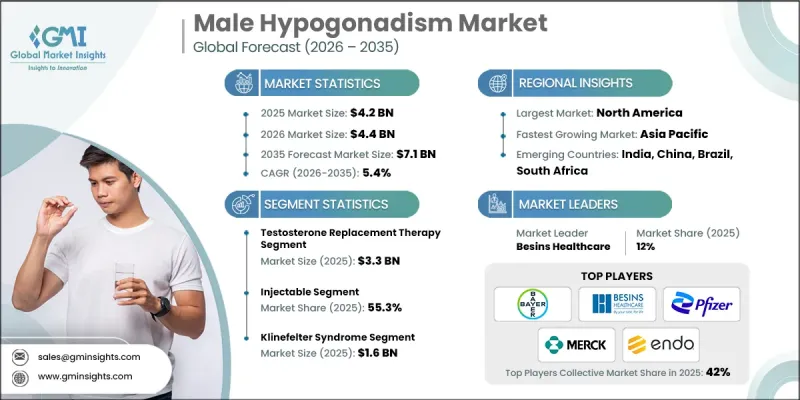
醫療機構、政府部門和私人組織正加強,致力於推廣男性性腺功能低下症症是指睪丸無法產生足夠的睪固酮或功能異常,進而導致生理、性功能和心理方面的併發症。睪固酮替代療法 (TRT) 的進步正在改變疾病管理方式,提供更安全、更有效、更方便的治療方案。改良的配方、個人化的治療方案、創新的給藥系統以及與數位健康工具的整合,使患者能夠以最小的副作用維持穩定的荷爾蒙水平。隨著臨床意識的提高和先進治療方法的引入,市場正受益於患者療效的改善、醫療基礎設施的加強以及人們對睾酮缺乏症長期管理策略接受度的提高。
| 市場範圍 | |
|---|---|
| 開始年份 | 2025 |
| 預測期 | 2026-2035 |
| 上市時的市場規模 | 42億美元 |
| 預計金額 | 71億美元 |
| 複合年成長率 | 5.4% |
預計到2025年,睪固酮替代療法(TRT)市場規模將達到33億美元,並有望以5.5%的複合年成長率穩定成長至2035年。 TRT在恢復正常睪固酮水平方面發揮著至關重要的作用,從而改善性功能、性慾、勃起功能和整體健康狀況。除了性健康之外,睪酮還會影響脂肪分佈和代謝,低水平的睪酮會導致內臟脂肪堆積。支持性的醫療政策和法律規範正在擴大患者獲得TRT的機會,並促進對新治療方法的探索。隨著醫生越來越注重精準的劑量控制和個人化治療,先進睪酮療法的應用也進一步推動了市場成長。
預計到2025年,注射類藥物市場規模將達23億美元,佔市佔率的55.3%。注射用睪酮療法,例如庚酸睪酮和環戊丙酸睪酮,能夠穩定荷爾蒙水平,減少情緒波動、疲勞和性慾減退。精準的劑量調整使臨床醫生能夠為每位患者制定個人化的治療方案,在最大限度地提高療效的同時,最大限度地減少副作用。由於其可靠性、療效穩定和臨床適用性,注射類藥物仍然是患者和醫療專業人員的首選。
預計2025年,北美男性性腺功能低下症市場規模將達18億美元,2035年將達33億美元。該地區的強勁市場地位得益於男性健康意識的提高、睾酮替代療法(TRT)的廣泛應用以及先進的診斷服務。成熟的醫療保健體系,包括專業的內分泌和泌尿系統診所,以及不斷擴展的遠端醫療TRT項目,正在加速早期診斷和治療的啟動。美國和加拿大受益於全面的荷爾蒙檢測覆蓋、強大的製藥公司網路以及先進的給藥方式,例如經皮凝膠、長效注射和植入式植入。這些因素共同鞏固了該地區市場的主導地位。
目錄
第1章:調查方法和範圍
第2章執行摘要
第3章業界考察
- 生態系分析
- 影響產業的因素
- 促進因素
- 意識提高和診斷數量增加
- 性腺功能減退症發生率增加
- 睾酮替代療法的進展
- 男性健康和保健計劃的成長
- 產業潛在風險與挑戰
- 安全隱憂和副作用
- 嚴格遵守規章制度
- 市場機遇
- 遠距遠端醫療TRT平台的擴展
- 促進因素
- 成長潛力分析
- 監理情勢
- 技術格局
- 目前技術
- 注射以睪固酮製劑作為主要標準治療
- 擴大經皮凝膠和貼片的應用,以實現穩定的每日荷爾蒙傳遞。
- 新興技術
- 人們對長效緩釋療法的興趣日益濃厚。
- 下一代口服睪固酮製劑的研發
- 微針和經皮給藥系統的進展
- 目前技術
- 未來市場趨勢
- 投資和資金籌措趨勢
- 管道分析
- 波特五力分析
- PESTEL 分析
第4章 競爭情勢
- 介紹
- 企業市佔率分析
- 世界
- 北美洲
- 歐洲
- 亞太地區
- 企業矩陣分析
- 主要市場公司的競爭分析
- 競爭定位矩陣
- 主要進展
- 併購
- 夥伴關係與合作
- 新產品發布
- 業務拓展計劃
第5章 市場估計與預測:依治療方法,2022-2035年
- 睾酮替代療法
- 荷爾蒙療法
第6章 市場估計與預測:依給藥途徑分類,2022-2035年
- 注射藥物
- 外用
- 口服
第7章 市場估計與預測:依應用領域分類,2022-2035年
- 卡門氏症候群
- 柯林菲特氏症
- 腦下垂體疾病
- 其他用途
第8章 市場估計與預測:依地區分類,2022-2035年
- 北美洲
- 美國
- 加拿大
- 歐洲
- 德國
- 英國
- 法國
- 西班牙
- 義大利
- 荷蘭
- 亞太地區
- 中國
- 日本
- 印度
- 澳洲
- 韓國
- 拉丁美洲
- 巴西
- 墨西哥
- 阿根廷
- 中東和非洲
- 南非
- 沙烏地阿拉伯
- 阿拉伯聯合大公國
第9章:公司簡介
- Antares Pharma
- Acerus Pharmaceuticals
- Aspen Pharmacare
- Aurobindo Pharmaceutical
- Bayer AG
- Besins Healthcare
- Bharat Serums and Vaccines
- Eli Lilly and Company
- Endo Pharmaceuticals
- Lupin Pharmaceuticals
- Merck
- Simple Pharma
- Pfizer
- Teva Pharmaceutical Industries
- Viatris
The Global Male Hypogonadism Market was valued at USD 4.2 billion in 2025 and is estimated to grow at a CAGR of 5.4% to reach USD 7.1 billion by 2035.
Growing initiatives by healthcare providers, government agencies, and private organizations are focusing on promoting early diagnosis, preventive care, and education around male hypogonadism. This condition occurs when the testicles fail to produce sufficient testosterone or function properly, leading to physical, sexual, and psychological complications. Advancements in testosterone replacement therapy (TRT) are transforming disease management through safer, more effective, and convenient treatment options. Improved formulations, personalized treatment plans, innovative delivery systems, and integration with digital health tools are helping patients maintain stable hormone levels while minimizing side effects. With rising clinical awareness and the adoption of advanced therapeutic options, the market is benefiting from enhanced patient outcomes, stronger healthcare infrastructure, and increased acceptance of long-term management strategies for testosterone deficiency.
| Market Scope | |
|---|---|
| Start Year | 2025 |
| Forecast Year | 2026-2035 |
| Start Value | $4.2 Billion |
| Forecast Value | $7.1 Billion |
| CAGR | 5.4% |
The testosterone replacement therapy segment reached USD 3.3 billion in 2025 and is expected to experience steady growth at a CAGR of 5.5% through 2035. TRT plays a critical role in restoring normal testosterone levels, which improves sexual health, libido, erectile function, and overall well-being. Beyond sexual health, testosterone impacts fat distribution and metabolism, making low levels a contributor to increased visceral fat accumulation. Supportive healthcare policies and regulatory frameworks have expanded patient access to TRT and incentivized research into new therapies. As physicians increasingly focus on precision dosing and personalized management, the adoption of advanced testosterone therapies continues to strengthen market growth.
The injectable segment reached USD 2.3 billion in 2025, representing 55.3% share. Injectable testosterone therapies, such as enanthate and cypionate, provide stable hormone levels, reducing mood fluctuations, fatigue, and libido variations. The ability to precisely adjust dosages allows clinicians to tailor treatment plans for individual patients, optimizing efficacy while minimizing side effects. Injectable formulations remain a preferred option for patients and healthcare providers due to their proven reliability, consistent results, and adaptability in clinical practice.
North America Male Hypogonadism Market accounted for USD 1.8 billion in 2025 and is expected to reach USD 3.3 billion by 2035. The region's strong position is supported by high awareness of men's health, widespread use of TRT, and advanced diagnostic services. Mature healthcare ecosystems, including specialized endocrinology and urology clinics, along with expanding telehealth TRT programs, have facilitated early diagnosis and treatment adoption. The U.S. and Canada benefit from comprehensive hormone testing coverage, robust pharmaceutical presence, and the availability of advanced delivery methods, including transdermal gels, long-acting injectables, and subcutaneous implants. These factors collectively strengthen the market's dominance in the region.
Key players in the Global Male Hypogonadism Market include Antares Pharma, Acerus Pharmaceuticals, Aspen Pharmacare, Aurobindo Pharmaceutical, Bayer AG, Besins Healthcare, Bharat Serums and Vaccines, Eli Lilly and Company, Endo Pharmaceuticals, Lupin Pharmaceuticals, Merck, Simple Pharma, Pfizer, Teva Pharmaceutical Industries, and Viatris. Companies in the Male Hypogonadism Market are pursuing multiple strategies to reinforce their market presence and competitive positioning. They are focusing on developing innovative testosterone formulations with improved bioavailability, extended-release profiles, and patient-friendly delivery systems to enhance treatment adherence. Many are investing in R&D to create personalized therapies tailored to individual hormonal profiles. Strategic partnerships with healthcare providers, clinics, and telehealth platforms are expanding distribution networks and patient access. Additionally, marketing campaigns and educational programs are increasing awareness of men's health issues, supporting early diagnosis and adoption of therapies. Regulatory compliance and engagement with advocacy initiatives further strengthen their credibility and market footprint.
Table of Contents
Chapter 1 Methodology and Scope
- 1.1 Market scope and definition
- 1.2 Research approach
- 1.3 Quality commitments
- 1.3.1 GMI AI policy and data integrity commitment
- 1.3.1.1 Source consistency protocol
- 1.3.1 GMI AI policy and data integrity commitment
- 1.4 Research trail and confidence scoring
- 1.4.1 Research trail components
- 1.4.2 Scoring components
- 1.5 Data collection
- 1.5.1 Partial list of primary sources
- 1.6 Data mining sources
- 1.6.1 Paid sources
- 1.6.1.1 Sources, by region
- 1.6.1 Paid sources
- 1.7 Base estimates and calculations
- 1.7.1 Revenue share analysis
- 1.7.2 Base year calculation
- 1.8 Forecast model
- 1.9 Research transparency addendum
- 1.9.1 Source attribution framework
- 1.9.2 Quality assurance metrics
- 1.10 Our commitment to trust
Chapter 2 Executive Summary
- 2.1 Industry 360° synopsis
- 2.2 Business trends
- 2.2.1 Treatment type trends
- 2.2.2 Route of administration trends
- 2.2.3 Application trends
- 2.2.4 Regional trends
- 2.3 CXO perspectives: Strategic imperatives
Chapter 3 Industry Insights
- 3.1 Industry ecosystem analysis
- 3.2 Industry impact forces
- 3.2.1 Growth drivers
- 3.2.1.1 Increasing awareness and diagnosis
- 3.2.1.2 Rising incidence of hypogonadism
- 3.2.1.3 Advancements in testosterone replacement therapies
- 3.2.1.4 Growth in men’s health and wellness programs
- 3.2.2 Industry pitfalls and challenges
- 3.2.2.1 Safety concerns and side effects
- 3.2.2.2 Stringent regulatory compliance
- 3.2.3 Market opportunity
- 3.2.3.1 Expansion of telemedicine-based TRT platforms
- 3.2.1 Growth drivers
- 3.3 Growth potential analysis
- 3.4 Regulatory landscape
- 3.4.1 North America
- 3.4.2 Europe
- 3.4.3 Asia Pacific
- 3.4.4 Latin America
- 3.4.5 Middle East and Africa
- 3.5 Technological landscape
- 3.5.1 Current technology
- 3.5.1.1 Injectable testosterone formulations as the primary standard of care
- 3.5.1.2 Growing adoption of transdermal gels and patches for stable daily hormone delivery
- 3.5.2 Emerging technology
- 3.5.2.1 Growing focus towards long-acting, controlled-release therapies
- 3.5.2.2 Development of next-generation oral testosterone formulations
- 3.5.2.3 Advancements in microneedle and transdermal delivery systems
- 3.5.1 Current technology
- 3.6 Future market trends
- 3.7 Investment and funding landscape
- 3.8 Pipeline analysis
- 3.9 Porter's analysis
- 3.10 PESTEL analysis
Chapter 4 Competitive Landscape, 2025
- 4.1 Introduction
- 4.2 Company market share analysis
- 4.2.1 Global
- 4.2.2 North America
- 4.2.3 Europe
- 4.2.4 Asia Pacific
- 4.3 Company matrix analysis
- 4.4 Competitive analysis of major market players
- 4.5 Competitive positioning matrix
- 4.6 Key developments
- 4.6.1 Merger and acquisition
- 4.6.2 Partnership and collaboration
- 4.6.3 New product launches
- 4.6.4 Expansion plans
Chapter 5 Market Estimates and Forecast, By Treatment Type, 2022 - 2035 ($ Mn)
- 5.1 Key trends
- 5.2 Testosterone replacement therapy
- 5.3 Gonadotropin therapy
Chapter 6 Market Estimates and Forecast, By Route of Administration, 2022 - 2035 ($ Mn)
- 6.1 Key trends
- 6.2 Injectable
- 6.3 Topical
- 6.4 Oral
Chapter 7 Market Estimates and Forecast, By Application, 2022 - 2035 ($ Mn)
- 7.1 Key trends
- 7.2 Kallmann syndrome
- 7.3 Klinefelter syndrome
- 7.4 Pituitary disorders
- 7.5 Other applications
Chapter 8 Market Estimates and Forecast, By Region, 2022 - 2035 ($ Mn)
- 8.1 Key trends
- 8.2 North America
- 8.2.1 U.S.
- 8.2.2 Canada
- 8.3 Europe
- 8.3.1 Germany
- 8.3.2 UK
- 8.3.3 France
- 8.3.4 Spain
- 8.3.5 Italy
- 8.3.6 Netherlands
- 8.4 Asia Pacific
- 8.4.1 China
- 8.4.2 Japan
- 8.4.3 India
- 8.4.4 Australia
- 8.4.5 South Korea
- 8.5 Latin America
- 8.5.1 Brazil
- 8.5.2 Mexico
- 8.5.3 Argentina
- 8.6 Middle East and Africa
- 8.6.1 South Africa
- 8.6.2 Saudi Arabia
- 8.6.3 UAE
Chapter 9 Company Profiles
- 9.1 Antares Pharma
- 9.2 Acerus Pharmaceuticals
- 9.3 Aspen Pharmacare
- 9.4 Aurobindo Pharmaceutical
- 9.5 Bayer AG
- 9.6 Besins Healthcare
- 9.7 Bharat Serums and Vaccines
- 9.8 Eli Lilly and Company
- 9.9 Endo Pharmaceuticals
- 9.10 Lupin Pharmaceuticals
- 9.11 Merck
- 9.12 Simple Pharma
- 9.13 Pfizer
- 9.14 Teva Pharmaceutical Industries
- 9.15 Viatris

