


 |
市場調查報告書
商品編碼
1998684
電池隔膜市場機會、成長要素、產業趨勢分析及2026-2035年預測。Battery Separators Market Opportunity, Growth Drivers, Industry Trend Analysis, and Forecast 2026 - 2035 |
||||||

全球電池隔膜市場預計到 2025 年價值 77 億美元,預計到 2035 年將以 9.5% 的複合年成長率成長至 191 億美元。
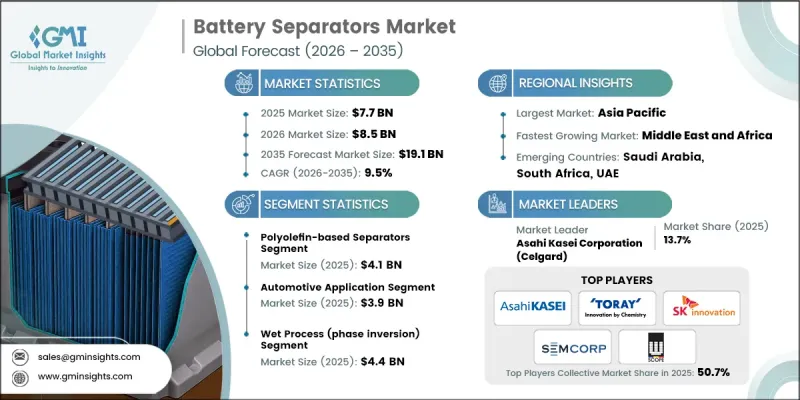
市場成長的驅動力來自於電動車、家用電子電器和工業應用領域對高性能、安全儲能解決方案日益成長的需求。電池隔膜作為一種薄膜,能夠防止正負極之間直接接觸,同時允許離子在正負極之間流動,從而確保安全運行並防止可能導致過熱或電池故障的短路。這些隔膜通常由聚乙烯、聚丙烯和複合材料等聚合物材料製成,旨在維持鋰離子電池、鉛酸電池和鎳氫電池的熱穩定性、耐化學性和機械強度。採用陶瓷塗層和奈米結構的高級隔膜可提高熱穩定性和電解潤濕性,而超薄設計則可降低內阻,從而在不影響安全性的前提下實現更高的輸出功率。對高能量密度電池、快速充電功能和軟性穿戴應用的需求不斷成長,進一步加速了全球技術的進步和應用。
| 市場範圍 | |
|---|---|
| 開始年份 | 2025 |
| 預測期 | 2026-2035 |
| 上市時的市場規模 | 77億美元 |
| 預測金額 | 191億美元 |
| 複合年成長率 | 9.5% |
預計到2025年,聚烯隔膜市場規模將達41億美元,優勢在於價格實惠且化學穩定性佳。同時,由於陶瓷塗層隔膜和聚合物塗層隔膜具有更佳的熱保護性能和更高的安全性,市場需求也不斷成長。芳香聚醯胺和不織布隔膜因其優異的性能和長壽命,在高性能電池中的應用日益廣泛。靜電紡絲隔膜作為尖端材料,正逐漸成為支持高能量密度、快速充電和軟性電池應用的新興材料。
預計到2025年,鋰離子電池隔膜市場規模將達到10億美元,反映出其在電動車、能源儲存系統和家用電子電器的廣泛應用。鉛酸電池隔膜因其成本效益和可靠的性能,在汽車起動電池和工業備用電源應用中仍然至關重要。
受電動車普及、超級工廠建設、供應鏈重組以及政府主導的電池製造扶持政策等因素的推動,北美電池隔膜市場預計將從2025年的10億美元成長到2035年的27億美元。高安全性隔膜和全固體隔膜的研發正在將該地區打造成為下一代儲能解決方案的中心。
目錄
第1章:調查方法和範圍
第2章執行摘要
第3章業界考察
- 生態系分析
- 供應商情況
- 利潤率
- 每個階段增加的價值
- 影響價值鏈的因素
- 中斷
- 影響產業的因素
- 促進因素
- 消費者對富含膠原蛋白的機能性食品的興趣日益濃厚
- 原始人飲食法和生酮飲食法的傳播
- 對不含乳製品的蛋白質替代品的需求
- 產業潛在風險與挑戰
- 高昂的生產和採購成本
- 它對素食者和純素食消費者的吸引力有限。
- 市場機遇
- 拓展至即飲飲品及便利商店領域
- 風味增強和掩味技術的創新
- 新興健康和保健市場的成長
- 促進因素
- 成長潛力分析
- 監理情勢
- 北美洲
- 歐洲
- 亞太地區
- 拉丁美洲
- 中東和非洲
- 波特五力分析
- PESTEL 分析
- 科技與創新趨勢
- 當前技術趨勢
- 新興技術
- 價格趨勢
- 按地區
- 來源
- 未來市場趨勢
- 專利趨勢
- 貿易統計(HS編碼)
- 主要進口國
- 主要出口國
- 永續性和環境方面
- 永續計劃
- 減少廢棄物策略
- 生產中的能源效率
- 具有環保意識的舉措
- 考慮碳足跡
第4章 競爭情勢
- 介紹
- 企業市佔率分析
- 按地區
- 北美洲
- 歐洲
- 亞太地區
- 拉丁美洲
- 中東和非洲
- 按地區
- 企業矩陣分析
- 主要市場公司的競爭分析
- 競爭定位矩陣
- 主要進展
- 併購
- 夥伴關係與合作
- 新產品發布
- 業務拓展計劃
第5章 市場估算與預測:依材料類型分類,2022-2035年
- 聚烯分離器
- 聚丙烯(PP)隔膜
- 聚乙烯(PE)隔膜
- 多層PP/PE/PP隔膜
- 陶瓷塗層隔膜
- 氧化鋁(Al₂O₃)塗層隔膜
- 二氧化矽(SiO2)塗層隔膜
- 氧化鋯(ZrO2)塗層隔膜
- 博米特塗層分離器
- 聚合物塗層隔膜
- PVDF塗層隔膜
- PMMA塗層隔膜
- PVA塗層隔膜
- 芳香聚醯胺分離器
- 芳香聚醯胺奈米纖維(ANF)隔膜
- 間位芳香聚醯胺不織布隔膜
- 對位芳香聚醯胺複合隔膜
- 不織布隔膜
- 纖維素基不織布隔膜
- PET不織布隔膜
- 玻璃纖維不織布隔膜
- 靜電紡絲分離器
- 奈米纖維靜電紡絲膜
- 複合靜電紡絲分離器
- 其他
第6章 市場估價與預測:依製造流程分類,2022-2035年
- 濕式製程(相變)
- 熱致相分離(TIPS)
- 非溶劑誘導相分離(NIPS)
- 乾法(拉伸)
- 單軸拉伸
- 雙軸拉伸
- 其他
第7章 市場估計與預測:依厚度分類,2022-2035年
- 超薄隔膜(小於12µm)
- 標準厚度隔膜(12–20µm)
- 厚隔膜(超過 20µm)
第8章 市場估計與預測:依電池化學品分類,2022-2035年
- 鋰離子電池隔膜
- 鉛酸電池隔板
- 鈉離子電池隔膜
- 全固態電池隔離膜
- 鋰硫電池隔離膜
第9章 市場估計與預測:依應用領域分類,2022-2035年
- 汽車應用
- 電池式電動車(BEV)
- 插電式混合動力汽車(PHEV)
- 混合動力電動車(HEV)
- 電動摩托車
- 電動商用車輛(巴士、卡車)
- 用於非公路用途的電動車
- 其他
- 家用電子電器
- 智慧型手機
- 筆記型電腦和平板電腦
- 穿戴式裝置(智慧型手錶、健身追蹤器)
- 行動電池
- 電子菸和電子煙設備
- 其他
- 能源儲存系統(ESS)
- 電網級儲能
- 住宅儲能
- 商用和工業儲能
- 公用事業規模儲能
- 其他
- 工業應用
- 物料搬運設備(堆高機)
- UPS(不斷電系統)
- 通訊備用電源
- 醫療設備
- 其他
- 電動工具和設備
- 無線電動工具
- 園藝設備
- 其他
- 船舶/航太
- 船舶電力推進系統
- 航太應用
- 其他
- 可再生能源的整合
- 太陽能發電+儲能系統
- 風力發電+儲能系統
- 其他
- 其他
第10章 市場估價與預測:依地區分類,2022-2035年
- 北美洲
- 美國
- 加拿大
- 歐洲
- 德國
- 英國
- 法國
- 西班牙
- 義大利
- 其他歐洲地區
- 亞太地區
- 中國
- 印度
- 日本
- 澳洲
- 韓國
- 亞太其他地區
- 拉丁美洲
- 巴西
- 墨西哥
- 阿根廷
- 其他拉丁美洲地區
- 中東和非洲
- 沙烏地阿拉伯
- 南非
- 阿拉伯聯合大公國
- 其他中東和非洲地區
第11章:公司簡介
- Asahi Kasei Corporation(Celgard)
- Toray Industries, Inc.
- SK Innovation Co., Ltd.(SK On)
- W-SCOPE Corporation
- Sumitomo Chemical Co., Ltd.
- Mitsubishi Chemical Group Corporation
- UBE Corporation
- ENTEK International LLC
- SEMCORP Co., Ltd.
- Arkema SA
- Solvay SA
- Hollingsworth &Vose Company
- Dreamweaver International
- Blue Solutions(Bollore Group)
- Cangzhou Mingzhu Plastic Co., Ltd.
- Xinxiang Zhongke Science &Technology Co., Ltd.
- Shenzhen Senior Technology Material Co., Ltd.
The Global Battery Separators Market was valued at USD 7.7 billion in 2025 and is estimated to grow at a CAGR of 9.5% to reach USD 19.1 billion by 2035.
Market growth is driven by the increasing demand for high-performance and safe energy storage solutions across electric vehicles, consumer electronics, and industrial applications. Battery separators act as thin membranes that allow ion flow between anode and cathode while preventing direct electrical contact, ensuring safe operation and preventing short circuits that could lead to overheating or battery failure. These separators are typically made from polymeric materials such as polyethylene, polypropylene, and composite blends, designed to maintain thermal stability, chemical resistance, and mechanical strength across lithium-ion, lead-acid, and nickel-metal hydride batteries. Advanced separators incorporating ceramic coatings or nanostructures enhance thermal stability and electrolyte wettability, while ultra-thin designs reduce internal resistance, enabling higher power output without compromising safety. The push for high-energy-density batteries, fast-charging capabilities, and flexible wearable applications is further accelerating technological advancements and adoption globally.
| Market Scope | |
|---|---|
| Start Year | 2025 |
| Forecast Year | 2026-2035 |
| Start Value | $7.7 Billion |
| Forecast Value | $19.1 Billion |
| CAGR | 9.5% |
The polyolefin-based separators segment reached USD 4.1 billion in 2025, offering affordability and chemical stability. Meanwhile, ceramic-coated and polymer-coated separators are gaining traction due to enhanced thermal protection and improved safety features. Aramid-based and nonwoven separators are increasingly used in high-performance batteries requiring long-lasting durability. Electrospun separators are emerging as advanced materials to support higher energy density, rapid charging, and flexible battery applications.
The lithium-ion battery separators segment generated USD 1 billion in 2025, reflecting their widespread use in electric vehicles, energy storage systems, and consumer electronics. Lead-acid battery separators remain essential for automotive starter batteries and industrial backup applications due to their cost-effectiveness and reliable performance.
North America Battery Separators Market is expected to grow from USD 1 billion in 2025 to USD 2.7 billion by 2035, driven by electric vehicle adoption, gigafactory development, supply chain restructuring, and government-backed initiatives supporting battery manufacturing. Research and development in high-safety and solid-state separators is positioning the region as a hub for next-generation energy storage solutions.
Prominent players in the Global Battery Separators Market include Asahi Kasei Corporation (Celgard), Toray Industries, Inc., SK Innovation Co., Ltd. (SK On), W-SCOPE Corporation, Sumitomo Chemical Co., Ltd., Mitsubishi Chemical Group Corporation, UBE Corporation, ENTEK International LLC, SEMCORP Co., Ltd., Arkema S.A., Solvay, Hollingsworth & Vose Company, Dreamweaver International, Blue Solutions (Bollore Group), Cangzhou Mingzhu Plastic Co., Ltd., Xinxiang Zhongke Science & Technology Co., Ltd., Shenzhen Senior Technology Material Co., Ltd. Key strategies employed by companies in the Global Battery Separators Market include investing in R&D to develop ultra-thin and high-safety separators, launching ceramic-coated and polymer-coated products, focusing on advanced lithium-ion and solid-state battery technologies, expanding manufacturing capacities through strategic partnerships and joint ventures, enhancing supply chain localization to ensure steady raw material availability, entering emerging markets with cost-effective solutions, providing technical support and training for battery manufacturers, integrating IoT-enabled monitoring for smart energy management, and promoting environmentally friendly and recyclable separator materials to align with sustainability trends.
Table of Contents
Chapter 1 Methodology & Scope
- 1.1 Market scope and definition
- 1.2 Research design
- 1.2.1 Research approach
- 1.2.2 Data collection methods
- 1.3 Data mining sources
- 1.3.1 Global
- 1.3.2 Regional/Country
- 1.4 Base estimates and calculations
- 1.4.1 Base year calculation
- 1.4.2 Key trends for market estimation
- 1.5 Primary research and validation
- 1.5.1 Primary sources
- 1.6 Forecast model
- 1.7 Research assumptions and limitations
Chapter 2 Executive Summary
- 2.1 Industry 360° synopsis
- 2.2 Key market trends
- 2.2.1 Material Type
- 2.2.2 Manufacturing Process
- 2.2.3 Thickness
- 2.2.4 Battery Chemistry
- 2.2.5 Application
- 2.2.6 Regional
- 2.3 TAM Analysis, 2026-2035
- 2.4 CXO perspectives: Strategic imperatives
- 2.5 Future outlook and strategic recommendations
Chapter 3 Industry Insights
- 3.1 Industry ecosystem analysis
- 3.1.1 Supplier landscape
- 3.1.2 Profit margin
- 3.1.3 Value addition at each stage
- 3.1.4 Factor affecting the value chain
- 3.1.5 Disruptions
- 3.2 Industry impact forces
- 3.2.1 Growth drivers
- 3.2.1.1 Rising consumer interest in collagen-rich functional nutrition
- 3.2.1.2 Increasing adoption of paleo and keto lifestyles
- 3.2.1.3 Demand for dairy-free protein alternatives
- 3.2.2 Industry pitfalls and challenges
- 3.2.2.1 High production and sourcing costs
- 3.2.2.2 Limited appeal among vegetarian and vegan consumers
- 3.2.3 Market opportunities
- 3.2.3.1 Expansion into ready-to-drink and convenience formats
- 3.2.3.2 Innovation in flavor enhancement and masking technologies
- 3.2.3.3 Growth in emerging health and wellness markets
- 3.2.1 Growth drivers
- 3.3 Growth potential analysis
- 3.4 Regulatory landscape
- 3.4.1 North America
- 3.4.2 Europe
- 3.4.3 Asia Pacific
- 3.4.4 Latin America
- 3.4.5 Middle East & Africa
- 3.5 Porter's analysis
- 3.6 PESTEL analysis
- 3.7 Technology and innovation landscape
- 3.7.1 Current technological trends
- 3.7.2 Emerging technologies
- 3.8 Price trends
- 3.8.1 By region
- 3.8.2 By source
- 3.9 Future market trends
- 3.10 Patent landscape
- 3.11 Trade statistics (HS code)
- 3.11.1 Major importing countries
- 3.11.2 Major exporting countries
- 3.12 Sustainability and environmental aspects
- 3.12.1 Sustainable practices
- 3.12.2 Waste reduction strategies
- 3.1.3 Energy efficiency in production
- 3.12.4 Eco-friendly initiatives
- 3.13 Carbon footprint consideration
Chapter 4 Competitive Landscape, 2025
- 4.1 Introduction
- 4.2 Company market share analysis
- 4.2.1 By region
- 4.2.1.1 North America
- 4.2.1.2 Europe
- 4.2.1.3 Asia Pacific
- 4.2.1.4 LATAM
- 4.2.1.5 MEA
- 4.2.1 By region
- 4.3 Company matrix analysis
- 4.4 Competitive analysis of major market players
- 4.5 Competitive positioning matrix
- 4.6 Key developments
- 4.6.1 Mergers & acquisitions
- 4.6.2 Partnerships & collaborations
- 4.6.3 New product launches
- 4.6.4 Expansion plans
Chapter 5 Market Estimates and Forecast, By Material Type, 2022-2035 (USD Billion) (Kilo Tons)
- 5.1 Key trends
- 5.2 Polyolefin-based separators
- 5.2.1 Polypropylene (PP) separators
- 5.2.2 Polyethylene (PE) separators
- 5.2.3 Multi-layer PP/PE/PP separators
- 5.3 Ceramic-coated separators
- 5.3.1 Alumina (Al2O3) coated separators
- 5.3.2 Silica (SiO2) coated separators
- 5.3.3 Zirconia (ZrO2) coated separators
- 5.3.4 Boehmite coated separators
- 5.4 Polymer-coated separators
- 5.4.1 PVDF coated separators
- 5.4.2 PMMA coated separators
- 5.4.3 PVA coated separators
- 5.5 Aramid-based separators
- 5.5.1 Aramid nanofiber (ANF) separators
- 5.5.2 Meta-aramid nonwoven separators
- 5.5.3 Para-aramid composite separators
- 5.6 Nonwoven separators
- 5.6.1 Cellulose-based nonwoven separators
- 5.6.2 PET nonwoven separators
- 5.6.3 Glass fiber nonwoven separators
- 5.7 Electrospun separators
- 5.7.1 Nanofiber electrospun membranes
- 5.7.2 Composite electrospun separators
- 5.8 Others
Chapter 6 Market Estimates and Forecast, By Manufacturing Process, 2022-2035 (USD Billion) (Kilo Tons)
- 6.1 Key trends
- 6.2 Wet process (phase inversion)
- 6.2.1 Thermally induced phase separation (TIPS)
- 6.2.2 Non-solvent induced phase separation (NIPS)
- 6.3 Dry process (stretching)
- 6.3.1 Uniaxial stretching
- 6.3.2 Biaxial stretching
- 6.4 Others
Chapter 7 Market Estimates and Forecast, By Thickness, 2022-2035 (USD Billion) (Kilo Tons)
- 7.1 Key trends
- 7.2 Ultra-thin separators (<12 µm)
- 7.3 Standard thickness separators (12-20 µm)
- 7.4 Thick separators (>20 µm)
Chapter 8 Market Estimates and Forecast, By Battery Chemistry, 2022-2035 (USD Billion) (Kilo Tons)
- 8.1 Key trends
- 8.2 Lithium-ion battery separators
- 8.3 Lead-acid battery separators
- 8.4 Sodium-ion battery separators
- 8.5 Solid-state battery separators
- 8.6 Lithium-sulfur battery separators
Chapter 9 Market Estimates and Forecast, By Application, 2022-2035 (USD Billion) (Kilo Tons)
- 9.1 Key trends
- 9.2 Automotive applications
- 9.2.1 Battery electric vehicles (BEV)
- 9.2.2 Plug-in hybrid electric vehicles (PHEV)
- 9.2.3 Hybrid electric vehicles (HEV)
- 9.2.4 Electric two-wheelers
- 9.2.5 Electric commercial vehicles (buses, trucks)
- 9.2.6 Electric off-highway vehicles
- 9.2.7 Others
- 9.3 Consumer electronics
- 9.3.1 Smartphones
- 9.3.2 Laptops and tablets
- 9.3.3 Wearables (smartwatches, fitness trackers)
- 9.3.4 Power banks
- 9.3.5 E-cigarettes and vaping devices
- 9.3.6 Others
- 9.4 Energy storage systems (ESS)
- 9.4.1 Grid-scale energy storage
- 9.4.2 Residential energy storage
- 9.4.3 Commercial and industrial (C&I) storage
- 9.4.4 Utility-scale storage
- 9.4.5 Others
- 9.5 Industrial applications
- 9.5.1 Material handling equipment (forklifts)
- 9.5.2 UPS (uninterruptible power supply)
- 9.5.3 Telecom backup power
- 9.5.4 Medical devices
- 9.5.5 Others
- 9.6 Power tools and equipment
- 9.6.1 Cordless power tools
- 9.6.2 Garden equipment
- 9.6.3 Others
- 9.7 Marine and aerospace
- 9.7.1 Electric marine propulsion
- 9.7.2 Aerospace applications
- 9.7.3 Others
- 9.8 Renewable energy integration
- 9.8.1 Solar + storage systems
- 9.8.2 Wind + storage systems
- 9.8.3 Others
- 9.9 Others
Chapter 10 Market Estimates and Forecast, By Region, 2022-2035 (USD Billion) (Kilo Tons)
- 10.1 Key trends
- 10.2 North America
- 10.2.1 U.S.
- 10.2.2 Canada
- 10.3 Europe
- 10.3.1 Germany
- 10.3.2 UK
- 10.3.3 France
- 10.3.4 Spain
- 10.3.5 Italy
- 10.3.6 Rest of Europe
- 10.4 Asia Pacific
- 10.4.1 China
- 10.4.2 India
- 10.4.3 Japan
- 10.4.4 Australia
- 10.4.5 South Korea
- 10.4.6 Rest of Asia Pacific
- 10.5 Latin America
- 10.5.1 Brazil
- 10.5.2 Mexico
- 10.5.3 Argentina
- 10.5.4 Rest of Latin America
- 10.6 Middle East and Africa
- 10.6.1 Saudi Arabia
- 10.6.2 South Africa
- 10.6.3 UAE
- 10.6.4 Rest of Middle East and Africa
Chapter 11 Company Profiles
- 11.1 Asahi Kasei Corporation (Celgard)
- 11.2 Toray Industries, Inc.
- 11.3 SK Innovation Co., Ltd. (SK On)
- 11.4 W-SCOPE Corporation
- 11.5 Sumitomo Chemical Co., Ltd.
- 11.6 Mitsubishi Chemical Group Corporation
- 11.7 UBE Corporation
- 11.8 ENTEK International LLC
- 11.9 SEMCORP Co., Ltd.
- 11.10 Arkema S.A.
- 11.11 Solvay S.A.
- 11.12 Hollingsworth & Vose Company
- 11.13 Dreamweaver International
- 11.14 Blue Solutions (Bollore Group)
- 11.15 Cangzhou Mingzhu Plastic Co., Ltd.
- 11.16 Xinxiang Zhongke Science & Technology Co., Ltd.
- 11.17 Shenzhen Senior Technology Material Co., Ltd.

 電池隔膜市場報告:趨勢、預測和競爭分析(至2035年)
 電池隔膜市場:2026-2032年全球市場預測(按材料、電池化學成分、電芯類型、技術和最終用途行業分類)
 水泥分離器市場規模、佔有率和成長分析:按產品類型、產量、產能、應用、最終用途產業和地區分類-2026-2033年產業預測
 全球電池隔膜市場(至2040年):產業趨勢與預測
 全球電池隔膜市場規模、佔有率、趨勢和成長分析報告(2026-2034年)
 2026年全球工業分離器市場報告2026年全球電池隔離膜市場報告
 電池隔膜市場 - 全球產業規模、佔有率、趨勢、機會及預測(按類型、材料、最終用途產業、地區和競爭格局分類,2021-2031年)軟包電池用鋁塑薄膜市場:按產品類型、阻隔材料、厚度範圍、製造流程和應用分類的全球預測(2026-2032年)鋰陶瓷電池模組市場(按產品類型、應用和銷售管道),全球預測(2026-2032年)