


 |
市場調查報告書
商品編碼
1998682
異位性皮膚炎治療市場:市場機會、成長要素、產業趨勢分析及2026-2035年預測Atopic Dermatitis Drugs Market Opportunity, Growth Drivers, Industry Trend Analysis, and Forecast 2026 - 2035 |
||||||

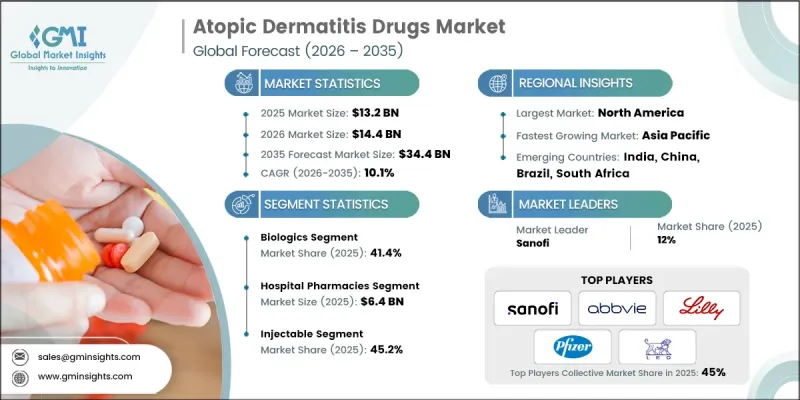
2025 年全球異位性皮膚炎治療市場價值 132 億美元,預計到 2035 年將達到 344 億美元,年複合成長率為 10.1%。
異位性皮膚炎治療市場正經歷強勁成長,這主要得益於這種慢性發炎性皮膚病在全球日益普遍的盛行率以及創新治療方法的快速發展。異位性皮膚炎持續影響越來越多的兒童和成人患者,因此對有效、長期的治療方案的需求也持續成長。製藥公司正積極投資研發,以推出能夠改善症狀控制和疾病管理的先進治療方法。皮膚科治療領域的持續創新拓寬了可用的治療方法範圍,使醫生能夠根據每位患者的個別需求制定治療策略。此外,新型局部和全身療法的出現正在改變輕度、中度和重度異位性皮膚炎的治療框架。隨著這些新治療方法在臨床實踐中廣受認可,並在真實臨床環境中展現出良好的長期療效,其應用範圍也不斷擴大。多樣化的治療類別和給藥途徑的日益豐富度正在增強治療格局,預計將在未來幾年內支撐異位性皮膚炎治療市場的持續成長。
| 市場範圍 | |
|---|---|
| 開始年份 | 2025 |
| 預測期 | 2026-2035 |
| 上市時的市場規模 | 132億美元 |
| 預測金額 | 344億美元 |
| 複合年成長率 | 10.1% |
異位性皮膚炎藥物是專門用於控制異位性皮膚炎症狀和延緩其進展的藥物。異位性皮膚炎是一種慢性皮膚病,其特徵是發炎、持續性搔癢和乾燥。這些藥物旨在減輕發炎反應,緩解症狀加重帶來的不適,並長期維持皮膚健康。治療方案旨在透過標靶治療機制來控制症狀、預防疾病復發和進行長期疾病管理。
到2025年,生物製劑將佔據41.4%的市場。生物製劑療法是中重度異位性皮膚炎患者的重要治療選擇,因為它們能夠針對與疾病相關的特定發炎路徑進行高度標靶干預。這些療法透過選擇性地調節參與慢性發炎的關鍵免疫訊號分子來發揮作用。因此,生物製藥可以實現持續的症狀控制,減少疾病復發,並顯著改善皮膚健康和患者的生活品質。與廣泛抑制免疫系統不同,生物製劑能夠精準靶向發炎的分子因子,從而提高臨床療效,同時確保需要長期治療的患者的安全性。
預計到2025年,注射劑市佔率將達到45.2%。該領域的成長與先進注射療法的日益普及密切相關,這些療法專注於調節疾病進展中涉及的特定發炎路徑。標靶治療方案的擴展顯著促進了中度至重度症狀患者對注射劑的接受度。此外,主要醫藥市場的監管機構已核准多種注射療法用於治療異位性皮膚炎。這些監管核准正在加速新治療方法在臨床實踐中的應用,為醫療專業人員提供更廣泛的有效治療選擇,並促進整個醫療系統的普及。
預計到2025年,北美異位性皮膚炎治療市場將佔據顯著佔有率。該地區憑藉其先進的皮膚科醫療基礎設施、便捷獲取最新治療方案以及創新治療方法(包括生物製藥和靶向免疫調節藥物)的快速引入,保持著強勁的全部區域地位。完善的法規結構確保了新皮膚科治療方法的評估和核准的一致性,同時維持了高標準的臨床安全性。支撐該地區市場主導地位的關鍵因素之一是異位性皮膚炎在人群中的高發病率,這持續推動對先進治療方案的需求。中重度患者越來越傾向於尋求能夠更有效地控制症狀和進行長期疾病管理的全新治療方案,這進一步增強了該地區的市場前景。
目錄
第1章:調查方法
- 研究途徑
- 品質改進計劃
- GMI人工智慧政策和資料完整性計劃
- 資訊來源一致性通訊協定
- GMI人工智慧政策和資料完整性計劃
- 調查過程和可靠性評分
- 調查過程的組成部分
- 評分組成部分
- 數據收集
- 主要來源部分列表
- 資料探勘資訊來源
- 付費資訊來源
- 區域資訊來源
- 付費資訊來源
- 基本估算和計算方法
- 每種方法中基準年的計算
- 預測模型
- 量化市場影響分析
- 生長參數對預測的數學影響
- 量化市場影響分析
- 關於調查透明度的補充信息
- 資訊來源歸屬框架
- 品質保證指標
- 對信任的承諾
第2章執行摘要
第3章業界考察
- 生態系分析
- 影響產業的因素
- 促進因素
- 異位性皮膚炎盛行率增加
- 生物製藥治療的進展
- 提高對皮膚病護理的認知和獲取途徑
- 加強臨床試驗流程
- 產業潛在風險與挑戰
- 生物製藥和先進治療方法高成本
- 副作用和用藥依從性問題
- 市場機遇
- 局部用藥的創新和非類固醇療法的擴展
- 促進因素
- 成長潛力分析
- 監理情勢
- 技術趨勢(基於初步調查)
- 目前技術
- 新興技術
- 未來市場趨勢(基於初步研究)
- 管道分析(基於初步調查)
- 人工智慧和生成式人工智慧對市場的影響
- 波特五力分析
- PESTEL 分析
第4章 競爭情勢
- 介紹
- 企業市佔率分析
- 企業矩陣分析
- 主要市場公司的競爭分析
- 競爭定位矩陣
- 主要進展
- 併購
- 夥伴關係與合作
- 新產品發布
- 業務拓展計劃
第5章 市場估計與預測:依藥物類別分類,2022-2035年
- 皮質類固醇
- Calcineurin抑制劑
- 生物製藥
- 磷酸二酯酶-4 (PDE-4) 抑制劑
- 其他藥物分類
第6章 市場估計與預測:依給藥途徑分類,2022-2035年
- 外用
- 口服
- 注射藥物
第7章 市場估計與預測:依病患群體分類,2022-2035年
- 兒童
- 成人
第8章 市場估算與預測:依通路分類,2022-2035年
- 醫院藥房
- 零售藥房
- 電子商務
第9章 市場估計與預測:依地區分類,2022-2035年
- 北美洲
- 美國
- 加拿大
- 歐洲
- 德國
- 英國
- 法國
- 西班牙
- 義大利
- 荷蘭
- 亞太地區
- 中國
- 日本
- 印度
- 澳洲
- 韓國
- 拉丁美洲
- 巴西
- 墨西哥
- 阿根廷
- 中東和非洲
- 南非
- 沙烏地阿拉伯
- 阿拉伯聯合大公國
第10章:公司簡介
- AbbVie
- Arcutis Biotherapeutics
- Chugai Pharmaceutical
- Eli Lilly and Company
- Galderma Laboratories
- Incyte Corporation
- Leo Pharma
- Maruho
- Otsuka Pharmaceutical
- Pfizer
- Sanofi
- Viatris
The Global Atopic Dermatitis Drugs Market was valued at USD 13.2 billion in 2025 and is estimated to grow at a CAGR of 10.1% to reach USD 34.4 billion by 2035.
The market for atopic dermatitis therapeutics is experiencing strong expansion, largely driven by the increasing global prevalence of this chronic inflammatory skin disorder and the rapid development of innovative treatment options. Atopic dermatitis continues to affect a growing number of individuals across both pediatric and adult populations, creating sustained demand for effective long-term treatment solutions. Pharmaceutical companies are actively investing in research and development to introduce advanced therapies capable of delivering improved symptom control and disease management. Continuous innovation in dermatology treatments is expanding the range of available therapeutic approaches, allowing physicians to tailor treatment strategies to individual patient needs. In addition, emerging topical and systemic therapies are contributing to the transformation of treatment frameworks for mild, moderate, and severe disease stages. As new therapies gain wider clinical acceptance and demonstrate favorable long-term outcomes in real-world use, their adoption continues to increase. The growing availability of diverse treatment classes and administration routes is helping to strengthen the therapeutic landscape and is expected to support sustained growth in the atopic dermatitis drugs market over the coming years.
| Market Scope | |
|---|---|
| Start Year | 2025 |
| Forecast Year | 2026-2035 |
| Start Value | $13.2 Billion |
| Forecast Value | $34.4 Billion |
| CAGR | 10.1% |
Atopic dermatitis drugs are pharmaceutical therapies developed to manage the symptoms and progression of atopic dermatitis, a chronic skin condition characterized by inflammation, persistent itching, and dryness. These medications aim to reduce inflammatory responses, relieve discomfort associated with flare-ups, and help maintain a healthy skin condition over time. Treatment approaches are designed to control symptoms, prevent disease recurrence, and support long-term disease management through targeted therapeutic mechanisms.
The biologics segment held a 41.4% share in 2025. Biologic therapies have become an important treatment option for patients experiencing moderate to severe disease conditions because they provide highly targeted intervention within specific inflammatory pathways associated with atopic dermatitis. These therapies act by selectively regulating key immune signaling molecules that contribute to chronic inflammation. As a result, biologics can deliver sustained symptom control, reduce the frequency of disease flare-ups, and significantly improve skin health and patient quality of life. Their ability to target precise molecular drivers of inflammation rather than suppressing the immune system broadly has strengthened their clinical effectiveness while supporting favorable long-term safety outcomes for patients requiring ongoing treatment.
The injectable segment generated 45.2% share in 2025. Growth in this segment is closely linked to the increasing availability of advanced injectable therapies that focus on regulating specific inflammatory pathways involved in disease progression. The expansion of targeted treatment options has contributed significantly to the adoption of injectable medications for patients with moderate to severe forms of the condition. In addition, regulatory authorities across major pharmaceutical markets have granted approvals for several injectable therapies intended for the management of atopic dermatitis. These regulatory approvals have accelerated the introduction of new treatments into clinical practice, allowing healthcare providers to access a broader selection of effective therapeutic solutions and increasing adoption across healthcare systems.
North America Atopic Dermatitis Drugs Market held a significant share in 2025. The region maintains a strong position due to its advanced dermatology care infrastructure, high accessibility to modern treatment options, and rapid adoption of innovative therapies, including biologics and targeted immunomodulatory medications. Well-established regulatory frameworks across the region ensure consistent evaluation and approval of new dermatology therapies while maintaining high clinical safety standards. A major factor supporting regional market leadership is the substantial prevalence of atopic dermatitis among the population, which continues to drive demand for advanced treatment solutions. Patients experiencing moderate to severe disease conditions are increasingly seeking newer therapeutic options capable of providing more effective symptom control and long-term disease management, further strengthening the regional market outlook.
Prominent companies operating in the Global Atopic Dermatitis Drugs Market include Sanofi, Pfizer, AbbVie, Eli Lilly and Company, Leo Pharma, Galderma Laboratories, Incyte Corporation, Otsuka Pharmaceutical, Maruho, Arcutis Biotherapeutics, Chugai Pharmaceutical, and Viatris. Companies competing in the Global Atopic Dermatitis Drugs Market are adopting multiple strategic initiatives to reinforce their market presence and strengthen competitive positioning. Major pharmaceutical manufacturers are prioritizing extensive research and development efforts aimed at discovering innovative therapies that target specific immune pathways associated with inflammatory skin diseases. Many organizations are also investing in the development of advanced biologic treatments, targeted immunomodulators, and improved topical formulations to enhance therapeutic effectiveness and patient outcomes. Strategic collaborations with biotechnology firms and research institutions are accelerating drug discovery and clinical development activities. In addition, companies are expanding their product pipelines, pursuing regulatory approvals across global markets, and strengthening commercial distribution networks. Continuous investment in clinical trials, technological innovation, and global market expansion remains essential for sustaining long-term growth within the atopic dermatitis drugs market.
Table of Contents
Chapter 1 Research Methodology
- 1.1 Research approach
- 1.2 Quality commitments
- 1.2.1 GMI AI policy & data integrity commitment
- 1.2.1.1 Source consistency protocol
- 1.2.1 GMI AI policy & data integrity commitment
- 1.3 Research trail & confidence scoring
- 1.3.1 Research trail components
- 1.3.2 Scoring components
- 1.4 Data collection
- 1.4.1 Partial list of primary sources
- 1.5 Data mining sources
- 1.5.1 Paid sources
- 1.5.1.1 Sources, by region
- 1.5.1 Paid sources
- 1.6 Base estimates and calculations
- 1.6.1 Base year calculation for any one approach
- 1.7 Forecast model
- 1.7.1 Quantified market impact analysis
- 1.7.1.1 Mathematical impact of growth parameters on forecast
- 1.7.1 Quantified market impact analysis
- 1.8 Research transparency addendum
- 1.8.1 Source attribution framework
- 1.8.2 Quality assurance metrics
- 1.8.3 Our commitment to trust
Chapter 2 Executive Summary
- 2.1 Industry 360° synopsis
- 2.2 Key market trends
- 2.2.1 Drug class trends
- 2.2.2 Route of administration trends
- 2.2.3 Patient demographics trends
- 2.2.4 Distribution channel trends
- 2.3 CXO perspectives: Strategic imperatives
Chapter 3 Industry Insights
- 3.1 Industry ecosystem analysis
- 3.2 Industry impact forces
- 3.2.1 Growth drivers
- 3.2.1.1 Rising prevalence of atopic dermatitis
- 3.2.1.2 Advancements in biologic therapies
- 3.2.1.3 Growing awareness and access to dermatological care
- 3.2.1.4 Strengthening clinical pipeline
- 3.2.2 Industry pitfalls and challenges
- 3.2.2.1 High cost of biologic and advanced therapies
- 3.2.2.2 Side effects and compliance issues
- 3.2.3 Market opportunity
- 3.2.3.1 Expansion of topical innovation and non-steroidal therapies
- 3.2.1 Growth drivers
- 3.3 Growth potential analysis
- 3.4 Regulatory landscape
- 3.5 Technological landscape (Driven by Primary Research)
- 3.5.1 Current technologies
- 3.5.2 Emerging technologies
- 3.6 Future market trends (Driven by Primary Research)
- 3.7 Pipeline analysis (Driven by Primary Research)
- 3.8 Impact of AI and generative AI on the market
- 3.9 Porter's analysis
- 3.10 PESTEL analysis
Chapter 4 Competitive Landscape, 2025
- 4.1 Introduction
- 4.2 Company market share analysis
- 4.3 Company matrix analysis
- 4.4 Competitive analysis of major market players
- 4.5 Competitive positioning matrix
- 4.6 Key developments
- 4.6.1 Merger and acquisition
- 4.6.2 Partnership and collaboration
- 4.6.3 New product launches
- 4.6.4 Expansion plans
Chapter 5 Market Estimates and Forecast, By Drug Class, 2022 - 2035 ($ Bn)
- 5.1 Key trends
- 5.2 Corticosteroids
- 5.3 Calcineurin inhibitors
- 5.4 Biologics
- 5.5 Phosphodiesterase-4 (PDE-4) inhibitors
- 5.6 Other drug classes
Chapter 6 Market Estimates and Forecast, By Route of Administration, 2022 - 2035 ($ Bn)
- 6.1 Key trends
- 6.2 Topical
- 6.3 Oral
- 6.4 Injectable
Chapter 7 Market Estimates and Forecast, By Patient Demographics, 2022 - 2035 ($ Bn)
- 7.1 Key trends
- 7.2 Pediatric
- 7.3 Adults
Chapter 8 Market Estimates and Forecast, By Distribution Channel, 2022 - 2035 ($ Bn)
- 8.1 Key trends
- 8.2 Hospital pharmacies
- 8.3 Retail pharmacies
- 8.4 E-commerce
Chapter 9 Market Estimates and Forecast, By Region, 2022 - 2035 ($ Bn)
- 9.1 Key trends
- 9.2 North America
- 9.2.1 U.S.
- 9.2.2 Canada
- 9.3 Europe
- 9.3.1 Germany
- 9.3.2 UK
- 9.3.3 France
- 9.3.4 Spain
- 9.3.5 Italy
- 9.3.6 Netherlands
- 9.4 Asia Pacific
- 9.4.1 China
- 9.4.2 Japan
- 9.4.3 India
- 9.4.4 Australia
- 9.4.5 South Korea
- 9.5 Latin America
- 9.5.1 Brazil
- 9.5.2 Mexico
- 9.5.3 Argentina
- 9.6 Middle East and Africa
- 9.6.1 South Africa
- 9.6.2 Saudi Arabia
- 9.6.3 UAE
Chapter 10 Company Profiles
- 10.1 AbbVie
- 10.2 Arcutis Biotherapeutics
- 10.3 Chugai Pharmaceutical
- 10.4 Eli Lilly and Company
- 10.5 Galderma Laboratories
- 10.6 Incyte Corporation
- 10.7 Leo Pharma
- 10.8 Maruho
- 10.9 Otsuka Pharmaceutical
- 10.10 Pfizer
- 10.11 Sanofi
- 10.12 Viatris

 生物相似藥研發管線市場分析:依產品類型、服務、技術、應用及地區分類
 全球卒中流行病學分析與預測:2026 年
 犬異位性皮膚炎市場:2026-2032年全球市場預測(依產品類型、給藥途徑、適應症、年齡層和分銷管道分類)異位性皮膚炎治療市場:2026-2032年全球市場預測(按藥物類別、給藥途徑、給藥方法、患者年齡層、最終用戶和分銷管道分類)
 犬異位性皮膚炎市場規模、佔有率和成長分析:按治療方法、給藥途徑、分銷管道、疾病嚴重程度、最終用戶和地區分類-2026-2033年產業預測
 異位性皮膚炎臨床試驗市場:分析與預測(至 2035 年)-按類型、產品類型、服務、技術、應用、最終用戶、解決方案、實施方式和階段分類
 犬異位性皮膚炎市場-全球產業規模、佔有率、趨勢、機會、預測:按產品、給藥途徑、分銷管道、地區和競爭格局分類,2021-2031年
 杜必康市場規模、佔有率和趨勢分析報告:按類型、分銷管道、地區和細分市場預測(2026-2033 年)
 犬異位性皮膚炎市場報告:按藥物類別、給藥途徑、分銷管道和地區分類(2026-2034 年)異位性皮膚炎市場:2026-2032年全球市場預測(依產品、給藥途徑、嚴重程度、病患細分及分銷管道分類)