

 |
市場調查報告書
商品編碼
1998674
功率半導體市場機會、成長要素、產業趨勢分析及2026-2035年預測。Power Semiconductor Market Opportunity, Growth Drivers, Industry Trend Analysis, and Forecast 2026 - 2035 |
||||||

預計到 2025 年,全球功率半導體市場規模將達到 557 億美元,並預計以 5.8% 的複合年成長率成長,到 2035 年達到 975 億美元。
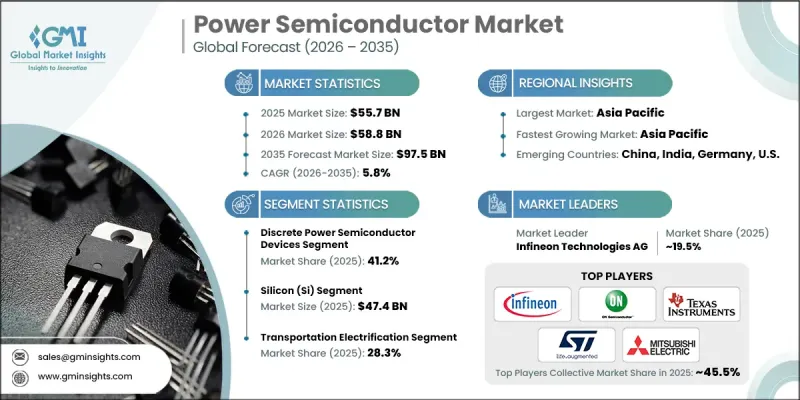
隨著眾多技術主導產業對先進電力電子技術的依賴日益加深,功率半導體市場持續成長。交通運輸電氣化的推進、對高效電源管理日益成長的需求以及數位基礎設施的擴展,都顯著推動了市場成長。節能電子系統的日益普及和高性能電源管理技術的進步,進一步強化了市場需求。此外,新一代半導體材料的持續研發,也為提升各種應用領域的效率和性能提供了支持。各公司正致力於提高產能並增強供應鏈韌性,以滿足全球對功率半導體日益成長的需求。隨著能源效率成為世界各國政府和產業的首要任務,功率半導體技術正成為現代電子系統不可或缺的一部分。預計這些因素將共同推動全球功率半導體市場在預測期內保持持續成長。
| 市場範圍 | |
|---|---|
| 開始年份 | 2025 |
| 預測期 | 2026-2035 |
| 初始市場規模 | 557億美元 |
| 預計金額 | 975億美元 |
| 複合年成長率 | 5.8% |
交通運輸系統的快速電氣化持續推動功率半導體市場的成長。汽車生產中對先進電力電子技術的日益依賴,顯著提升了對高性能半導體元件的需求。這些元件支援現代車輛架構中的高效率能量轉換、電壓調節和電源管理。同時,工業設施正朝著先進的自動化技術發展,旨在提高營運效率並降低能耗。全球數位基礎設施和運算設施的擴展也增加了對能夠支援高效能電子系統的可靠電源管理解決方案的需求。先進充電基礎設施的建設和能源系統的改進,進一步促進了半導體的應用。
預計到2025年,離散式功率半導體元件市場佔有率將達到41.2%。由於單一半導體元件在多種電子系統中的廣泛應用,該細分市場保持著強勁的地位。分立式裝置憑藉其成本效益、操作柔軟性以及對各種電源管理需求的適應性,仍被廣泛應用。它們能夠在眾多電子應用中執行關鍵的開關和電源控制功能,從而支撐了消費和工業領域的穩定需求。此外,離散半導體解決方案的擴充性使製造商能夠輕鬆地將其整合到各種電力電子架構中。隨著工業領域對需要可靠電源調節的先進電氣系統的持續採用,預計在整個預測期內,離散式功率半導體裝置的重要性將保持在高位。
預計到2025年,矽半導體市場規模將達474億美元。憑藉成熟的製造基礎設施和廣泛的市場覆蓋,矽基半導體技術在行業中持續保持強勁地位。圍繞矽元件建立的完善生產生態系統使製造商能夠在確保可靠性能標準的同時,實現成本效益。矽功率元件廣泛應用於各種需要穩定功率轉換和電壓管理的電子系統。悠久的工業應用歷史、標準化的設計框架以及龐大的供應商網路,共同推動了全球半導體市場需求的持續成長。因此,儘管其他半導體技術不斷湧現,矽仍然是功率半導體市場的核心材料。
預計到2025年,北美功率半導體市佔率將達到21.9%。該地區持續穩定成長,這主要得益於各行業電氣化舉措的推進和能源效率要求的不斷提高。基礎設施現代化和向更先進電力系統的轉型,也推動了該地區對精密半導體元件需求的成長。工商業企業正積極投資於旨在提升電源管理和最佳化能源消耗的技術。此外,數位生態系統的擴展和對先進電子系統的日益依賴,也持續推動北美地區的半導體需求。隨著各行業致力於減少能源損耗和提高營運效率,先進功率電子技術的整合在該地區的技術格局中正變得日益重要。
目錄
第1章:調查方法和範圍
第2章執行摘要
第3章業界考察
- 生態系分析
- 供應商情況
- 利潤率
- 成本結構
- 每個階段增加的價值
- 影響價值鏈的因素
- 中斷
- 影響產業的因素
- 促進因素
- 電動車的快速普及增加了對IGBT和SiC的需求。
- 工業自動化的發展正在推動電源模組的需求成長。
- 能源效率法規要求採用先進的電力電子技術。
- 資料中心的電源最佳化導致 MOSFET 功耗增加。
- 快速充電基礎設施的擴展正在推動對寬能隙半導體的需求。
- 產業潛在風險與挑戰
- SiC和GaN元件的製造成本高昂
- 供應鏈中對數量有限的晶圓供應商的依賴
- 市場機遇
- 在800V電動車平台中採用SiC
- 智慧電網的升級改造增加了對高功率分立元件的需求。
- 促進因素
- 成長潛力分析
- 監理情勢
- 北美洲
- 歐洲
- 亞太地區
- 拉丁美洲
- 中東和非洲
- 波特的分析
- PESTEL 分析
- 科技與創新趨勢
- 當前技術趨勢
- 新興技術
- 價格趨勢
- 按地區
- 依產品
- 定價策略
- 新興經營模式
- 合規要求
- 專利和智慧財產權分析
- 地緣政治和貿易趨勢
第4章 競爭情勢
- 介紹
- 企業市佔率分析
- 按地區
- 北美洲
- 歐洲
- 亞太地區
- 拉丁美洲
- 中東和非洲
- 市場集中度分析
- 按地區
- 主要企業的競爭標竿分析
- 財務績效比較
- 銷售量
- 利潤率
- 研究與開發
- 產品系列比較
- 產品線寬度
- 科技
- 創新
- 區域擴張比較
- 全球擴張分析
- 服務網路覆蓋
- 按地區分類的市場滲透率
- 競爭定位矩陣
- 領導者
- 挑戰者
- 追蹤者
- 小眾玩家
- 戰略展望矩陣
- 財務績效比較
- 主要進展
- 併購
- 夥伴關係與合作
- 技術進步
- 擴張和投資策略
- 數位轉型計劃
- 新興競爭對手和Start-Ups競爭對手的發展趨勢
第5章 市場估算與預測:依產品類型分類,2022-2035年
- 分離式功率半導體裝置
- 分離式功率電晶體
- 分立式 MOSFET
- 離散式IGBT
- 其他分立式功率電晶體
- 分離式功率二極體和整流器
- 整流二極體(PN結)
- 肖特基勢壘二極體
- 高速和超高速恢復二極體
- 分離式閘流體和交流功率控制裝置
- 可控制矽/閘流體
- 三端雙向可控矽開關和其他交流電源控制裝置
- 分離式功率電晶體
- 電源模組
- IGBT模組
- MOSFET模組
- 二極體和閘流體模組
- 混合和混合技術模組
- 智慧型電源模組(IPM)
- 功率積體電路(功率IC)
- DC-DC轉換器積體電路
- AC-DC控制器和轉換器IC
- 閘極驅動器積體電路
- 電源管理積體電路(PMIC)
- 馬達控制和驅動積體電路
第6章 市場估算與預測:依材料類型分類,2022-2035年
- 矽(Si)
- 碳化矽(SiC)
- 氮化鎵(GaN)
第7章 市場估計與預測:依應用領域分類,2022-2035年
- 交通運輸電氣化
- 發電、輸電和配電基礎設施
- 工業製造和自動化
- 消費者使用
- 資訊通訊技術基礎設施
- 商業建築和基礎設施
- 航太、國防與航太
- 醫療設備
第8章 市場估計與預測:依地區分類,2022-2035年
- 北美洲
- 美國
- 加拿大
- 歐洲
- 德國
- 英國
- 法國
- 西班牙
- 義大利
- 俄羅斯
- 亞太地區
- 中國
- 印度
- 日本
- 澳洲
- 韓國
- 拉丁美洲
- 巴西
- 墨西哥
- 阿根廷
- 中東和非洲
- 南非
- 沙烏地阿拉伯
- 阿拉伯聯合大公國
第9章:公司簡介
- 主要企業
- Infineon Technologies AG
- STMicroelectronics NV
- Texas Instruments Inc.
- Mitsubishi Electric Corporation
- NXP Semiconductors NV
- Renesas Electronics Corporation
- 按地區分類的主要企業
- 北美洲
- ON Semiconductor(onsemi)
- Littelfuse, Inc.
- Powerex, Inc.
- 亞太地區
- ROHM Semiconductor
- Fuji Electric Co., Ltd.
- Toshiba Corporation(E-Devices)
- Shindengen Electric Manufacturing Co., Ltd.
- 歐洲
- Semikron International GmbH
- Vishay Intertechnology, Inc.
- 北美洲
- 特殊玩家/干擾者
- Wolfspeed, Inc.
The Global Power Semiconductor Market was valued at USD 55.7 billion in 2025 and is estimated to grow at a CAGR of 5.8% to reach USD 97.5 billion by 2035.
The power semiconductor market continues to gain momentum as multiple technology-driven industries increase their reliance on advanced power electronics. Growing electrification across transportation, the rising need for efficient power management, and the expanding footprint of digital infrastructure are contributing significantly to market expansion. Increased deployment of energy-efficient electronic systems and the evolution of high-performance power management technologies are further strengthening demand. Additionally, the continuous development of next-generation semiconductor materials is supporting improved efficiency and higher performance across a wide range of applications. Companies are also focusing on improving manufacturing capacity and strengthening supply chain resilience to support the increasing global demand for power semiconductors. As energy efficiency becomes a key priority for governments and industries worldwide, power semiconductor technologies are becoming essential components in modern electronic systems. These combined factors are expected to support the sustained growth of the global power semiconductor market over the forecast period.
| Market Scope | |
|---|---|
| Start Year | 2025 |
| Forecast Year | 2026-2035 |
| Start Value | $55.7 Billion |
| Forecast Value | $97.5 Billion |
| CAGR | 5.8% |
Rapid electrification of transportation systems continues to play a critical role in the growth of the power semiconductor market. Increasing vehicle production that relies on advanced power electronics has significantly strengthened demand for high-performance semiconductor components. These devices support efficient energy conversion, voltage regulation, and power management within modern vehicle architectures. At the same time, industrial facilities are increasingly transitioning toward advanced automation technologies designed to improve operational efficiency and reduce energy consumption. The expansion of digital infrastructure and computing facilities worldwide is also raising demand for reliable power management solutions capable of supporting high-performance electronic systems. The development of advanced charging infrastructure and improved energy systems further contributes to rising semiconductor adoption.
The discrete power semiconductor devices segment accounted for 41.2% share in 2025. This segment maintains a strong position due to the extensive use of individual semiconductor components across multiple electronic systems. Discrete devices remain widely adopted because they offer cost efficiency, operational flexibility, and design adaptability for various power management requirements. Their ability to perform essential switching and power control functions across numerous electronic applications supports consistent demand in both consumer-oriented and industrial environments. In addition, the scalability of discrete semiconductor solutions allows manufacturers to integrate them easily into a broad range of power electronics architectures. As industries continue to adopt advanced electrical systems requiring reliable power regulation, the importance of discrete power semiconductor devices is expected to remain significant throughout the forecast period.
The silicon segment reached USD 47.4 billion in 2025. Silicon-based semiconductor technologies continue to maintain a strong industry position due to their mature manufacturing infrastructure and widespread commercial availability. The well-established production ecosystem surrounding silicon devices allows manufacturers to achieve cost efficiency while maintaining reliable performance standards. Silicon power devices are widely implemented in various electronic systems requiring stable power conversion and voltage management. Their long history of industrial use, standardized design frameworks, and broad supplier network contribute to sustained demand in the global semiconductor landscape. As a result, silicon remains a core material within the power semiconductor market despite the emergence of alternative semiconductor technologies.
North America Power Semiconductor Market represented 21.9% share in 2025. The region continues to experience steady expansion due to increasing electrification initiatives and rising energy-efficiency requirements across multiple sectors. Infrastructure modernization efforts and the transition toward more advanced electrical systems are contributing to higher demand for sophisticated semiconductor components in the region. Businesses across industrial and commercial environments are investing in technologies designed to improve power management and optimize energy consumption. In addition, the expanding digital ecosystem and increasing reliance on advanced electronic systems continue to drive semiconductor demand across North America. As industries focus on improving operational efficiency while reducing energy losses, the integration of advanced power electronics is becoming increasingly important across the regional technology landscape.
Leading companies operating in the Global Power Semiconductor Market include Infineon Technologies AG, Mitsubishi Electric Corporation, STMicroelectronics NV, Fuji Electric Co., Ltd., Texas Instruments Inc., Renesas Electronics Corporation, Toshiba Corporation (E-Devices), NXP Semiconductors NV, ON Semiconductor (onsemi), Vishay Intertechnology, Inc., ROHM Semiconductor, Littelfuse, Inc., Wolfspeed, Inc., Semikron International GmbH, Powerex, Inc., and Shindengen Electric Manufacturing Co., Ltd. Companies participating in the Global Power Semiconductor Market are implementing several strategic initiatives to strengthen their competitive position and expand their technological capabilities. Many firms are investing heavily in research and development to create advanced semiconductor materials and improve device efficiency, power density, and thermal performance. Expanding manufacturing capacity and building vertically integrated production systems are also key priorities, enabling companies to secure supply stability and reduce dependence on external suppliers. Strategic collaborations and partnerships with technology developers and industrial customers help companies accelerate innovation and broaden application opportunities. Businesses are also focusing on strengthening regional manufacturing footprints to enhance supply chain resilience.
Table of Contents
Chapter 1 Methodology and Scope
- 1.1 Market scope and definition
- 1.2 Research design
- 1.2.1 Research approach
- 1.2.2 Data collection methods
- 1.3 Data mining sources
- 1.3.1 Global
- 1.3.2 Regional/Country
- 1.4 Base estimates and calculations
- 1.4.1 Base year calculation
- 1.4.2 Key trends for market estimation
- 1.5 Primary research and validation
- 1.5.1 Primary sources
- 1.6 Forecast model
- 1.7 Research assumptions and limitations
Chapter 2 Executive Summary
- 2.1 Industry 360° synopsis, 2022 - 2035
- 2.2 Key market trends
- 2.2.1 Product form trends
- 2.2.2 Material type trends
- 2.2.3 Application trends
- 2.2.4 Regional trends
- 2.3 TAM Analysis, 2026-2035
- 2.4 CXO perspectives: Strategic imperatives
- 2.4.1 Executive decision points
- 2.4.2 critical success factors
- 2.5 Future outlook and strategic recommendations
Chapter 3 Industry Insights
- 3.1 Industry ecosystem analysis
- 3.1.1 Supplier Landscape
- 3.1.2 Profit Margin
- 3.1.3 Cost structure
- 3.1.4 Value addition at each stage
- 3.1.5 Factor affecting the value chain
- 3.1.6 Disruptions
- 3.2 Industry impact forces
- 3.2.1 Growth drivers
- 3.2.1.1 Rapid EV adoption increasing IGBT and SiC demand
- 3.2.1.2 Industrial automation growth raising demand for power modules
- 3.2.1.3 Energy efficiency regulations mandating advanced power electronics
- 3.2.1.4 Data center power optimization increasing MOSFET consumption
- 3.2.1.5 Fast-charging infrastructure expansion boosting wide-bandgap semiconductors
- 3.2.2 Industry pitfalls and challenges
- 3.2.2.1 High manufacturing cost of SiC and GaN devices
- 3.2.2.2 Supply chain dependence on limited wafer suppliers
- 3.2.3 Market opportunities
- 3.2.3.1 Adoption of SiC in 800V electric vehicle platforms
- 3.2.3.2 Smart grid upgrades increasing demand for high-power discrete devices
- 3.2.1 Growth drivers
- 3.3 Growth potential analysis
- 3.4 Regulatory landscape
- 3.4.1 North America
- 3.4.2 Europe
- 3.4.3 Asia Pacific
- 3.4.4 Latin America
- 3.4.5 Middle East & Africa
- 3.5 Porter’s analysis
- 3.6 PESTEL analysis
- 3.7 Technology and Innovation landscape
- 3.7.1 Current technological trends
- 3.7.2 Emerging technologies
- 3.8 Price trends
- 3.8.1 By region
- 3.8.2 By product
- 3.9 Pricing Strategies
- 3.10 Emerging Business Models
- 3.11 Compliance Requirements
- 3.12 Patent and IP analysis
- 3.13 Geopolitical and trade dynamics
Chapter 4 Competitive Landscape, 2025
- 4.1 Introduction
- 4.2 Company market share analysis
- 4.2.1 By region
- 4.2.1.1 North America
- 4.2.1.2 Europe
- 4.2.1.3 Asia Pacific
- 4.2.1.4 Latin America
- 4.2.1.5 Middle East & Africa
- 4.2.2 Market concentration analysis
- 4.2.1 By region
- 4.3 Competitive benchmarking of key players
- 4.3.1 Financial performance comparison
- 4.3.1.1 Revenue
- 4.3.1.2 Profit margin
- 4.3.1.3 R&D
- 4.3.2 Product portfolio comparison
- 4.3.2.1 Product range breadth
- 4.3.2.2 Technology
- 4.3.2.3 Innovation
- 4.3.3 Geographic presence comparison
- 4.3.3.1 Global footprint analysis
- 4.3.3.2 Service network coverage
- 4.3.3.3 Market penetration by region
- 4.3.4 Competitive positioning matrix
- 4.3.4.1 Leaders
- 4.3.4.2 Challengers
- 4.3.4.3 Followers
- 4.3.4.4 Niche players
- 4.3.5 Strategic outlook matrix
- 4.3.1 Financial performance comparison
- 4.4 Key developments
- 4.4.1 Mergers and acquisitions
- 4.4.2 Partnerships and collaborations
- 4.4.3 Technological advancements
- 4.4.4 Expansion and investment strategies
- 4.4.5 Digital transformation initiatives
- 4.5 Emerging/ startup competitors landscape
Chapter 5 Market Estimates and Forecast, By Product Form, 2022 - 2035 (USD Million)
- 5.1 Key trends
- 5.2 Discrete power semiconductor devices
- 5.2.1 Discrete power transistors
- 5.2.1.1 Discrete MOSFETs
- 5.2.1.2 Discrete IGBTs
- 5.2.1.3 Other discrete power transistors
- 5.2.2 Discrete power diodes & rectifiers
- 5.2.2.1 Rectifier diodes (PN junction)
- 5.2.2.2 Schottky barrier diodes
- 5.2.2.3 Fast & ultra-fast recovery diodes
- 5.2.3 Discrete thyristors & AC power control devices
- 5.2.3.1 SCR / thyristors
- 5.2.3.2 TRIACs and other AC power control devices
- 5.2.1 Discrete power transistors
- 5.3 Power modules
- 5.3.1 IGBT modules
- 5.3.2 MOSFET modules
- 5.3.3 Diode & thyristor modules
- 5.3.4 Hybrid & mixed-technology modules
- 5.3.5 Intelligent power modules (IPMs)
- 5.4 Power Integrated Circuits (Power ICs)
- 5.4.1 DC-DC converter ICs
- 5.4.2 AC-DC controller & converter ICs
- 5.4.3 Gate driver ICs
- 5.4.4 Power management ICs (PMICs)
- 5.4.5 Motor control & driver ICs
Chapter 6 Market Estimates and Forecast, By Material Type, 2022 - 2035 (USD Million)
- 6.1 Key trends
- 6.2 Silicon (Si)
- 6.3 Silicon carbide (SiC)
- 6.4 Gallium nitride (GaN)
Chapter 7 Market Estimates and Forecast, By Application, 2022 - 2035 (USD Million)
- 7.1 Key trends
- 7.2 Transportation electrification
- 7.3 Power generation, transmission & distribution infrastructure
- 7.4 Industrial manufacturing & automation
- 7.5 Consumer
- 7.6 ICT infrastructure
- 7.7 Commercial buildings & infrastructure
- 7.8 Aerospace, defense & space
- 7.9 Healthcare equipment
Chapter 8 Market Estimates and Forecast, By Region, 2022 - 2035 (USD Million)
- 8.1 Key trends
- 8.2 North America
- 8.2.1 U.S.
- 8.2.2 Canada
- 8.3 Europe
- 8.3.1 Germany
- 8.3.2 UK
- 8.3.3 France
- 8.3.4 Spain
- 8.3.5 Italy
- 8.3.6 Russia
- 8.4 Asia Pacific
- 8.4.1 China
- 8.4.2 India
- 8.4.3 Japan
- 8.4.4 Australia
- 8.4.5 South Korea
- 8.5 Latin America
- 8.5.1 Brazil
- 8.5.2 Mexico
- 8.5.3 Argentina
- 8.6 Middle East and Africa
- 8.6.1 South Africa
- 8.6.2 Saudi Arabia
- 8.6.3 UAE
Chapter 9 Company Profiles
- 9.1 Global Key Players
- 9.1.1 Infineon Technologies AG
- 9.1.2 STMicroelectronics NV
- 9.1.3 Texas Instruments Inc.
- 9.1.4 Mitsubishi Electric Corporation
- 9.1.5 NXP Semiconductors NV
- 9.1.6 Renesas Electronics Corporation
- 9.2 Regional key players
- 9.2.1 North America
- 9.2.1.1 ON Semiconductor (onsemi)
- 9.2.1.2 Littelfuse, Inc.
- 9.2.1.3 Powerex, Inc.
- 9.2.2 Asia Pacific
- 9.2.2.1 ROHM Semiconductor
- 9.2.2.2 Fuji Electric Co., Ltd.
- 9.2.2.3 Toshiba Corporation (E-Devices)
- 9.2.2.4 Shindengen Electric Manufacturing Co., Ltd.
- 9.2.3 Europe
- 9.2.3.1 Semikron International GmbH
- 9.2.3.2 Vishay Intertechnology, Inc.
- 9.2.1 North America
- 9.3 Niche Players/Disruptors
- 9.3.1 Wolfspeed, Inc.

 功率半導體市場:2026-2032年全球市場預測(依元件類型、材料、電壓範圍、晶圓尺寸、終端用戶產業及通路分類)
 功率半導體市場預測至2034年-按裝置類型、材料類型、封裝類型、應用和地區分類的全球分析
 世界功率半導體市場、材料與技術
 新一代功率半導體市場-全球產業規模、佔有率、趨勢、機會與預測:按類型、組件、應用、地區和競爭格局分類,2021-2031年
 2026年第四代半導體全球市場報告
 2026-2030年全球功率半導體市場
 功率半導體市場報告:按組件、材料、終端應用產業和地區分類(2026-2034 年)
 高壓BCD製程市場報告:趨勢、預測與競爭分析(至2035年)高密度BCD製程市場報告:趨勢、預測與競爭分析(至2035年)
 NFC標籤IC市場分析及預測(至2035年):依類型、產品類型、服務、技術、組件、應用、形狀、材質、最終用戶及功能分類