


 |
市場調查報告書
商品編碼
1998663
男性應力性尿失禁市場機會、成長促進因素、產業趨勢分析及預測(2026-2035年)Male Stress Urinary Incontinence Market Opportunity, Growth Drivers, Industry Trend Analysis, and Forecast 2026 - 2035 |
||||||

預計到 2025 年,全球男性應力性尿失禁市場價值將達到 8.347 億美元,年複合成長率為 6.7%,到 2035 年將達到 16 億美元。
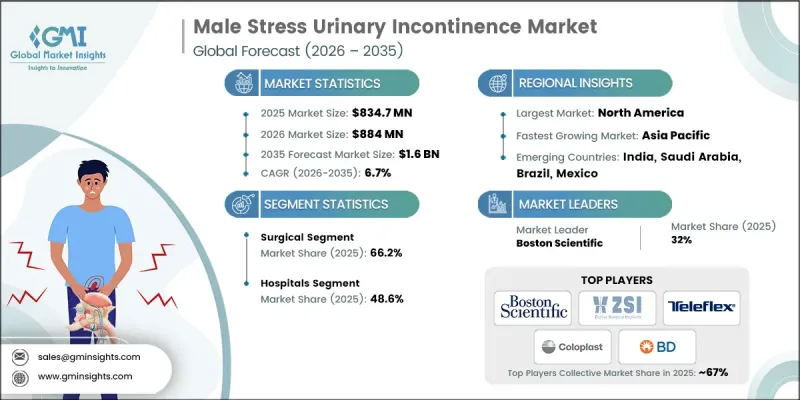
市場成長主要受前列腺癌發病率上升、男性應力性尿失禁(SUI)盛行率增加以及醫療設備和外科手術技術的持續創新所驅動。由於攝護腺癌仍然是男性最常見的癌症之一,治療後出現尿失禁併發症的患者人數持續成長。全球男性人口老化加劇,進一步推高了尿失禁的診斷率,並導致尿失禁管理需求增加。隨著人們對治療後泌尿系統併發症的認知不斷提高,對侵入性和非侵入性治療方案的需求也在穩步成長。該市場涵蓋了專門用於治療因身體用力引起的尿失禁的專業醫療技術。主要產品類型包括人工尿道括約肌和男性用吊帶系統,旨在恢復尿失禁功能並顯著提高患者的生活品質。此外,泌尿系統專科醫療中心的擴張以及新一代人工尿道括約肌設計的進步,正在推動該行業的長期需求。
| 市場範圍 | |
|---|---|
| 開始年份 | 2025 |
| 預測年份 | 2026-2035 |
| 起始金額 | 8.347億美元 |
| 預測金額 | 16億美元 |
| 複合年成長率 | 6.7% |
預計到2025年,手術治療將佔總治療量的66.2%,這主要得益於門診和日間手術中心手術量的增加。手術仍然是中重度男性壓力性尿失禁(SUI)的首選治療方法。人工尿道括約肌系統因其長期療效顯著且排尿控制效果穩定,廣受認可為臨床治療的標竿。男性用吊帶系統也是重要的治療選擇,尤其適用於症狀較輕微且尿道功能尚存的患者。臨床指引和既定的治療通訊協定持續推動手術治療在整個醫療體系中的普及。
到2025年,醫院通路將佔48.6%的市佔率。這些機構是進行複雜外科手術(包括尿道括約肌植入術)的主要中心,這些手術需要經驗豐富的外科團隊和先進的手術設施。醫院泌尿系統經常處理更複雜的術後尿失禁病例,並透過多學科協作提供全面的患者照護。即使門診手術模式不斷發展,醫院仍然是提供先進的男性壓力性尿失禁治療的核心。
預計到2025年,北美男性應力性尿失禁市場佔有率將達到46.6%,並有望在預測期內保持穩定成長。該地區市場擴張的促進因素包括前列腺相關治療後尿失禁問題日益受到關注,以及先進治療技術的普及率較高。完善的泌尿系統基礎設施提升了患者獲得治療的便利性,實現了快速診斷、系統化的轉診途徑,並提供了手術和保守治療方案。
目錄
第1章:調查方法和範圍
第2章執行摘要
第3章業界考察
- 產業生態系分析
- 影響產業的因素
- 成長促進因素
- 男性應力性尿失禁盛行率增加(主要見於接受根治性攝護腺切除術的患者)
- 醫療設備和外科手術技術的進步
- 攝護腺癌發生率增加
- 產業潛在風險與挑戰
- 高昂的手術費用
- 機會
- 大量未接受治療的中度至重度壓力性尿失禁患者
- 成長促進因素
- 成長潛力分析
- 監理情勢
- 北美洲
- 歐洲
- 亞太地區
- 科技與創新趨勢
- 當前技術趨勢
- 新興技術
- 消費者洞察
- 投資環境
- 2025年各地區手術數量
- 男性用吊帶
- 人工尿道括約肌(AUS)
- 以嚴重程度分類的尿失禁流行病學狀況
- 波特五力分析
- PESTEL 分析
- 差距分析
- 未來市場趨勢
第4章 競爭情勢
- 介紹
- 企業矩陣分析
- 企業市佔率分析
- 世界
- 北美洲
- 歐洲
- 主要市場公司的競爭分析
- 競爭定位矩陣
- 主要進展
- 併購
- 夥伴關係與合作
- 新產品發布
- 業務拓展計劃
第5章 市場估算與預測:依產品類型分類,2022-2035年
- 外科
- 人工尿道括約肌(AUS)
- 男性用吊帶
- 可調節尿失禁氣囊
- 非手術
- 保險套導尿管
- 陰莖夾
第6章 市場估算與預測:依最終用途分類,2022-2035年
- 醫院
- 門診手術中心
- 泌尿系統診所
- 其他最終用戶
第7章 市場估計與預測:依地區分類,2022-2035年
- 北美洲
- 美國
- 加拿大
- 歐洲
- 德國
- 英國
- 法國
- 西班牙
- 義大利
- 荷蘭
- 亞太地區
- 中國
- 日本
- 印度
- 澳洲
- 韓國
- 拉丁美洲
- 巴西
- 墨西哥
- 阿根廷
- 中東和非洲
- 南非
- 沙烏地阿拉伯
- 阿拉伯聯合大公國
第8章:公司簡介
- AMI GmbH
- Becton, Dickinson and Company
- Boston Scientific
- CL Medical
- Coloplast
- Neomedic
- Promedon
- Rigicon, Inc.
- Teleflex
- Zephyr Surgical Implants(ZSI)
The Global Male Stress Urinary Incontinence Market was valued at USD 834.7 million in 2025 and is estimated to grow at a CAGR of 6.7% to reach USD 1.6 billion by 2035.
Market growth is fueled by the rising incidence of prostate cancer, the increasing prevalence of male stress urinary incontinence (SUI), and continuous innovation in medical devices and surgical procedures. As prostate cancer remains one of the most frequently diagnosed cancers among men, the number of patients experiencing urinary control complications following treatment continues to grow. The expanding aging male population worldwide further contributes to higher diagnosis rates and subsequent incontinence management needs. As awareness surrounding post-treatment urinary complications improves, demand for both interventional and non-invasive management solutions is steadily increasing. The market encompasses specialized medical technologies developed to manage involuntary urine leakage associated with physical exertion. Core product categories include artificial urinary sphincters and male sling systems designed to restore continence and significantly enhance patient quality of life. Additionally, the expansion of urology-focused specialty centers and the advancement of next-generation artificial urinary sphincter designs are reinforcing long-term industry demand.
| Market Scope | |
|---|---|
| Start Year | 2025 |
| Forecast Year | 2026-2035 |
| Start Value | $834.7 Million |
| Forecast Value | $1.6 Billion |
| CAGR | 6.7% |
The surgical treatment segment held a 66.2% share in 2025, supported by the growing number of outpatient and ambulatory surgical center-based procedures. Surgical intervention remains the preferred approach for moderate to severe male SUI cases. Artificial urinary sphincter systems are widely recognized as the clinical benchmark due to their strong long-term efficacy data and consistent continence outcomes. Male sling systems also represent an important therapeutic option, particularly for patients with less severe symptoms and preserved urethral function. Clinical recommendations and established treatment protocols continue to reinforce surgical adoption rates across healthcare systems.
The hospitals segment captured 48.6% share in 2025. These institutions serve as primary centers for complex surgical procedures, including artificial urinary sphincter implantation, which requires experienced surgical teams and advanced operating facilities. Hospital-based urology departments frequently manage more complicated post-treatment incontinence cases and provide comprehensive patient care through multidisciplinary collaboration. Even as outpatient surgical models expand, hospitals remain central to delivering advanced male SUI interventions.
North America Male Stress Urinary Incontinence Market held 46.6% share in 2025 and is expected to witness steady growth throughout the forecast period. Regional expansion is supported by strong awareness of urinary incontinence following prostate-related treatments and high adoption of advanced therapeutic technologies. A well-established urology infrastructure enables timely diagnosis, structured referral pathways, and access to both surgical and conservative management strategies, strengthening overall treatment accessibility.
Key companies operating in the Global Male Stress Urinary Incontinence Market include Boston Scientific, Coloplast, Becton, Dickinson and Company, Teleflex, and A.M.I. GmbH, Promedon, Rigicon, Inc., Zephyr Surgical Implants (ZSI), Neomedic, and CL Medical. These organizations compete through technological innovation, clinical validation, and expansion of global distribution networks. Companies in the Global Male Stress Urinary Incontinence Market are strengthening their competitive positions through continuous product development and clinical research investments. Manufacturers are focusing on enhancing device durability, ease of implantation, and patient comfort to improve long-term treatment outcomes. Strategic partnerships with urology centers and surgeon training programs help expand procedural adoption and build physician confidence. Firms are also pursuing geographic expansion strategies to penetrate emerging markets while reinforcing their presence in established regions. Regulatory compliance, post-market surveillance programs, and real-world clinical data generation further strengthen brand credibility.
Table of Contents
Chapter 1 Methodology and Scope
- 1.1 Market scope and definition
- 1.2 Research design
- 1.2.1 Research approach
- 1.2.2 Data collection methods
- 1.3 Data mining sources
- 1.3.1 Global
- 1.3.2 Regional/Country
- 1.4 Base estimates and calculations
- 1.4.1 Base year calculation
- 1.4.2 Key trends for market estimation
- 1.5 Primary research and validation
- 1.5.1 Primary sources
- 1.6 Forecast model
- 1.7 Research assumptions and limitations
Chapter 2 Executive Summary
- 2.1 Industry 360° synopsis
- 2.2 Key market trends
- 2.2.1 Regional trends
- 2.2.2 Product type trends
- 2.2.3 End use trends
- 2.3 CXO perspectives: Strategic imperatives
Chapter 3 Industry Insights
- 3.1 Industry ecosystem analysis
- 3.2 Industry impact forces
- 3.2.1 Growth drivers
- 3.2.1.1 Rising prevalence of male stress urinary incontinence (post-prostatectomy dominance)
- 3.2.1.2 Technological advancements in devices and surgical techniques
- 3.2.1.3 Growing incidence of prostate cancer
- 3.2.2 Industry pitfalls and challenges
- 3.2.2.1 High procedural cost
- 3.2.3 Opportunities
- 3.2.3.1 Large untreated moderate-to-severe SUI population
- 3.2.1 Growth drivers
- 3.3 Growth potential analysis
- 3.4 Regulatory landscape
- 3.4.1 North America
- 3.4.2 Europe
- 3.4.3 Asia Pacific
- 3.5 Technology and innovation landscape
- 3.5.1 Current technological trends
- 3.5.2 Emerging technologies
- 3.6 Consumer insights
- 3.7 Investment landscape
- 3.8 Number of procedures, by region, 2025
- 3.8.1 Male slings
- 3.8.2 Artificial urinary sphincters (AUS)
- 3.9 Epidemiology scenario by severity of incontinence
- 3.10 Porter's analysis
- 3.11 PESTEL analysis
- 3.12 Gap analysis
- 3.13 Future market trends
Chapter 4 Competitive Landscape, 2025
- 4.1 Introduction
- 4.2 Company matrix analysis
- 4.3 Company market share analysis
- 4.3.1 Global
- 4.3.2 North America
- 4.3.3 Europe
- 4.4 Competitive analysis of major market players
- 4.5 Competitive positioning matrix
- 4.6 Key developments
- 4.6.1 Mergers & acquisitions
- 4.6.2 Partnerships & collaborations
- 4.6.3 New product launches
- 4.6.4 Expansion plans
Chapter 5 Market Estimates and Forecast, By Product Type, 2022 - 2035 ($ Mn)
- 5.1 Key trends
- 5.2 Surgical
- 5.2.1 Artificial Urinary Sphincter (AUS)
- 5.2.2 Male slings
- 5.2.3 Adjustable continence balloons
- 5.3 Non-Surgical
- 5.3.1 Condom catheters
- 5.3.2 Penile clamps
Chapter 6 Market Estimates and Forecast, By End Use, 2022 - 2035 ($ Mn)
- 6.1 Key trends
- 6.2 Hospitals
- 6.3 Ambulatory surgical centers
- 6.4 Urology clinics
- 6.5 Other end users
Chapter 7 Market Estimates and Forecast, By Region, 2022 - 2035 ($ Mn)
- 7.1 Key trends
- 7.2 North America
- 7.2.1 U.S.
- 7.2.2 Canada
- 7.3 Europe
- 7.3.1 Germany
- 7.3.2 UK
- 7.3.3 France
- 7.3.4 Spain
- 7.3.5 Italy
- 7.3.6 Netherlands
- 7.4 Asia Pacific
- 7.4.1 China
- 7.4.2 Japan
- 7.4.3 India
- 7.4.4 Australia
- 7.4.5 South Korea
- 7.5 Latin America
- 7.5.1 Brazil
- 7.5.2 Mexico
- 7.5.3 Argentina
- 7.6 MEA
- 7.6.1 South Africa
- 7.6.2 Saudi Arabia
- 7.6.3 UAE
Chapter 8 Company Profiles
- 8.1 A.M.I. GmbH
- 8.2 Becton, Dickinson and Company
- 8.3 Boston Scientific
- 8.4 CL Medical
- 8.5 Coloplast
- 8.6 Neomedic
- 8.7 Promedon
- 8.8 Rigicon, Inc.
- 8.9 Teleflex
- 8.10 Zephyr Surgical Implants (ZSI)


