


 |
市場調查報告書
商品編碼
1982379
消防系統市場機會、成長要素、產業趨勢分析及2026-2035年預測。Fire Protection Systems Market Opportunity, Growth Drivers, Industry Trend Analysis, and Forecast 2026 - 2035 |
||||||

預計到 2025 年,全球消防系統市場規模將達到 814 億美元,年複合成長率為 7.1%,到 2035 年將達到 1,609 億美元。
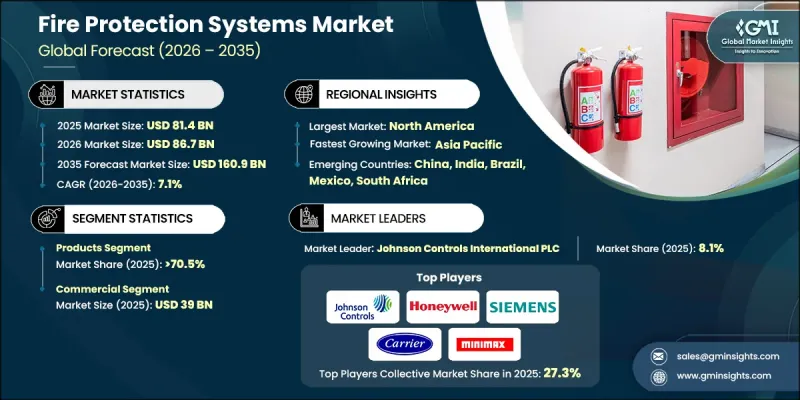
市場成長的促進因素包括日益嚴格的消防安全法規、持續成長的建設活動以及商業、工業和住宅領域安全標準意識的不斷提高。全球基礎設施的現代化進一步推動了對先進消防解決方案的需求。都市化的加速以及對商業建築、工業設施、交通樞紐和住宅開發案的投資增加,直接影響火災偵測、警報、噴灌和滅火系統的應用。此外,智慧消防解決方案正逐漸與物聯網、雲端平台和建築管理系統整合。這些技術能夠實現即時監控、遠端預警、預測性維護和快速回應,從而提高企業和建築使用者的安全水準、營運效率並降低風險。
| 市場範圍 | |
|---|---|
| 開始年份 | 2025 |
| 預測期 | 2026-2035 |
| 初始市場規模 | 814億美元 |
| 預測金額 | 1609億美元 |
| 複合年成長率 | 7.1% |
預計到2025年,該產品細分市場將佔據70.5%的市場。這一成長主要得益於對火災偵測設備、警報器、噴灌和滅火系統需求的增加,而這又受到更嚴格的法規和人們火災風險意識不斷提高的推動。
受石油天然氣、化學、公共產業和製造業等產業對更高安全性的需求推動,工業領域預計將穩定擴張,到2035年將達到520億美元,年複合成長率為7.3%。監管要求、職場的高火災風險以及對自動化火災偵測和抑制系統的投資,正促使製造商開發針對危險環境的專用解決方案。
預計到2025年,北美消防系統市佔率將達到40.5%。這一成長主要得益於消防安全法規的嚴格執行、工業和商業設施的擴張、公眾火災風險意識的提高以及先進探測和滅火技術的應用。智慧建築和工業安全措施的實施進一步推動了尖端消防解決方案的普及。該地區的製造商正優先投資研發可靠、符合規格且技術先進的系統,以滿足市場需求。
目錄
第1章:調查方法和範圍
第2章執行摘要
第3章業界考察
- 生態系分析
- 供應商情況
- 利潤率
- 成本結構
- 每個階段增加的價值
- 影響價值鏈的因素
- 中斷
- 影響產業的因素
- 促進因素
- 加強商業、工業和住宅建築的消防安全法規。
- 全球建築和基礎設施發展成長
- 人們越來越意識到職場安全和資產保護的重要性。
- 工業化和高風險產業的擴張
- 先進的自動化火災偵測技術正在被更廣泛地採用。
- 產業潛在風險與挑戰
- 安裝和維護消防系統成本高昂
- 將該系統整合到現有建築物中的複雜性
- 市場機遇
- 對智慧和物聯網消防解決方案的需求日益成長
- 擴大老舊基礎設施的維修和現代化計劃
- 促進因素
- 成長潛力分析
- 監理情勢
- 北美洲
- 歐洲
- 亞太地區
- 拉丁美洲
- 中東和非洲
- 波特的分析
- PESTEL 分析
- 科技與創新趨勢
- 當前技術趨勢
- 新興技術
- 新興經營模式
- 合規要求
- 專利分析
第4章 競爭情勢
- 介紹
- 企業市佔率分析
- 按地區
- 北美洲
- 歐洲
- 亞太地區
- 拉丁美洲
- 中東和非洲
- 市場集中度分析
- 按地區
- 主要企業的競爭標竿分析
- 財務績效比較
- 銷售量
- 利潤率
- 研究與開發
- 產品系列比較
- 產品線
- 科技
- 創新
- 區域擴張比較
- 全球擴張分析
- 服務網路覆蓋
- 按地區分類的市場滲透率
- 競爭定位矩陣
- 領導者
- 挑戰者
- 追蹤者
- 小眾玩家
- 戰略展望矩陣
- 財務績效比較
- 2022-2025 年重大發展
- 併購
- 夥伴關係和聯盟
- 技術進步
- 業務拓展與投資策略
- 永續發展計劃
- 數位轉型計劃
- 新興/Start-Ups競爭對手的發展趨勢
第5章 消防系統市場估價與預測:依產品分類,2022-2035年
- ,
- 產品
- 火災偵測系統
- 煙霧偵測器
- 熱探測器
- 火焰偵測器
- 氣體探測器
- 滅火系統
- 水基滅火系統
- 噴灌
- 水霧系統
- 滅火器
- 瓦斯動力滅火系統
- 泡沫滅火系統
- 水基滅火系統
- 火災警報和通知系統
- 其他
- 火災偵測系統
- 服務
- 安裝和設計服務
- 維護和檢查服務
- 其他
第6章 市場估算與預測:依最終用途分類,2022-2035年
- 住宅
- 商業的
- 零售
- 醫療設施
- 飯店業
- 辦公大樓
- 其他
- 工業的
- 製造業
- 能源與電力
- 石油和天然氣
- 礦業
- 其他
第7章 消防系統市場估價與預測:依地區分類,2022-2035年
- 按地區
- 北美洲
- 美國
- 加拿大
- 歐洲
- 英國
- 德國
- 法國
- 義大利
- 西班牙
- 荷蘭
- 其他歐洲地區
- 亞太地區
- 中國
- 印度
- 日本
- 韓國
- 澳洲
- 亞太其他地區
- 拉丁美洲
- 巴西
- 墨西哥
- 阿根廷
- 其他拉丁美洲地區
- 中東和非洲(MEA)
- 沙烏地阿拉伯
- 南非
- 阿拉伯聯合大公國
- 其他中東和非洲地區
第8章:公司簡介
- Viking Group Inc.
- Carrier
- Kidde-Fenwal, LLC
- Fike Corporation
- Johnson Controls International plc
- Control Fire Systems Ltd
- Troy Life &Fire Safety Ltd.
- Vipond Fire Protection
- Siemens AG
- Elite Fire Protection
- Chubb Fire &Security.
- Onyx Fire Protection Services Inc.
- Georgian Bay Fire &Safety
- Automated Fire Protection Systems Ltd.
- Honeywell International Inc.
- Minimax GmbH &Co. KG
- Securiton AG
- Robert Bosch GmbH
The Global Fire Protection Systems Market was valued at USD 81.4 billion in 2025 and is estimated to grow at a CAGR of 7.1% to reach USD 160.9 billion by 2035.
Market growth is driven by stricter regulatory requirements for fire safety, the ongoing rise in construction activity, and growing awareness of safety standards across commercial, industrial, and residential sectors. The modernization of infrastructure worldwide is further supporting demand for advanced fire protection solutions. Increasing urbanization and investments in commercial buildings, industrial facilities, transportation hubs, and residential developments are directly influencing the adoption of fire detection, alarm, sprinkler, and suppression systems. The trend is also shifting toward intelligent fire protection solutions integrated with IoT, cloud platforms, and building management systems. These technologies provide real-time monitoring, remote alerts, predictive maintenance, and faster response times, improving safety levels, operational efficiency, and risk mitigation for businesses and building occupants.
| Market Scope | |
|---|---|
| Start Year | 2025 |
| Forecast Year | 2026-2035 |
| Start Value | $81.4 Billion |
| Forecast Value | $160.9 Billion |
| CAGR | 7.1% |
The products segment accounted for 70.5% share in 2025. Rising demand for fire detection devices, alarms, sprinklers, and suppression systems, supported by stricter compliance mandates and increasing awareness of fire hazards, has fueled growth in the products segment.
The industrial sector is expected to witness robust expansion, projected to reach USD 52 billion by 2035 at a CAGR of 7.3%, due to the need for enhanced safety in oil and gas, chemical, utility, and manufacturing operations. Regulatory requirements, high workplace fire risks, and investments in automated fire detection and suppression systems are encouraging manufacturers to develop specialized solutions for hazardous environments.
North America Fire Protection Systems Market held a 40.5% share in 2025. Growth in the region is supported by stricter enforcement of fire safety regulations, expansion of industrial and commercial facilities, increased public awareness of fire risks, and adoption of advanced detection and suppression technologies. Smart building integration and industrial safety initiatives are further driving the adoption of modern fire protection solutions. Manufacturers in the region are prioritizing investments in reliable, code-compliant, and technologically advanced systems to meet market demand.
Key players operating in the Global Fire Protection Systems Market include: Johnson Controls International plc, Siemens AG, Carrier, Honeywell International Inc., Viking Group Inc., Fike Corporation, Kidde-Fenwal LLC, Troy Life & Fire Safety Ltd., Onyx Fire Protection Services Inc., Minimax GmbH & Co. KG, Robert Bosch GmbH, Securiton AG, Control Fire Systems Ltd., Vipond Fire Protection, Elite Fire Protection, Chubb Fire & Security, Georgian Bay Fire & Safety, and Automated Fire Protection Systems Ltd. Companies in the Fire Protection Systems Market are adopting multiple strategies to enhance their market position and expand global reach. Key approaches include developing smart, IoT-enabled fire detection and suppression solutions with predictive maintenance capabilities and cloud connectivity. Firms are investing in R&D to create code-compliant, energy-efficient, and modular systems tailored for industrial, commercial, and residential applications. Strategic partnerships with construction companies, facility managers, and governments help improve market penetration. Companies are also focusing on after-sales service, training programs, and maintenance contracts to boost customer loyalty and recurring revenue.
Table of Contents
Chapter 1 Methodology and Scope
- 1.1 Market scope and definition
- 1.2 Research design
- 1.2.1 Research approach
- 1.2.2 Data collection methods
- 1.3 Data mining sources
- 1.3.1 Global
- 1.3.2 Regional/Country
- 1.4 Base estimates and calculations
- 1.4.1 Base year calculation
- 1.4.2 Key trends for market estimation
- 1.5 Primary research and validation
- 1.5.1 Primary sources
- 1.6 Forecast model
- 1.7 Research assumptions and limitations
Chapter 2 Executive Summary
- 2.1 Industry snapshot
- 2.2 Key market trends
- 2.2.1 Offerings trends
- 2.2.2 End Use trends
- 2.2.3 Regional
- 2.3 TAM Analysis, 2026-2035 (USD Billion)
- 2.4 CXO perspectives: Strategic imperatives
Chapter 3 Industry Insights
- 3.1 Industry ecosystem analysis
- 3.1.1 Supplier Landscape
- 3.1.2 Profit Margin
- 3.1.3 Cost structure
- 3.1.4 Value addition at each stage
- 3.1.5 Factor affecting the value chain
- 3.1.6 Disruptions
- 3.2 Industry impact forces
- 3.2.1 Growth drivers
- 3.2.1.1 Stricter fire safety regulations across commercial, industrial, and residential buildings
- 3.2.1.2 Growth in construction and infrastructure development worldwide
- 3.2.1.3 Rising awareness of workplace safety and asset protection
- 3.2.1.4 Increasing industrialization and expansion of high-risk industries
- 3.2.1.5 Growing adoption of advanced and automated fire detection technologies
- 3.2.2 Industry pitfalls and challenges
- 3.2.2.1 High installation and maintenance costs of fire protection systems
- 3.2.2.2 Complexity of integrating systems in existing buildings
- 3.2.3 Market opportunities
- 3.2.3.1 Rising demand for smart and IoT-enabled fire protection solutions
- 3.2.3.2 Expansion of retrofitting and modernization projects in aging infrastructure
- 3.2.1 Growth drivers
- 3.3 Growth potential analysis
- 3.4 Regulatory landscape
- 3.4.1 North America
- 3.4.2 Europe
- 3.4.3 Asia Pacific
- 3.4.4 Latin America
- 3.4.5 Middle East & Africa
- 3.5 Porter’s analysis
- 3.6 PESTEL analysis
- 3.7 Technology and innovation landscape
- 3.7.1 Current technological trends
- 3.7.2 Emerging technologies
- 3.8 Emerging business models
- 3.9 Compliance requirements
- 3.10 Patent analysis
Chapter 4 Competitive Landscape, 2025
- 4.1 Introduction
- 4.2 Company market share analysis
- 4.2.1 By Region
- 4.2.1.1 North America
- 4.2.1.2 Europe
- 4.2.1.3 Asia Pacific
- 4.2.1.4 Latin America
- 4.2.1.5 Middle East & Africa
- 4.2.2 Market Concentration Analysis
- 4.2.1 By Region
- 4.3 Competitive benchmarking of key players
- 4.3.1 Financial performance comparison
- 4.3.1.1 Revenue
- 4.3.1.2 Profit margin
- 4.3.1.3 R&D
- 4.3.2 Product portfolio comparison
- 4.3.2.1 Product range breadth
- 4.3.2.2 Technology
- 4.3.2.3 Innovation
- 4.3.3 Geographic presence comparison
- 4.3.3.1 Global footprint analysis
- 4.3.3.2 Service network coverage
- 4.3.3.3 Market penetration by region
- 4.3.4 Competitive positioning matrix
- 4.3.4.1 Leaders
- 4.3.4.2 Challengers
- 4.3.4.3 Followers
- 4.3.4.4 Niche players
- 4.3.5 Strategic outlook matrix
- 4.3.1 Financial performance comparison
- 4.4 Key developments, 2022-2025
- 4.4.1 Mergers and acquisitions
- 4.4.2 Partnerships and collaborations
- 4.4.3 Technological advancements
- 4.4.4 Expansion and investment strategies
- 4.4.5 Sustainability initiatives
- 4.4.6 Digital transformation initiatives
- 4.5 Emerging/ startup competitors landscape
Chapter 5 Fire Protection Systems Market Estimates & Forecast, By Offerings, 2022 - 2035 (USD Billion)
- 5.1 Key trends,
- 5.2 Products
- 5.2.1 Fire detection systems
- 5.2.1.1 Smoke detectors
- 5.2.1.2 Heat detectors
- 5.2.1.3 Flame detectors
- 5.2.1.4 Gas detectors
- 5.2.2 Fire suppression systems
- 5.2.2.1 Water-based suppression systems
- 5.2.2.1.1 Fire sprinkler
- 5.2.2.1.2 Water mist systems
- 5.2.2.2 Fire extinguishers
- 5.2.2.3 Gas-based suppression systems
- 5.2.2.4 Foam-based suppression systems
- 5.2.2.1 Water-based suppression systems
- 5.2.3 Fire alarm & notification systems
- 5.2.4 Others
- 5.2.1 Fire detection systems
- 5.3 Service
- 5.3.1 Installation and design service
- 5.3.2 Maintenance and inspection services
- 5.3.3 Others
Chapter 6 Market Estimates and Forecast, By End Use, 2022 - 2035 (USD Billion)
- 6.1 Key trends
- 6.2 Residential
- 6.3 Commercial
- 6.3.1 Retail
- 6.3.2 Healthcare facilities
- 6.3.3 Hospitality
- 6.3.4 Office buildings
- 6.3.5 Others
- 6.4 Industrial
- 6.4.1 Manufacturing
- 6.4.2 Energy & power
- 6.4.3 Oil & gas
- 6.4.4 Mining
- 6.4.5 Others
Chapter 7 Fire Protection Systems Market Estimates & Forecast, By Region, 2022 - 2035 (USD Billion)
- 7.1 Key trends, by region
- 7.2 North America
- 7.2.1 U.S.
- 7.2.2 Canada
- 7.3 Europe
- 7.3.1 UK
- 7.3.2 Germany
- 7.3.3 France
- 7.3.4 Italy
- 7.3.5 Spain
- 7.3.6 Netherlands
- 7.3.7 Rest of Europe
- 7.4 Asia-Pacific
- 7.4.1 China
- 7.4.2 India
- 7.4.3 Japan
- 7.4.4 South Korea
- 7.4.5 Australia
- 7.4.6 Rest of Asia-Pacific
- 7.5 Latin America
- 7.5.1 Brazil
- 7.5.2 Mexico
- 7.5.3 Argentina
- 7.5.4 Rest of Latin America
- 7.6 MEA
- 7.6.1 Saudi Arabia
- 7.6.2 South Africa
- 7.6.3 UAE
- 7.6.4 Rest of MEA
Chapter 8 Company Profiles
- 8.1 Viking Group Inc.
- 8.2 Carrier
- 8.3 Kidde-Fenwal, LLC
- 8.4 Fike Corporation
- 8.5 Johnson Controls International plc
- 8.6 Control Fire Systems Ltd
- 8.7 Troy Life & Fire Safety Ltd.
- 8.8 Vipond Fire Protection
- 8.9 Siemens AG
- 8.10 Elite Fire Protection
- 8.11 Chubb Fire & Security.
- 8.12 Onyx Fire Protection Services Inc.
- 8.13 Georgian Bay Fire & Safety
- 8.14 Automated Fire Protection Systems Ltd.
- 8.15 Honeywell International Inc.
- 8.16 Minimax GmbH & Co. KG
- 8.17 Securiton AG
- 8.18 Robert Bosch GmbH

 消防系統市場-2026-2032年全球市場預測
 消防系統市場規模、佔有率和趨勢分析報告:按組件、應用、地區和細分市場分類(2026-2033 年)
 被動防火市場-全球產業規模、佔有率、趨勢、機會、預測:按產品、應用、最終用戶、地區和競爭對手分類,2021-2031年
 消防系統市場:依產品、組件和地區分類
 被動防火市場規模、佔有率、成長及全球產業分析:按類型、應用和地區分類的洞察,2026-2034 年預測消防系統測試、檢驗和認證市場:2026-2030年全球市場預測(按服務類型、系統類型、頻率、合約類型、安裝類型、交付方式、所有權方式和最終用戶分類)
 雙線制消防系統市場規模、佔有率和成長分析:按組件類型、安裝類型、技術、最終用戶、地區和產業預測,2026-2033年
 消防系統市場分析及預測(至2035年):依類型、產品類型、服務、技術、組件、應用、材質、安裝方法及最終使用者分類全球消防系統市場規模、佔有率、趨勢和成長分析報告(2026-2034年)
 2026年全球消防系統市場報告