


 |
市場調查報告書
商品編碼
1982367
蛋白質體學市場機會、成長要素、產業趨勢分析及2026-2035年預測Proteomics Market Opportunity, Growth Drivers, Industry Trend Analysis, and Forecast 2026 - 2035 |
||||||

全球蛋白質體學市場預計到 2025 年將達到 412 億美元,預計到 2035 年將以 12% 的複合年成長率成長至 1,263 億美元。
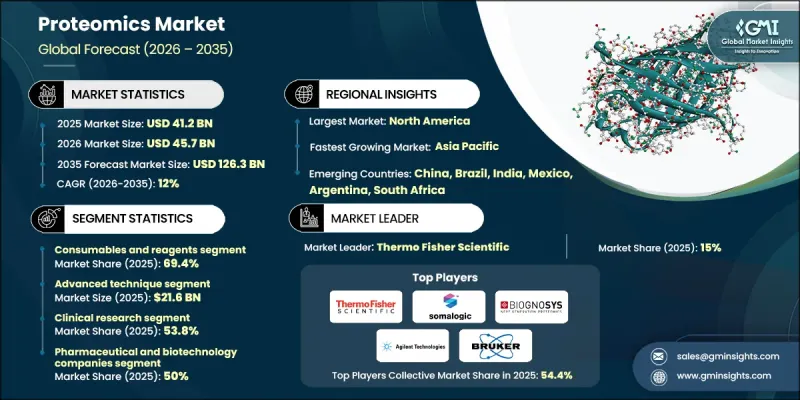
蛋白質體學是對生物系統中蛋白質的研究,包括蛋白質的鑑定、定量和功能分析。該領域的工具包括質譜平台、蛋白質微陣列和無標定定量系統,以支援高通量蛋白質譜分析。科技的快速進步以及人工智慧和機器學習在蛋白質體學工作流程中的應用正在推動市場擴張。單細胞蛋白質體學的興起正在革新研究,它能夠在單一細胞層面進行蛋白質分析,從而深入了解腫瘤異質性、疾病進展和免疫系統動態。這些進步不僅改變了研究方式,也使蛋白質體學在臨床診斷上的應用日益廣泛。現代高通量系統不斷提高靈敏度、速度和準確性,增強了大規模研究的數據質量,並加速了全球精準醫療的發展。
| 市場範圍 | |
|---|---|
| 開始年份 | 2025 |
| 預測期 | 2026-2035 |
| 上市時的市場規模 | 412億美元 |
| 預測金額 | 1263億美元 |
| 複合年成長率 | 12% |
預計到 2025 年,耗材和試劑領域將佔市場佔有率的 69.4%,複合年成長率為 12.3%。該領域包括蛋白質晶片、檢測試劑盒、試劑、緩衝液、層析管柱和電泳凝膠,這些產品在質譜、層析法和微陣列分析中反覆使用,從而確保了持續的收入。
預計到2025年,先進技術領域的市場規模將達到216億美元。此領域涵蓋質譜分析、蛋白質微陣列、凝膠電泳技術及其他先進技術。與傳統方法相比,這些技術具有更高的靈敏度、準確性和通量,從而推動了研究、臨床診斷、藥物研發和個人化醫療領域的創新。
預計北美蛋白質體學市場規模將在2025年達到199億美元,到2035年將達到619億美元,複合年成長率(CAGR)為12.2%。這一成長得益於強大的生物醫學研究基礎設施、快速的技術應用以及先進的醫療保健生態系統。人工智慧和機器學習在數據分析中的應用,以及學術機構、生技公司和製藥公司之間的合作,正在加速蛋白質譜分析、生物標記開發和精準醫療的應用。
目錄
第1章:調查方法和範圍
第2章執行摘要
第3章業界考察
- 生態系分析
- 供應商情況
- 每個階段增加的價值
- 影響價值鏈的因素
- 影響產業的因素
- 促進因素
- 慢性病和複雜疾病盛行率增加
- 對個人化醫療和精準醫療的需求日益成長
- 質譜和生物資訊技術的進步
- 增加對基於蛋白質體學的藥物發現和診斷的投資。
- 產業潛在風險與挑戰
- 設備和試劑高成本
- 數據解讀與分析的複雜性
- 市場機遇
- 拓展臨床蛋白質體學在疾病早期檢測的應用
- 開發用於標靶治療的新型生物標記
- 促進因素
- 成長潛力分析
- 監理情勢
- 北美洲
- 美國
- 加拿大
- 歐洲
- 亞太地區
- 北美洲
- 科技趨勢
- 當前技術趨勢
- 新興技術
- 未來市場趨勢
- 波特五力分析
- PESTEL 分析
第4章 競爭情勢
- 介紹
- 企業市佔率分析
- 企業矩陣分析
- 主要市場公司的競爭分析
- 競爭定位矩陣
- 主要進展
- 併購
- 夥伴關係與合作
- 新產品發布
- 業務拓展計劃
第5章 市場估計與預測:依組件分類,2022-2035年
- 裝置
- 耗材和試劑
- 服務
第6章 市場估計與預測:依技術分類,2022-2035年
- 先進技術
- 蛋白質微陣列
- 基於凝膠的方法
- 質譜分析
- 其他先進技術
- 傳統技術
- ELISA
- 層析法
- 艾德曼定序
- 蛋白質印跡法
- 生物資訊學和電腦分析
- 其他方法
第7章 市場估計與預測:依應用領域分類,2022-2035年
- 臨床診斷
- 臨床研究
第8章 市場估算與預測:依最終用途分類,2022-2035年
- 製藥和生物製藥公司
- 學術和研究機構
- 研究所
- 其他最終用戶
第9章 市場估計與預測:依地區分類,2022-2035年
- 北美洲
- 美國
- 加拿大
- 歐洲
- 德國
- 英國
- 法國
- 西班牙
- 義大利
- 荷蘭
- 亞太地區
- 中國
- 印度
- 日本
- 澳洲
- 韓國
- 拉丁美洲
- 巴西
- 墨西哥
- 阿根廷
- 中東和非洲
- 南非
- 沙烏地阿拉伯
- 阿拉伯聯合大公國
第10章:公司簡介
- Agilent Technologies
- Biognosys
- Bio-Rad
- Bruker
- Creative Proteomics
- F. Hoffmann-La Roche
- Merck KGaA
- PREOMICS
- Promega
- Quantum-Si
- Seer
- SomaLogic Operating
- Thermo Fisher Scientific(Olink)
- Waters
The Global Proteomics Market was valued at USD 41.2 billion in 2025 and is estimated to grow at a CAGR of 12% to reach USD 126.3 billion by 2035.
Proteomics encompasses the study of proteins within biological systems, including their identification, quantification, and functional analysis. Tools in this market include mass spectrometry platforms, protein microarrays, and label-free quantification systems that support high-throughput protein profiling. Rapid advancements in technology and the integration of AI and machine learning into proteomic workflows are driving market expansion. The rise of single-cell proteomics is revolutionizing research by enabling protein analysis at the individual cell level, providing deep insights into tumor heterogeneity, disease progression, and immune system dynamics. These advances are not only transforming research but are also making proteomics increasingly applicable in clinical diagnostics. Modern high-throughput systems continue to improve sensitivity, speed, and accuracy, enhancing data quality for large-scale studies and accelerating precision medicine development worldwide.
| Market Scope | |
|---|---|
| Start Year | 2025 |
| Forecast Year | 2026-2035 |
| Start Value | $41.2 Billion |
| Forecast Value | $126.3 Billion |
| CAGR | 12% |
The consumables and reagents segment accounted for 69.4% share in 2025 and is projected to grow at a CAGR of 12.3%. This segment includes protein chips, assay kits, reagents, buffers, chromatography columns, and electrophoresis gels, which are repeatedly used in mass spectrometry, chromatography, and microarray analyses, ensuring recurring revenue.
The advanced techniques segment reached USD 21.6 billion in 2025. This category includes mass spectrometry, protein microarrays, gel-based techniques, and other advanced methods. These approaches provide superior sensitivity, precision, and throughput compared to conventional methods, driving innovation in research, clinical diagnostics, drug development, and personalized therapies.
North America Proteomics Market reached USD 19.9 billion in 2025 and is projected to reach USD 61.9 billion by 2035, at a CAGR of 12.2%. Growth in the region is fueled by strong biomedical research infrastructure, rapid technology adoption, and an advanced healthcare ecosystem. The integration of AI and machine learning for data analysis, alongside collaboration among academic institutions, biotech firms, and pharmaceutical companies, is accelerating protein profiling, biomarker development, and precision medicine applications.
Key players in the Global Proteomics Market include Agilent Technologies, Biognosys, Bio-Rad, Bruker, Creative Proteomics, F. Hoffmann-La Roche, Merck KGaA, PREOMICS, Promega, Quantum-Si, Seer, SomaLogic, Thermo Fisher Scientific (Olink), and Waters. Companies in the Proteomics Market are strengthening their position by investing heavily in R&D to improve the sensitivity, accuracy, and throughput of proteomics platforms. They are forming strategic partnerships with academic institutions, pharmaceutical firms, and biotech startups to expand their service offerings and enhance collaborative innovation. Firms are also integrating AI and machine learning to streamline workflows and generate actionable insights from large proteomic datasets. Additionally, they are launching comprehensive consumable and reagent portfolios to ensure recurring revenue, expanding geographically to capture emerging markets, and participating in clinical validation programs to support regulatory approvals and adoption in clinical diagnostics.
Table of Contents
Chapter 1 Methodology and Scope
- 1.1 Research approach
- 1.2 Quality commitments
- 1.2.1 GMI AI policy & data integrity commitment
- 1.2.1.1 Source consistency protocol
- 1.2.1 GMI AI policy & data integrity commitment
- 1.3 Research trail & confidence scoring
- 1.3.1 Research trail components
- 1.3.2 Scoring components
- 1.4 Data collection
- 1.4.1 Partial list of primary sources
- 1.5 Data mining sources
- 1.5.1 Paid sources
- 1.5.1.1 Sources, by region
- 1.5.1 Paid sources
- 1.6 Base estimates and calculations
- 1.6.1 Base year calculation for any one approach
- 1.7 Forecast model
- 1.7.1 Quantified market impact analysis
- 1.7.1.1 Mathematical impact of growth parameters on forecast
- 1.7.1 Quantified market impact analysis
- 1.8 Research transparency addendum
- 1.8.1 Source attribution framework
- 1.8.2 Quality assurance metrics
- 1.8.3 Our commitment to trust
Chapter 2 Executive Summary
- 2.1 Industry 360° synopsis
- 2.2 Key market trends
- 2.2.1 Regional trends
- 2.2.2 Component trends
- 2.2.3 Technique trends
- 2.2.4 Application trends
- 2.2.5 End use trends
- 2.3 CXO perspectives: Strategic imperatives
- 2.3.1 Key decision points for industry executives
- 2.3.2 Critical success factors for market players
- 2.4 Future outlook and strategic recommendations
Chapter 3 Industry Insights
- 3.1 Industry ecosystem analysis
- 3.1.1 Supplier landscape
- 3.1.2 Value addition at each stage
- 3.1.3 Factors affecting the value chain
- 3.2 Industry impact forces
- 3.2.1 Growth drivers
- 3.2.1.1 Rising prevalence of chronic and complex diseases
- 3.2.1.2 Increasing demand for personalized and precision medicine
- 3.2.1.3 Advancements in mass spectrometry and bioinformatics technologies
- 3.2.1.4 Growing investments in proteomics-based drug discovery and diagnostics
- 3.2.2 Industry pitfalls and challenges
- 3.2.2.1 High cost of instruments and reagents
- 3.2.2.2 Complexity in data interpretation and analysis
- 3.2.3 Market opportunities
- 3.2.3.1 Expansion of clinical proteomics for early disease detection
- 3.2.3.2 Development of novel biomarkers for targeted therapies
- 3.2.1 Growth drivers
- 3.3 Growth potential analysis
- 3.4 Regulatory landscape
- 3.4.1 North America
- 3.4.1.1 U.S.
- 3.4.1.2 Canada
- 3.4.2 Europe
- 3.4.3 Asia Pacific
- 3.4.1 North America
- 3.5 Technology landscape
- 3.5.1 Current technological trends
- 3.5.2 Emerging technologies
- 3.6 Future market trends
- 3.7 Porter's analysis
- 3.8 PESTEL analysis
Chapter 4 Competitive Landscape, 2025
- 4.1 Introduction
- 4.2 Company market share analysis
- 4.3 Company matrix analysis
- 4.4 Competitive analysis of major market players
- 4.5 Competitive positioning matrix
- 4.6 Key developments
- 4.6.1 Merger and acquisition
- 4.6.2 Partnership and collaboration
- 4.6.3 New product launches
- 4.6.4 Expansion plans
Chapter 5 Market Estimates and Forecast, By Component, 2022 - 2035 ($ Mn)
- 5.1 Key trends
- 5.2 Instruments
- 5.3 Consumables and reagents
- 5.4 Services
Chapter 6 Market Estimates and Forecast, By Technique, 2022 - 2035 ($ Mn)
- 6.1 Key trends
- 6.2 Advanced technique
- 6.2.1 Protein microarray
- 6.2.2 Gel-based technique
- 6.2.3 Mass spectrometry
- 6.2.4 Other advanced techniques
- 6.3 Conventional technique
- 6.3.1 ELISA
- 6.3.2 Chromatography based technique
- 6.3.3 Edman sequencing
- 6.3.4 Western blotting
- 6.4 Bioinformatics and computational analysis
- 6.5 Other techniques
Chapter 7 Market Estimates and Forecast, By Application, 2022 - 2035 ($ Mn)
- 7.1 Key trends
- 7.2 Clinical diagnostics
- 7.3 Clinical research
Chapter 8 Market Estimates and Forecast, By End Use, 2022 - 2035 ($ Mn)
- 8.1 Key trends
- 8.2 Pharmaceutical and biopharmaceutical companies
- 8.3 Academic and research institutions
- 8.4 Laboratories
- 8.5 Other end users
Chapter 9 Market Estimates and Forecast, By Region, 2022 - 2035 ($ Mn)
- 9.1 Key trends
- 9.2 North America
- 9.2.1 U.S.
- 9.2.2 Canada
- 9.3 Europe
- 9.3.1 Germany
- 9.3.2 UK
- 9.3.3 France
- 9.3.4 Spain
- 9.3.5 Italy
- 9.3.6 Netherlands
- 9.4 Asia Pacific
- 9.4.1 China
- 9.4.2 India
- 9.4.3 Japan
- 9.4.4 Australia
- 9.4.5 South Korea
- 9.5 Latin America
- 9.5.1 Brazil
- 9.5.2 Mexico
- 9.5.3 Argentina
- 9.6 Middle East and Africa
- 9.6.1 South Africa
- 9.6.2 Saudi Arabia
- 9.6.3 UAE
Chapter 10 Company Profiles
- 10.1 Agilent Technologies
- 10.2 Biognosys
- 10.3 Bio-Rad
- 10.4 Bruker
- 10.5 Creative Proteomics
- 10.6 F. Hoffmann-La Roche
- 10.7 Merck KGaA
- 10.8 PREOMICS
- 10.9 Promega
- 10.10 Quantum-Si
- 10.11 Seer
- 10.12 SomaLogic Operating
- 10.13 Thermo Fisher Scientific (Olink)
- 10.14 Waters

 臨床蛋白質體學市場:技術、應用領域及至2030年的預測
 蛋白質體學市場分析及預測(至2035年):依類型、產品、服務、技術、組件、應用、流程、最終使用者、解決方案、模式分類
 蛋白質體學市場:按類型、產品類型、樣品類型、自動化程度、應用和最終用戶分類-2026-2032年全球市場預測
 蛋白質體學市場規模、佔有率和趨勢分析報告:按產品/服務、應用、技術、地區和細分市場預測(2026-2033 年)
 蛋白質體學服務市場規模、佔有率和成長分析:按服務類型、應用、最終用戶和地區分類-2026-2033年產業預測
 全球蛋白質體學市場(至 2030 年):按產品(光譜學、層析法、電泳法、X光晶體學)、試劑、服務(核心蛋白質組學、生物資訊學)、應用(診斷、藥物發現)和最終用戶(醫院、生物製藥公司)分類
 蛋白質體學市場報告:按分析方法、成分類型、技術、應用、最終用戶和地區分類(2026-2034 年)
 蛋白質體學生物標記分析市場(第二版):按應用、技術、產品和地區分類的預測 - 面向高階主管和顧問,人工智慧 (AI) 的影響(2026-2030 年)2026-2034年全球蛋白質體學市場規模、佔有率、趨勢和成長分析報告全球蛋白質體學市場:策略性洞察與預測(2026-2031年)