


 |
市場調查報告書
商品編碼
1982366
功能性印刷市場:成長機會、成長要素、產業趨勢分析及2026-2035年預測Functional Printing Market Opportunity, Growth Drivers, Industry Trend Analysis, and Forecast 2026 - 2035 |
||||||

全球功能性印刷市場預計到 2025 年將達到 173 億美元,預計到 2035 年將達到 1,349 億美元,年複合成長率為 24.2%。
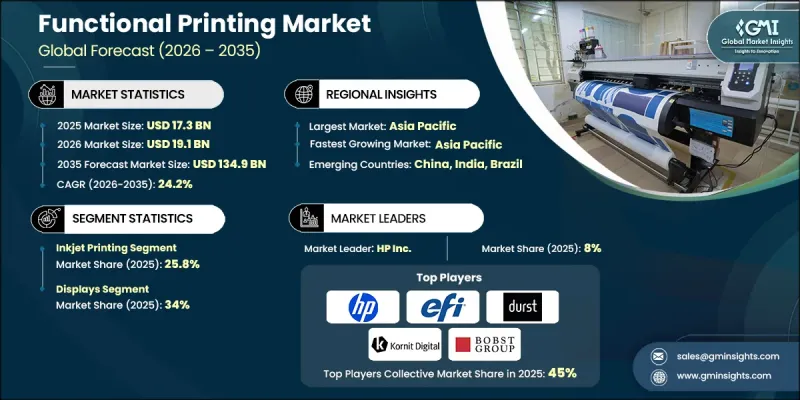
該市場的發展動力源於先進材料、導電油墨以及噴墨、絲網印刷和凹版印刷等新一代印刷技術的持續創新。功能性印刷因其高度客製化、減少廢棄物和縮短產品開發週期等優勢,在高價值應用中日益受到青睞。從光刻和標準PCB製造等傳統減材製造方法朝向積層製造和數位化生產的轉變,代表著製造理念的重大模式轉移。透過併購和技術合作實現的策略整合正在加速市場成長,使導電油墨、軟式電路板和印刷感測器技術領域的主要企業能夠建立整合解決方案。隨著行業對柔軟性、小批量生產和多品種生產的需求日益成長,功能性印刷正在成為電子、包裝和智慧型裝置等領域的關鍵驅動力。
| 市場範圍 | |
|---|---|
| 開始年份 | 2025 |
| 預測期 | 2026-2035 |
| 上市時的市場規模 | 173億美元 |
| 預測金額 | 1349億美元 |
| 複合年成長率 | 24.2% |
噴墨列印領域佔25.8%的市場佔有率,預計2025年市場規模將達44億美元。噴墨列印之所以引領市場,是因為它能夠靈活應用於印刷電子產品、高解析度功能層和智慧包裝等領域。奈米導電油墨、軟式電路板和低溫燒結技術的快速創新正在推動市場成長。噴墨列印適用於按需生產和多品種小批量生產,使其成為電子、紡織品和先進包裝應用的理想選擇。
預計到2025年,顯示器產業將佔據34%的市場佔有率,這主要得益於軟性顯示器、OLED面板、觸控介面和印刷背板的日益普及。卷軸式製造流程和透明導電材料的應用將進一步推動這一成長。包括噴墨、網版印刷和凹版印刷在內的功能性印刷技術,能夠製造軟性且複雜的顯示結構,從而促進攜帶式電子產品、能源解決方案和建築整合技術(BIT)等領域的應用。
到2025年,美國功能性印刷市佔率將達到64.4%。印刷電子、軟性顯示器數位化包裝的普及是推動市場成長的主要動力。電子商務、醫療保健和家用電子電器等行業對智慧標籤、印刷感測器、RFID追蹤和增材電子的需求激增。除了採用結合柔版印刷和噴墨技術的混合印刷平台外,人工智慧驅動的印刷最佳化、在線連續檢測和預測性維護等技術也提高了原始設備製造商 (OEM) 和加工商在工業應用領域的可靠性。
目錄
第1章:調查方法和範圍
第2章執行摘要
第3章業界考察
- 生態系分析
- 供應商情況
- 利潤率
- 每個階段增加的價值
- 影響價值鏈的因素
- 影響產業的因素
- 促進因素
- 勞動力短缺加劇和製造業回流
- 人工智慧、衍生設計和軟體整合
- IT/OT在印刷作業中的整合
- 產業潛在風險與挑戰
- 高階整合的複雜性
- 資料隱私和網路安全
- 機會
- Printing-as-a-Service(PaaS)
- 印刷電子和智慧包裝的成長
- 促進因素
- 成長潛力分析
- 未來市場趨勢
- 科技與創新趨勢
- 當前技術趨勢
- 新興技術
- 價格趨勢
- 按地區
- 透過技術
- 監理情勢
- 標準和合規要求
- 區域法律規範
- 認證標準
- 波特的分析
- PESTEL 分析
第4章 競爭情勢
- 介紹
- 企業市佔率分析
- 按地區
- 企業矩陣分析
- 主要市場公司的競爭分析
- 競爭定位矩陣
- 主要進展
- 併購
- 夥伴關係與合作
- 新產品發布
- 業務拓展計劃
第5章 市場估計與預測:依材料分類,2022-2035年
- 基板
- 玻璃
- 塑膠
- 紙
- 碳化矽
- 氮化鎵
- 其他
- 墨水
- 導電油墨
- 介電油墨
- 石墨烯墨水
- 其他
第6章 市場估計與預測:依技術分類,2022-2035年
- 噴墨列印
- 網版印刷
- 柔版印刷
- 凹版印刷
- 其他
第7章 市場估計與預測:依應用領域分類,2022-2035年
- 展示
- 感應器
- 太陽能
- 照明
- 電池
- RFID標籤
- 其他
第8章 市場估計與預測:依地區分類,2022-2035年
- 北美洲
- 美國
- 加拿大
- 歐洲
- 德國
- 英國
- 法國
- 義大利
- 西班牙
- 亞太地區
- 中國
- 日本
- 印度
- 澳洲
- 韓國
- 拉丁美洲
- 巴西
- 墨西哥
- 阿根廷
- 中東和非洲
- 南非
- 沙烏地阿拉伯
- 阿拉伯聯合大公國
第9章:公司簡介
- Bobst Group
- Comexi Group
- Domino
- Durst Group
- EFI
- HP Inc.
- Kornit Digital
- KYMC
- Mark Andy
- Mimaki Engineering
- PCMC
- Roland DG
- SPGPrints
- Thieme
- Uteco Converting
The Global Functional Printing Market was valued at USD 17.3 billion in 2025 and is estimated to grow at a CAGR of 24.2% to reach USD 134.9 billion by 2035.
The market is driven by continuous innovations in advanced materials, conductive inks, and next-generation printing technologies such as inkjet, screen, and gravure printing. Functional printing is increasingly preferred in high-value applications due to its ability to enable high customization, low waste, and faster product development cycles. The shift from traditional subtractive manufacturing methods, like lithography and standard PCB fabrication, toward additive and digitalized production represents a major paradigm shift in manufacturing philosophy. Strategic consolidations through mergers, acquisitions, and technology partnerships are accelerating market growth, allowing key players in conductive inks, flexible substrates, and printed sensor technologies to build integrated solutions. As industries increasingly demand flexible, low-volume, and high-mix production, functional printing is emerging as a critical enabler across sectors like electronics, packaging, and smart devices.
| Market Scope | |
|---|---|
| Start Year | 2025 |
| Forecast Year | 2026-2035 |
| Start Value | $17.3 Billion |
| Forecast Value | $134.9 Billion |
| CAGR | 24.2% |
The inkjet printing segment held 25.8% share, valued at USD 4.4 billion in 2025. Inkjet dominates due to its adaptability for printed electronics, high-resolution functional layers, and smart packaging. Rapid innovations in nanoparticle conductive inks, flexible substrates, and low-temperature sintering are supporting growth. Its suitability for on-demand, high-mix, and low-volume production makes it ideal for electronics, textiles, and advanced packaging applications.
In 2025, the displays segment held a 34% share, driven by the increasing adoption of flexible displays, OLED panels, touch interfaces, and printed backplanes. Roll-to-roll manufacturing and the use of transparent conductive materials further support growth. Functional printing technologies, including inkjet, screen, and gravure, enable the production of flexible and complex display structures, serving applications in portable electronics, energy solutions, and building-integrated technologies.
U.S. Functional Printing Market held 64.4% share in 2025. Strong adoption of printed electronics, flexible displays, and digitized packaging fuels the market. Rapid growth in demand for smart labels, printed sensors, RFID tracking, and additive electronics is being driven by sectors such as e-commerce, healthcare, and consumer electronics. The use of hybrid printing platforms combining flexo and inkjet technologies, coupled with AI-driven print optimization, inline inspection, and predictive maintenance, strengthens reliability for OEMs and converters across industrial applications.
Key players in the Global Functional Printing Market include Bobst Group, Comexi Group, Domino, Durst Group, EFI, HP Inc., Kornit Digital, KYMC, Mark Andy, Mimaki Engineering, PCMC, Roland DG, SPGPrints, Thieme, and Uteco Converting. Companies in the Global Functional Printing Market are strengthening their position by investing heavily in R&D to develop high-precision, high-speed, and energy-efficient printing technologies. They focus on expanding their product portfolios with hybrid printing solutions and customizable applications to meet diverse industry needs. Strategic partnerships, joint ventures, and acquisitions help them integrate complementary technologies, enhance scale, and expand geographic reach. Companies also leverage AI, IoT, and predictive maintenance tools to improve reliability, minimize downtime, and optimize print quality. Expanding into emerging markets, targeting high-growth verticals like flexible electronics and smart packaging, and offering service and support solutions help players enhance customer loyalty and maintain a competitive advantage.
Table of Contents
Chapter 1 Methodology and Scope
- 1.1 Market scope and definition
- 1.2 Research design
- 1.2.1 Research approach
- 1.2.2 Data collection methods
- 1.3 Data mining sources
- 1.3.1 Global
- 1.3.2 Regional/Country
- 1.4 Base estimates and calculations
- 1.4.1 Base year calculation
- 1.4.2 Key trends for market estimation
- 1.5 Primary research and validation
- 1.5.1 Primary sources
- 1.6 Forecast model
- 1.7 Research assumptions and limitations
Chapter 2 Executive Summary
- 2.1 Industry 360° synopsis
- 2.2 Key market trends
- 2.2.1 Regional
- 2.2.2 Material
- 2.2.3 Application
- 2.2.4 Technology
- 2.3 CXO perspectives: Strategic imperatives
- 2.3.1 Key decision points for industry executives
- 2.3.2 Critical success factors for market players
- 2.4 Future outlook and strategic recommendations
Chapter 3 Industry Insights
- 3.1 Industry ecosystem analysis
- 3.1.1 Supplier landscape
- 3.1.2 Profit margin
- 3.1.3 Value addition at each stage
- 3.1.4 Factor affecting the value chain
- 3.2 Industry impact forces
- 3.2.1 Growth drivers
- 3.2.1.1 Rising Labor Shortages & Manufacturing Reshoring
- 3.2.1.2 AI, Generative Design & Software Integration
- 3.2.1.3 IT/OT Convergence in Printing Operations
- 3.2.2 Industry pitfalls & challenges
- 3.2.2.1 High Integration Complexity
- 3.2.2.2 Data Privacy & Cybersecurity
- 3.2.3 Opportunities
- 3.2.3.1 Printing-as-a-Service (PaaS)
- 3.2.3.2 Growth in Printed Electronics & Smart Packaging
- 3.2.1 Growth drivers
- 3.3 Growth potential analysis
- 3.4 Future market trends
- 3.5 Technology and innovation landscape
- 3.5.1 Current technological trends
- 3.5.2 Emerging technologies
- 3.6 Price trends
- 3.6.1 By region
- 3.6.2 By Technology
- 3.7 Regulatory landscape
- 3.7.1 Standards and compliance requirements
- 3.7.2 Regional regulatory frameworks
- 3.7.3 Certification standards
- 3.8 Porter’s analysis
- 3.9 PESTEL analysis
Chapter 4 Competitive Landscape, 2025
- 4.1 Introduction
- 4.2 Company market share analysis
- 4.2.1 By region
- 4.2.1.1 North America
- 4.2.1.2 Europe
- 4.2.1.3 Asia Pacific
- 4.2.1.4 Latin America
- 4.2.1.5 Middle East and Africa
- 4.2.1 By region
- 4.3 Company matrix analysis
- 4.4 Competitive analysis of major market players
- 4.5 Competitive positioning matrix
- 4.6 Key developments
- 4.6.1 Mergers & acquisitions
- 4.6.2 Partnerships & collaborations
- 4.6.3 New product launches
- 4.6.4 Expansion plans
Chapter 5 Market Estimates and Forecast, By Material, 2022 - 2035 (USD Billion) (Thousand Units)
- 5.1 Key trends
- 5.2 Substrate
- 5.2.1 Glass
- 5.2.2 Plastic
- 5.2.3 Paper
- 5.2.4 Silicon Carbide
- 5.2.5 Gallium Nitride
- 5.2.6 Others
- 5.3 Inks
- 5.3.1 Conductive Inks
- 5.3.2 Dielectric Inks
- 5.3.3 Graphene Inks
- 5.3.4 Others
Chapter 6 Market Estimates and Forecast, By Technology, 2022 - 2035 (USD Billion) (Thousand Units)
- 6.1 Key trends
- 6.2 Inkjet Printing
- 6.3 Screen Printing
- 6.4 Flexographic Printing
- 6.5 Gravure Printing
- 6.6 Others
Chapter 7 Market Estimates and Forecast, By Application, 2022 - 2035 (USD Billion) (Thousand Units)
- 7.1 Key trends
- 7.2 Displays
- 7.3 Sensors
- 7.4 Photovoltaics
- 7.5 Lighting
- 7.6 Batteries
- 7.7 RFID Tags
- 7.8 Others
Chapter 8 Market Estimates and Forecast, By Region, 2022 - 2035 (USD Billion) (Thousand Units)
- 8.1 Key trends
- 8.2 North America
- 8.2.1 U.S.
- 8.2.2 Canada
- 8.3 Europe
- 8.3.1 Germany
- 8.3.2 UK
- 8.3.3 France
- 8.3.4 Italy
- 8.3.5 Spain
- 8.4 Asia Pacific
- 8.4.1 China
- 8.4.2 Japan
- 8.4.3 India
- 8.4.4 Australia
- 8.4.5 South Korea
- 8.5 Latin America
- 8.5.1 Brazil
- 8.5.2 Mexico
- 8.5.3 Argentina
- 8.6 Middle East and Africa
- 8.6.1 South Africa
- 8.6.2 Saudi Arabia
- 8.6.3 UAE
Chapter 9 Company Profiles
- 9.1 Bobst Group
- 9.2 Comexi Group
- 9.3 Domino
- 9.4 Durst Group
- 9.5 EFI
- 9.6 HP Inc.
- 9.7 Kornit Digital
- 9.8 KYMC
- 9.9 Mark Andy
- 9.10 Mimaki Engineering
- 9.11 PCMC
- 9.12 Roland DG
- 9.13 SPGPrints
- 9.14 Thieme
- 9.15 Uteco Converting

 全球功能性印刷市場:市場規模、佔有率、趨勢和成長分析(2026-2034)
 功能性印刷市場:依印刷技術、油墨類型、產品類型、終端用戶產業和應用分類-2026-2032年全球市場預測
 功能性印刷市場分析及預測(至2035年):類型、產品、技術、應用、材料類型、組件、製程、最終用戶、功能
 功能性印刷市場-全球產業規模、佔有率、趨勢、機會和預測,依材料、技術、塗層、應用、地區和競爭格局分類,2020-2030年預測功能印刷市場:2025-2030 年預測
 工業印刷市場:全球2025-2029功能性印刷的全球市場規模:各技術,各用途,各地區,範圍及預測