


 |
市場調查報告書
商品編碼
1982361
訊號情報(SIGINT)市場機會、成長要素、產業趨勢分析及2026-2035年預測Signals Intelligence (SIGINT) Market Opportunity, Growth Drivers, Industry Trend Analysis, and Forecast 2026 - 2035 |
||||||

全球訊號情報(SIGINT)市場預計到 2025 年將達到 304 億美元,預計到 2035 年將達到 609 億美元,年複合成長率為 7.6%。
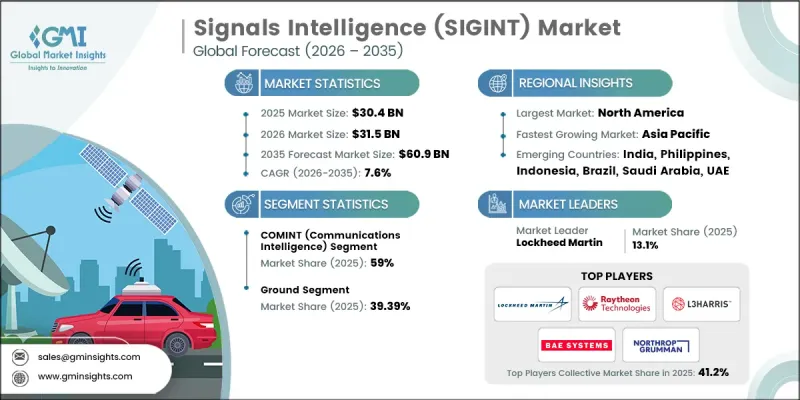
訊號與情報(SIGINT)產業正發展成為現代國防和國家安全戰略的關鍵支柱。不斷變化的地緣政治格局、日益成長的網路威脅、頻寬擁擠以及不斷擴大的電子戰活動,正迫使各國政府將訊號與情報能力從單純的輔助功能提升為核心戰略資產。情報機構越來越依賴先進的訊號與情報系統,以獲取即時情境察覺、識別新興威脅,並在複雜的安全環境中保持作戰優勢。不斷成長的國防預算、非對稱衝突場景以及全球通訊網路的快速數位化,正在加速先進訊號與情報平台的部署。解決方案正在陸、空、海、空各領域整合,建構多層次的情報網。人工智慧、機器學習、雲端分析和軟體定義架構等技術進步正在變革資料處理能力。先進的訊號偵測、自動分類和高速電磁資料流分析正在提升整個國防生態系統的作戰效率和情報準確性。
| 市場範圍 | |
|---|---|
| 開始年份 | 2025 |
| 預測期 | 2026-2035 |
| 初始市場規模 | 304億美元 |
| 預測金額 | 609億美元 |
| 複合年成長率 | 7.6% |
預計到2025年,通訊情報(COMINT)市場佔有率將達到59%,並在2035年之前以7.8%的複合年成長率成長。通訊情報之所以能保持其主導地位,是因為其對跨網路截獲和分析通訊訊號至關重要。通訊情報能夠提供有關敵方協調和意圖的可操作訊息,從而為國防、安全和戰略行動提供支援。隨著加密和多通道通訊變得日益複雜,對能夠處理大量資料並提供準確及時情報結果的先進通訊情報系統的需求也日益成長。
預計到2025年,地面訊號情報市場將佔據39.39%的市場佔有率,並在2026年至2035年間以6.2%的複合年成長率成長。由於其可靠性和對各種作戰環境的適應性,地面訊號情報平台在資訊作戰中繼續發揮核心作用。這些系統支援對戰略要地進行持續監視和訊號截獲。與更廣泛的國防網路整合,增強了指揮層面的決策和作戰協調能力。靈活的部署能力以及與其他資訊框架的互通性,進一步鞏固了該領域在訊號情報市場的主導地位。
美國訊號情報(SIGINT)市場佔93%的佔有率,預計2025年市場規模將達到164億美元。美國市場成長的主要驅動力是聯邦政府對國防現代化和情報能力的持續投入。日益加劇的地緣政治緊張局勢以及不斷擴大的網路戰和電子戰挑戰,正在強化對先進訊號情報技術的長期需求。國防和情報機構正優先考慮即時情報解決方案,以在多個作戰領域保持資訊優勢。人工智慧驅動的分析、雲端運算整合以及模組化系統結構的持續創新,正在加速技術升級,並延長訊號情報平台的生命週期。
目錄
第1章:調查方法
第2章執行摘要
第3章業界考察
- 生態系分析
- 供應商情況
- 利潤率分析
- 成本結構
- 每個階段增加的價值
- 影響價值鏈的因素
- 中斷
- 影響產業的因素
- 促進因素
- 國防現代化計劃的增加
- 網路攻擊和網路入侵激增。
- 人工智慧和機器學習的日益普及
- 擴展基於空間和衛星的訊號情報平台部署
- 擴大無人攜帶式訊號情報系統的使用
- 產業潛在風險與挑戰
- 先進訊號情報系統高成本
- 監管和隱私問題
- 市場機遇
- 來自私部門和私人公司的需求增加
- 新興市場訊號情報應用激增
- 與物聯網和5G網路整合的進展
- 管理型訊號情報服務模式的增加
- 多域資訊戰的興起
- 促進因素
- 成長潛力分析
- 監理情勢
- 北美洲
- 《外國情報監視法》(FISA)
- 國防授權法案(NDAA)
- 加拿大通訊安全局法案
- 受控產品計劃 (CGP)
- 歐洲
- 德國:電訊法(TKG)
- 英國:網路與資訊系統(NIS)安全法規
- 義大利:網路安全法令
- 法國:數位共和國法
- 亞太地區
- 中國:國家資訊法
- 印度:資訊科技(IT)法
- 日本:防止未授權存取法
- 澳洲:《關鍵基礎設施安全法》
- 拉丁美洲
- 巴西:國家情報法
- 墨西哥:《資訊與國家安全聯邦法》
- 阿根廷:網路防禦法規
- 中東和非洲(MEA)
- 阿拉伯聯合大公國:網路安全聯邦法規
- 沙烏地阿拉伯:網路安全與資訊保護架構(CIPF)
- 南非:《通訊相關資訊竊聽與提供法案》(RICA)
- 北美洲
- 波特的分析
- PESTEL 分析
- 科技與創新趨勢
- 當前技術趨勢
- 新興技術
- 專利分析
- 成本細分分析
- 永續性和環境影響分析
- 永續計劃
- 減少廢棄物策略
- 生產中的能源效率
- 具有環保意識的舉措
- 關於碳足跡的考量
- 國防採購與採購框架
- 平台架構和部署模型
- 訊號情報的演進,利用軟體定義和人工智慧驅動的架構。
- 多領域和跨領域情報的整合
- 未來前景與機遇
第4章 競爭情勢
- 介紹
- 企業市佔率分析
- 主要市場公司的競爭分析
- 競爭定位矩陣
- 主要進展
- 併購
- 夥伴關係與合作
- 新產品發布
- 業務拓展計劃及資金籌措
第5章 市場估計與預測:依類型分類,2022-2035年
- 通訊資訊 (COMINT)
- 電子情報(ELINT)
- FISINT(外國測量訊號資訊)
第6章 市場估計與預測:依應用領域分類,2022-2035年
- 網路
- 地面類型
- 機載
- 戰鬥機
- 運輸機
- 無人駕駛飛行器(UAV)
- 海軍
- 船
- 潛水艇
- 無人水面航行器(UMV)
- 宇宙
第7章 市場估計與預測:依運輸方式分類,2022-2035年
- 固定的
- 可攜式的
第8章 市場估算與預測:依最終用途分類,2022-2035年
- 軍事/國防
- 政府和執法機關
- 商業/私部門
第9章 市場估計與預測:依地區分類,2022-2035年
- 北美洲
- 美國
- 加拿大
- 歐洲
- 德國
- 英國
- 法國
- 義大利
- 西班牙
- 俄羅斯
- 比利時
- 荷蘭
- 亞太地區
- 中國
- 印度
- 日本
- 澳洲
- 韓國
- 菲律賓
- 印尼
- 拉丁美洲
- 巴西
- 墨西哥
- 阿根廷
- 中東和非洲(MEA)
- 南非
- 沙烏地阿拉伯
- 阿拉伯聯合大公國
第10章:公司簡介
- 世界公司
- BAE Systems
- Boeing Defense
- General Dynamics Mission Systems
- L3Harris Technologies
- Leonardo
- Lockheed Martin
- Northrop Grumman
- Raytheon Technologies
- Thales
- Mitsubishi Electric
- 當地公司
- Babcock International
- CACI International
- HENSOLDT
- Leidos
- QinetiQ
- Ultra Electronics
- 新興企業
- Kawasaki Heavy Industries
- Mercury Systems
- NEC Corporation
- Palantir Technologies
The Global Signals Intelligence (SIGINT) Market was valued at USD 30.4 billion in 2025 and is estimated to grow 7.6% to reach USD 60.9 billion by 2035.
The signals intelligence (SIGINT) industry is evolving into a critical pillar of modern defense and national security strategies. Shifting geopolitical dynamics, rising cyber threats, spectrum congestion, and expanding electronic warfare activities are driving governments to elevate SIGINT capabilities from supporting functions to central strategic assets. Intelligence agencies are increasingly relying on advanced SIGINT systems to obtain real-time situational awareness, identify emerging threats, and maintain operational superiority across complex security environments. Growing defense allocations, asymmetric conflict scenarios, and rapid digitalization of global communications networks are accelerating the deployment of sophisticated SIGINT platforms. Solutions across land, air, naval, and space domains are being integrated to provide multi-layered intelligence coverage. Technological advancements such as artificial intelligence, machine learning, cloud-enabled analytics, and software-defined architectures are transforming data processing capabilities. Enhanced signal detection, automated classification, and faster analysis of electromagnetic data streams are strengthening operational efficiency and intelligence accuracy across defense ecosystems.
| Market Scope | |
|---|---|
| Start Year | 2025 |
| Forecast Year | 2026-2035 |
| Start Value | $30.4 Billion |
| Forecast Value | $60.9 Billion |
| CAGR | 7.6% |
The communications intelligence (COMINT) segment held 59% share in 2025 and is projected to grow at a CAGR of 7.8% through 2035. COMINT maintains a dominant position due to the essential requirement to intercept and analyze communication signals across diverse networks. Its capability to provide actionable insights into adversarial coordination and intent supports defense, security, and strategic operations. The growing complexity of encrypted and multi-channel communications is increasing the need for advanced COMINT systems capable of managing high data volumes while delivering precise and timely intelligence outputs.
The ground segment held 39.39% share in 2025 and is anticipated to grow at a CAGR of 6.2% between 2026 and 2035. Ground-based SIGINT platforms remain central to intelligence operations due to their reliability and adaptability in various operational environments. These systems support continuous monitoring and signal interception in strategically sensitive locations. Their integration with broader defense networks enhances command-level decision-making and operational coordination. Flexible deployment capabilities and interoperability with other intelligence frameworks further reinforce the segment's leadership within the signals intelligence market.
United States Signals Intelligence (SIGINT) Market held 93% share, generating USD 16.4 billion in 2025. Market growth in the country is supported by sustained federal investment in defense modernization and intelligence capabilities. Rising geopolitical tensions and expanding cyber and electronic warfare challenges are strengthening long-term demand for advanced SIGINT technologies. Defense and intelligence agencies are prioritizing real-time intelligence solutions to maintain information superiority across multiple operational domains. Continuous innovation in AI-driven analytics, cloud computing integration, and modular system architectures is accelerating technology upgrades and extending the lifecycle performance of SIGINT platforms.
Key companies operating in the Global Signals Intelligence (SIGINT) Market include Lockheed Martin Corporation, Northrop Grumman Corporation, Raytheon Technologies Corporation (RTX), L3Harris Technologies, Inc., Thales, BAE Systems plc, Leidos Holdings, Mitsubishi Electric Corporation, QinetiQ Limited, and Ultra Electronics. Companies in the Signals Intelligence (SIGINT) Market are reinforcing their competitive position through sustained investment in research and development and strategic defense partnerships. Leading firms are integrating artificial intelligence, advanced analytics, and secure cloud architectures into next-generation SIGINT systems to enhance data processing speed and accuracy. Collaboration with government defense agencies and military organizations supports long-term contracts and modernization initiatives. Companies are also focusing on modular, software-defined platforms that allow scalable upgrades and lifecycle extensions. Expanding global presence through joint ventures and regional alliances strengthens market penetration.
Table of Contents
Chapter 1 Methodology
- 1.1 Research approach
- 1.2 Quality commitments
- 1.2.1 GMI AI policy & data integrity commitment
- 1.3 Research trail & confidence scoring
- 1.3.1 Research trail components
- 1.3.2 Scoring components
- 1.4 Data collection
- 1.4.1 Partial list of primary sources
- 1.5 Data mining sources
- 1.5.1 Paid sources
- 1.6 Base estimates and calculations
- 1.6.1 Base year calculation
- 1.7 Forecast model
- 1.8 Research transparency addendum
Chapter 2 Executive Summary
- 2.1 Industry 360° synopsis, 2022 - 2035
- 2.2 Key market trends
- 2.2.1 Regional
- 2.2.2 Type
- 2.2.3 Application
- 2.2.4 Mobility
- 2.2.5 End Use
- 2.3 TAM Analysis, 2026-2035
- 2.4 CXO perspectives: Strategic imperatives
- 2.4.1 Executive decision points
- 2.4.2 Critical success factors
- 2.5 Future outlook and strategic recommendations
Chapter 3 Industry Insights
- 3.1 Industry ecosystem analysis
- 3.1.1 Supplier landscape
- 3.1.2 Profit margin analysis
- 3.1.3 Cost structure
- 3.1.4 Value addition at each stage
- 3.1.5 Factor affecting the value chain
- 3.1.6 Disruptions
- 3.2 Industry impact forces
- 3.2.1 Growth drivers
- 3.2.1.1 Increase in defense modernization programs
- 3.2.1.2 Surge in cyberattacks and network intrusions
- 3.2.1.3 Rise in adoption of AI and machine learning
- 3.2.1.4 Increase in deployment of space- and satellite-based SIGINT platforms
- 3.2.1.5 Rise in use of unmanned and portable SIGINT systems
- 3.2.2 Industry pitfalls and challenges
- 3.2.2.1 High Costs of Advanced SIGINT Systems
- 3.2.2.2 Regulatory and Privacy Concerns
- 3.2.3 Market opportunities
- 3.2.3.1 Increase in demand from commercial and private sectors
- 3.2.3.2 Surge in SIGINT adoption in emerging markets
- 3.2.3.3 Rise in integration with IoT and 5G networks
- 3.2.3.4 Increase in managed SIGINT service models
- 3.2.3.5 Rise in multi-domain intelligence operations
- 3.2.1 Growth drivers
- 3.3 Growth potential analysis
- 3.4 Regulatory landscape
- 3.4.1 North America
- 3.4.1.1 Foreign Intelligence Surveillance Act (FISA)
- 3.4.1.2 National Defense Authorization Act (NDAA)
- 3.4.1.3 Communications Security Establishment Act (Canada)
- 3.4.1.4 Controlled Goods Program (CGP)
- 3.4.2 Europe
- 3.4.2.1 Germany: Telecommunications Act (TKG)
- 3.4.2.2 UK: Security of Network and Information Systems (NIS) Regulations
- 3.4.2.3 Italy: Legislative Decree on Cybersecurity
- 3.4.2.4 France: Digital Republic Act
- 3.4.3 Asia Pacific
- 3.4.3.1 China: National Intelligence Law
- 3.4.3.2 India: Information Technology (IT) Act
- 3.4.3.3 Japan: Act on Prohibition of Unauthorized Computer Access
- 3.4.3.4 Australia: Security of Critical Infrastructure Act
- 3.4.4 Latin America
- 3.4.4.1 Brazil: National Intelligence Law
- 3.4.4.2 Mexico: Federal Law on Intelligence and National Security
- 3.4.4.3 Argentina: Cyber Defense Regulations
- 3.4.5 MEA
- 3.4.5.1 UAE: Federal Decree Law on Cybersecurity
- 3.4.5.2 Saudi Arabia: Cybersecurity & Information Protection Framework (CIPF)
- 3.4.5.3 South Africa: Regulation of Interception of Communications and Provision of Communication-Related Information Act (RICA)
- 3.4.1 North America
- 3.5 Porter’s analysis
- 3.6 PESTEL analysis
- 3.7 Technology and Innovation landscape
- 3.7.1 Current technological trends
- 3.7.2 Emerging technologies
- 3.8 Patent analysis
- 3.9 Cost breakdown analysis
- 3.10 Sustainability and environmental impact analysis
- 3.10.1 Sustainable practices
- 3.10.2 Waste reduction strategies
- 3.10.3 Energy efficiency in production
- 3.10.4 Eco-friendly initiatives
- 3.10.5 Carbon footprint considerations
- 3.11 Defense Procurement & Acquisition Framework
- 3.12 Platform Architecture & Deployment Models
- 3.13 Software-Defined & AI-Enabled SIGINT Evolution
- 3.14 Multi-Domain & Cross-Intelligence Integration
- 3.15 Future outlook & opportunities
Chapter 4 Competitive Landscape, 2025
- 4.1 Introduction
- 4.2 Company market share analysis
- 4.2.1 North America
- 4.2.2 Europe
- 4.2.3 Asia Pacific
- 4.2.4 Latin America
- 4.2.5 MEA
- 4.3 Competitive analysis of major market players
- 4.4 Competitive positioning matrix
- 4.5 Key developments
- 4.5.1 Mergers & acquisitions
- 4.5.2 Partnerships & collaborations
- 4.5.3 New Product Launches
- 4.5.4 Expansion Plans and funding
Chapter 5 Market Estimates & Forecast, By Type, 2022 - 2035 ($Bn)
- 5.1 Key trends
- 5.2 COMINT (Communications Intelligence)
- 5.3 ELINT (Electronic Intelligence)
- 5.4 FISINT (Foreign Instrumentation Signals Intelligence)
Chapter 6 Market Estimates & Forecast, By Application, 2022 - 2035 ($Bn)
- 6.1 Key trends
- 6.2 Cyber & Network
- 6.3 Ground
- 6.4 Airborne
- 6.4.1 Fighter Jets
- 6.4.2 Transport Aircrafts
- 6.4.3 Unmanned Aerial Vehicles (UAVs)
- 6.5 Naval
- 6.5.1 Ships
- 6.5.2 Submarines
- 6.5.3 Unmanned Marine Vehicles (UMVs)
- 6.6 Space
Chapter 7 Market Estimates & Forecast, By Mobility, 2022 - 2035 ($Bn)
- 7.1 Key trends
- 7.2 Fixed
- 7.3 Portable
Chapter 8 Market Estimates & Forecast, By End Use, 2022 - 2035 ($Bn)
- 8.1 Key trends
- 8.2 Military & Defense
- 8.3 Government & Law Enforcement
- 8.4 Commercial & Private Sector
Chapter 9 Market Estimates & Forecast, By Region, 2022 - 2035 ($Bn)
- 9.1 Key trends
- 9.2 North America
- 9.2.1 US
- 9.2.2 Canada
- 9.3 Europe
- 9.3.1 Germany
- 9.3.2 UK
- 9.3.3 France
- 9.3.4 Italy
- 9.3.5 Spain
- 9.3.6 Russia
- 9.3.7 Belgium
- 9.3.8 Netherlands
- 9.4 Asia Pacific
- 9.4.1 China
- 9.4.2 India
- 9.4.3 Japan
- 9.4.4 Australia
- 9.4.5 South Korea
- 9.4.6 Philippines
- 9.4.7 Indonesia
- 9.5 Latin America
- 9.5.1 Brazil
- 9.5.2 Mexico
- 9.5.3 Argentina
- 9.6 MEA
- 9.6.1 South Africa
- 9.6.2 Saudi Arabia
- 9.6.3 UAE
Chapter 10 Company Profiles
- 10.1 Global Players
- 10.1.1 BAE Systems
- 10.1.2 Boeing Defense
- 10.1.3 General Dynamics Mission Systems
- 10.1.4 L3Harris Technologies
- 10.1.5 Leonardo
- 10.1.6 Lockheed Martin
- 10.1.7 Northrop Grumman
- 10.1.8 Raytheon Technologies
- 10.1.9 Thales
- 10.1.10 Mitsubishi Electric
- 10.2 Regional Players
- 10.2.1 Babcock International
- 10.2.2 CACI International
- 10.2.3 HENSOLDT
- 10.2.4 Leidos
- 10.2.5 QinetiQ
- 10.2.6 Ultra Electronics
- 10.3 Emerging Players
- 10.3.1 Kawasaki Heavy Industries
- 10.3.2 Mercury Systems
- 10.3.3 NEC Corporation
- 10.3.4 Palantir Technologies

 訊號情報全球市場:2026-2036年
 訊號情報(SIGINT)市場規模、佔有率和趨勢分析報告:按解決方案、類型、移動性、地區和細分市場預測(2026-2033 年)
 訊號情報市場:按組件、應用和最終用戶分類 - 2026-2032 年全球市場預測
 2026年全球訊號情報(SIGINT)市場報告2026年全球通訊智慧市場報告2026年全球網路支援服務市場報告
 交通號誌資訊市場 - 全球產業規模、佔有率、趨勢、機會及預測(按類型、應用、出行方式、地區和競爭格局分類,2021-2031年)訊號資訊系統市場按組件、平台類型、技術、部署模式、應用和最終用戶分類,全球預測(2026-2032年)訊號情報市場-全球產業規模、佔有率、趨勢、機會及預測(按類型(電子情報和通訊情報)、應用、移動性、地區和競爭格局分類,2020-2030 年預測)
 訊號情報(SIGNIT)市場(按類型、應用和地區)2026 年至 2032 年