

 |
市場調查報告書
商品編碼
1982353
地板清潔設備市場機會、成長要素、產業趨勢分析及2026-2035年預測。Floor Cleaning Equipment Market Opportunity, Growth Drivers, Industry Trend Analysis, and Forecast 2026 - 2035 |
||||||

預計到 2025 年,全球地面清潔設備市場價值將達到 1,780 億美元,並將以 13.8% 的複合年成長率成長,到 2035 年達到 6,241 億美元。
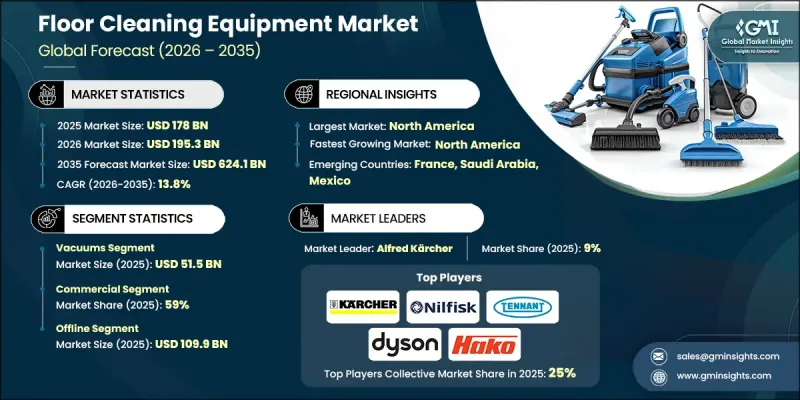
人們對住宅、商業和公共環境中的衛生和公共衛生標準的日益重視,正顯著推動市場擴張。乾淨且維護良好的地板越來越被認為是保障整體安全、舒適度和提升品牌形象的關鍵。消費者越來越重視外觀衛生的生活和職場環境,這正在改變傳統的清潔方式。企業不再只依賴人工,而是投資先進的設備型清潔解決方案,以提高營運效率並維持一致的衛生標準。同時,生活方式的改變、健康意識的增強以及對低塵室內環境的需求,也提高了屋主對清潔度的期望。使用者希望以最少的努力減少過敏原、改善室內空氣品質並保持美觀的空間,因此對高效且技術先進的地板清潔設備的需求不斷成長。快速的都市化、住宅基礎設施的擴張以及自動化清潔技術的創新,持續重塑全球地板清潔設備市場的競爭格局。
| 市場範圍 | |
|---|---|
| 開始年份 | 2025 |
| 預測期 | 2026-2035 |
| 上市時的市場規模 | 1780億美元 |
| 預測金額 | 6241億美元 |
| 複合年成長率 | 13.8% |
在住宅中,安裝高性能吸塵器以維持更健康的室內環境並簡化日常維護已成為日益流行的趨勢。人們對空氣中顆粒物和整體健康的擔憂正在影響他們的購買決策,促使住宅選擇耐用、節能且易於使用的產品。這種意識的增強推動了市場對能夠以更少的時間和精力實現卓越清潔效果的設備的需求。
預計到2025年,吸塵器市場規模將達到515億美元。吸塵器在日常清潔中扮演著核心角色,能夠有效率地吸除各種地面上的灰塵、污垢和細小顆粒。與傳統的掃地方式(可能將細小顆粒擴散到空氣中)不同,吸塵器系統利用吸力和過濾機制來收集污染物,直到進行處理。其便利性、穩定的性能以及能夠清潔難以觸及的角落,使其成為各種室內環境清潔的理想選擇。吸力、過濾技術和人體工學設計的不斷進步,正進一步推動著這個細分市場的成長。
到2025年,商業領域將佔據59%的市場。長期以來,地面清潔設備在商業環境中至關重要,因為商業環境需要對大占地面積進行持續的衛生管理。這些機器旨在提供快速、均勻且徹底的清潔效果,滿足嚴格的衛生標準和操作要求。人流量大的企業依賴高效的清潔系統來維護安全、符合法規要求並確保整體環境品質。與人工清潔方法相比,機械化清潔解決方案具有更高的一致性和生產效率,因此在商業設施中廣泛使用。
預計2025年,美國地面清潔設備市佔率將達到78.5%,市場規模將達428億美元。美國是全球最大的先進地面清潔設備市場之一,這得益於其完善的商業基礎設施和嚴格的清潔標準。隨著各組織機構優先考慮能夠提高效率、減少人工依賴並確保清潔標準一致的現代化自動化設備,市場需求仍然強勁。技術主導解決方案的加速普及仍然是美國市場格局的關鍵因素。
目錄
第1章:調查方法和範圍
第2章執行摘要
第3章業界考察
- 生態系分析
- 供應商情況
- 利潤率
- 每個階段增加的價值
- 影響價值鏈的因素
- 影響產業的因素
- 促進因素
- 人們越來越關注衛生和清潔問題
- 技術進步
- 從人工清潔過渡到機械化清潔
- 產業潛在風險與挑戰
- 高昂的維護和營運成本
- 與傳統清潔方法的競爭
- 機會
- 機器人和自動化系統的快速普及
- 醫療和公共設施領域的需求不斷成長
- 促進因素
- 成長潛力分析
- 未來市場趨勢
- 科技與創新趨勢
- 當前技術趨勢
- 新興技術
- 價格趨勢
- 按地區
- 透過裝置
- 監理情勢
- 標準和合規要求
- 區域法規結構
- 認證標準
- 波特的分析
- PESTEL 分析
第4章 競爭情勢
- 介紹
- 企業市佔率分析
- 按地區
- 企業矩陣分析
- 主要市場公司的競爭分析
- 競爭定位矩陣
- 主要進展
- 併購
- 夥伴關係與合作
- 新產品發布
- 業務拓展計劃
第5章 市場估算與預測:依設備類型分類,2022-2035年
- 洗滌器
- 搭乘用式洗滌器
- 推式洗地機
- 清掃機
- 吸塵器
- 立式吸塵器
- 臥式吸塵器
- 背包式吸塵器
- 機器人吸塵器
- 消失者
- 拋光機
- 擷取器
- 其他(落地式烘乾機)
第6章 市場估計與預測:依應用領域分類,2022-2035年
- 住宅
- 商業的
- 飯店及餐飲業
- 辦公室
- 其他
第7章 市場估計與預測:依價格分類,2022-2035年
- 低的
- 中等的
- 高的
第8章 市場估算與預測:依通路分類,2022-2035年
- 線上
- 電子商務
- 品牌官方網站
- 離線
- 超級市場
- 專賣店
- 其他(百貨公司等)
第9章 市場估計與預測:依地區分類,2022-2035年
- 北美洲
- 美國
- 加拿大
- 歐洲
- 德國
- 英國
- 法國
- 義大利
- 西班牙
- 亞太地區
- 中國
- 日本
- 印度
- 澳洲
- 韓國
- 拉丁美洲
- 巴西
- 墨西哥
- 阿根廷
- 中東和非洲
- 南非
- 沙烏地阿拉伯
- 阿拉伯聯合大公國
第10章:公司簡介
- Alfred Karcher
- Bosch
- Comac
- Dyson
- Eureka
- Factory Cat
- Fimap
- Haier
- Hako
- IPC Group
- LG
- Nilfisk
- Panasonic
- Taski
- Tennant
The Global Floor Cleaning Equipment Market was valued at USD 178 billion in 2025 and is estimated to grow at a CAGR of 13.8% to reach USD 624.1 billion by 2035.
Rising awareness of hygiene and sanitation standards across residential, commercial, and public environments is significantly driving market expansion. Clean and well-maintained floors are increasingly viewed as essential to overall safety, comfort, and brand perception. Consumers are placing greater emphasis on visibly sanitized living and working spaces, which has transformed traditional cleaning practices. Organizations are investing in advanced, equipment-driven cleaning solutions to improve operational efficiency and maintain consistent hygiene standards rather than relying solely on manual labor. At the same time, homeowners are elevating their cleanliness expectations due to lifestyle shifts, health awareness, and the desire for low-dust indoor environments. Demand for efficient and technologically advanced floor cleaning machines is rising as users seek to reduce allergens, enhance indoor air quality, and maintain visually appealing spaces with minimal effort. Rapid urbanization, growth in commercial infrastructure, and innovation in automated cleaning technologies continue to reshape the competitive landscape of the global floor cleaning equipment market.
| Market Scope | |
|---|---|
| Start Year | 2025 |
| Forecast Year | 2026-2035 |
| Start Value | $178 Billion |
| Forecast Value | $624.1 Billion |
| CAGR | 13.8% |
Residential consumers are increasingly adopting high-performance cleaning machines to support healthier indoor environments and simplify routine maintenance. Concerns about airborne particles and general well-being are influencing purchasing decisions, encouraging households to select durable, energy-efficient, and user-friendly products. As awareness grows, the preference for equipment that delivers superior cleaning outcomes with less time and effort is strengthening market demand.
In 2025, the vacuums segment accounted for USD 51.5 billion. Vacuum cleaners play a central role in daily cleaning by efficiently extracting dust, debris, and microscopic particles from various floor surfaces. Unlike conventional sweeping techniques that may disperse fine particles into the air, vacuum systems use suction and filtration mechanisms to contain contaminants until disposal. Their practicality, performance consistency, and ability to access hard-to-reach areas make them highly preferred for maintaining cleanliness across diverse indoor environments. Continuous advancements in suction power, filtration technology, and ergonomic design are further supporting segment growth.
The commercial segment held 59% share in 2025. Floor cleaning equipment has long been essential in commercial environments that require consistent sanitation across extensive floor areas. These machines are designed to deliver rapid, uniform, and thorough cleaning results, meeting strict hygiene standards and operational requirements. Businesses with high foot traffic depend on efficient cleaning systems to maintain safety, regulatory compliance, and overall environmental quality. Mechanized cleaning solutions provide greater consistency and productivity compared to manual methods, reinforcing their widespread adoption in commercial settings.
U.S. Floor Cleaning Equipment Market held 78.5% share, generating USD 42.8 billion in 2025. The country represents one of the largest global markets for advanced floor cleaning machines, supported by extensive commercial infrastructure and stringent cleanliness expectations. Demand remains strong as organizations prioritize modern, automated equipment that enhances efficiency, reduces labor dependency, and ensures uniform cleaning standards. Accelerated adoption of technology-driven solutions continues to characterize the U.S. market landscape.
Key companies operating in the Global Floor Cleaning Equipment Market include Tennant, Dyson, Nilfisk, Panasonic, Alfred Karcher, Hako, LG, Fimap, Comac, Haier, IPC Group, Eureka, Factory Cat, Bosch, and Taski. Companies in the Global Floor Cleaning Equipment Market are strengthening their competitive positioning through product innovation, automation, and global expansion strategies. Manufacturers are investing in research and development to introduce smart, sensor-enabled, and autonomous cleaning systems that enhance operational efficiency and reduce labor costs. Many firms are focusing on sustainability by developing energy-efficient models and incorporating environmentally responsible materials. Strategic partnerships with distributors and facility management providers are improving market reach and after-sales service capabilities. Companies are also expanding their presence in emerging markets while reinforcing brand visibility through digital marketing and e-commerce platforms.
Table of Contents
Chapter 1 Methodology and Scope
- 1.1 Market scope and definition
- 1.2 Research design
- 1.2.1 Research approach
- 1.2.2 Data collection methods
- 1.3 Data mining sources
- 1.3.1 Global
- 1.3.2 Regional/Country
- 1.4 Base estimates and calculations
- 1.4.1 Base year calculation
- 1.4.2 Key trends for market estimation
- 1.5 Primary research and validation
- 1.5.1 Primary sources
- 1.6 Forecast model
- 1.7 Research assumptions and limitations
Chapter 2 Executive Summary
- 2.1 Industry 360° synopsis
- 2.2 Key market trends
- 2.2.1 Regional
- 2.2.2 Equipment type
- 2.2.3 Application
- 2.2.4 Price
- 2.2.5 Distribution channel
- 2.3 CXO perspectives: Strategic imperatives
- 2.3.1 Key decision points for industry executives
- 2.3.2 Critical success factors for market players
- 2.4 Future outlook and strategic recommendations
Chapter 3 Industry Insights
- 3.1 Industry ecosystem analysis
- 3.1.1 Supplier landscape
- 3.1.2 Profit margin
- 3.1.3 Value addition at each stage
- 3.1.4 Factor affecting the value chain
- 3.2 Industry impact forces
- 3.2.1 Growth drivers
- 3.2.1.1 Rising focus on hygiene & cleanliness
- 3.2.1.2 Technological advancements
- 3.2.1.3 Shift from manual to mechanized cleaning
- 3.2.2 Industry pitfalls & challenges
- 3.2.2.1 High maintenance & operational costs
- 3.2.2.2 Competition with traditional cleaning methods
- 3.2.3 Opportunities
- 3.2.3.1 Rapid adoption of robotic & automated systems
- 3.2.3.2 Growing demand in healthcare & institutional sectors
- 3.2.1 Growth drivers
- 3.3 Growth potential analysis
- 3.4 Future market trends
- 3.5 Technology and innovation landscape
- 3.5.1 Current technological trends
- 3.5.2 Emerging technologies
- 3.6 Price trends
- 3.6.1 By region
- 3.6.2 By equipment type
- 3.7 Regulatory landscape
- 3.7.1 Standards and compliance requirements
- 3.7.2 Regional regulatory frameworks
- 3.7.3 Certification standards
- 3.8 Porter’s analysis
- 3.9 PESTEL analysis
Chapter 4 Competitive Landscape, 2025
- 4.1 Introduction
- 4.2 Company market share analysis
- 4.2.1 By region
- 4.2.1.1 North America
- 4.2.1.2 Europe
- 4.2.1.3 Asia Pacific
- 4.2.1.4 Latin America
- 4.2.1.5 Middle East and Africa
- 4.2.1 By region
- 4.3 Company matrix analysis
- 4.4 Competitive analysis of major market players
- 4.5 Competitive positioning matrix
- 4.6 Key developments
- 4.6.1 Mergers & acquisitions
- 4.6.2 Partnerships & collaborations
- 4.6.3 New product launches
- 4.6.4 Expansion plans
Chapter 5 Market Estimates and Forecast, By Equipment Type, 2022 - 2035 (USD Billion) (Thousand Units)
- 5.1 Key trends
- 5.2 Scrubbers
- 5.2.1 Ride-on scrubbers
- 5.2.2 Walk-behind scrubbers
- 5.3 Sweepers
- 5.4 Vacuums
- 5.4.1 Upright vacuums
- 5.4.2 Canister vacuums
- 5.4.3 Backpack vacuums
- 5.4.4 Robotic vacuums
- 5.5 Burnishers
- 5.6 Polishers
- 5.7 Extractors
- 5.8 Others (Floor Dryers)
Chapter 6 Market Estimates and Forecast, By Application, 2022 - 2035 (USD Billion) (Thousand Units)
- 6.1 Key trends
- 6.2 Residential
- 6.3 Commercial
- 6.3.1 Hotels & hospitality
- 6.3.2 Offices
- 6.3.3 Others
Chapter 7 Market Estimates and Forecast, By Price, 2022 - 2035 (USD Billion) (Thousand Units)
- 7.1 Key trends
- 7.2 Low
- 7.3 Medium
- 7.4 High
Chapter 8 Market Estimates and Forecast, By Distribution Channel, 2022 - 2035 (USD Billion) (Thousand Units)
- 8.1 Key trends
- 8.2 Online
- 8.2.1 E-commerce
- 8.2.2 Brand websites
- 8.3 Offline
- 8.3.1 Supermarkets
- 8.3.2 Specialty stores
- 8.3.3 Others (Departmental stores, etc.)
Chapter 9 Market Estimates and Forecast, By Region, 2022 - 2035 (USD Billion) (Thousand Units)
- 9.1 Key trends
- 9.2 North America
- 9.2.1 U.S.
- 9.2.2 Canada
- 9.3 Europe
- 9.3.1 Germany
- 9.3.2 UK
- 9.3.3 France
- 9.3.4 Italy
- 9.3.5 Spain
- 9.4 Asia Pacific
- 9.4.1 China
- 9.4.2 Japan
- 9.4.3 India
- 9.4.4 Australia
- 9.4.5 South Korea
- 9.5 Latin America
- 9.5.1 Brazil
- 9.5.2 Mexico
- 9.5.3 Argentina
- 9.6 Middle East and Africa
- 9.6.1 South Africa
- 9.6.2 Saudi Arabia
- 9.6.3 UAE
Chapter 10 Company Profiles
- 10.1 Alfred Karcher
- 10.2 Bosch
- 10.3 Comac
- 10.4 Dyson
- 10.5 Eureka
- 10.6 Factory Cat
- 10.7 Fimap
- 10.8 Haier
- 10.9 Hako
- 10.10 IPC Group
- 10.11 LG
- 10.12 Nilfisk
- 10.13 Panasonic
- 10.14 Taski
- 10.15 Tennant

 地板拋光服務市場:按服務類型、地板材料、合約類型、服務提供者、價格範圍、最終用戶分類,全球預測(2026-2032年)家用地面清潔設備市場:依產品類型、操作方式、應用和分銷管道分類-2026-2032年全球預測AI Ultra 二合一掃拖機器人市場:按連接方式、導航技術、地板類型、價格範圍、最終用戶和分銷管道分類的全球預測(2026-2032 年)
 2026-2030年全球地板墊市場地面清潔設備市場依產品類型、操作方式、動力來源、通路和最終用戶分類,全球預測(2026-2032年)
 磨床市場機會、成長要素、產業趨勢分析及預測(2026年至2035年)
 全球水泥漿清洗設備市場
 2025-2029年全球地板清潔機市場全球地板拋光機市場全球地板清潔機市場