

 |
市場調查報告書
商品編碼
1982345
工業熱泵市場機會、成長要素、產業趨勢分析及2026-2035年預測Industrial Heat Pump Market Opportunity, Growth Drivers, Industry Trend Analysis, and Forecast 2026 - 2035 |
||||||

預計到 2025 年,全球工業熱泵市場規模將達到 14.8 億美元,年複合成長率為 6.6%,到 2035 年將達到 27.9 億美元。
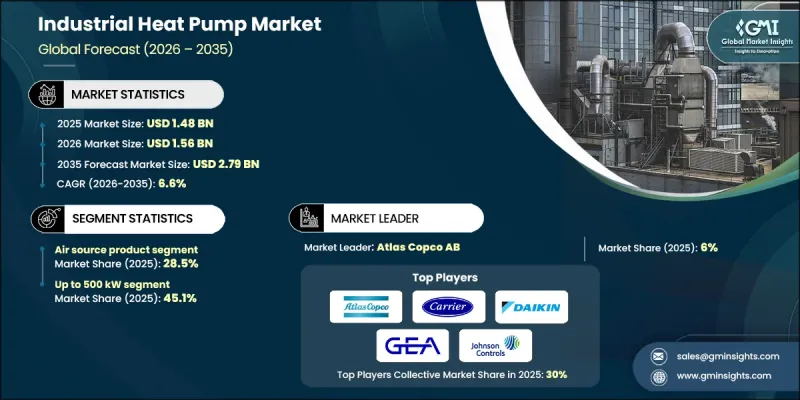
人們日益關注環境問題,並加強減少工業活動中的碳排放,這推動了對節能技術的需求。工業熱泵已成為回收和再利用低溫廢熱的關鍵解決方案,能夠提高效率和永續性。隨著越來越多的產業優先考慮減少對石化燃料的依賴,這些系統的應用正在加速。支持性的監管政策,加上不斷上漲的能源成本和永續性目標壓力,正在改變工業熱能的管理方式。工業工廠對高效供暖和製冷的需求,以及對逐步淘汰系統的日益關注,持續推動市場的發展勢頭。產業相關人員認知到熱泵在提高能源效率和降低營運成本方面的潛力。加之對乾淨科技和智慧基礎設施(尤其是在新興經濟體)投資的增加,預計未來幾年該市場將迎來強勁成長。
| 市場範圍 | |
|---|---|
| 開始年份 | 2025 |
| 預測期 | 2026-2035 |
| 初始市場規模 | 14.8億美元 |
| 預測金額 | 27.9億美元 |
| 複合年成長率 | 6.6% |
預計到2025年,空氣源熱泵市佔率將達到28.5%。工業應用領域對高效供暖、冷氣和熱水解決方案的需求不斷成長,以及人們對減少碳排放日益關注,預計將進一步鞏固該行業的發展前景。組件技術的持續進步,例如改進的熱泵壓縮機和冷媒的改進,提高了整體效率,正在加速空氣源熱泵的普及應用。此外,空氣源熱泵易於安裝、操作靈活、經濟高效,並且廣泛適用於各種工業流程,這些優勢也進一步推動了空氣源熱泵市場的成長。
預計到2025年,500kW以下功率段的市佔率將達到45.1%,並在2035年之前維持超過6.5%的複合年成長率。在工業領域,節能型暖氣和冷氣系統的應用日益普及,以降低營運成本和碳排放,從而推動了製造業、化工、食品飲料以及紙漿造紙等行業的需求成長。針對特定工業需求量身定做的先進熱泵技術的應用正在重塑市場格局,而各行業的快速普及進一步鞏固了其成長勢頭。
預計到2025年,美國工業熱泵市場將佔據75.6%的市場佔有率,市場規模達3.396億美元。北美市場預計將保持強勁成長,2026年至2035年的複合年成長率(CAGR)將達到7.2%。 《通貨膨脹控制法案》(IRA)等政策以及美國能源局(DOE)的定向津貼顯著降低了工業電氣化投資的門檻。能源密集型產業,尤其是食品飲料和紙漿造紙產業,正擴大採用熱泵來取代老舊的燃氣鍋爐,並滿足企業環境、社會和治理(ESG)目標。 2026年的技術進步將催生出能夠在加拿大和美國北部等惡劣環境下運作的高效機組,從而擴大目標市場。
目錄
第1章:調查方法和範圍
第2章執行摘要
第3章業界考察
- 生態系分析
- 供應商情況
- 利潤率
- 每個階段增加的價值
- 影響價值鏈的因素
- 影響產業的因素
- 促進因素
- 遏止工業排放的前景光明
- 大型工業應用領域的新投資流入
- 各主管機關支持的法規結構
- 產業潛在風險與挑戰
- 前期實施成本高
- 特種合金供應鏈的可變性
- 機會
- 工業製程脫碳
- 政府獎勵和支持政策
- 促進因素
- 成長潛力分析
- 未來市場趨勢
- 科技與創新趨勢
- 當前技術趨勢
- 新興技術
- 價格趨勢
- 按地區
- 依產品類型
- 監理情勢
- 標準和合規要求
- 區域法規結構
- 認證標準
- 波特五力分析
- PESTEL 分析
第4章 競爭情勢
- 介紹
- 企業市佔率分析
- 按地區
- 企業矩陣分析
- 主要市場公司的競爭分析
- 競爭定位矩陣
- 主要進展
- 併購
- 夥伴關係與合作
- 新產品發布
- 業務拓展計劃
第5章 市場估價與預測:依產品分類,2022-2035年
- 空氣源
- 地熱
- 水源
- 閉式循環機械熱泵
- 開式循環機械蒸氣壓縮熱泵
- 開式循環機械熱壓縮熱泵
- 封閉回路型吸收式熱泵
第6章 市場估計與預測:依產能分類,2022-2035年
- 500千瓦或以下
- 500千瓦至2兆瓦
- 2 MW~5 MW
- 超過5兆瓦
第7章 市場估計與預測:依溫度分類,2022-2035年
- 80~100°C
- 100~150°C
- 150~200°C
- 高於 200 度C
第8章 市場估計與預測:依應用領域分類,2022-2035年
- 工業的
- 造紙
- 食品/飲料
- 化學
- 鋼
- 機器
- 非金屬礦物
- 其他行業
- 區域供熱
第9章 市場估計與預測:依國家分類,2022-2035年
- 北美洲
- 美國
- 加拿大
- 歐洲
- 德國
- 英國
- 法國
- 義大利
- 西班牙
- 亞太地區
- 中國
- 日本
- 印度
- 澳洲
- 韓國
- 拉丁美洲
- 巴西
- 墨西哥
- 阿根廷
- 中東和非洲
- 南非
- 沙烏地阿拉伯
- 阿拉伯聯合大公國
第10章:公司簡介
- Armstrong International Inc.
- Atlas Copco AB
- Baker Hughes Company
- Carrier
- 大金應用歐洲有限公司
- Dalrada Climate Technology
- Ecop
- Emerson Electric Co.
- Enerin AS
- GEA Group Aktiengesellschaft
- Hien New Energy Equipment Co., Ltd.
- Johnson Controls
- MAN Energy Solutions
- OCHSNER
- Oilon Group Oy
- Piller Blowers &Compressors GmbH
- Qvantum Energi AB
- Swegon Ltd
- Trane Technologies International Limited
- Turboden SpA
The Global Industrial Heat Pump Market was valued at USD 1.48 billion in 2025 and is estimated to grow at a CAGR of 6.6% to reach USD 2.79 billion by 2035.
Rising environmental concerns and increased efforts to cut carbon emissions in industrial operations are pushing the demand for energy-efficient technologies. Industrial heat pumps have emerged as a key solution for capturing and repurposing low-temperature waste heat, enhancing both efficiency and sustainability. As more industries prioritize reducing reliance on fossil fuels, the adoption of these systems is accelerating. Supportive regulatory policies, combined with increasing energy costs and growing pressure to align with sustainability targets, are reshaping how industries manage thermal energy. The need for efficient heating and cooling across industrial plants, along with growing interest in phasing out outdated systems, continues to boost market momentum. Industrial players are recognizing the potential of heat pumps to improve energy performance while cutting operational expenditures. Coupled with rising investments in clean technologies and smart infrastructure, especially across emerging economies, the market is set to witness robust expansion in the years ahead.
| Market Scope | |
|---|---|
| Start Year | 2025 |
| Forecast Year | 2026-2035 |
| Start Value | $1.48 Billion |
| Forecast Value | $2.79 Billion |
| CAGR | 6.6% |
The air source heat pump segment held 28.5% share in 2025. Rising demand for efficient solutions in space heating, cooling, and hot water across industrial applications, coupled with the increasing focus on reducing carbon emissions, is expected to strengthen the industry outlook. Continuous advancements in component technologies, including improvements in heat pump compressors and refrigerants to enhance overall efficiency, are accelerating adoption. Additionally, the ease of installation, operational versatility, cost-effectiveness, and wide applicability across various industrial processes are further supporting the growth of the air source heat pump market.
The up to 500 kW segment accounted for 45.1% share in 2025 and is projected to grow at over 6.5% CAGR through 2035. Industrial sectors are increasingly deploying energy-efficient heating and cooling systems to lower operational costs and reduce carbon footprints, driving demand in manufacturing, chemical processing, food & beverage, and pulp & paper industries. The adoption of advanced heat pump technologies tailored to specific industrial requirements is reshaping the market, with rapid implementation across diverse sectors further enhancing the growth trajectory.
U.S. Industrial Heat Pump Market held 75.6% share in 2025, generating USD 339.6 million. North America is expected to grow at a strong CAGR of 7.2% from 2026 to 2035. Policies such as the Inflation Reduction Act (IRA) and targeted Department of Energy (DOE) grants are significantly reducing capital expenditure barriers for industrial electrification. Energy-intensive industries, particularly food & beverage and pulp & paper, are increasingly adopting heat pumps to replace aging gas-fired boilers and meet corporate ESG targets. Technological advances in 2026 have introduced high-efficiency units capable of operating under extreme conditions in Canada and northern U.S., broadening the addressable market.
Key players shaping the competitive landscape of the Global Industrial Heat Pump Market include Turboden S.p.A., Ecop, MAN Energy Solutions, Carrier, Qvantum Energi AB, Oilon Group Oy, Dalrada Climate Technology, Armstrong International Inc., Johnson Controls, Atlas Copco AB, GEA Group Aktiengesellschaft, Hien New Energy Equipment Co., Ltd., Daikin Applied Europe S.p.A., Trane Technologies International Limited, Swegon Ltd, Enerin AS, OCHSNER, Emerson Electric Co., Baker Hughes Company, and Piller Blowers & Compressors GmbH. To strengthen their positioning, companies in the industrial heat pump space are prioritizing strategic investments in product innovation and R&D to offer higher efficiency systems compatible with modern industrial demands. Several players are expanding global manufacturing capabilities and establishing local partnerships to cater to region-specific requirements. Firms are also aligning their portfolios with low-carbon and renewable energy trends, introducing systems capable of integrating with waste heat recovery and hybrid setups.
Table of Contents
Chapter 1 Methodology and Scope
- 1.1 Market scope and definition
- 1.2 Research design
- 1.2.1 Research approach
- 1.2.2 Data collection methods
- 1.3 Data mining sources
- 1.3.1 Countrywise
- 1.3.2 Regional/Country
- 1.4 Base estimates and calculations
- 1.4.1 Base year calculation
- 1.4.2 Key trends for market estimation
- 1.5 Primary research and validation
- 1.5.1 Primary sources
- 1.6 Forecast model
- 1.7 Research assumptions and limitations
Chapter 2 Executive Summary
- 2.1 Industry 360° synopsis
- 2.2 Key market trends
- 2.2.1 Regional
- 2.2.2 Product Type
- 2.2.3 By Power Range
- 2.2.4 Material/Construction
- 2.2.5 End-User
- 2.3 CXO perspectives: Strategic imperatives
- 2.3.1 Key decision points for industry executives
- 2.3.2 Critical success factors for market players
- 2.4 Future outlook and strategic recommendations
Chapter 3 Industry Insights
- 3.1 Industry ecosystem analysis
- 3.1.1 Supplier landscape
- 3.1.2 Profit margin
- 3.1.3 Value addition at each stage
- 3.1.4 Factor affecting the value chain
- 3.2 Industry impact forces
- 3.2.1 Growth drivers
- 3.2.1.1 Positive outlook to curb industrial emission levels
- 3.2.1.2 Influx of new investments across heavy-duty industrial applications
- 3.2.1.3 Encouraging regulatory framework by respective authorities
- 3.2.2 Industry pitfalls & challenges
- 3.2.2.1 Significant initial deployment cost
- 3.2.2.2 Supply Chain Volatility for Specialized Alloys
- 3.2.3 Opportunities
- 3.2.3.1 Decarbonization of industrial processes
- 3.2.3.2 Government incentives and supportive policies
- 3.2.1 Growth drivers
- 3.3 Growth potential analysis
- 3.4 Future market trends
- 3.5 Technology and innovation landscape
- 3.5.1 Current technological trends
- 3.5.2 Emerging technologies
- 3.6 Price trends
- 3.6.1 By region
- 3.6.2 By Product Type
- 3.7 Regulatory landscape
- 3.7.1 Standards and compliance requirements
- 3.7.2 Regional regulatory frameworks
- 3.7.3 Certification standards
- 3.8 Porter’s analysis
- 3.9 PESTEL analysis
Chapter 4 Competitive Landscape, 2025
- 4.1 Introduction
- 4.2 Company market share analysis
- 4.2.1 By region
- 4.2.1.1 North America
- 4.2.1.2 Europe
- 4.2.1.3 Asia Pacific
- 4.2.1.4 Latin America
- 4.2.1.5 Middle East and Africa
- 4.2.1 By region
- 4.3 Company matrix analysis
- 4.4 Competitive analysis of major market players
- 4.5 Competitive positioning matrix
- 4.6 Key developments
- 4.6.1 Mergers & acquisitions
- 4.6.2 Partnerships & collaborations
- 4.6.3 New product launches
- 4.6.4 Expansion plans
Chapter 5 Market Estimates and Forecast, By Product, 2022 - 2035 (USD Million) (Thousand Units)
- 5.1 Key trends
- 5.2 Air source
- 5.3 Ground source
- 5.4 Water source
- 5.5 Closed cycle mechanical heat pump
- 5.6 Open cycle mechanical vapor compression heat pump
- 5.7 Open cycle mechanical thermocompression heat pump
- 5.8 Closed cycle absorption heat pump
Chapter 6 Market Estimates and Forecast, By Capacity, 2022 - 2035 (USD Million) (Thousand Units)
- 6.1 Key trends
- 6.2 Up to 500 kW
- 6.3 > 500 kW to 2 MW
- 6.4 2 MW - 5 MW
- 6.5 > 5 MW
Chapter 7 Market Estimates and Forecast, By Temperature, 2022 - 2035 (USD Million) (Thousand Units)
- 7.1 Key trends
- 7.2 80 - 100 °C
- 7.3 100 - 150 °C
- 7.4 150 - 200 °C
- 7.5 > 200 °C
Chapter 8 Market Estimates and Forecast, By Application, 2022 - 2035 (USD Million) (Thousand Units)
- 8.1 Key trends
- 8.2 Industrial
- 8.2.1 Paper
- 8.2.2 Food & beverages
- 8.2.3 Chemical
- 8.2.4 Iron & Steel
- 8.2.5 Machinery
- 8.2.6 Non-Metallic minerals
- 8.2.7 Other industries
- 8.3 District heating
Chapter 9 Market Estimates and Forecast, By Country, 2022 - 2035 (USD Million) (Thousand Units)
- 9.1 Key trends
- 9.2 Key trends
- 9.3 North America
- 9.3.1 U.S.
- 9.3.2 Canada
- 9.4 Europe
- 9.4.1 Germany
- 9.4.2 UK
- 9.4.3 France
- 9.4.4 Italy
- 9.4.5 Spain
- 9.5 Asia Pacific
- 9.5.1 China
- 9.5.2 Japan
- 9.5.3 India
- 9.5.4 Australia
- 9.5.5 South Korea
- 9.6 Latin America
- 9.6.1 Brazil
- 9.6.2 Mexico
- 9.6.3 Argentina
- 9.7 Middle East and Africa
- 9.7.1 South Africa
- 9.7.2 Saudi Arabia
- 9.7.3 UAE
Chapter 10 Company Profiles
- 10.1 Armstrong International Inc.
- 10.2 Atlas Copco AB
- 10.3 Baker Hughes Company
- 10.4 Carrier
- 10.5 Daikin Applied Europe S.p.A.
- 10.6 Dalrada Climate Technology
- 10.7 Ecop
- 10.8 Emerson Electric Co.
- 10.9 Enerin AS
- 10.10 GEA Group Aktiengesellschaft
- 10.11 Hien New Energy Equipment Co., Ltd.
- 10.12 Johnson Controls
- 10.13 MAN Energy Solutions
- 10.14 OCHSNER
- 10.15 Oilon Group Oy
- 10.16 Piller Blowers & Compressors GmbH
- 10.17 Qvantum Energi AB
- 10.18 Swegon Ltd
- 10.19 Trane Technologies International Limited
- 10.20 Turboden S.p.A.

 2026-2030年全球工業熱泵市場
 菸葉空氣源熱泵乾燥機市場:依菸草類型、技術類型、容量範圍、電源、運作模式、通路分類,全球預測(2026-2032年)
 全球熱泵市場規模、佔有率、趨勢和成長分析報告(2026-2034年)
 全球工業熱泵市場:預測(至2034年)-按熱源、容量、溫度範圍、技術、最終用戶和地區進行分析
 2026年全球熱泵市場報告
 熱驅動熱泵市場-全球產業規模、佔有率、趨勢、機會、預測:依產品類型、應用、技術、地區和競爭格局分類,2021-2031年空氣源熱泵市場按類型、容量、應用和分銷管道分類-2026-2032年全球預測
 全球熱泵市場:市場佔有率分析、產業趨勢與統計、成長預測(2026-2031年)
 日本熱泵市場報告(按額定容量、產品類型、最終用途產業和地區分類,2026-2034 年)
 熱泵市場規模、佔有率和趨勢分析報告:按技術、容量、應用、運作方式、地區和細分市場預測(2026-2033 年)