

 |
市場調查報告書
商品編碼
1982307
智慧行李箱市場機會、成長要素、產業趨勢分析及2026-2035年預測Smart Luggage Market Opportunity, Growth Drivers, Industry Trend Analysis, and Forecast 2026 - 2035 |
||||||

全球智慧行李箱市場預計到 2025 年價值 21 億美元,並將以 13.6% 的複合年成長率成長,到 2035 年達到 73 億美元。
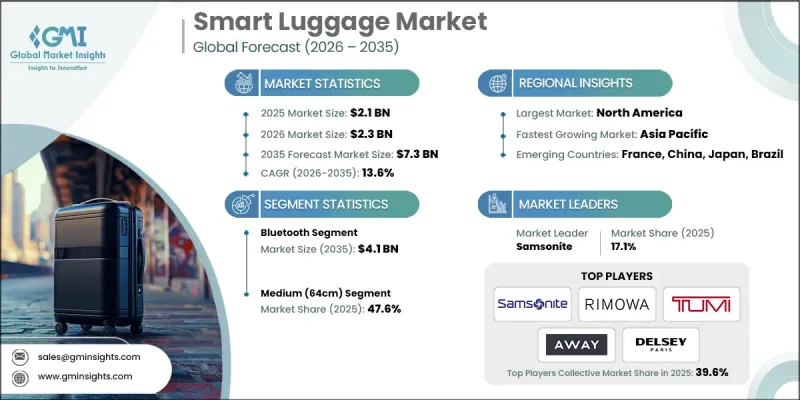
互聯通訊技術的快速創新以及國際旅行的普及推動了這個市場的成長。消費者越來越青睞那些能夠提升便利性、安全性和效率的功能,例如GPS定位、內建充電介面、藍牙連接和遠端鎖定系統。物聯網(IoT)在幫助用戶將行李箱連接到行動應用程式方面發揮著至關重要的作用,從而實現即時追蹤和電量查詢。電子商務平台透過提供便利的全球智慧行李箱選擇,進一步加速了市場普及,讓消費者能夠輕鬆比較不同型號並進行購買。從傳統零售通路向線上通路的轉變,使製造商能夠拓展其全球銷售網路,滿足消費者對高科技旅行產品日益成長的需求,並推動市場快速發展。
| 市場範圍 | |
|---|---|
| 開始年份 | 2025 |
| 預測期 | 2026-2035 |
| 上市時的市場規模 | 21億美元 |
| 預測金額 | 73億美元 |
| 複合年成長率 | 13.6% |
預計到2025年,藍牙市場規模將達到12億美元,2035年將達到41億美元。配備藍牙功能的行李箱可為旅客提供一定範圍內的即時追蹤,幫助他們快速找到行李,避免在機場延誤。除了追蹤功能外,藍牙行李箱通常還配備防篡改警報、內建秤以及其他多功能特性,進一步提升安全性和便利性,使其成為經常出差旅行人士的首選。
預計到2025年,中型智慧行李箱市場佔有率將達到47.6%。這些產品兼具容量和便攜性,並整合了GPS定位、可充電電池和自動鎖定等功能。這些功能滿足了消費者對安全、高科技且易於使用的旅行解決方案的需求,使用者還可以透過行動應用程式遠端監控和控制行李箱的各項功能。
到2025年,美國智慧行李箱市佔率將達到75.7%。該地區智慧行李箱的快速普及得益於GPS定位模組、應用程式整合和生物識別鎖的早期應用。美國消費者樂於接受兼具便利性、安全性和互聯性的創新產品,而領先品牌也持續將先進的數位技術融入高級產品中。
目錄
第1章:調查方法和範圍
第2章執行摘要
第3章業界考察
- 生態系分析
- 供應商情況
- 利潤率
- 每個階段增加的價值
- 影響價值鏈的因素
- 影響產業的因素
- 促進因素
- 消費者對便利性和安全性的需求日益成長
- 技術進步
- 可支配所得增加
- 產業潛在風險與挑戰
- 對配備先進技術的行李箱的需求日益成長。
- 疫情後旅遊需求的復甦和電子商務的擴張推動了成長。
- 機會
- 智慧行李箱價格高昂,阻礙了其廣泛普及。
- 安全、隱私和航空監管風險
- 促進因素
- 成長潛力分析
- 未來市場趨勢
- 科技與創新趨勢
- 當前技術趨勢
- 新興技術
- 價格趨勢
- 按地區
- 監理情勢
- 標準和合規要求
- 區域法規結構
- 認證標準
- 貿易統計
- 主要進口國
- 主要出口國
- 波特五力分析
- PESTEL 分析
- 消費行為分析
- 購買模式
- 偏好分析
- 不同地區的消費行為差異
- 電子商務對購買決策的影響
第4章 競爭情勢
- 介紹
- 企業市佔率分析
- 按地區
- 企業矩陣分析
- 主要市場公司的競爭分析
- 競爭定位矩陣
- 主要進展
- 併購
- 夥伴關係與合作
- 新產品發布
- 業務拓展計劃
第5章 市場估計與預測:依技術分類,2022-2035年
- 感應器
- SIM卡
- USB充電
第6章 市場規模估算與預測(2022-2035年)
- 小號(55公分)
- 中號(64公分)
- 大號(77公分)
第7章 市場估計與預測:以連結方式分類,2022-2035年
- Wi-Fi
- Bluetooth
- GPS
- RFID
第8章 市場估算與預測:依殼類型分類,2022-2035年
- 硬殼
- 軟殼
第9章 市場估計與預測:依材料分類,2022-2035年
- 帆布
- 塑膠
- 尼龍
- 聚酯纖維
- 其他(聚碳酸酯等)
第10章 市場估價與預測:依應用領域分類,2022-2035年
- 即時追蹤
- 近距離警報
- 遙控鎖
- 電子稱重
- 其他(例如,智慧打包助理)
第11章 市場估價與預測:依價格分類,2022-2035年
- 低的
- 中等的
- 高的
第12章 市場估計與預測:依通路分類,2022-2035年
- 線上
- 電子商務
- 企業網站
- 離線
- 超級市場/大賣場
- 專賣店
- 其他(個體店、百貨公司等)
第13章 市場估計與預測:依地區分類,2022-2035年
- 北美洲
- 美國
- 加拿大
- 歐洲
- 德國
- 法國
- 英國
- 義大利
- 西班牙
- 亞太地區
- 中國
- 印度
- 日本
- 韓國
- 澳洲
- 拉丁美洲
- 巴西
- 墨西哥
- 阿根廷
- 中東和非洲(MEA)
- 南非
- 沙烏地阿拉伯
- 阿拉伯聯合大公國
第14章:公司簡介
- Airwheel Holding
- Arista Vault
- Away Travel
- Briggs & Riley Travelware
- Delsey
- ForwardX Robotics(Ovis)
- Horizn Studios
- July
- Level8
- Rimowa
- Samsara Luggage
- Samsonite
- Travelpro International
- Tumi
- Victorinox
The Global Smart Luggage Market was valued at USD 2.1 billion in 2025 and is estimated to grow at a CAGR of 13.6% to reach USD 7.3 billion by 2035.
The market growth is fueled by rapid innovations in connectivity and communication technologies, combined with the expansion of international travel. Consumers are increasingly drawn to features such as GPS tracking, built-in charging ports, Bluetooth connectivity, and remote locking systems, which enhance convenience, safety, and efficiency. The Internet of Things (IoT) plays a key role by enabling users to connect their luggage to mobile applications, allowing real-time tracking and battery monitoring. E-commerce platforms further accelerate market adoption by providing easy access to global smart luggage options, allowing consumers to compare models and purchase with convenience. The shift from traditional retail to online channels has allowed manufacturers to expand their reach worldwide, meeting the growing demand for technologically advanced travel gear and reinforcing the market's rapid evolution.
| Market Scope | |
|---|---|
| Start Year | 2025 |
| Forecast Year | 2026-2035 |
| Start Value | $2.1 Billion |
| Forecast Value | $7.3 Billion |
| CAGR | 13.6% |
The Bluetooth segment accounted for USD 1.2 billion in 2025 and is expected to reach USD 4.1 billion by 2035. Bluetooth-enabled luggage provides travelers with real-time tracking over defined distances, giving them the ability to locate bags quickly and avoid delays at airports. Beyond tracking, Bluetooth luggage often includes tamper alerts, built-in scales, and multi-functional features that enhance security and user convenience, making it a preferred choice for frequent travelers.
The medium-sized smart luggage segment held a 47.6% share in 2025. These products offer an optimal balance between capacity and portability, integrating GPS tracking, rechargeable batteries, and automatic locks. Such features cater to consumer demand for secure, tech-enabled, and easy-to-use travel solutions, with applications managed via mobile apps that allow users to monitor and control luggage functions remotely.
U.S. Smart Luggage Market held 75.7% share in 2025. The region's early adoption of GPS-enabled modules, app-synced features, and biometric locks has driven rapid uptake of smart luggage. Consumers in the U.S. embrace innovations that combine convenience, security, and connectivity, while leading brands continue integrating advanced digital technologies into premium offerings.
Key players in the Global Smart Luggage Market include Airwheel Holding, Arista Vault, Away Travel, Briggs & Riley Travelware, Delsey, ForwardX Robotics (Ovis), Horizn Studios, July, Level8, Rimowa, Samsara Luggage, Samsonite, Travelpro International, Tumi, and Victorinox. Companies in the Global Smart Luggage Market strengthen their position by investing in R&D to enhance connectivity features, battery efficiency, and security systems. They are forming strategic collaborations with technology firms and travel solution providers to integrate mobile applications, IoT, and AI-driven tracking solutions. Expanding e-commerce presence and leveraging global online marketplaces allows them to reach international consumers efficiently. Firms are also introducing mid-to-premium product lines to cater to different traveler segments while offering customizable luggage solutions, ensuring brand differentiation. Marketing campaigns focusing on convenience, safety, and innovation further help these companies capture consumer attention and expand market share.
Table of Contents
Chapter 1 Methodology & Scope
- 1.1 Research approach
- 1.2 Quality Commitments
- 1.3 GMI AI policy & data integrity commitment
- 1.3.1 Source consistency protocol
- 1.4 Research Trail & Confidence Scoring
- 1.4.1 Research Trail Components
- 1.4.2 Scoring Components
- 1.5 Data Collection
- 1.5.1 Partial list of primary sources
- 1.6 Data mining sources
- 1.7 Paid sources
- 1.7.1 Sources, by region
- 1.8 Base estimates and calculations
- 1.8.1 Base year calculation for any one approach
- 1.9 Forecast model
- 1.9.1 Quantified market impact analysis
- 1.9.1.1 Mathematical impact of growth parameters on forecast
- 1.9.1 Quantified market impact analysis
- 1.10 Research transparency addendum
- 1.10.1 Source attribution framework
- 1.10.2 Quality assurance metrics
- 1.10.3 Our commitment to trust
Chapter 2 Executive Summary
- 2.1 Industry 360° synopsis
- 2.2 Key market trends
- 2.2.1 Regional
- 2.2.2 Technology
- 2.2.3 Size
- 2.2.4 Connectivity
- 2.2.5 Shell Type
- 2.2.6 Material
- 2.2.7 Application
- 2.2.8 Price
- 2.2.9 Distribution Channel
Chapter 3 Industry Insights
- 3.1 Industry ecosystem analysis
- 3.1.1 Supplier landscape
- 3.1.2 Profit margin
- 3.1.3 Value addition at each stage
- 3.1.4 Factor affecting the value chain
- 3.2 Industry impact forces
- 3.2.1 Growth drivers
- 3.2.1.1 Rising consumer demand for convenience and security
- 3.2.1.2 Technological advancements
- 3.2.1.3 Increased disposable income
- 3.2.2 Industry pitfalls & challenges
- 3.2.2.1 Rising demand for advanced, tech-enabled luggage
- 3.2.2.2 Growth driven by post-pandemic travel recovery & e-commerce expansion
- 3.2.3 Opportunities
- 3.2.3.1 High cost of smart luggage limiting mass adoption
- 3.2.3.2 Security, privacy, and airline regulation risks
- 3.2.1 Growth drivers
- 3.3 Growth potential analysis
- 3.4 Future market trends
- 3.5 Technology and innovation landscape
- 3.5.1 Current technological trends
- 3.5.2 Emerging technologies
- 3.6 Price trends
- 3.6.1 By region
- 3.7 Regulatory landscape
- 3.7.1 Standards and compliance requirements
- 3.7.2 Regional regulatory frameworks
- 3.7.3 Certification standards
- 3.8 Trade statistics
- 3.8.1 Major importing countries
- 3.8.2 Major exporting countries
- 3.9 Porter's analysis
- 3.10 PESTEL analysis
- 3.11 Consumer behaviour analysis
- 3.11.1 Purchasing patterns
- 3.11.2 Preference analysis
- 3.11.3 Regional variations in consumer behaviour
- 3.11.4 Impact of e-commerce on buying decisions
Chapter 4 Competitive Landscape, 2025
- 4.1 Introduction
- 4.2 Company market share analysis
- 4.2.1 By region
- 4.2.1.1 North America
- 4.2.1.2 Europe
- 4.2.1.3 Asia Pacific
- 4.2.1.4 Latin America
- 4.2.1.5 Middle East and Africa
- 4.2.1 By region
- 4.3 Company matrix analysis
- 4.4 Competitive analysis of major market players
- 4.5 Competitive positioning matrix
- 4.6 Key developments
- 4.6.1 Mergers & acquisitions
- 4.6.2 Partnerships & collaborations
- 4.6.3 New product launches
- 4.6.4 Expansion plans
Chapter 5 Market Estimates & Forecast, By Technology, 2022-2035 (USD Billion) (Thousand Units)
- 5.1 Key trends
- 5.2 Sensors
- 5.3 SIM cards
- 5.4 USB charging
Chapter 6 Market Estimates & Forecast, By Size, 2022-2035 (USD Billion) (Thousand Units)
- 6.1 Key trends
- 6.2 Small (55cm)
- 6.3 Medium (64cm)
- 6.4 Large (77 cm)
Chapter 7 Market Estimates & Forecast, By Connectivity, 2022-2035 (USD Billion) (Thousand Units)
- 7.1 Key trends
- 7.2 Wi-Fi
- 7.3 Bluetooth
- 7.4 GPS
- 7.5 RFID
Chapter 8 Market Estimates & Forecast, By Shell Type, 2022-2035 (USD Billion) (Thousand Units)
- 8.1 Key trends
- 8.2 Hard shell
- 8.3 Soft shell
Chapter 9 Market Estimates & Forecast, By Material, 2022-2035 (USD Billion) (Thousand Units)
- 9.1 Key trends
- 9.2 Canvas
- 9.3 Plastic
- 9.4 Nylon
- 9.5 Polyester
- 9.6 Others (polycarbonate etc.)
Chapter 10 Market Estimates & Forecast, By Application, 2022-2035 (USD Billion) (Thousand Units)
- 10.1 Key trends
- 10.2 Real-time tracking
- 10.3 Proximity alerts
- 10.4 Remote locking
- 10.5 Digital scaling
- 10.6 Others (smart packing assistants etc.)
Chapter 11 Market Estimates & Forecast, By Price, 2022-2035 (USD Billion) (Thousand Units)
- 11.1 Key trends
- 11.2 Low
- 11.3 Medium
- 11.4 High
Chapter 12 Market Estimates & Forecast, By Distribution Channel, 2022-2035 (USD Billion) (Thousand Units)
- 12.1 Key trends
- 12.2 Online
- 12.2.1 E-Commerce
- 12.2.2 Company website
- 12.3 Offline
- 12.3.1 Supermarkets/Hypermarkets
- 12.3.2 Specialty Stores
- 12.3.3 Others (Individual stores, Departmental stores, etc.)
Chapter 13 Market Estimates & Forecast, By Region, 2022-2035 (USD Billion) (Thousand Units)
- 13.1 Key trends
- 13.2 North America
- 13.2.1 U.S.
- 13.2.2 Canada
- 13.3 Europe
- 13.3.1 Germany
- 13.3.2 France
- 13.3.3 UK
- 13.3.4 Italy
- 13.3.5 Spain
- 13.4 Asia Pacific
- 13.4.1 China
- 13.4.2 India
- 13.4.3 Japan
- 13.4.4 South Korea
- 13.4.5 Australia
- 13.5 Latin America
- 13.5.1 Brazil
- 13.5.2 Mexico
- 13.5.3 Argentina
- 13.6 MEA
- 13.6.1 South Africa
- 13.6.2 Saudi Arabia
- 13.6.3 UAE
Chapter 14 Company Profiles
- 14.1 Airwheel Holding
- 14.2 Arista Vault
- 14.3 Away Travel
- 14.4 Briggs & Riley Travelware
- 14.5 Delsey
- 14.6 ForwardX Robotics (Ovis)
- 14.7 Horizn Studios
- 14.8 July
- 14.9 Level8
- 14.10 Rimowa
- 14.11 Samsara Luggage
- 14.12 Samsonite
- 14.13 Travelpro International
- 14.14 Tumi
- 14.15 Victorinox

 全球智慧行李箱市場規模、佔有率、趨勢和成長分析報告(2026-2034)
 智慧行李箱市場-全球產業規模、佔有率、趨勢、機會及預測(按技術、連接方式、應用、地區和競爭格局分類,2021-2031年)
 智慧行李掛鎖市場:鎖類型、通路、客戶群、鎖定機制、材料、電源、連接方式、性別、全球預測(2026-2032年)智慧行李箱市場按產品類型、功能、價格範圍、技術、最終用戶和分銷管道分類,全球預測(2026-2032)
 智慧行李箱市場規模、佔有率和成長分析(按技術、尺寸、連接方式、外殼類型、材料、應用、價格分佈、分銷管道和地區分類)—2026-2033年產業預測
 智慧行李標籤銷售市場報告:趨勢、預測和競爭分析(至 2031 年)智慧行李箱市場:依連結性、材料、分銷管道和地區分類,2026 年至 2032 年全球智慧行李箱市場:未來預測(2025-2030)