


 |
市場調查報告書
商品編碼
1982306
流動化學市場機會、成長要素、產業趨勢分析及2026-2035年預測Flow Chemistry Market Opportunity, Growth Drivers, Industry Trend Analysis, and Forecast 2026 - 2035 |
||||||

全球流動化學市場預計到 2025 年價值 20 億美元,預計到 2035 年將以 7.2% 的複合年成長率成長至 41 億美元。
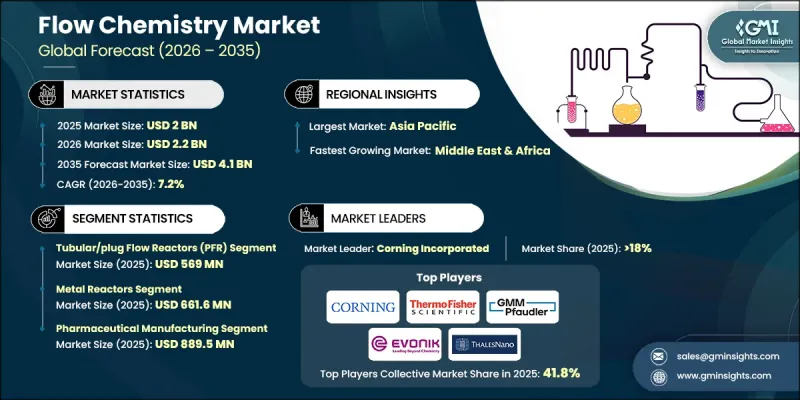
製藥業向連續生產的轉型正顯著推動市場擴張。美國FDA等監管機構積極推廣連續生產流程,因為它能夠提高產品品質、增強過程控制並縮短生產前置作業時間。流動化學能夠安全處理高活性中間體,同時支援即時監控,並符合品質源自於設計(QbD)原則和先進的製程最佳化。隨著製藥企業生產設施的現代化,對流動系統的需求持續成長。對永續和環保化學實踐的日益重視進一步加速了流動技術的應用。與傳統的間歇式生產相比,連續流動製程消耗的溶劑較少、產生的廢棄物較少,通常所需的能源也較低。更嚴格的環境法規和全球永續性努力正迫使製造商轉向更清潔的生產技術。流動化學透過實現更可控的反應並最大限度地減少對環境的影響,為實現這些目標提供了支持。微反應器工程和模組化流動平台的進步也透過提高擴充性、柔軟性和操作響應能力,進一步鞏固了市場地位。
| 市場範圍 | |
|---|---|
| 開始年份 | 2025 |
| 預測期 | 2026-2035 |
| 上市時的市場規模 | 20億美元 |
| 預測金額 | 41億美元 |
| 複合年成長率 | 7.2% |
2025年,管式或活塞流反應器(PFR)市場規模將達5.69億美元。反應器類型的細分反映了化學製程策略的明顯轉變,製造商力求在適應性、擴充性和運作性能之間取得平衡。間歇式反應器因其能夠適應多種產品線並實現小規模規模生產的精確控制,仍保持較高的應用率。然而,化學技術的進步,以及日益嚴格的安全和環境法規,正迫使企業重新考慮傳統的間歇式配置。這種轉變在傳熱需求高和涉及危險中間體的製程中尤其明顯,因為在這些製程中,連續性系統通常在可控性和安全性方面更具優勢。
預計到2025年,金屬反應器市場規模將達到6.616億美元。隨著業界採用針對特定化學應用和連續加工需求的客製化系統,反應器的選擇也呈現出明顯的專業化趨勢。管式反應器、活塞流反應器(PFR)和連續攪拌釜式反應器(CSTR)因其運作可靠性和擴充性而仍然廣受歡迎。在催化應用領域,填充床反應器和固定台反應器因其能夠改善催化劑相互作用和提高整體反應效率,正日益受到業界的認可。同時,微結構反應器也因其緊湊的結構能夠實現卓越的傳熱傳質性能,從而支援高度可控和精確的合成工藝,而備受關注。
預計2025年,北美流動化學市場規模將達到2.995億美元。這一區域市場的擴張主要得益於製藥、特種化學品和生技產業對連續生產技術的日益普及。美國在區域市場中佔據重要佔有率,這得益於其在工藝創新方面的巨額投資、先進合成技術的廣泛應用以及強大的研究機構和合約開發與生產組織(CDMO)網路。製造商正擴大利用流動化學來提高反應效率、增強操作安全性並確保符合法規要求,尤其是在複雜和高風險的化學製程中。
目錄
第1章:調查方法和範圍
第2章執行摘要
第3章業界考察
- 生態系分析
- 供應商情況
- 利潤率
- 每個階段增加的價值
- 影響價值鏈的因素
- 中斷
- 影響產業的因素
- 促進因素
- 製藥業連續生產製程的推廣應用
- 大力推動綠色永續化學
- 微反應器和模組化系統的技術進步
- 產業潛在風險與挑戰
- 大筆初始投資
- 與傳統基礎設施整合相關的挑戰
- 市場機遇
- 在光化學和電化學等新興應用領域的拓展
- 對客製化、模組化和滑座式系統的需求日益成長
- 促進因素
- 成長潛力分析
- 監理情勢
- 北美洲
- 歐洲
- 亞太地區
- 拉丁美洲
- 中東和非洲
- 波特的分析
- PESTEL 分析
- 價格趨勢
- 按地區
- 產品類型
- 未來市場趨勢
- 科技與創新趨勢
- 當前技術趨勢
- 新興技術
- 專利趨勢
- 貿易統計資料(HS編碼)(註:僅提供主要國家的貿易統計資料)
- 主要進口國
- 主要出口國
- 永續性和環境方面
- 永續計劃
- 減少廢棄物策略
- 生產中的能源效率
- 環保意識的舉措
- 關於碳足跡的考量
第4章 競爭情勢
- 介紹
- 企業市佔率分析
- 按地區
- 北美洲
- 歐洲
- 亞太地區
- 拉丁美洲
- 中東和非洲
- 按地區
- 企業矩陣分析
- 主要市場公司的競爭分析
- 競爭定位矩陣
- 主要進展
- 併購
- 夥伴關係與合作
- 新產品發布
- 業務拓展計劃
第5章 市場估算與預測:依反應器類型分類,2022-2035年
- 管式/活塞流反應器(PFR)
- 微結構反應器
- 填充床/固定床反應器
- 連續攪拌釜式反應器(CSTR)
- 光化學流體反應器
- 電化學流動反應器
- 振盪流反應器(OFR)
- 混合和整合系統
- 其他
第6章 市場估算與預測:依材料類型分類,2022-2035年
- 聚合物反應器
- 金屬反應器
- 玻璃/石英反應器
- 陶瓷/矽反應器
- 其他材料
第7章 市場估計與預測:依應用領域分類,2022-2035年
- 製藥生產
- 精細化學品生產
- 石油化學加工
- 農藥生產
- 其他
第8章 市場估計與預測:依地區分類,2022-2035年
- 北美洲
- 美國
- 加拿大
- 歐洲
- 德國
- 英國
- 法國
- 西班牙
- 義大利
- 其他歐洲地區
- 亞太地區
- 中國
- 印度
- 日本
- 澳洲
- 韓國
- 亞太其他地區
- 拉丁美洲
- 巴西
- 墨西哥
- 其他拉丁美洲地區
- 中東和非洲
- 沙烏地阿拉伯
- 南非
- 阿拉伯聯合大公國
- 其他中東和非洲地區
第9章:公司簡介
- Thermo Fisher Scientific
- Xylem Inc.
- Alfa Laval AB
- SPX Technologies Inc.
- Sulzer Ltd.
- Corning Incorporated
- Syrris Ltd.
- Vapourtec Ltd.
- Chemtrix BV
- Evonik
- Zibo Taiji Industrial Enamel Co.,Ltd
- GMM Pfaudler
The Global Flow Chemistry Market was valued at USD 2 billion in 2025 and is estimated to grow at a CAGR of 7.2% to reach USD 4.1 billion by 2035.
The rising shift toward continuous manufacturing in the pharmaceutical sector is significantly contributing to market expansion. Regulatory bodies such as the U.S. FDA actively encourage continuous processing due to its ability to improve product quality, enhance process control, and shorten production timelines. Flow chemistry enables the safe handling of highly reactive intermediates while supporting real-time monitoring, aligning with Quality by Design principles and advanced process optimization. As pharmaceutical manufacturers modernize production facilities, demand for flow-based systems continues to grow. Growing emphasis on sustainable and green chemistry practices is further accelerating adoption. Continuous flow processes consume less solvent, generate lower waste volumes, and typically require reduced energy compared to conventional batch operations. Increasing environmental regulations and global sustainability initiatives are encouraging manufacturers to transition toward cleaner production technologies. Flow chemistry supports these objectives by enabling more controlled reactions with minimized environmental impact. Advancements in microreactor engineering and modular flow platforms are also strengthening the market by improving scalability, flexibility, and operational responsiveness.
| Market Scope | |
|---|---|
| Start Year | 2025 |
| Forecast Year | 2026-2035 |
| Start Value | $2 Billion |
| Forecast Value | $4.1 Billion |
| CAGR | 7.2% |
The tubular or plug flow reactors (PFR) segment reached USD 569 million in 2025. Segmentation by reactor type reflects a clear shift in chemical processing strategies, as manufacturers aim to balance adaptability, scalability, and operational performance. Batch reactors continue to maintain strong adoption due to their versatility in handling multiple product lines and enabling precise control in small- to mid-scale production. However, advancements in chemical engineering technologies, along with more rigorous safety and environmental regulations, are prompting companies to reassess traditional batch configurations. This transition is particularly evident in processes involving high heat transfer demands or hazardous intermediates, where continuous systems often provide enhanced control and safety advantages.
The metal reactors segment captured USD 661.6 million in 2025. Increasing specialization in reactor selection is evident as industries adopt systems tailored to specific chemical applications and continuous processing requirements. Tubular or plug flow reactors (PFR) and continuous stirred-tank reactors (CSTR) remain widely preferred due to their operational reliability and scalability. In catalytic applications, packed-bed and fixed-bed reactors are gaining stronger industry acceptance because they improve catalyst interaction and overall reaction efficiency. At the same time, microstructured reactors are drawing growing research attention, as their compact configurations enable superior heat and mass transfer performance, supporting highly controlled and precise synthesis processes.
North America Flow Chemistry Market generated USD 299.5 million in 2025. The region's expansion is driven by the growing implementation of continuous manufacturing across pharmaceuticals, specialty chemicals, and biotechnology sectors. The United States holds the dominant regional share, supported by significant investments in process innovation, widespread adoption of advanced synthesis technologies, and a strong network of research institutions and contract development and manufacturing organizations. Manufacturers are increasingly leveraging flow chemistry to improve reaction efficiency, enhance operational safety, and ensure regulatory compliance, particularly in complex and high-risk chemical processes.
Key participants in the Global Flow Chemistry Market include Evonik, Corning Incorporated, GMM Pfaudler, Thermo Fisher Scientific, Sulzer Ltd., Vapourtec Ltd., Zibo Taiji Industrial Enamel Co. Ltd, Syrris Ltd., SPX Technologies Inc., Chemtrix BV, Xylem Inc., and Alfa Laval AB. Companies operating in the Global Flow Chemistry Market are implementing strategic initiatives to strengthen their competitive positioning and expand their global footprint. Major players are investing in advanced reactor technologies, modular system design, and digital process integration to enhance efficiency and scalability. Strategic collaborations with pharmaceutical manufacturers and specialty chemical producers enable customized solutions and long-term supply agreements. Firms are also focusing on expanding production capabilities and regional distribution networks to improve market accessibility. Continuous investment in research and development supports innovation in microreactor platforms and automation technologies.
Table of Contents
Chapter 1 Methodology & Scope
- 1.1 Market scope and definition
- 1.2 Research design
- 1.2.1 Research approach
- 1.2.2 Data collection methods
- 1.3 Data mining sources
- 1.3.1 Global
- 1.3.2 Regional/Country
- 1.4 Base estimates and calculations
- 1.4.1 Base year calculation
- 1.4.2 Key trends for market estimation
- 1.5 Primary research and validation
- 1.5.1 Primary sources
- 1.6 Forecast model
- 1.7 Research assumptions and limitations
Chapter 2 Executive Summary
- 2.1 Industry 360° synopsis
- 2.2 Key market trends
- 2.2.1 Regional
- 2.2.2 Reactor Type
- 2.2.3 Material Type
- 2.2.4 Application
- 2.3 TAM Analysis, 2026-2035
- 2.4 CXO perspectives: Strategic imperatives
- 2.4.1 Executive decision points
- 2.4.2 Critical success factors
- 2.5 Future Outlook and Strategic Recommendations
Chapter 3 Industry Insights
- 3.1 Industry ecosystem analysis
- 3.1.1 Supplier Landscape
- 3.1.2 Profit Margin
- 3.1.3 Value addition at each stage
- 3.1.4 Factor affecting the value chain
- 3.1.5 Disruptions
- 3.2 Industry impact forces
- 3.2.1 Growth drivers
- 3.2.1.1 Increasing adoption of continuous manufacturing in pharmaceuticals
- 3.2.1.2 Strong push for green and sustainable chemistry
- 3.2.1.3 Technological advancements in microreactors and modular systems
- 3.2.2 Industry pitfalls and challenges
- 3.2.2.1 High Initial Capital Investment
- 3.2.2.2 Integration Issues with Legacy Infrastructure
- 3.2.3 Market opportunities
- 3.2.3.1 Expansion in Emerging Applications like Photochemistry & Electrochemistry
- 3.2.3.2 Growing Demand for Custom, Modular, and Skid Mounted Systems
- 3.2.1 Growth drivers
- 3.3 Growth potential analysis
- 3.4 Regulatory landscape
- 3.4.1 North America
- 3.4.2 Europe
- 3.4.3 Asia Pacific
- 3.4.4 Latin America
- 3.4.5 Middle East & Africa
- 3.5 Porter's analysis
- 3.6 PESTEL analysis
- 3.7 Price trends
- 3.7.1 By region
- 3.7.2 Product type
- 3.8 Future market trends
- 3.9 Technology and Innovation Landscape
- 3.9.1 Current technological trends
- 3.9.2 Emerging technologies
- 3.10 Patent Landscape
- 3.11 Trade statistics (HS code) (Note: the trade statistics will be provided for key countries only)
- 3.11.1 Major importing countries
- 3.11.2 Major exporting countries
- 3.12 Sustainability and environmental aspects
- 3.12.1 Sustainable practices
- 3.12.2 Waste reduction strategies
- 3.12.3 Energy efficiency in production
- 3.12.4 Eco-friendly initiatives
- 3.13 Carbon footprint considerations
Chapter 4 Competitive Landscape, 2024
- 4.1 Introduction
- 4.2 Company market share analysis
- 4.2.1 By region
- 4.2.1.1 North America
- 4.2.1.2 Europe
- 4.2.1.3 Asia Pacific
- 4.2.1.4 LATAM
- 4.2.1.5 MEA
- 4.2.1 By region
- 4.3 Company matrix analysis
- 4.4 Competitive analysis of major market players
- 4.5 Competitive positioning matrix
- 4.6 Key developments
- 4.6.1 Mergers & acquisitions
- 4.6.2 Partnerships & collaborations
- 4.6.3 New product launches
- 4.6.4 Expansion plans
Chapter 5 Market Estimates and Forecast, By Reactor Type, 2022 - 2035 (USD million) (Tons)
- 5.1 Key trends
- 5.2 Tubular/Plug Flow Reactors (PFR)
- 5.3 Microstructured Reactors
- 5.4 Packed-Bed/Fixed-Bed Reactors
- 5.5 Continuous Stirred-Tank Reactors (CSTR)
- 5.6 Photochemical Flow Reactors
- 5.7 Electrochemical Flow Reactors
- 5.8 Oscillatory Flow Reactors (OFR)
- 5.9 Hybrid & Integrated Systems
- 5.10 Others
Chapter 6 Market Estimates and Forecast, By Material Type, 2022 - 2035 (USD million) (Tons)
- 6.1 Key trends
- 6.2 Polymer-Based Reactors
- 6.3 Metal Reactors
- 6.4 Glass/Quartz Reactors
- 6.5 Ceramic/Silicon Reactors
- 6.6 Other materials
Chapter 7 Market Estimates and Forecast, By Application, 2022 - 2035 (USD million) (Tons)
- 7.1 Key trends
- 7.2 Pharmaceutical manufacturing
- 7.3 Fine chemicals production
- 7.4 Petrochemical processing
- 7.5 Agrochemical manufacturing
- 7.6 Others
Chapter 8 Market Estimates and Forecast, By Region, 2022 - 2035 (USD million) (Tons)
- 8.1 Key trends
- 8.2 North America
- 8.2.1 U.S.
- 8.2.2 Canada
- 8.3 Europe
- 8.3.1 Germany
- 8.3.2 UK
- 8.3.3 France
- 8.3.4 Spain
- 8.3.5 Italy
- 8.3.6 Rest of Europe
- 8.4 Asia Pacific
- 8.4.1 China
- 8.4.2 India
- 8.4.3 Japan
- 8.4.4 Australia
- 8.4.5 South Korea
- 8.4.6 Rest of Asia Pacific
- 8.5 Latin America
- 8.5.1 Brazil
- 8.5.2 Mexico
- 8.5.3 Rest of Latin America
- 8.6 Middle East and Africa
- 8.6.1 Saudi Arabia
- 8.6.2 South Africa
- 8.6.3 UAE
- 8.6.4 Rest of Middle East and Africa
Chapter 9 Company Profiles
- 9.1 Thermo Fisher Scientific
- 9.2 Xylem Inc.
- 9.3 Alfa Laval AB
- 9.4 SPX Technologies Inc.
- 9.5 Sulzer Ltd.
- 9.6 Corning Incorporated
- 9.7 Syrris Ltd.
- 9.8 Vapourtec Ltd.
- 9.9 Chemtrix BV
- 9.10 Evonik
- 9.11 Zibo Taiji Industrial Enamel Co.,Ltd
- 9.12 GMM Pfaudler

 工業規模製程光反應器市場:依反應器類型、運作模式、光源、應用和終端用戶產業分類-全球預測,2026-2032年
 全球流動化學品市場規模、佔有率、趨勢和成長分析報告(2026-2034)
 2026年全球流動化學市場報告流動化學市場-2026-2031年預測
 微反應器技術市場規模、佔有率和成長分析(按類型、產品類型、混合方法、應用、最終用戶和地區分類)—2026-2033年產業預測
 流動化學市場規模、佔有率和成長分析(按反應器類型、應用、純化方法和地區分類)—產業預測(2026-2033 年)
 微反應器技術市場規模、佔有率和趨勢分析報告:按類型、應用、地區和細分市場預測(2025-2033 年)全球微反應器技術市場規模(按產品類型、混合、相類型、區域覆蓋和預測)
 到 2030 年的流動化學市場預測 - 按產品、化學反應類型、操作模式、操作規模、技術、應用和地理位置進行的全球分析