


 |
市場調查報告書
商品編碼
1982298
介入性心臟病學及周邊血管器材市場:成長機會、成長要素、產業趨勢分析及2026-2035年預測Interventional Cardiology and Peripheral Vascular Devices Market Opportunity, Growth Drivers, Industry Trend Analysis, and Forecast 2026 - 2035 |
||||||

全球介入性心臟病學和周邊血管器械市場預計到 2025 年將達到 277 億美元,年複合成長率為 8.2%,到 2035 年將達到 608 億美元。
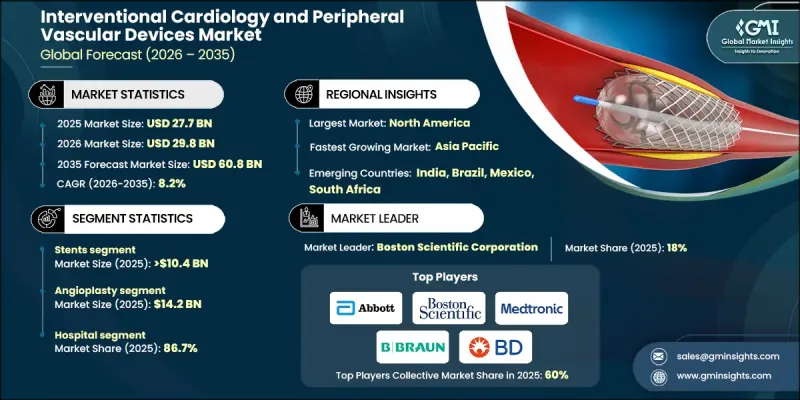
全球血管疾病盛行率上升、周邊血管器械技術的持續創新、微創手術的日益普及以及政府為應對心血管疾病負擔而增加的醫療費用支出,共同推動了這一成長。這些醫療設備,例如支架、球囊和導管,使醫療專業人員能夠在無需進行大型手術的情況下治療心臟和血管疾病。微創治療在現代心血管醫學中備受青睞,因為它們可以縮短患者復原時間、降低手術相關風險並改善臨床療效。公共衛生政策和報銷政策進一步促進了微創治療的普及,使先進的醫療設備更容易取得且更具成本效益。創新的器械設計、監管支援以及患者對更安全手術的需求,持續推動全球市場的擴張。
| 市場範圍 | |
|---|---|
| 開始年份 | 2025 |
| 預測期 | 2026-2035 |
| 上市時的市場規模 | 277億美元 |
| 預測金額 | 608億美元 |
| 複合年成長率 | 8.2% |
預計到2025年,支架市場規模將達到104億美元。支架是一種小型、可擴張的網狀管,能夠恢復狹窄或阻塞動脈的血流,廣泛應用於冠狀動脈和周邊血管介入治療。其臨床療效、可靠性和持續的設計改進使其成為微創治療的理想選擇。與傳統手術相比,藥物釋放型支架透過降低血管再阻塞和再次治療率並縮短恢復時間,進一步鞏固了其市場主導地位。
預計到2025年,血管成形術市場規模將達到142億美元,並在2026年至2035年間以8.3%的複合年成長率成長。血管成形術是一種將球囊擴張到動脈內以疏通阻塞血管的手術,通常隨後會植入支架。此手術廣泛用於治療冠狀動脈疾病和周邊動脈疾病,可減少開胸手術的需求並加速患者復原。由於其微創性和治療心血管疾病的有效性,血管成形術是全球最常進行的手術之一。
預計到2025年,北美介入性心臟病學和周邊血管器械市場將佔據28%的市場佔有率。該地區的主導地位得益於心血管疾病的高發病率、先進的醫療基礎設施、有利的報銷政策以及微創技術的早期應用。人們對心血管疾病管理的日益重視、技術的進步以及患者對微創手術的偏好,都將繼續鞏固北美市場的主導地位。
目錄
第1章:調查方法和範圍
第2章執行摘要
第3章業界考察
- 生態系分析
- 影響產業的因素
- 促進因素
- 全球血管疾病盛行率不斷上升
- 周邊血管裝置的技術進步
- 微創手術的廣泛應用
- 政府支出增加與心血管疾病負擔有關
- 產業潛在風險與挑戰:
- 嚴格的法規結構
- 與醫療設備相關的術後併發症
- 市場機遇
- 門診及門診手術中心擴建
- 擴大機器人技術在介入手術的應用
- 促進因素
- 成長潛力分析
- 監理情勢
- 技術進步(基於初步調查)
- 當前技術趨勢
- 新興技術
- 未來市場趨勢(基於初步研究)
- 還款方案(基於初步調查)
- 波特的分析
- PESTEL 分析
第4章 競爭情勢
- 介紹
- 企業市佔率分析
- 企業矩陣分析
- 主要市場公司的競爭分析
- 競爭定位矩陣
- 主要進展
- 併購
- 夥伴關係與合作
- 新產品發布
- 業務拓展計劃
第5章 市場估價與預測:依產品分類,2022-2035年
- 介入導管
- 導管導引線
- 支架
- 生物可吸收支架
- 藥物釋放型支架
- 裸金屬支架
- 其他支架
- PTCA球囊擴張術
- 動脈粥狀硬化斑塊切除術裝置
- 慢性完全閉塞裝置
- 人工外科移植
- 栓塞預防裝置
- 下腔靜脈濾器
- 其他產品
第6章 市場估計與預測:依應用領域分類,2022-2035年
- 先天性心臟疾病矯正
- 冠狀動脈血栓切除術
- 血管成形術
- 瓣環成形手術
- 經皮瓣修復
- 其他用途
第7章 市場估計與預測:依最終用途分類,2022-2035年
- 醫院
- 門診手術中心
- 其他最終用戶
第8章 市場估計與預測:依地區分類,2022-2035年
- 北美洲
- 美國
- 加拿大
- 歐洲
- 德國
- 英國
- 法國
- 西班牙
- 義大利
- 荷蘭
- 亞太地區
- 中國
- 印度
- 日本
- 澳洲
- 韓國
- 拉丁美洲
- 巴西
- 墨西哥
- 阿根廷
- 中東和非洲
- 沙烏地阿拉伯
- 南非
- 阿拉伯聯合大公國
第9章:公司簡介
- Abbott Laboratories
- AngioDynamics
- B. Braun Melsungen AG
- Becton, Dickinson and Company
- Biotronik SE &Co. KG
- Boston Scientific Corporation
- Cardinal Health
- Cook Medical
- Cordis
- Endologix
- iVascular
- Medtronic Plc
- Teleflex Inc.
- Terumo Corporation
- WL Gore &Associates, Inc.
The Global Interventional Cardiology and Peripheral Vascular Devices Market was valued at USD 27.7 billion in 2025 and is estimated to grow at a CAGR of 8.2% to reach USD 60.8 billion by 2035.
This growth is fueled by the rising prevalence of vascular diseases worldwide, continuous technological innovations in peripheral vascular devices, increasing adoption of minimally invasive procedures, and growing government healthcare spending to address cardiovascular disease burdens. These devices, including stents, balloons, and catheters, enable healthcare professionals to treat heart and blood vessel conditions without major surgery. Minimally invasive interventions reduce patient recovery time, lower procedural risks, and improve clinical outcomes, making them highly desirable in modern cardiovascular care. Public health initiatives and reimbursement policies further support widespread adoption, making advanced devices more accessible and cost-effective. The combination of innovative device design, regulatory support, and patient preference for safer procedures continues to drive market expansion globally.
| Market Scope | |
|---|---|
| Start Year | 2025 |
| Forecast Year | 2026-2035 |
| Start Value | $27.7 Billion |
| Forecast Value | $60.8 Billion |
| CAGR | 8.2% |
The stents segment generated USD 10.4 billion in 2025. Stents, small expandable mesh tubes, restore blood flow in narrowed or blocked arteries and are used in both coronary and peripheral interventions. Their clinical effectiveness, reliability, and continuous design improvements make them the preferred solution for minimally invasive treatments. Drug-eluting stents reduce restenosis and repeat procedures while shortening recovery time compared to traditional surgery, reinforcing their market dominance.
The angioplasty segment reached USD 14.2 billion in 2025 and is expected to grow at a CAGR of 8.3% during 2026-2035. Angioplasty involves inflating a balloon inside an artery to open blocked vessels, often followed by stent placement. It is widely performed for coronary and peripheral artery disease, reducing the need for open-heart surgery and promoting faster patient recovery. Its minimally invasive nature and effectiveness in treating cardiovascular conditions make angioplasty one of the most performed procedures worldwide.
North America Interventional Cardiology and Peripheral Vascular Devices Market held a 28% share in 2025. The region's market leadership is supported by a high prevalence of cardiovascular conditions, advanced healthcare infrastructure, favorable reimbursement policies, and the early adoption of minimally invasive technologies. Increasing awareness of cardiovascular disease management, technological advancements, and patient preference for less invasive procedures continue to strengthen North America's dominant market position.
Key players in the Global Interventional Cardiology and Peripheral Vascular Devices Market include Abbott Laboratories, AngioDynamics, B. Braun Melsungen AG, Becton, Dickinson and Company, Biotronik SE & Co. KG, Boston Scientific Corporation, Cardinal Health, Cook Medical, Cordis, Endologix, iVascular, Medtronic Plc, Teleflex Inc., Terumo Corporation, and W.L. Gore & Associates, Inc. Companies in the Interventional Cardiology and Peripheral Vascular Devices Market strengthen their position by investing heavily in R&D to enhance device performance, safety, and design. Strategic collaborations with hospitals, research institutions, and technology partners enable the development of next-generation stents, balloons, and catheters. Firms focus on expanding global distribution networks, securing regulatory approvals in new regions, and offering training programs for healthcare providers to increase adoption. Marketing efforts highlight clinical efficacy and procedural benefits to reinforce trust among physicians and patients.
Table of Contents
Chapter 1 Methodology and Scope
- 1.1 Market scope and definition
- 1.2 Research design
- 1.2.1 Research approach
- 1.2.2 Data collection methods
- 1.3 Data mining sources
- 1.3.1 Global
- 1.3.2 Regional/country
- 1.4 Base estimates and calculations
- 1.4.1 Base year calculation
- 1.4.2 Key trends for market estimation
- 1.5 Primary research and validation
- 1.5.1 Primary sources
- 1.6 Forecast model
- 1.7 Research assumptions and limitations
Chapter 2 Executive Summary
- 2.1 Industry 360° synopsis
- 2.2 Key market trends
- 2.2.1 Regional trends
- 2.2.2 Product trends
- 2.2.3 Application trends
- 2.2.4 End use trends
- 2.3 CXO perspectives: Strategic imperatives
Chapter 3 Industry Insights
- 3.1 Industry ecosystem analysis
- 3.2 Industry impact forces
- 3.2.1 Growth drivers
- 3.2.1.1 Growing prevalence of vascular diseases worldwide
- 3.2.1.2 Technological advancements in peripheral vascular devices
- 3.2.1.3 Rising adoption of minimally invasive procedures
- 3.2.1.4 Increasing government spending pertaining to cardiovascular diseases burden
- 3.2.2 Industry Pitfalls and Challenges:
- 3.2.2.1 Stringent regulatory framework
- 3.2.2.2 Post-procedural complications associated with devices
- 3.2.3 Market Opportunities
- 3.2.3.1 Growth in outpatient and ambulatory surgical centers
- 3.2.3.2 Increasing use of robotics in interventions
- 3.2.1 Growth drivers
- 3.3 Growth potential analysis
- 3.4 Regulatory landscape
- 3.5 Technological advancements (Driven by Primary Research)
- 3.5.1 Current technological trends
- 3.5.2 Emerging technologies
- 3.6 Future market trends (Driven by Primary Research)
- 3.7 Reimbursement scenario (Driven by Primary Research)
- 3.8 Porter's analysis
- 3.9 PESTEL analysis
Chapter 4 Competitive Landscape, 2025
- 4.1 Introduction
- 4.2 Company market share analysis
- 4.3 Company matrix analysis
- 4.4 Competitive analysis of major market players
- 4.5 Competitive positioning matrix
- 4.6 Key developments
- 4.6.1 Mergers and acquisitions
- 4.6.2 Partnerships and collaborations
- 4.6.3 New product launches
- 4.6.4 Expansion plans
Chapter 5 Market Estimates and Forecast, By Product, 2022 - 2035 ($ Mn)
- 5.1 Key trends
- 5.2 Interventional catheters
- 5.3 Guidewires
- 5.4 Stents
- 5.4.1 Bioabsorbable stents
- 5.4.2 Drug eluting stents
- 5.4.3 Bare metal stents
- 5.4.4 Other stents
- 5.5 PTCA balloons
- 5.6 Atherectomy devices
- 5.7 Chronic total occlusion devices
- 5.8 Synthetic surgical grafts
- 5.9 Embolic protection devices
- 5.10 Inferior vena cava filters
- 5.11 Other products
Chapter 6 Market Estimates and Forecast, By Application, 2022 - 2035 ($ Mn)
- 6.1 Key trends
- 6.2 Congenital heart defect correction
- 6.3 Coronary thrombectomy
- 6.4 Angioplasty
- 6.5 Valvuloplasty
- 6.6 Percutaneous valve repair
- 6.7 Other applications
Chapter 7 Market Estimates and Forecast, By End Use, 2022 - 2035 ($ Mn)
- 7.1 Key trends
- 7.2 Hospitals
- 7.3 Ambulatory surgical centers
- 7.4 Other end users
Chapter 8 Market Estimates and Forecast, By Region, 2022 - 2035 ($ Mn)
- 8.1 Key trends
- 8.2 North America
- 8.2.1 U.S.
- 8.2.2 Canada
- 8.3 Europe
- 8.3.1 Germany
- 8.3.2 UK
- 8.3.3 France
- 8.3.4 Spain
- 8.3.5 Italy
- 8.3.6 Netherlands
- 8.4 Asia Pacific
- 8.4.1 China
- 8.4.2 India
- 8.4.3 Japan
- 8.4.4 Australia
- 8.4.5 South Korea
- 8.5 Latin America
- 8.5.1 Brazil
- 8.5.2 Mexico
- 8.5.3 Argentina
- 8.6 Middle East and Africa
- 8.6.1 Saudi Arabia
- 8.6.2 South Africa
- 8.6.3 UAE
Chapter 9 Company Profiles
- 9.1 Abbott Laboratories
- 9.2 AngioDynamics
- 9.3 B. Braun Melsungen AG
- 9.4 Becton, Dickinson and Company
- 9.5 Biotronik SE & Co. KG
- 9.6 Boston Scientific Corporation
- 9.7 Cardinal Health
- 9.8 Cook Medical
- 9.9 Cordis
- 9.10 Endologix
- 9.11 iVascular
- 9.12 Medtronic Plc
- 9.13 Teleflex Inc.
- 9.14 Terumo Corporation
- 9.15 W.L. Gore & Associates, Inc.

 2026年機器人輔助經皮冠狀動脈介入治療(PCI)全球市場報告
 兒童介入性心臟病市場規模、佔有率和成長分析:按手術類型、器械類型、適應症、最終用戶和地區分類-2026-2033年產業預測
 兒童介入性心臟病市場:按產品類型、年齡層、應用和最終用戶分類-2026-2032年全球市場預測介入性心臟病器材市場:按器材類型、材料、技術、應用和最終用戶分類-2026-2032年全球市場預測
 全球介入心臟病學器材市場(至2031年):按類型和最終用戶分類
 介入性心臟病醫療設備市場報告:按產品、最終用戶和地區分類(2026-2034 年)
 介入性心臟病醫療設備市場規模、佔有率和趨勢分析報告:按產品、手術、應用、地區和細分市場預測(2026-2033 年)
 介入性心臟病設備市場:按設備、最終用戶和地區分類介入性心臟病學和周邊血管器械市場:按產品類型、適應症、年齡層、最終用戶和地區分類(2026-2034 年)兒童介入性心臟病市場規模、佔有率、趨勢和預測:按設備類型、手術、最終用途和地區分類(2026-2034 年)