


 |
市場調查報告書
商品編碼
1982293
汽車道路救援系統市場機會、成長要素、產業趨勢分析及2026-2035年預測Vehicle Roadside Assistance Market Opportunity, Growth Drivers, Industry Trend Analysis, and Forecast 2026 - 2035 |
||||||

全球汽車道路救援系統市場預計到 2025 年將達到 409 億美元,預計到 2035 年將以 5.4% 的複合年成長率成長至 687 億美元。
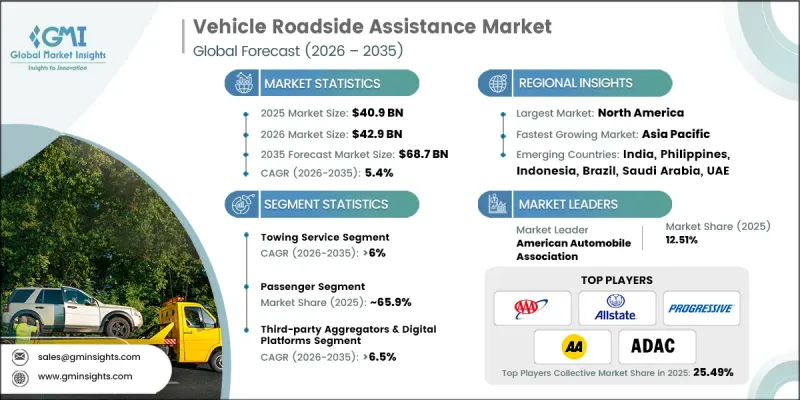
隨著全球車輛數量的成長、交通堵塞的加劇以及現代汽車技術的進步,車輛道路救援系統(VRA)行業正在經歷重大變革。道路救援系統不再只是在車輛發生故障時救援車服務;它已成為一個全面的出行支援網路,旨在保障駕駛員安全、最大限度地減少車輛停運時間並維持服務的連續性。在人們對可靠性和便利性日益成長的需求驅動下,道路救援系統正成為保險套餐、原廠保固計畫、車隊管理解決方案和訂閱式旅遊服務的重要組成部分。隨著與聯網汽車技術和數位平台的整合不斷深入,援助的提供方式也在改變。隨著車輛系統變得越來越複雜,專業的道路救援支援服務對於個人駕駛員和商業車隊營運商都至關重要,這有助於在已開發市場和新興市場實現長期的市場擴張。
| 市場範圍 | |
|---|---|
| 開始年份 | 2025 |
| 預測期 | 2026-2035 |
| 上市時的市場規模 | 409億美元 |
| 預測金額 | 687億美元 |
| 複合年成長率 | 5.4% |
現代車輛道路救援系統平台以技術主導,功能多元。救援車、電池支援、更換輪胎、燃油輸送、開鎖服務和小型機械維修等服務,如今都由支援GPS定位的叫車工具、遠端資訊處理連接、預測性診斷和行動應用程式提供支援。服務供應商正努力透過縮短回應時間、簡化數位化計費和實施即時車輛追蹤功能來提高營運效率和客戶滿意度。保險公司、汽車製造商、遠端資訊處理公司、獨立服務供應商和數位出行平台之間的合作正在不斷加強。基於訂閱的承保模式、保險輔助服務、基於使用量的服務以及應用程式驅動的按需解決方案,正在重新定義車輛道路救援系統市場的收入模式和服務可及性。
預計到2025年,救援車服務市佔率將達到33%,並在2035年之前以6%的複合年成長率成長。救援車服務仍然是車主和車隊管理人員最常需要的道路救援服務。其需求涵蓋個人車和商用車,滿足車輛救援、事故應變以及都市區和高速公路網路上的長途運輸需求。救援車服務的必要性鞏固了其在行業中的主導地位。
預計到2025年,乘用車市佔率將達到65.9%,並在2026年至2035年間以4.2%的複合年成長率成長。私家車保有量高、城市人口不斷成長以及對快速可靠的緊急救援服務日益成長的需求,是推動該細分市場成長的主要因素。乘用車對各種道路救援服務的需求也顯著增加。數位平台和聯網汽車系統的引進,能夠加快回應速度,實現更順暢的溝通,並提升駕駛者的使用者體驗。
預計到2025年,北美汽車道路救援系統市場將佔據33.5%的市場佔有率,並在2035年之前以5.7%的複合年成長率成長。高汽車保有率、高保險滲透率以及聯網汽車汽車和電動車的快速普及是該地區成長的主要驅動力。完善的汽車俱樂部、汽車製造商支援的項目以及數位化按需救援平台確保了廣泛的服務網路。此外,物流業者和商用車隊越來越依賴整合式道路救援系統解決方案來減少停機時間並保持營運效率,這進一步增強了該地區的市場表現。
目錄
第1章:調查方法
第2章執行摘要
第3章業界考察
- 生態系分析
- 供應商情況
- 利潤率分析
- 成本結構
- 每個階段增加的價值
- 影響價值鏈的因素
- 中斷
- 影響產業的因素
- 促進因素
- 全球汽車擁有量增加
- 保險單中包含的道路救援系統增加
- 聯網汽車和OEM項目的激增
- 都市化進程和人們日益增強的交通安全意識
- 產業潛在風險與挑戰
- 新興市場滲透率低
- 由於覆蓋範圍重疊,增量收入減少
- 市場機遇
- 電動車服務增加
- 商用車輛和共享出行方式的增加
- 數位平台和聚合平台的擴張
- 新興市場汽車擁有量增加
- 促進因素
- 成長潛力分析
- 監理情勢
- 北美洲
- 美國聯邦機動車輛安全管理局 (FMCSA)道路救援系統與緊急服務指南
- 美國國家公路交通安全管理局 (NHTSA) 車輛安全召回和援助計劃
- 歐洲
- 歐盟道路救援系統指令(2006/126/EC)
- 德國:遵守《道路車輛登記條例》(StVZO) 下的緊急援助規定
- 英國:道路救援與車輛援助條例
- 法國:道路交通法 - 車輛故障時的道路救援
- 亞太地區
- 中國:道路交通安全法-道路救援系統指南
- 日本:道路運輸車輛法-有關路邊服務的規定
- 韓國:《汽車管理法》-關於緊急援助的規定
- 新加坡:《道路交通法》-車輛故障與路邊援助
- 拉丁美洲
- 巴西:ANTT道路救援系統。
- 墨西哥:道路安全與車輛援助聯邦標準
- 智利:道路運輸安全與支援指南
- 中東和非洲
- 阿拉伯聯合大公國:聯邦交通管理局關於道路救援系統和緊急服務的政策
- 沙烏地阿拉伯:2030願景-車輛路邊支援框架
- 南非:《國家道路交通法》—道路救援系統條例
- 北美洲
- 波特的分析
- PESTEL 分析
- 科技與創新趨勢
- 當前技術趨勢
- 新興技術
- 專利分析
- 價格分析與成本結構
- 按服務類型分類的平均價格
- 訂閱模式與計量收費模式的比較
- 成本結構細分:人事費用、燃料成本、保險費
- 各地區價格波動
- 成本上升的趨勢和影響
- 永續性和環境影響分析
- 永續計劃
- 減少廢棄物策略
- 生產中的能源效率
- 具有環保意識的舉措
- 碳足跡考量
- 未來展望與機遇
- 永續性和環境影響分析
- 永續計劃
- 減少廢棄物策略
- 生產中的能源效率
- 具有環保意識的舉措
- 碳足跡考量
- 未來展望與機遇
- 服務等級協定 (SLA) 和績效指標
- 業界標準 SLA 基準
- 按服務類型分類的平均回應時間
- 首次解析率
- 顧客滿意度評分 (CSAT) 指標
- 淨推薦值 (NPS) 基準
- 單位經濟效益和盈利基準
- 每次服務的平均收入
- 每次服務事件的成本
- 按服務類型分類的貢獻利潤
- 客戶獲取成本 (CAC)
- 客戶生命週期價值(LTV)
第4章 競爭情勢
- 介紹
- 企業市佔率分析
- 主要市場公司的競爭分析
- 競爭定位矩陣
- 主要進展
- 併購
- 夥伴關係與合作
- 新產品發布
- 業務拓展計劃及資金籌措
第5章 市場估計與預測:依服務業分類,2022-2035年
- 救援車服務
- 輪胎更換服務
- 電池支援服務
- 燃料配送服務
- 鑰匙遺失及更換服務
- 贏得和挽救服務
- 其他
第6章 市場估價與預測:依車輛類型分類,2022-2035年
- 搭乘用車
- 轎車
- SUV 與跨界車
- 掀背車
- 商用車輛
- 輕型商用車(LCV)
- 中型商用車(MCV)
- 重型商用車(HCV)
第7章 市場估計與預測:依服務管道分類,2022-2035年
- OEM網路
- 保險公司網路
- 獨立服務供應商
- 第三方聚合器和數位平台
第8章 市場估算與預測:依最終用途分類,2022-2035年
- 個人/零售客戶
- 商用車輛營運商
- 汽車經銷店
- 租賃公司
- 其他
第9章 市場估計與預測:依地區分類,2022-2035年
- 北美洲
- 美國
- 加拿大
- 歐洲
- 德國
- 英國
- 法國
- 義大利
- 西班牙
- 俄羅斯
- 比利時
- 荷蘭
- 瑞典
- 亞太地區
- 中國
- 印度
- 日本
- 澳洲
- 韓國
- 菲律賓
- 印尼
- 新加坡
- 拉丁美洲
- 巴西
- 墨西哥
- 阿根廷
- 中東和非洲(MEA)
- 南非
- 沙烏地阿拉伯
- 阿拉伯聯合大公國
第10章:公司簡介
- 世界公司
- Automobile Association(AA)
- Agero
- Allianz Global Assistance
- Allstate Insurance
- American Automobile Association(AAA)
- AXA Assistance USA
- Europ Assistance
- GEICO
- Liberty Mutual Insurance
- Nationwide
- Progressive Insurance
- RAC Limited
- Travelers Insurance
- 本地球員
- ADAC
- Better World Club
- Japan Automobile Federation(JAF)
- RACE
- 新興企業
- ARC
- Five Star Roadside
- HONK Technologies
The Global Vehicle Roadside Assistance Market was valued at USD 40.9 billion in 2025 and is estimated to grow at a CAGR of 5.4% to reach USD 68.7 billion by 2035.
The vehicle roadside assistance (VRA) industry is undergoing significant evolution as global vehicle ownership rises, traffic congestion intensifies, and modern vehicles become more technologically advanced. Roadside assistance is no longer limited to basic breakdown towing; it now operates as a comprehensive mobility support network designed to ensure driver safety, minimize vehicle downtime, and maintain service continuity. Growing expectations for reliability and convenience are positioning roadside assistance as an essential component of insurance packages, OEM warranty programs, fleet management solutions, and subscription-based mobility services. Increasing integration of connected vehicle technologies and digital platforms is reshaping how assistance is delivered. As vehicle systems become more complex, professional roadside support services are becoming indispensable to both individual drivers and commercial fleet operators, supporting long-term market expansion across developed and emerging economies.
| Market Scope | |
|---|---|
| Start Year | 2025 |
| Forecast Year | 2026-2035 |
| Start Value | $40.9 Billion |
| Forecast Value | $68.7 Billion |
| CAGR | 5.4% |
Modern vehicle roadside assistance platforms are technology-driven and multi-functional. Services such as towing, battery support, tire replacement, fuel delivery, lockout assistance, and minor mechanical repairs are now supported by GPS-enabled dispatch tools, telematics connectivity, predictive diagnostics, and mobile applications. Providers are improving response times, streamlining digital claims processing, and enabling real-time vehicle tracking to enhance operational efficiency and customer satisfaction. Collaboration among insurers, automotive manufacturers, telematics firms, independent service providers, and digital mobility platforms is intensifying. Subscription-based coverage models, insurance add-ons, usage-based services, and app-enabled on-demand solutions are redefining revenue models and service accessibility within the vehicle roadside assistance market.
The towing services segment accounted for 33% share in 2025 and is projected to grow at a CAGR of 6% through 2035. Towing remains the most frequently requested roadside service among vehicle owners and fleet managers. Demand spans across personal and commercial vehicles, addressing breakdown recovery, accident response, and long-distance transport needs across urban and highway networks. The essential nature of towing services continues to anchor its dominant position within the industry.
The passenger vehicle segment held 65.9% share in 2025 and is anticipated to grow at a CAGR of 4.2% between 2026 and 2035. High levels of private vehicle ownership, expanding urban populations, and increased dependence on fast and reliable emergency assistance services are driving this segment's growth. Passenger vehicles generate substantial demand for a wide range of roadside support services. The adoption of digital platforms and connected vehicle systems enables quicker dispatch, improved communication, and enhanced user experience for individual motorists.
North America Vehicle Roadside Assistance Market accounted for 33.5% share in 2025 and is expected to grow at a CAGR of 5.7% through 2035. Strong vehicle ownership rates, widespread insurance penetration, and rapid adoption of connected and electric vehicles are key contributors to regional growth. The presence of established automotive clubs, OEM-supported programs, and digital on-demand assistance platforms ensures extensive service coverage. Additionally, logistics providers and commercial fleets increasingly rely on integrated roadside assistance solutions to reduce downtime and maintain operational efficiency, further strengthening regional market performance.
Major companies operating in the Global Vehicle Roadside Assistance Market include American Automobile Association, Allianz, Allstate, GEICO, Progressive, ADAC, Automobile Association, Japan Automobile Federation (JAF), Better World Club, and RACE. Companies in the Vehicle Roadside Assistance Market are reinforcing their competitive position through digital transformation and strategic partnerships. Leading providers are investing in telematics integration, AI-powered dispatch systems, and mobile application platforms to enhance response speed and service transparency. Collaboration with insurance companies, automotive OEMs, and fleet operators is expanding bundled service offerings and subscription-based coverage models. Firms are also focusing on data analytics to predict service demand and optimize resource allocation. Expansion into electric vehicle support services and specialized fleet solutions is creating new revenue streams.
Table of Contents
Chapter 1 Methodology
- 1.1 Research approach
- 1.2 Quality commitments
- 1.2.1 GMI AI policy & data integrity commitment
- 1.3 Research trail & confidence scoring
- 1.3.1 Research trail components
- 1.3.2 Scoring components
- 1.4 Data collection
- 1.4.1 Partial list of primary sources
- 1.5 Data mining sources
- 1.5.1 Paid sources
- 1.6 Base estimates and calculations
- 1.6.1 Base year calculation
- 1.7 Forecast model
- 1.8 Research transparency addendum
Chapter 2 Executive Summary
- 2.1 Industry 360° synopsis, 2022 - 2035
- 2.2 Key market trends
- 2.2.1 Regional
- 2.2.2 Vehicle
- 2.2.3 Service
- 2.2.4 Service Channel
- 2.2.5 End Use
- 2.3 TAM Analysis, 2026-2035
- 2.4 CXO perspectives: Strategic imperatives
Chapter 3 Industry Insights
- 3.1 Industry ecosystem analysis
- 3.1.1 Supplier landscape
- 3.1.2 Profit margin analysis
- 3.1.3 Cost structure
- 3.1.4 Value addition at each stage
- 3.1.5 Factor affecting the value chain
- 3.1.6 Disruptions
- 3.2 Industry impact forces
- 3.2.1 Growth drivers
- 3.2.1.1 Rise in global vehicle ownership
- 3.2.1.2 Increase in insurance-bundled roadside assistance
- 3.2.1.3 Surge in connected cars and OEM programs
- 3.2.1.4 Growth in urbanization and road safety awareness
- 3.2.2 Industry pitfalls and challenges
- 3.2.2.1 Low penetration in emerging markets
- 3.2.2.2 Overlap in coverage reducing incremental revenue
- 3.2.3 Market opportunities
- 3.2.3.1 Rise in electric vehicle (EV) specific services
- 3.2.3.2 Growth in commercial fleets and shared mobility
- 3.2.3.3 Expansion of digital and aggregator platforms
- 3.2.3.4 Increase in vehicle ownership in emerging markets
- 3.2.1 Growth drivers
- 3.3 Growth potential analysis
- 3.4 Regulatory landscape
- 3.4.1 North America
- 3.4.1.1 Federal Motor Carrier Safety Administration (FMCSA) Roadside Assistance & Emergency Service Guidelines
- 3.4.1.2 National Highway Traffic Safety Administration (NHTSA) Vehicle Safety Recall & Assistance Programs.
- 3.4.2 Europe
- 3.4.2.1 EU Roadside Assistance Directive (2006/126/EC)
- 3.4.2.2 Germany: Straßenverkehrs-Zulassungs-Ordnung (StVZO) Emergency Assistance Compliance
- 3.4.2.3 UK: Roadside Recovery & Vehicle Assistance Regulations
- 3.4.2.4 France: Code de la Route - Vehicle Breakdown Assistance
- 3.4.3 Asia Pacific
- 3.4.3.1 China: Road Traffic Safety Law - Roadside Assistance Guidelines
- 3.4.3.2 Japan: Road Transport Vehicle Act - Roadside Service Regulations
- 3.4.3.3 South Korea: Motor Vehicle Management Act - Emergency Assistance Provisions
- 3.4.3.4 Singapore: Road Traffic Act - Vehicle Breakdown & Roadside Support
- 3.4.4 Latin America
- 3.4.4.1 Brazil: ANTT Roadside Assistance Regulations
- 3.4.4.2 Mexico: Federal Road Safety & Vehicle Assistance Norms
- 3.4.4.3 Chile: Road Transport Safety & Assistance Guidelines
- 3.4.5 MEA
- 3.4.5.1 UAE: Federal Transport Authority Roadside Assistance & Emergency Services Policy
- 3.4.5.2 Saudi Arabia: Vision 2030 - Vehicle Roadside Support Framework
- 3.4.5.3 South Africa: National Road Traffic Act - Roadside Assistance Regulations
- 3.4.1 North America
- 3.5 Porter’s analysis
- 3.6 PESTEL analysis
- 3.7 Technology and Innovation landscape
- 3.7.1 Current technological trends
- 3.7.2 Emerging technologies
- 3.8 Patent analysis
- 3.9 Pricing analysis & cost structure
- 3.9.1 Average service pricing by type
- 3.9.2 Subscription vs. pay-per-use models
- 3.9.3 Cost structure breakdown: labor, fuel, insurance
- 3.9.4 Regional price variations
- 3.9.5 Cost inflation trends & impact
- 3.10 Sustainability and environmental impact analysis
- 3.10.1 Sustainable practices
- 3.10.2 Waste reduction strategies
- 3.10.3 Energy efficiency in production
- 3.10.4 Eco-friendly initiatives
- 3.10.5 Carbon footprint considerations
- 3.11 Future outlook & opportunities
- 3.12 Sustainability and environmental impact analysis
- 3.12.1 Sustainable practices
- 3.12.2 Waste reduction strategies
- 3.12.3 Energy efficiency in production
- 3.12.4 Eco-friendly initiatives
- 3.12.5 Carbon footprint considerations
- 3.13 Future outlook & opportunities
- 3.14 Service level agreement (SLA) & performance metrics
- 3.14.1 Industry-standard SLA benchmarks
- 3.14.2 Average response time by service type
- 3.14.3 First-call resolution rates
- 3.14.4 Customer Satisfaction Score (CSAT) metrics
- 3.14.5 Net Promoter Score (NPS) benchmarking
- 3.15 Unit Economics & Profitability Benchmarking
- 3.15.1 Average revenue per service call
- 3.15.2 Cost per service event
- 3.15.3 Contribution margin by service type
- 3.15.4 Customer acquisition cost (CAC)
- 3.15.5 Customer lifetime value (LTV)
Chapter 4 Competitive Landscape, 2025
- 4.1 Introduction
- 4.2 Company market share analysis
- 4.2.1 North America
- 4.2.2 Europe
- 4.2.3 Asia Pacific
- 4.2.4 Latin America
- 4.2.5 MEA
- 4.3 Competitive analysis of major market players
- 4.4 Competitive positioning matrix
- 4.5 Key developments
- 4.5.1 Mergers & acquisitions
- 4.5.2 Partnerships & collaborations
- 4.5.3 New Product Launches
- 4.5.4 Expansion Plans and funding
Chapter 5 Market Estimates & Forecast, By Service, 2022 - 2035 ($Bn)
- 5.1 Key trends
- 5.2 Towing Services
- 5.3 Tire Replacement Services
- 5.4 Battery Assistance Services
- 5.5 Fuel Delivery Services
- 5.6 Lockout & Replacement Key Services
- 5.7 Winching & Extraction Services
- 5.8 Others
Chapter 6 Market Estimates & Forecast, By Vehicle, 2022 - 2035 ($Bn)
- 6.1 Key trends
- 6.2 Passenger Cars
- 6.2.1 Sedans
- 6.2.2 SUVs & Crossovers
- 6.2.3 Hatchbacks
- 6.3 Commercial Vehicles
- 6.3.1 Light Commercial Vehicles (LCVs)
- 6.3.2 Medium Commercial Vehicles (MCVs)
- 6.3.3 Heavy Commercial Vehicles (HCVs)
Chapter 7 Market Estimates & Forecast, By Service Channel, 2022 - 2035 ($Bn)
- 7.1 Key trends
- 7.2 OEM Networks
- 7.3 Insurance Company Networks
- 7.4 Independent Service Providers
- 7.5 Third-Party Aggregators & Digital Platforms
Chapter 8 Market Estimates & Forecast, By End Use, 2022 - 2035 ($Bn)
- 8.1 Key trends
- 8.2 Individual/Retail Customers
- 8.3 Commercial Fleet Operators
- 8.4 Automotive Dealerships
- 8.5 Rental & Leasing Companies
- 8.6 Others
Chapter 9 Market Estimates & Forecast, By Region, 2022 - 2035 ($Bn)
- 9.1 Key trends
- 9.2 North America
- 9.2.1 US
- 9.2.2 Canada
- 9.3 Europe
- 9.3.1 Germany
- 9.3.2 UK
- 9.3.3 France
- 9.3.4 Italy
- 9.3.5 Spain
- 9.3.6 Russia
- 9.3.7 Belgium
- 9.3.8 Netherlands
- 9.3.9 Sweden
- 9.4 Asia Pacific
- 9.4.1 China
- 9.4.2 India
- 9.4.3 Japan
- 9.4.4 Australia
- 9.4.5 South Korea
- 9.4.6 Philippines
- 9.4.7 Indonesia
- 9.4.8 Singapore
- 9.5 Latin America
- 9.5.1 Brazil
- 9.5.2 Mexico
- 9.5.3 Argentina
- 9.6 MEA
- 9.6.1 South Africa
- 9.6.2 Saudi Arabia
- 9.6.3 UAE
Chapter 10 Company Profiles
- 10.1 Global Players
- 10.1.1 Automobile Association (AA)
- 10.1.2 Agero
- 10.1.3 Allianz Global Assistance
- 10.1.4 Allstate Insurance
- 10.1.5 American Automobile Association (AAA)
- 10.1.6 AXA Assistance USA
- 10.1.7 Europ Assistance
- 10.1.8 GEICO
- 10.1.9 Liberty Mutual Insurance
- 10.1.10 Nationwide
- 10.1.11 Progressive Insurance
- 10.1.12 RAC Limited
- 10.1.13 Travelers Insurance
- 10.2 Regional Players
- 10.2.1 ADAC
- 10.2.2 Better World Club
- 10.2.3 Japan Automobile Federation (JAF)
- 10.2.4 RACE
- 10.3 Emerging Players
- 10.3.1 ARC
- 10.3.2 Five Star Roadside
- 10.3.3 HONK Technologies

 道路救援系統市場規模、佔有率和成長分析:按服務類型、提供者、車輛類型、分銷方式和地區分類-2026-2033年產業預測
 2026-2030年全球車輛道路救援系統市場
 汽車道路救援系統市場規模、佔有率和成長分析:按服務類型、車輛類型、服務提供者類型、服務交付方式、回應方式、最終用戶和地區分類-2026-2033年產業預測
 汽車道路救援系統市場規模、佔有率和趨勢分析報告:按服務類型、提供者、車輛類型、地區和細分市場分類(2026-2033 年)
 車輛道路救援市場 - 全球產業規模、佔有率、趨勢、機會、預測:按車輛類型、服務類型、提供者、地區和競爭格局分類,2021-2031年
 汽車道路救援系統市場:按車輛類型、服務類型、服務提供者和地區分類
 2026年全球車輛道路救援系統市場報告
 2026-2034年全球車輛道路救援系統市場規模、佔有率、趨勢和成長分析報告
 全球緊急道路救援系統服務市場(按服務類型、車輛類型、合約類型、最終用戶、分銷管道和獲取管道分類)預測(2026-2032年)車輛道路救援系統服務市場:依拖車、電瓶搭電、輪胎修理、燃油輸送、開鎖服務及絞盤救援分類,全球預測,2026-2032年