

 |
市場調查報告書
商品編碼
1982277
2026 年至 2035 年家用電子電器製造設備的市場機會、成長要素、產業趨勢分析與預測。Consumer Electronics Manufacturing Equipment Market Opportunity, Growth Drivers, Industry Trend Analysis, and Forecast 2026 - 2035 |
||||||

預計到 2025 年,全球家用電子電器製造設備市場規模將達到 1,549 億美元,並預計以 6.8% 的複合年成長率成長,到 2035 年達到 2,960 億美元。
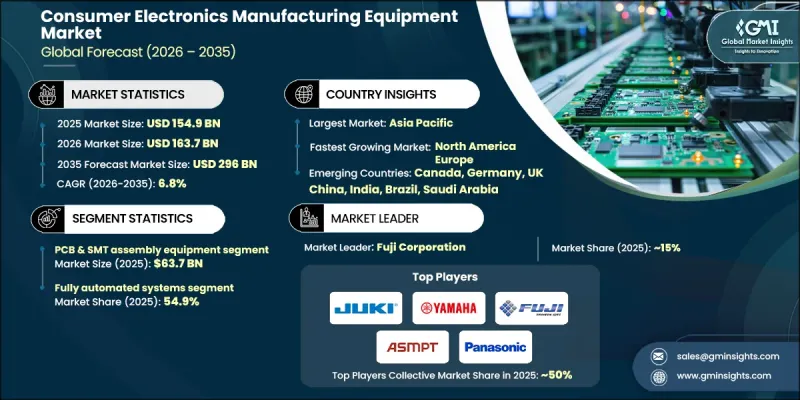
市場成長的驅動力在於消費者對緊湊型、高性能電子產品日益成長的期望,而這些產品對生產能力的要求也越來越高。為了滿足性能和設計要求,設備製造商正優先考慮精密工程、高密度整合和先進的製造流程。這種轉變正在加速對下一代組裝、檢測和半導體生產系統的投資,這些系統能夠處理複雜的架構和微型化的元件。不斷擴展的連接趨勢和下一代通訊技術也促進了產量的成長和對更複雜元件的需求。隨著電子產品變得越來越複雜,製造商正在採用高吞吐量的自動化解決方案來維持品質、提高效率並擴大生產規模。向先進封裝技術和基板設計的轉變進一步推動了對尖端生產工具的需求。總而言之,製造流程的持續創新、全球電子產品消費量的成長以及整合系統日益複雜化,都為這個市場帶來了益處。
| 市場範圍 | |
|---|---|
| 開始年份 | 2025 |
| 預測期 | 2026-2035 |
| 上市時的市場規模 | 1549億美元 |
| 預測金額 | 2960億美元 |
| 複合年成長率 | 6.8% |
預計到2025年,PCB和SMT組裝設備市場規模將達到637億美元,並在2026年至2035年間以6.5%的複合年成長率成長。自動化、機器人技術的整合以及人工智慧檢測技術的廣泛應用,提高了生產效率和產量比率,從而推動了設備升級。製造商正在實施智慧缺陷檢測、預測性維護模型、即時過程追蹤和精密返工能力,以減少停機時間並提高營運效率。這些技術進步正在推動PCB和SMT生產線的持續現代化。
預計到2025年,全自動化系統市佔率將達到54.9%,並在2026年至2035年間以7%的複合年成長率成長。各公司正在將人工智慧驅動的分析、機器人搬運系統、物聯網監控設備、數位模擬工具和預測性維護平台整合到其製造環境中,以最佳化生產效率並最大限度地減少錯誤。日益激烈的全球競爭、不斷上漲的人事費用以及小型化和複雜化電子組件帶來的技術挑戰,正在加速向全面自動化解決方案的轉型。
美國家用電子電器製造設備市場預計到2025年將達到291億美元,並在2026年至2035年間以6.2%的複合年成長率成長。由於對先進半導體技術、數據基礎設施組件以及人工智慧專用硬體系統的需求不斷成長,國內產能正在擴張。主要晶片製造商的大規模資本投資,以及支持國內製造業的公共舉措,正在加強區域供應鏈。全國各地的製造工廠擴大採用人工智慧驅動的品管系統、機器人、智慧工廠框架和預測分析平台,這推動了對先進SMT、半導體製造、測試和自動化設備的需求。
目錄
第1章:調查方法和範圍
第2章執行摘要
第3章業界考察
- 生態系分析
- 供應商情況
- 利潤率
- 每個階段增加的價值
- 影響價值鏈的因素
- 影響產業的因素
- 促進因素
- 對體積更小、性能更高的電子設備的需求日益成長。
- 物聯網、5G和互聯技術的擴展。
- 汽車電子和電氣化(電動車)的成長
- 產業潛在風險與挑戰
- 供應鏈中斷和零件短缺
- 技術複雜性不斷增加,產品週期不斷縮短
- 促進因素
- 成長潛力分析
- 未來市場趨勢
- 科技與創新趨勢
- 當前技術趨勢
- 新興技術
- 價格趨勢
- 按地區
- 透過裝置
- 監理情勢
- 標準和合規要求
- 區域法規結構
- 認證標準
- 貿易統計
- 主要進口國
- 主要出口國
- 波特五力分析
- PESTEL 分析
第4章 競爭情勢
- 介紹
- 企業市佔率分析
- 按地區
- 北美洲
- 歐洲
- 亞太地區
- 拉丁美洲
- 中東和非洲
- 按地區
- 企業矩陣分析
- 主要市場公司的競爭分析
- 競爭定位矩陣
- 主要進展
- 併購
- 夥伴關係與合作
- 新產品發布
- 業務拓展計劃
第5章 市場估算與預測:依設備類型分類,2022-2035年
- PCB及SMT組裝設備
- 測試和檢驗設備
- 零件運輸和儲存系統
- 組裝和整合系統
- 塗層和點膠設備
- 清潔和表面處理設備
- 標記和貼標設備
- 切割/分離設備
第6章 市場估計與預測:依技術分類,2022-2035年
- 全自動系統
- 半自動系統
- 手動/基本系統
第7章 市場估價與預測:依驅動零件分類,2022-2035年
- 線性滑軌
- 伸縮式軌道
- 線性致動器
- 滾珠螺桿
- 整合運動系統
第8章 市場估算與預測:依最終用途分類,2022-2035年
- 家用電子電器製造商
- OSAT(外包半導體組裝和測試服務)供應商
- 通訊電子設備
- 汽車電子
- 工業和物聯網電子產品
第9章 市場估價與預測:依通路分類,2022-2035年
- 直銷
- 間接銷售
第10章 市場估價與預測:依地區分類,2022-2035年
- 北美洲
- 美國
- 加拿大
- 歐洲
- 德國
- 英國
- 法國
- 義大利
- 西班牙
- 亞太地區
- 中國
- 印度
- 日本
- 韓國
- 澳洲
- 印尼
- 馬來西亞
- 拉丁美洲
- 巴西
- 墨西哥
- 阿根廷
- 中東和非洲(MEA)
- 沙烏地阿拉伯
- 阿拉伯聯合大公國
- 南非
第11章:公司簡介
- ABB Robotics
- Bosch Rexroth AG
- FANUC Corporation
- Fuji Corporation
- Hiwin Technologies Corporation
- JUKI Corporation
- KLA Corporation
- KUKA AG
- Mycronic AB
- Nordson Corporation
- NSK Ltd.
- Omron Corporation
- Saki Corporation
- The Timken Company
- THK Co., Ltd.
- Yamaha Motor Corporation
- Yaskawa Electric
The Global Consumer Electronics Manufacturing Equipment Market was valued at USD 154.9 billion in 2025 and is estimated to grow at a CAGR of 6.8% to reach USD 296 billion by 2035.
Market growth is driven by rising expectations for compact, high-performance electronic products that require increasingly advanced production capabilities. Device manufacturers are prioritizing precision engineering, high-density integration, and advanced fabrication processes to meet performance and design demands. This shift is accelerating investments in next-generation assembly, inspection, and semiconductor production systems capable of handling complex architectures and miniaturized components. Growing connectivity trends and next-wave communication technologies are also contributing to higher production volumes and more intricate component requirements. As electronics become more sophisticated, manufacturers are deploying high-throughput, automated solutions to maintain quality, improve efficiency, and scale output. The transition toward advanced packaging techniques and multilayer board designs further supports demand for cutting-edge production tools. Overall, the market is benefiting from continuous innovation in manufacturing processes, rising global electronics consumption, and the increasing complexity of integrated systems."
| Market Scope | |
|---|---|
| Start Year | 2025 |
| Forecast Year | 2026-2035 |
| Start Value | $154.9 Billion |
| Forecast Value | $296 Billion |
| CAGR | 6.8% |
The PCB and SMT assembly equipment segment generated USD 63.7 billion in 2025 and is forecast to grow at a CAGR of 6.5% from 2026 to 2035. Equipment upgrades are being fueled by widespread adoption of automation, robotics integration, and AI-powered inspection technologies that enhance productivity and improve yield rates. Manufacturers are implementing intelligent defect recognition, predictive servicing models, live process tracking, and precision rework capabilities to reduce downtime and improve operational efficiency. These advancements are encouraging the continuous modernization of PCB and SMT production lines.
The fully automated systems segment accounted for 54.9% share in 2025 and is projected to grow at a CAGR of 7% between 2026 and 2035. Companies are embedding AI-driven analytics, robotic handling systems, IoT-enabled monitoring devices, digital simulation tools, and predictive maintenance platforms into manufacturing environments to optimize throughput and minimize errors. Increasing global competition, higher labor expenses, and the technical challenges associated with miniaturized and complex electronic assemblies are accelerating the transition toward comprehensive automation solutions.
U.S. Consumer Electronics Manufacturing Equipment Market reached USD 29.1 billion in 2025 and is expected to grow at a CAGR of 6.2% from 2026 to 2035. Domestic production capacity is expanding due to heightened demand for advanced semiconductor technologies, data infrastructure components, and AI-focused hardware systems. Public policy initiatives supporting onshore manufacturing, along with large-scale capital investments by leading chip producers, are reinforcing local supply chains. Manufacturing facilities across the country are increasingly adopting AI-enabled quality systems, robotics, smart factory frameworks, and predictive analytics platforms, thereby strengthening demand for advanced SMT, semiconductor fabrication, testing, and automation equipment.
Key companies operating in the Global Consumer Electronics Manufacturing Equipment Market include KLA Corporation, FANUC Corporation, ABB Robotics, Yaskawa Electric, KUKA AG, Yamaha Motor Corporation, JUKI Corporation, Bosch Rexroth AG, Mycronic AB, Omron Corporation, Fuji Corporation, THK Co., Ltd., The Timken Company, Nordson Corporation, NSK Ltd., Saki Corporation, and Hiwin Technologies Corporation. Companies competing in the Global Consumer Electronics Manufacturing Equipment Market are reinforcing their position through continuous innovation and strategic investment. Many firms are expanding research and development capabilities to introduce high-precision, AI-integrated, and automation-centric equipment that enhances production scalability and reliability. Strategic partnerships with semiconductor manufacturers and electronics producers are strengthening long-term supply agreements and recurring revenue streams. Organizations are also focusing on geographic expansion, particularly in regions experiencing semiconductor capacity growth. Investments in digital manufacturing ecosystems, predictive maintenance platforms, and smart factory integration are improving customer retention.
Table of Contents
Chapter 1 Methodology & Scope
- 1.1 Market scope and definition
- 1.2 Research design
- 1.2.1 Research approach
- 1.2.2 Data collection methods
- 1.3 Data mining sources
- 1.3.1 Global
- 1.3.2 Regional/Country
- 1.4 Base estimates and calculations
- 1.4.1 Base year calculation
- 1.4.2 Key trends for market estimation
- 1.5 Primary research and validation
- 1.5.1 Primary sources
- 1.6 Forecast model
- 1.7 Research assumptions and limitations
Chapter 2 Executive Summary
- 2.1 Industry 360° synopsis
- 2.2 Key market trends
- 2.2.1 Regional
- 2.2.2 Equipment type
- 2.2.3 Technology
- 2.2.4 Motion component
- 2.2.5 End Use
- 2.2.6 Distribution channel
- 2.3 CXO perspectives: Strategic imperatives
- 2.3.1 Key decision points for industry executives
- 2.3.2 Critical success factors for market players
- 2.4 Future outlook and strategic recommendations
Chapter 3 Industry Insights
- 3.1 Industry ecosystem analysis
- 3.1.1 Supplier landscape
- 3.1.2 Profit margin
- 3.1.3 Value addition at each stage
- 3.1.4 Factor affecting the value chain
- 3.2 Industry impact forces
- 3.2.1 Growth drivers
- 3.2.1.1 Rising demand for miniaturized and high-performance electronic devices
- 3.2.1.2 Expansion of IoT, 5G, and connected technologies
- 3.2.1.3 Growth of automotive electronics and electrification (EVs)
- 3.2.2 Industry pitfalls & challenges
- 3.2.2.1 Supply chain disruptions and component shortages
- 3.2.2.2 Increasing technological complexity and faster product cycles
- 3.2.1 Growth drivers
- 3.3 Growth potential analysis
- 3.4 Future market trends
- 3.5 Technology and innovation landscape
- 3.5.1 Current technological trends
- 3.5.2 Emerging technologies
- 3.6 Price trends
- 3.6.1 By region
- 3.6.2 By Equipment type
- 3.7 Regulatory landscape
- 3.7.1 Standards and compliance requirements
- 3.7.2 Regional regulatory frameworks
- 3.7.3 Certification standards
- 3.8 Trade statistics
- 3.8.1 Major importing countries
- 3.8.2 Major exporting countries
- 3.9 Porter's analysis
- 3.10 PESTEL analysis
Chapter 4 Competitive Landscape, 2025
- 4.1 Introduction
- 4.2 Company market share analysis
- 4.2.1 By Region
- 4.2.1.1 North America
- 4.2.1.2 Europe
- 4.2.1.3 Asia Pacific
- 4.2.1.4 Latin America
- 4.2.1.5 Middle East & Africa
- 4.2.1 By Region
- 4.3 Company matrix analysis
- 4.4 Competitive analysis of major market players
- 4.5 Competitive positioning matrix
- 4.6 Key developments
- 4.6.1 Mergers & acquisitions
- 4.6.2 Partnerships & collaborations
- 4.6.3 New product launches
- 4.6.4 Expansion plans
Chapter 5 Market Estimates & Forecast, By Equipment type, 2022 - 2035, (USD Billion) (Million Units)
- 5.1 Key trends
- 5.2 PCB & SMT assembly equipment
- 5.3 Testing & inspection equipment
- 5.4 Component handling & storage systems
- 5.5 Assembly & integration systems
- 5.6 Coating & dispensing equipment
- 5.7 Cleaning & surface preparation equipment
- 5.8 Marking & labelling equipment
- 5.9 Cutting & singulation equipment
Chapter 6 Market Estimates & Forecast, By Technology, 2022 - 2035, (USD Billion) (Million Units)
- 6.1 Key trends
- 6.2 Fully automated systems
- 6.3 Semi-automated systems
- 6.4 Manual/basic systems
Chapter 7 Market Estimates & Forecast, By Motion component, 2022 - 2035, (USD Billion) (Million Units)
- 7.1 Key trends
- 7.2 Linear guides
- 7.3 Telescopic rails
- 7.4 Linear actuators
- 7.5 Ball screws
- 7.6 Integrated motion systems
Chapter 8 Market Estimates & Forecast, By End Use, 2022 - 2035, (USD Billion) (Million Units)
- 8.1 Key trends
- 8.2 Consumer electronics manufacturers
- 8.3 OSAT (outsourced semiconductor assembly & test) providers
- 8.4 Telecommunications electronics
- 8.5 Automotive electronics
- 8.6 Industrial and IoT electronics
Chapter 9 Market Estimates & Forecast, By Distribution Channel, 2022 - 2035, (USD Billion) (Million Units)
- 9.1 Key trends
- 9.2 Direct
- 9.3 Indirect
Chapter 10 Market Estimates & Forecast, By Region, 2022 - 2035, (USD Billion) (Million Units)
- 10.1 Key trends
- 10.2 North America
- 10.2.1 U.S.
- 10.2.2 Canada
- 10.3 Europe
- 10.3.1 Germany
- 10.3.2 UK
- 10.3.3 France
- 10.3.4 Italy
- 10.3.5 Spain
- 10.4 Asia Pacific
- 10.4.1 China
- 10.4.2 India
- 10.4.3 Japan
- 10.4.4 South Korea
- 10.4.5 Australia
- 10.4.6 Indonesia
- 10.4.7 Malaysia
- 10.5 Latin America
- 10.5.1 Brazil
- 10.5.2 Mexico
- 10.5.3 Argentina
- 10.6 MEA
- 10.6.1 Saudi Arabia
- 10.6.2 UAE
- 10.6.3 South Africa
Chapter 11 Company Profiles
- 11.1 ABB Robotics
- 11.2 Bosch Rexroth AG
- 11.3 FANUC Corporation
- 11.4 Fuji Corporation
- 11.5 Hiwin Technologies Corporation
- 11.6 JUKI Corporation
- 11.7 KLA Corporation
- 11.8 KUKA AG
- 11.9 Mycronic AB
- 11.10 Nordson Corporation
- 11.11 NSK Ltd.
- 11.12 Omron Corporation
- 11.13 Saki Corporation
- 11.14 The Timken Company
- 11.15 THK Co., Ltd.
- 11.16 Yamaha Motor Corporation
- 11.17 Yaskawa Electric

 電子受託製造服務市場預測至2034年-按服務類型、經營模式、製造形式、最終用戶產業和地區分類的全球分析
 全球電訊設備受託製造服務(EMS)市場。
 通訊電子製造服務市場:全球產業規模、佔有率、趨勢、機會和預測(按服務、應用和地區分類)、競爭格局(2021-2031 年)
 綠色電子製造市場規模、佔有率和成長分析:按製造流程、產品類型、最終用途產業和地區分類-2026-2033年產業預測
 馬來西亞電子製造服務:市場佔有率分析、產業趨勢與統計、成長預測(2026-2031)
 2026-2030年全球電子製造服務市場
 全球電子製造服務市場規模、佔有率、趨勢和成長分析報告(2026-2034年)
 全球電子製造服務市場:按服務、應用和地區分類-預測至2030年
 電子受託製造服務 (EMS) 市場:2026-2032 年全球市場預測(按服務類型、技術、組件類型、應用、服務交付模式和客戶規模分類)歐洲電子製造服務:市場佔有率分析、行業趨勢和統計數據、成長預測(2026-2031 年)