


 |
市場調查報告書
商品編碼
1982271
室內電動代步車營運市場:成長機會、成長要素、產業趨勢分析及2026-2035年預測Indoor Electric Karting Operator Market Opportunity, Growth Drivers, Industry Trend Analysis, and Forecast 2026 - 2035 |
||||||

預計到 2025 年,全球室內電動代步車營運市場價值將達到 5.271 億美元,並以 5.4% 的複合年成長率成長,到 2035 年將達到 8.78 億美元。
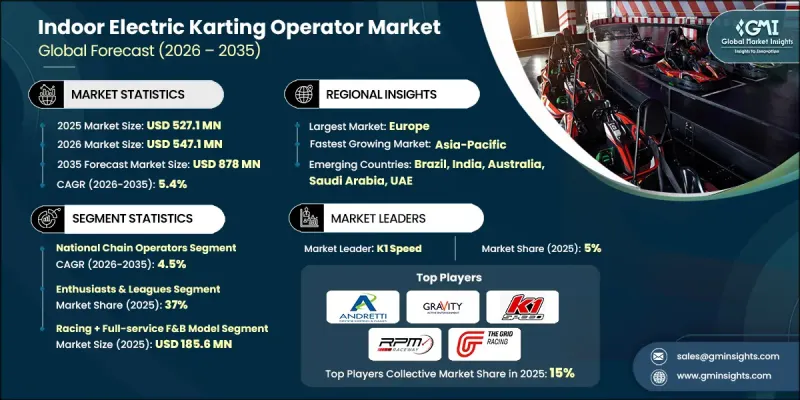
全球室內電動代步車營運市場的成長主要得益於人們對永續、全年開放的娛樂體驗日益成長的需求,這種體驗與不斷變化的都市生活方式趨勢相契合。營運商正加速從汽油動力卡丁車轉向電動代步車轉型,以滿足更嚴格的環保法規並利用電動系統提高營運效率。維護需求降低、噪音水平下降以及能源效率提升,正推動著設施升級和新場館的開發。現代化的室內卡丁車中心融合了先進的賽道設計、多層佈局和數位化賽事管理平台,以增強客戶互動。該行業也積極採用身臨其境型技術,例如數據驅動的性能追蹤、互動式遊戲介面和模擬技術,這些技術能夠擴展賽車體驗,從而提升整體用戶體驗。這些創新提高了客戶留存率,並使營運商能夠設定更高的價格。隨著社交娛樂競爭的持續升溫,室內電動代步車營運產業正在成為更廣泛的離線娛樂市場中一個高成長的細分領域。
| 市場範圍 | |
|---|---|
| 開始年份 | 2025 |
| 預測期 | 2026-2035 |
| 上市時的市場規模 | 5.271億美元 |
| 預計金額 | 8.78億美元 |
| 複合年成長率 | 5.4% |
預計到2025年,全國連鎖業者將佔據44%的市場佔有率,並在2026年至2035年間以4.5%的複合年成長率成長。此細分市場憑藉著規模經濟、標準化服務模式和集中式車輛籌資策略,推動室內電動代步車營運市場的發展。領先的營運商受益於統一的品牌形象、一體化的技術生態系統以及在多個場地部署自有賽事管理系統的能力,從而提升營運效率和客戶忠誠度。
預計到2025年,愛好者和聯賽用戶群將佔市場佔有率的37%,並在2026年至2035年間以3.9%的複合年成長率成長。該群體由專業賽車手和定期參與者組成,他們為營運商提供穩定的收入來源。結構化的聯盟管理能夠提高賽程的可預測性,最佳化車輛運轉率,並建立以社區主導模式,從而支持長期盈利。
預計2025年,美國室內電動代步車市場規模將達到1.005億美元。美國市場的擴張得益於消費者強大的購買力、成熟的賽車運動文化以及完善的家庭娛樂體系。競爭激烈的聯賽模式和常規賽事模式不斷提升客戶維繫和本地市場滲透率,從而推動了全國各地場館營運商的營收成長。
目錄
第1章:調查方法和範圍
第2章執行摘要
第3章業界考察
- 生態系分析
- 供應商情況
- 成本結構
- 利潤率
- 每個階段增加的價值
- 垂直整合趨勢
- 顛覆者
- 影響因素
- 促進因素
- 向電動動力傳動系統過渡
- 體驗經濟的興起
- 餐飲與娛樂的融合
- 企業和團體活動的需求
- 產業潛在風險與挑戰
- 高資本密集度
- 保險和責任成本正在飆升。
- 市場機遇
- 遊戲化與數據分析
- 車輛管理和快速充電
- 混合實境和模擬器
- 國際特許經營擴張
- 促進因素
- 技術趨勢與創新生態系統
- 目前技術
- 新興技術
- 成長潛力分析
- 監理情勢
- 北美洲
- 美國安全與設施法規
- 行業認證和營運標準
- 保險和責任的考慮
- 歐洲
- 歐盟機械指令 (MD) 和 CE 認證
- 歐盟第五階段排放氣體法規
- ISO 12100 和 EN 13814
- 亞太地區
- 日本產業安全衛生法
- 中國GB標準
- 印度的AIS/排放氣體與安全指南
- 拉丁美洲
- 巴西INMETRO認證
- 哥倫比亞勞動部安全法規
- 阿根廷遊樂設施安全指南
- 中東和非洲
- 阿拉伯聯合大公國聯邦人力資源機構及ESMA標準
- 阿曼勞動部設備安全法規
- 南非SABS施工機械標準
- 北美洲
- 波特五力分析
- PESTEL 分析
- 價格趨勢
- 每場比賽的定價
- 會員制度和套餐價格
- 專利分析
- 營運成本結構分析
- 按設施類型分類的固定成本明細
- 變動成本構成
- 區域成本結構
- 變動成本最佳化策略
- 收入模式是如何運作的
- 按收入模式分類的收入明細
- 人均所得(經濟效率)
- 每次造訪的平均消費額
- 促進提升銷售(食品飲料、商品、附加選項)
- 經常性收入水平
- 會員模型
- 賽車聯盟
- 忠誠度計畫
- 需求和使用趨勢
- 按客戶群構成比的銷售明細
- 按一天中的不同時段分類的使用模式
- 尖峰時段與離峰時段的比較
- 週末和工作日需求
- 產能商業化戰略
- 最佳化預訂
- 活動日程表
- 人工智慧(AI)的影響
- 電動車的預測性維護
- 最佳化課程安排並提高課程使用率
- 個性化和動態定價
- 遊戲化和排行榜
- 即時碰撞偵測
- 自動化比賽分析與指導
- 用例
- 長島RPM電氣管槽維修-整合多項娛樂項目
- 英國團隊運動協會 - 競賽聯賽和會員計劃
- K1 Speed的全球擴張與特許經營模式
- 全新概念-AR/VR卡丁車體驗
- 未來趨勢及其對市場的影響
- 多娛樂綜合體模式的成長
- 企業/B2B領域的擴張
- 智慧設施管理與物聯網實施
- 永續發展與向電動車的轉型
- 與電子競技和遊戲化相結合
- 永續性和環境方面
- 永續計劃
- 減少廢棄物策略
- 生產中的能源效率
- 具有環保意識的舉措
- 考慮碳足跡
第4章 競爭情勢
- 介紹
- 企業市佔率分析
- 北美洲
- 歐洲
- 亞太地區
- 拉丁美洲
- 中東和非洲
- 主要市場公司的競爭分析
- 競爭定位矩陣
- 主要進展
- 併購
- 夥伴關係與合作
- 新產品發布
- 業務拓展計劃及資金籌措
第5章 市場估計與預測:依經營者分類,2022-2035年
- 全國連鎖企業
- 特許經營連鎖店
- 公司自營連鎖店
- 區域企業
- 區域特許經營叢集
- 區域獨立連鎖店
- 單地點獨立企業
- 專為購物車設計
- 獨立多元娛樂公司
第6章 市場估計與預測:依所得模式分類,2022-2035年
- 種族中心模式
- 基本餐飲服務
- 小規模遊樂場/附加功能有限
- 賽事 + 全方位餐飲服務模式
- 室內餐廳和酒吧
- 商用廚房的運營
- 多功能娛樂設施模式
- 卡丁車競速 +遊樂場
- 購物車 + 保齡球
- 卡丁車競速+雷射槍戰
- 卡丁車 + VR/模擬器
第7章 市場估價與預測:依設施規模分類,2022-2035年
- 大型設施
- 中型設施
- 緊湊型設施
第8章 市場估算與預測:依客戶分類,2022-2035年
- 個人和散客
- 企業導向的B2B
- 活動和派對
- 業餘選手和聯賽
第9章 市場估計與預測:依地區分類,2022-2035年
- 北美洲
- 美國
- 加拿大
- 歐洲
- 英國
- 德國
- 法國
- 義大利
- 西班牙
- 比利時
- 荷蘭
- 瑞典
- 俄羅斯
- 亞太地區
- 中國
- 印度
- 日本
- 澳洲
- 新加坡
- 韓國
- 越南
- 印尼
- 拉丁美洲
- 巴西
- 墨西哥
- 阿根廷
- 中東和非洲(MEA)
- 南非
- 沙烏地阿拉伯
- 阿拉伯聯合大公國
第10章:公司簡介
- 世界公司
- Andretti Indoor Karting &Games
- Autobahn Indoor Speedway
- K1 Speed
- Karting Genk
- MONZA Foxwoods
- Pole Position Raceway
- R1 Indoor Karting
- RushHour Karting
- The Grid
- 本地企業
- Autobahn Indoor Speedway
- Karting Arena
- Kartworld
- Le Mans Karting International
- Monaco Kart
- Octane Raceway
- RPM Raceway
- TeamSport Indoor Karting
- 新興企業
- F1 Boston
- Race Planet
- SMAAASH Entertainment
The Global Indoor Electric Karting Operator Market was valued at USD 527.1 million in 2025 and is estimated to grow at a CAGR of 5.4% to reach USD 878 million by 2035.
Growth in the global indoor electric karting operator market is driven by rising demand for sustainable, all-season entertainment experiences aligned with evolving urban lifestyle trends. Operators are increasingly transitioning from gasoline-powered fleets to electric karts in response to stricter environmental policies and the operational efficiencies associated with electric systems. Lower maintenance requirements, reduced noise levels, and improved energy efficiency are encouraging facility upgrades and new venue development. Modern indoor karting centers are integrating advanced track designs, multi-level layouts, and digital race management platforms to enhance customer engagement. The industry is also embracing immersive technologies, including data-driven performance tracking, interactive gaming interfaces, and augmented race simulations that elevate the overall user experience. These innovations are strengthening customer retention and enabling operators to command premium pricing. As competitive social entertainment continues to gain traction, the indoor electric karting operator industry is positioning itself as a high-growth segment within the broader location-based entertainment market.
| Market Scope | |
|---|---|
| Start Year | 2025 |
| Forecast Year | 2026-2035 |
| Start Value | $527.1 Million |
| Forecast Value | $878 Million |
| CAGR | 5.4% |
The national chain operators segment accounted for 44% share in 2025 and is expected to grow at a CAGR of 4.5% between 2026 and 2035. This segment leads the indoor electric karting operator market due to its scale advantages, standardized service models, and centralized fleet procurement strategies. Large operators benefit from consistent branding, integrated technology ecosystems, and the ability to deploy proprietary race management systems across multiple venues, strengthening operational efficiency and customer loyalty.
The enthusiasts and leagues segment held 37% share in 2025 and is forecast to grow at a CAGR of 3.9% during 2026-2035. This segment consists of dedicated racers and recurring participants who generate stable revenue streams for operators. Structured league programming enhances scheduling predictability, optimizes fleet utilization, and builds community-driven engagement models that support long-term profitability.
United States Indoor Electric Karting Operator Market reached USD 100.5 million in 2025. Market expansion in the U.S. is supported by strong consumer spending power, a well-established motorsports culture, and a mature family entertainment infrastructure. Competitive league-based formats and recurring event models continue to strengthen customer retention and regional market penetration, driving revenue growth for facility operators across the country.
Key companies operating in the Global Indoor Electric Karting Operator Market include K1 Speed, Andretti Indoor Karting & Games, RPM Raceway, R1 Indoor Karting, Pole Position Raceway, Urban Air Adventure Park, Gravity Active Entertainment, Karting Genk, MONZA Foxwoods, and The Grid. Companies in the Indoor Electric Karting Operator Market are enhancing their competitive positioning through expansion strategies, technology integration, and diversified service offerings. Operators are investing in advanced electric kart fleets, upgrading track configurations, and incorporating digital race analytics to deliver differentiated customer experiences. Strategic site selection in high-traffic urban areas and partnerships with retail and entertainment complexes are strengthening brand visibility. Many players are implementing membership programs and loyalty initiatives to encourage repeat visits and stabilize recurring revenue. Businesses are also leveraging data insights to personalize marketing campaigns and optimize pricing strategies.
Table of Contents
Chapter 1 Methodology & Scope
- 1.1 Research approach
- 1.2 Quality Commitments
- 1.2.1 GMI AI policy & data integrity commitment
- 1.2.1.1 Source consistency protocol
- 1.2.1 GMI AI policy & data integrity commitment
- 1.3 Research Trail & Confidence Scoring
- 1.3.1 Research Trail Components
- 1.3.2 Scoring Components
- 1.4 Data Collection
- 1.4.1 Partial list of primary sources
- 1.5 Data mining sources
- 1.5.1 Paid sources
- 1.5.1.1 Sources, by region
- 1.5.1 Paid sources
- 1.6 Base estimates and calculations
- 1.6.1 Base year calculation for any one approach
- 1.7 Forecast
- 1.7.1 Quantified market impact analysis
- 1.7.1.1 Mathematical impact of growth parameters on forecast
- 1.7.1 Quantified market impact analysis
- 1.8 Research transparency addendum
- 1.8.1 Source attribution framework
- 1.8.2 Quality assurance metrics
- 1.8.3 Our commitment to trust
Chapter 2 Executive Summary
- 2.1 Industry 360° synopsis
- 2.2 Key market trends
- 2.2.1 Regional
- 2.2.2 Operator
- 2.2.3 Revenue Model
- 2.2.4 Facility Scale
- 2.2.5 Customer
- 2.3 TAM Analysis, 2026-2035
- 2.4 CXO perspectives: Strategic imperatives
Chapter 3 Industry Insights
- 3.1 Industry ecosystem analysis
- 3.1.1 Supplier landscape
- 3.1.2 Cost structure
- 3.1.3 Profit margin
- 3.1.4 Value addition at each stage
- 3.1.5 Vertical integration trends
- 3.1.6 Disruptors
- 3.2 Impact on forces
- 3.2.1 Growth drivers
- 3.2.1.1 Shift toward electric powertrains
- 3.2.1.2 Rise of experience economy
- 3.2.1.3 Integration of F&B & entertainment
- 3.2.1.4 Corporate & group event demand
- 3.2.2 Industry pitfalls & challenges
- 3.2.2.1 High capital intensity
- 3.2.2.2 Escalating insurance & liability costs
- 3.2.3 Market opportunities
- 3.2.3.1 Gamification & Data Analytics
- 3.2.3.2 Fleet Management & Fast Charging
- 3.2.3.3 Hybrid Realities & Simulators
- 3.2.3.4 International Franchise Expansion
- 3.2.1 Growth drivers
- 3.3 Technology trends & innovation ecosystem
- 3.3.1 Current technologies
- 3.3.2 Emerging technologies
- 3.4 Growth potential analysis
- 3.5 Regulatory landscape
- 3.5.1 North America
- 3.5.1.1 U.S. safety and facility regulations
- 3.5.1.2 Industry certifications and operational standards
- 3.5.1.3 Insurance and liability considerations
- 3.5.2 Europe
- 3.5.2.1 EU Machinery Directive (MD) & CE Certification
- 3.5.2.2 EU Stage V Emission Standards
- 3.5.2.3 ISO 12100 & EN 13814
- 3.5.3 Asia-Pacific
- 3.5.3.1 Japan Industrial Safety & Health Act
- 3.5.3.2 China GB Standards
- 3.5.3.3 India AIS/Emission & Safety Guidelines
- 3.5.4 Latin America
- 3.5.4.1 Brazil INMETRO Certification
- 3.5.4.2 Colombia Ministry of Labor Safety Regulations
- 3.5.4.3 Argentina Amusement & Equipment Safety Guidelines
- 3.5.5 Middle East & Africa
- 3.5.5.1 UAE Federal Authority for Human Resources & ESMA Standards
- 3.5.5.2 Oman Ministry of Labor Equipment Safety Regulations
- 3.5.5.3 South Africa SABS Construction Equipment Standards
- 3.5.1 North America
- 3.6 Porter's analysis
- 3.7 PESTEL analysis
- 3.8 Price trends
- 3.8.1 By race session pricing
- 3.8.2 By membership and package pricing
- 3.9 Patent analysis
- 3.10 Operating cost structure analysis
- 3.10.1 Fixed cost breakdown by facility format
- 3.10.2 Variable cost breakdown
- 3.10.3 Cost structure by geographic zone
- 3.10.4 Variable cost optimization strategies
- 3.11 Revenue model mechanics
- 3.11.1 Revenue mix structure, by revenue model
- 3.11.2 Revenue per visitor economics
- 3.11.2.1 Average spends per visit
- 3.11.2.2 Upsell contribution (F&B, merch, add-ons)
- 3.12 Recurring revenue levels
- 3.12.1 Membership models
- 3.12.2 Racing leagues
- 3.12.3 Loyalty programs
- 3.13 Demand and utilization dynamics
- 3.13.1 Customer segment contribution, by customer segment
- 3.13.2 Time-based utilization patterns
- 3.13.2.1 Peak vs off-peak hours
- 3.13.2.2 Weekend vs weekday demand
- 3.14 Capacity monetization strategy
- 3.14.1 Booking optimization
- 3.14.2 Event block scheduling
- 3.15 Impact of Artificial Intelligence (AI)
- 3.15.1 Predictive maintenance of electric karts
- 3.15.2 Optimized scheduling & track utilization
- 3.15.3 Personalization & dynamic pricing
- 3.15.4 Gamification and leaderboards
- 3.15.5 Real-time collision detection
- 3.15.6 Automated race analytics & coaching
- 3.16 Use cases
- 3.16.1 Rpm Raceway Long Island Renovation - Multi-Attraction Integration
- 3.16.2 TeamSport Uk - Competitive Leagues and Membership Programs
- 3.16.3 K1 Speed Global Expansion & Franchise Model
- 3.16.4 Emerging Concepts - AR/VR Karting Experiences
- 3.17 Future trends & market impact
- 3.17.1 Growth of multi-entertainment complex models
- 3.17.2 Corporate & b2b segment expansion
- 3.17.3 Smart facility management & iot adoption
- 3.17.4 Sustainability and electric fleet upgrades
- 3.17.5 Integration with e-sports & gamification
- 3.18 Sustainability and environmental aspects
- 3.18.1 Sustainable practices
- 3.18.2 Waste reduction strategies
- 3.18.3 Energy efficiency in production
- 3.18.4 Eco-friendly initiatives
- 3.18.5 Carbon footprint considerations
Chapter 4 Competitive Landscape, 2025
- 4.1 Introduction
- 4.2 Company market share analysis
- 4.2.1 North America
- 4.2.2 Europe
- 4.2.3 Asia-Pacific
- 4.2.4 Latin America
- 4.2.5 Middle East & Africa
- 4.3 Competitive analysis of major market players
- 4.4 Competitive positioning matrix
- 4.5 Key developments
- 4.5.1 Mergers & acquisitions
- 4.5.2 Partnerships & collaborations
- 4.5.3 New product launches
- 4.5.4 Expansion plans and funding
Chapter 5 Market Estimates & Forecast, By Operator, 2022 - 2035 ($Mn)
- 5.1 Key trends
- 5.2 National chain operators
- 5.2.1 Franchise-model chains
- 5.2.2 Corporate-owned chains
- 5.3 Regional operators
- 5.3.1 Regional franchise clusters
- 5.3.2 Regional independent chains
- 5.4 Single-location independents
- 5.4.1 Karting-focused
- 5.4.2 Multi-entertainment independents
Chapter 6 Market Estimates & Forecast, By Revenue Model, 2022 - 2035 ($Mn)
- 6.1 Key trends
- 6.2 Racing-dominant model
- 6.2.1 Basic F&B offering
- 6.2.2 Small arcade/limited add-ons
- 6.3 Racing + full-service F&B model
- 6.3.1 Sit-down restaurant/bar
- 6.3.2 Commercial kitchen operations
- 6.4 Multi-entertainment complex model
- 6.4.1 Karting + arcade
- 6.4.2 Karting + bowling
- 6.4.3 Karting + laser tag
- 6.4.4 Karting + VR/simulators
Chapter 7 Market Estimates & Forecast, By Facility Scale, 2022 - 2035 ($Mn)
- 7.1 Key trends
- 7.2 Large format facilities
- 7.3 Medium format facilities
- 7.4 Compact format facilities
Chapter 8 Market Estimates & Forecast, By Customer, 2022 - 2035 ($Mn)
- 8.1 Key trends
- 8.2 Individual & Walk-in customers
- 8.3 Corporate B2B
- 8.4 Events & parties
- 8.5 Enthusiasts & leagues
Chapter 9 Market Estimates & Forecast, By Region, 2022 - 2035 ($Mn)
- 9.1 North America
- 9.1.1 US
- 9.1.2 Canada
- 9.2 Europe
- 9.2.1 UK
- 9.2.2 Germany
- 9.2.3 France
- 9.2.4 Italy
- 9.2.5 Spain
- 9.2.6 Belgium
- 9.2.7 Netherlands
- 9.2.8 Sweden
- 9.2.9 Russia
- 9.3 Asia Pacific
- 9.3.1 China
- 9.3.2 India
- 9.3.3 Japan
- 9.3.4 Australia
- 9.3.5 Singapore
- 9.3.6 South Korea
- 9.3.7 Vietnam
- 9.3.8 Indonesia
- 9.4 Latin America
- 9.4.1 Brazil
- 9.4.2 Mexico
- 9.4.3 Argentina
- 9.5 MEA
- 9.5.1 South Africa
- 9.5.2 Saudi Arabia
- 9.5.3 UAE
Chapter 10 Company Profiles
- 10.1 Global players
- 10.1.1 Andretti Indoor Karting & Games
- 10.1.2 Autobahn Indoor Speedway
- 10.1.3 K1 Speed
- 10.1.4 Karting Genk
- 10.1.5 MONZA Foxwoods
- 10.1.6 Pole Position Raceway
- 10.1.7 R1 Indoor Karting
- 10.1.8 RushHour Karting
- 10.1.9 The Grid
- 10.2 Regional players
- 10.2.1 Autobahn Indoor Speedway
- 10.2.2 Karting Arena
- 10.2.3 Kartworld
- 10.2.4 Le Mans Karting International
- 10.2.5 Monaco Kart
- 10.2.6 Octane Raceway
- 10.2.7 RPM Raceway
- 10.2.8 TeamSport Indoor Karting
- 10.3 Emerging players
- 10.3.1 F1 Boston
- 10.3.2 Race Planet
- 10.3.3 SMAAASH Entertainment

 卡丁車市場規模、佔有率、成長、全球產業分析、區域洞察與 2026-2034 年預測。
 2026年全球卡丁車市場報告2026-2034年全球卡丁車市場規模、佔有率、趨勢和成長分析報告
 室內卡丁車市場:按卡丁車類型、比賽形式、年齡層、定價模式和應用分類-全球預測,2026-2032年電動卡丁車租賃市場按車輛類型、場地類型、座位配置、速度等級和應用分類-2026年至2032年全球預測
 卡丁車市場規模、佔有率和成長分析(按推進類型、應用(租賃)、座位容量、賽道和地區分類)-2026-2033年產業預測
 室內卡丁車:全球市場佔有率和排名、總收入和需求預測(2025-2031 年)電動卡丁車:全球市場佔有率排名、總銷量和需求預測(2025-2031年)卡丁車市場按類型、載客量、年齡層、最終用途和分銷管道分類-2025-2030 年全球預測
 全球卡丁車市場