


 |
市場調查報告書
商品編碼
1982262
2026 年至 2035 年聽覺和前庭診斷設備的市場機會、成長要素、產業趨勢和預測。Audiology and Vestibular Diagnostic Equipment Market Opportunity, Growth Drivers, Industry Trend Analysis, and Forecast 2026 - 2035 |
||||||

全球聽覺和前庭診斷設備市場預計到 2025 年價值 13 億美元,預計到 2035 年將以 5.4% 的複合年成長率成長至 22 億美元。
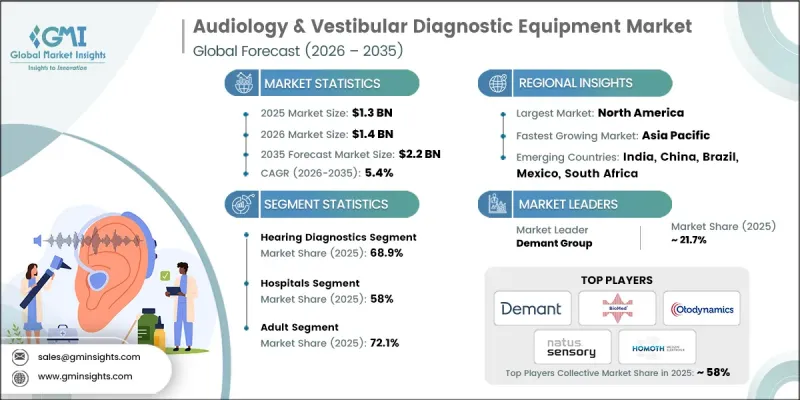
市場擴張的促進因素包括聽力和前庭功能障礙盛行率的上升、老年人口的快速成長以及診斷平台技術的不斷進步。這些醫療設備旨在評估臨床和醫院環境中的聽力和平衡功能。自動化和可攜式系統、無線支援解決方案以及基於人工智慧 (AI) 的診斷平台的開發,提高了診斷的準確性和操作效率,從而推動了該行業的蓬勃發展。現代設備能夠實現高效、以患者為中心且數據驅動的評估,同時增強了與電子健康記錄系統的整合。對即時診斷的需求不斷成長、醫療保健行業的數位轉型以及對兒童和老年人群早期檢測的日益重視,都在推動著行業成長。市場正穩步向互聯和軟體主導的診斷技術轉型,能夠實現即時分析和長期病患監測的智慧雲端系統日益普及,逐漸取代了傳統的獨立設備。
| 市場範圍 | |
|---|---|
| 開始年份 | 2025 |
| 預測期 | 2026-2035 |
| 上市時的市場規模 | 13億美元 |
| 預測金額 | 22億美元 |
| 複合年成長率 | 5.4% |
預計到2025年,聽覺診斷領域將佔據68.9%的市場。這一主導地位得益於全球聽力障礙負擔沉重、早期篩檢措施的廣泛實施、對常規聽力測試的持續需求以及醫療機構中日益成長的臨床應用。聽覺診斷系統在支援助聽器技術的調整、最佳化和持續管理方面也發揮著至關重要的作用。隨著助聽器普及率的提高,對精確聽閾值測量和語言評估工具的需求持續成長。持續監測的需求進一步推動了診斷平台的重複使用。
預計到2025年,成人市場將佔市場佔有率的72.1%,並在2026年至2035年間達到15億美元。在40歲及以上人群中,因老齡化因素、環境暴露和生活方式影響而出現聽力損失的比例正在上升,這推動了對定期診斷測試的需求。早期發現聽力問題有助於改善溝通效果和整體生活品質,並鼓勵患者參與專業評估。隨著老齡化,平衡功能障礙也日益普遍,因此對專業前庭功能評估技術的需求也隨之增加。這些診斷需求正在增強整體面向成人的醫療保健服務的需求。
預計到2025年,北美聽覺和前庭診斷設備市佔率將達到35.3% 。全部區域強勁的醫療費用支出為先進診斷基礎設施的投資提供了支持。成熟的醫療專科優先考慮高精度、數位化整合的系統,推動系統的持續升級和現代化。完善的報銷機制促進了這些設備在公立和私立醫療機構的應用。該地區在數位醫療領域的創新方面也發揮著主導作用,包括遠距離診斷能力和互聯醫療模式,這些都擴大了患者獲得專科服務的途徑。
目錄
第1章:調查方法
- 研究途徑
- 品質改進計劃
- GMI人工智慧政策和資料完整性計劃
- 資訊來源一致性通訊協定
- GMI人工智慧政策和資料完整性計劃
- 調查過程和可靠性評分
- 調查過程的組成部分
- 評分組成部分
- 數據收集
- 主要來源部分列表
- 資料探勘資訊來源
- 付費資訊來源
- 區域資訊來源
- 付費資訊來源
- 基本估算和計算方法
- 每種方法中基準年的計算
- 預測模型
- 量化市場影響分析
- 生長參數對預測的數學影響
- 量化市場影響分析
- 關於調查透明度的補充資訊
- 資訊來源歸屬框架
- 品質保證指標
- 對信任的承諾
第2章執行摘要
第3章業界考察
- 生態系分析
- 影響產業的因素
- 促進因素
- 聽力損失和平衡障礙的盛行率增加
- 聽力學和前庭功能診斷的技術進步
- 提高對聽力和前庭功能障礙早期診斷的認知
- 擴大新生兒和兒童聽力篩檢項目
- 產業潛在風險與挑戰
- 先進診斷設備高成本
- 低收入和中等收入地區的滲透率較低
- 市場機遇
- 擴展遠距聽力測試和遠距離診斷解決方案
- 對攜帶式和即時診斷設備的需求日益成長
- 促進因素
- 成長潛力分析
- 監理情勢
- 北美洲
- 歐洲
- 亞太地區
- 科技趨勢
- 當前技術趨勢
- 新興技術
- 救贖方案
- 未來市場趨勢
- 投資環境
- 波特五力分析
- PESTEL 分析
- 客戶洞察
- Start-Ups場景
- 差距分析
第4章 競爭情勢
- 介紹
- 企業矩陣分析
- 企業市佔率分析
- 世界
- 北美洲
- 歐洲
- 亞太地區
- 競爭定位矩陣
- 主要市場公司的競爭分析
- 主要進展
- 併購
- 夥伴關係與合作
- 新產品發布
- 業務拓展計劃
第5章 市場估價與預測:依產品分類,2022-2035年
- 聽覺診斷
- 聽力測試系統
- 鼓膜測量系統
- 耳聲傳射(OAE)系統
- 其他聽覺診斷
- 前庭功能診斷
- VNG系統
- VEMP系統
- 姿勢評估系統
- vHIT系統
- 其他前庭功能診斷
第6章 市場估計與預測:依病患分類,2022-2035年
- 成人版
- 兒童
第7章 市場估計與預測:依最終用途分類,2022-2035年
- 醫院
- 聽力診所
- 其他最終用戶
第8章 市場估計與預測:依地區分類,2022-2035年
- 北美洲
- 美國
- 加拿大
- 歐洲
- 德國
- 英國
- 法國
- 西班牙
- 義大利
- 荷蘭
- 亞太地區
- 中國
- 日本
- 印度
- 澳洲
- 韓國
- 拉丁美洲
- 巴西
- 墨西哥
- 阿根廷
- 中東和非洲
- 南非
- 沙烏地阿拉伯
- 阿拉伯聯合大公國
第9章:公司簡介
- Bertec
- BioMed Jena
- Demant Group
- Echodia
- Guangzhou Melison Medical Instrument
- hearX
- Homoth Medizinelektronik
- Intelligent Hearing Systems
- Labat Asia
- Natus Sensory
- Neurosoft
- Otodynamics
- Otopront
- PATH MEDICAL
- RION
The Global Audiology & Vestibular Diagnostic Equipment Market was valued at USD 1.3 billion in 2025 and is estimated to grow at a CAGR of 5.4% to reach USD 2.2 billion by 2035.
Market expansion is driven by the increasing incidence of auditory and vestibular disorders, a rapidly expanding aging population, and continuous technological advancements in diagnostic platforms. These medical devices are designed to assess hearing capability and balance function in clinical and hospital environments. The industry is benefiting from the development of automated and portable systems, wireless-enabled solutions, and artificial intelligence-based diagnostic platforms that enhance precision and operational efficiency. Modern equipment supports streamlined, patient-centric, and data-oriented assessments while improving integration with electronic medical record systems. Growing demand for point-of-care diagnostics, digital transformation across healthcare, and stronger focus on early detection in pediatric and geriatric populations are contributing to industry momentum. The market is steadily transitioning toward connected and software-driven diagnostic technologies, replacing conventional standalone devices with smart, cloud-enabled systems that enable real-time analytics and long-term patient monitoring.
| Market Scope | |
|---|---|
| Start Year | 2025 |
| Forecast Year | 2026-2035 |
| Start Value | $1.3 Billion |
| Forecast Value | $2.2 Billion |
| CAGR | 5.4% |
The hearing diagnostics segment accounted for a 68.9% share in 2025. This leadership position is supported by the high global burden of hearing disorders, broad implementation of early screening initiatives, consistent demand for routine hearing evaluations, and widespread clinical utilization across healthcare facilities. Hearing diagnostic systems also play a critical role in supporting the calibration, optimization, and ongoing management of hearing assistance technologies. As the adoption of supportive auditory devices increases, the need for accurate threshold measurement and speech assessment tools continues to grow. Ongoing monitoring requirements further contribute to repeat usage of diagnostic platforms.
The adult segment represented a 72.1% share in 2025 and is projected to reach USD 1.5 billion during 2026-2035. A growing proportion of individuals aged 40 and above are experiencing auditory decline due to age-related factors, environmental exposure, and lifestyle influences, prompting higher demand for routine diagnostic testing. Early identification of hearing challenges enhances communication outcomes and overall quality of life, encouraging greater participation in professional evaluations. Balance-related concerns also become more prevalent with age, driving the need for specialized vestibular assessment technologies. These diagnostic requirements are strengthening demand across adult-focused healthcare services.
North America Audiology & Vestibular Diagnostic Equipment Market captured 35.3% share in 2025. Strong healthcare expenditure across the region supports investment in advanced diagnostic infrastructure. Established specialty departments prioritize high-accuracy and digitally integrated systems, encouraging ongoing upgrades and modernization. Robust reimbursement structures enhance equipment utilization across both public and private healthcare settings. The region also demonstrates leadership in digital health innovation, including remote diagnostic capabilities and connected care models that expand patient access to specialized services.
Key participants in the Global Audiology & Vestibular Diagnostic Equipment Market include PATH MEDICAL, Demant Group, Natus Sensory, hearX, Otodynamics, Neurosoft, Bertec, Homoth Medizinelektronik, Otopront, Guangzhou Melison Medical Instrument, Echodia, Intelligent Hearing Systems, Labat Asia, RION, and BioMed Jena. Companies operating in the Audiology & Vestibular Diagnostic Equipment Market are reinforcing their competitive positions through continuous product innovation, strategic collaborations, and global expansion initiatives. Significant investments in research and development are enabling the introduction of AI-driven and digitally connected diagnostic platforms that enhance clinical accuracy and workflow efficiency. Many organizations are expanding their portable and point-of-care product portfolios to address rising demand for flexible diagnostic solutions. Partnerships with healthcare providers and technology firms are strengthening integration with electronic medical records and telehealth systems. Market players are also focusing on geographic expansion into emerging healthcare markets while enhancing distribution networks.
Table of Contents
Chapter 1 Research Methodology
- 1.1 Research approach
- 1.2 Quality commitments
- 1.2.1 GMI AI policy & data integrity commitment
- 1.2.1.1 Source consistency protocol
- 1.2.1 GMI AI policy & data integrity commitment
- 1.3 Research trail & confidence scoring
- 1.3.1 Research trail components
- 1.3.2 Scoring components
- 1.4 Data collection
- 1.4.1 Partial list of primary sources
- 1.5 Data mining sources
- 1.5.1 Paid sources
- 1.5.1.1 Sources, by region
- 1.5.1 Paid sources
- 1.6 Base estimates and calculations
- 1.6.1 Base year calculation for any one approach
- 1.7 Forecast model
- 1.7.1 Quantified market impact analysis
- 1.7.1.1 Mathematical impact of growth parameters on forecast
- 1.7.1 Quantified market impact analysis
- 1.8 Research transparency addendum
- 1.8.1 Source attribution framework
- 1.8.2 Quality assurance metrics
- 1.8.3 Our commitment to trust
Chapter 2 Executive Summary
- 2.1 Industry 360° synopsis
- 2.2 Key market trends
- 2.2.1 Regional trends
- 2.2.2 Product trends
- 2.2.3 Patient trends
- 2.2.4 End use trends
- 2.3 CXO perspectives: Strategic imperatives
Chapter 3 Industry Insights
- 3.1 Industry ecosystem analysis
- 3.2 Industry impact forces
- 3.2.1 Growth drivers
- 3.2.1.1 Rising prevalence of hearing loss and balance disorders
- 3.2.1.2 Technological advancements in audiology and vestibular diagnostics
- 3.2.1.3 Growing awareness of early hearing and vestibular disorder diagnosis
- 3.2.1.4 Expansion of newborn and pediatric hearing screening programs
- 3.2.2 Industry pitfalls and challenges
- 3.2.2.1 High cost of advanced diagnostic equipment
- 3.2.2.2 Low adoption in low- and middle-income regions
- 3.2.3 Market opportunities
- 3.2.3.1 Expansion of tele-audiology and remote diagnostic solutions
- 3.2.3.2 Growing demand for portable and point-of-care diagnostic devices
- 3.2.1 Growth drivers
- 3.3 Growth potential analysis
- 3.4 Regulatory landscape
- 3.4.1 North America
- 3.4.2 Europe
- 3.4.3 Asia Pacific
- 3.5 Technology landscape
- 3.5.1 Current technological trends
- 3.5.2 Emerging technologies
- 3.6 Reimbursement scenario
- 3.7 Future market trends
- 3.8 Investment landscape
- 3.9 Porter's analysis
- 3.10 PESTEL analysis
- 3.11 Customer insights
- 3.12 Start-up scenarios
- 3.13 Gap analysis
Chapter 4 Competitive Landscape, 2025
- 4.1 Introduction
- 4.2 Company matrix analysis
- 4.3 Company market share analysis
- 4.3.1 Global
- 4.3.2 North America
- 4.3.3 Europe
- 4.3.4 Asia Pacific
- 4.4 Competitive positioning matrix
- 4.5 Competitive analysis of major market players
- 4.6 Key developments
- 4.6.1 Mergers & acquisitions
- 4.6.2 Partnerships & collaborations
- 4.6.3 New product launches
- 4.6.4 Expansion plans
Chapter 5 Market Estimates and Forecast, By Product, 2022 - 2035 ($ Mn)
- 5.1 Key trends
- 5.2 Hearing diagnostics
- 5.2.1 Audiometry systems
- 5.2.2 Tympanometry systems
- 5.2.3 Otoacoustic emissions (OAE) systems
- 5.2.4 Other hearing diagnostics
- 5.3 Vestibular diagnostics
- 5.3.1 VNG systems
- 5.3.2 VEMP systems
- 5.3.3 Posturography systems
- 5.3.4 vHIT systems
- 5.3.5 Other vestibular diagnostics
Chapter 6 Market Estimates and Forecast, By Patient, 2022 - 2035 ($ Mn)
- 6.1 Key trends
- 6.2 Adult
- 6.3 Pediatric
Chapter 7 Market Estimates and Forecast, By End Use, 2022 - 2035 ($ Mn)
- 7.1 Key trends
- 7.2 Hospitals
- 7.3 Audiology clinics
- 7.4 Other end users
Chapter 8 Market Estimates and Forecast, By Region, 2022 - 2035 ($ Mn)
- 8.1 Key trends
- 8.2 North America
- 8.2.1 U.S.
- 8.2.2 Canada
- 8.3 Europe
- 8.3.1 Germany
- 8.3.2 UK
- 8.3.3 France
- 8.3.4 Spain
- 8.3.5 Italy
- 8.3.6 Netherlands
- 8.4 Asia Pacific
- 8.4.1 China
- 8.4.2 Japan
- 8.4.3 India
- 8.4.4 Australia
- 8.4.5 South Korea
- 8.5 Latin America
- 8.5.1 Brazil
- 8.5.2 Mexico
- 8.5.3 Argentina
- 8.6 Middle East and Africa
- 8.6.1 South Africa
- 8.6.2 Saudi Arabia
- 8.6.3 UAE
Chapter 9 Company Profiles
- 9.1 Bertec
- 9.2 BioMed Jena
- 9.3 Demant Group
- 9.4 Echodia
- 9.5 Guangzhou Melison Medical Instrument
- 9.6 hearX
- 9.7 Homoth Medizinelektronik
- 9.8 Intelligent Hearing Systems
- 9.9 Labat Asia
- 9.10 Natus Sensory
- 9.11 Neurosoft
- 9.12 Otodynamics
- 9.13 Otopront
- 9.14 PATH MEDICAL
- 9.15 RION

 2026年全球聽力測試設備市場報告2026年全球聽力篩檢與診斷設備市場報告2026年全球聽力診斷設備及器材市場報告
 全球聽力測試設備市場規模、佔有率、趨勢和成長分析報告(2026-2034年)全球鼓室壓力計市場規模、佔有率、趨勢和成長分析報告(2026-2034年)
 鼓室壓力計市場 - 全球產業規模、佔有率、趨勢、機會及預測(按產品類型、技術、應用、最終用戶、地區和競爭格局分類,2021-2031年)
 攜帶式鼓室壓力計市場:按最終用戶、產品類型、分銷管道、應用和技術類型分類的全球預測(2026-2032年)
 全球聽力檢查儀市場全球鼓室壓力計市場
 鼓室壓力計市場報告:至2031年的趨勢、預測與競爭分析