


 |
市場調查報告書
商品編碼
1959660
特種化學品市場機會、成長要素、產業趨勢分析及2026年至2035年預測Specialty Chemicals Market Opportunity, Growth Drivers, Industry Trend Analysis, and Forecast 2026 - 2035 |
||||||

2025年全球特用化學品市場價值為8,854億美元,預計到2035年將達到1.2兆美元,年複合成長率為2.9%。
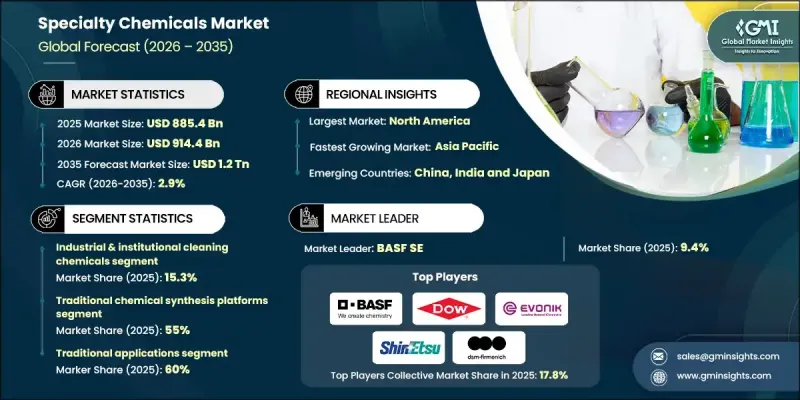
特種化學品產業在眾多工業應用領域中保持著基礎性產業的地位,即使在經濟不確定性中也展現出強大的韌性。高性能產品和關鍵工藝支撐著其持續成長,這些產品和工藝對傳統技術和新興技術都做出了貢獻。市場正從單純的量化成長轉向以價值為導向的擴張,這主要由技術創新、永續性以及清潔能源和數位基礎設施的特種解決方案所驅動。高附加價值應用正在不斷擴展,而那些優先考慮效率、影響力和效能而非規模的成熟市場也日益凸顯。儘管傳統特種化學品仍然佔據主導地位,但專為電動車、先進電子產品和數位應用而設計的下一代產品正在迅速獲得市場認可。已開發地區憑藉其成熟的產業生態系統和嚴格的品質標準保持著領先地位,而新興市場,特別是亞太地區,則在工業化、技術應用和產能擴張的推動下經歷了快速成長。
| 市場範圍 | |
|---|---|
| 開始年份 | 2025 |
| 預測年份 | 2026-2035 |
| 起始值 | 8854億美元 |
| 預測金額 | 1.2兆美元 |
| 複合年成長率 | 2.9% |
預計到2025年,工業和設施清潔化學品市場佔有率將達到15.3%,到2035年將以3%的複合年成長率成長。該細分市場受益於醫療保健、酒店、食品加工和工業設施等關鍵領域對高性能清潔解決方案日益成長的需求,在這些領域,衛生管理至關重要。配方技術的創新推動了清潔效率最大化和環境影響最小化的趨勢。隨著永續性成為全球企業和機構的核心要求,可生物分解和環保解決方案的應用正在不斷擴展。
預計到2025年,傳統應用領域將佔據60%的市場佔有率,到2035年將以2.4%的複合年成長率成長。這些應用在建築、汽車、消費品和工業加工等產業中佔據著基礎性地位,為這些產業提供了穩定的供應鏈和可靠的收入來源。同時,在電氣化、數位化和永續性的驅動下,高成長產業的需求結構正在重塑,這為專注於先進應用和創新製程的特種化學品創造了機會。
預計到2025年,北美特用化學品市佔率將達到50%。這一區域成長得益於強大的基礎設施、先進的研發能力以及供應商與終端用戶之間的緊密合作,從而打造出高品質、針對特定應用的產品。數位化和永續實踐是北美製造商的關鍵差異化優勢,推動了高價值特種化學品的創新。對乾淨科技的投資以及不斷變化的消費者需求,持續全部區域高性能、環保化學解決方案創造機會。
目錄
第1章:調查方法和範圍
第2章執行摘要
第3章業界考察
- 生態系分析
- 供應商情況
- 利潤率
- 每個階段增加的價值
- 影響價值鏈的因素
- 中斷
- 影響產業的因素
- 促進因素
- 電動車革命正在推動對電池化學的需求。
- 可再生能源的擴張需要尖端材料。
- 數位基礎設施的成長正在推動對電子化學品的需求。
- 產業潛在風險與挑戰
- 原物料價格波動及對原物料的依賴
- 嚴格的環境法規導致合規成本增加
- 市場機遇
- 人工智慧驅動的化學發現可將研發時間縮短50%。
- 能源轉換正在催生對專用電解槽組件的需求。
- 促進因素
- 成長潛力分析
- 監管環境
- 北美洲
- 歐洲
- 亞太地區
- 拉丁美洲
- 中東和非洲
- 波特的分析
- PESTEL 分析
- 價格趨勢
- 按地區
- 依產品
- 未來市場趨勢
- 科技與創新趨勢
- 當前技術趨勢
- 新興技術
- 專利狀態
- 貿易統計資料(HS編碼)(註:貿易統計僅提供主要國家的資料)
- 主要進口國
- 主要出口國
- 永續性和環境方面
- 永續努力
- 減少廢棄物策略
- 生產中的能源效率
- 具有環保意識的舉措
- 考慮碳足跡
第4章 競爭情勢
- 介紹
- 企業市佔率分析
- 按地區
- 北美洲
- 歐洲
- 亞太地區
- 拉丁美洲
- 中東和非洲
- 按地區
- 公司矩陣分析
- 主要市場公司的競爭分析
- 競爭定位矩陣
- 主要進展
- 併購
- 夥伴關係與合作
- 新產品發布
- 擴張計劃
第5章 市場估價與預測:依產品分類,2022-2035年
- 殺蟲劑
- 除草劑
- 殺蟲劑
- 消毒劑
- 生長調節劑
- 其他
- 水處理化學品
- 腐蝕抑制劑
- 阻垢劑
- 消毒劑
- 其他
- 油田化學品
- 潤滑劑和減磨劑
- 流變改性劑
- 消毒劑
- 界面活性劑
- 抑制劑和清除劑
- 去乳化劑
- 膠凝劑/增稠劑
- 流動點降低劑
- 黏度調節劑
- 其他
- 建築化學品
- 瀝青改質劑
- 混凝土外加劑
- 黏合劑
- 密封劑
- 保護塗層
- 其他
- 造紙添加劑
- 漂白
- 製程化學品
- 功能性化學品
- 基礎化學品
- 橡膠加工化學品
- 加速器
- 抗氧化劑
- 抗臭氧劑
- 延誤代理人
- 防沾劑
- 阻燃劑
- 其他
- 工業和設施清潔劑
- 氯基鹼性化學品
- 界面活性劑
- 溶劑
- 其他
- 煉油廠和管道用化學品
- 腐蝕抑制劑
- 抗氧化劑
- 流動點降低劑
- 潤滑油
- 乳化劑
- 防污劑
- 其他
- 塑膠添加劑
- 塑化劑
- 穩定器
- 阻燃劑
- 衝擊改質劑
- 潤滑油
- 其他
- 油漆和塗料添加劑
- 潤濕分散劑
- 流動性添加劑
- 消泡劑
- 流變改性劑
- 凝聚劑
- 消毒劑
- 防鏽抑制劑
- 其他
- 其他
第6章 市場估計與預測:依技術分類,2022-2035年
- 傳統化學合成平台
- 生物基生產技術
- 先進製造平台
- 循環化學技術
第7章 市場估計與預測:依應用領域分類,2022-2035年
- 傳統應用
- 農業/作物保護
- 建築和基礎設施
- 汽車製造和售後市場
- 電子設備/消費性設備
- 個人護理和化妝品
- 高成長應用
- 電動車和電池系統
- 可再生能源基礎設施
- 水處理和管理系統
- 醫療和醫療設備應用
- 食品/飲料加工
- 航太和國防技術
- 數位基礎設施和資料中心
第8章 市場估計與預測:依地區分類,2022-2035年
- 北美洲
- 美國
- 加拿大
- 歐洲
- 德國
- 英國
- 法國
- 西班牙
- 義大利
- 其他歐洲地區
- 亞太地區
- 中國
- 印度
- 日本
- 澳洲
- 韓國
- 亞太其他地區
- 拉丁美洲
- 巴西
- 墨西哥
- 阿根廷
- 其他拉丁美洲地區
- 中東和非洲
- 沙烏地阿拉伯
- 南非
- 阿拉伯聯合大公國
- 其他中東和非洲地區
第9章:公司簡介
- BASF SE
- Arkema SA
- Asahi Kasei Corporation
- Clariant AG
- Covestro AG
- Croda International
- Dow Inc.
- DSM-Firmenich
- Eastman Chemical Company
- Evonik Industries
- Huntsman Corporation
- Indovinya
- Lanxess AG
- LG Chem
- Mitsubishi Chemical Group
- Mitsui Chemicals
- Nouryon
- Shin-Etsu Chemical
- Solstice Advanced Materials
- Solvay SA
- Sumitomo Chemical
- Wacker Chemie AG
The Global Specialty Chemicals Market was valued at USD 885.4 billion in 2025 and is estimated to grow at a CAGR of 2.9% to reach USD 1.2 trillion by 2035.
The specialty chemicals industry remains a cornerstone for a vast range of industrial applications, demonstrating resilience even amid economic uncertainties. Its sustained performance is driven by high-performance products and indispensable processes that serve traditional industries and emerging technologies alike. The market is transitioning from growth based solely on volume to value-oriented expansion, fueled by innovations in technology, sustainability, and specialty solutions for clean energy and digital infrastructure. High-value applications are expanding, highlighting a maturing market that emphasizes efficiency, impact, and performance over scale. Conventional specialty chemicals still dominate, yet next-generation products designed for electric mobility, advanced electronics, and digital applications are rapidly gaining traction. Developed regions retain dominance due to advanced industrial ecosystems and rigorous quality standards, while emerging markets, particularly in Asia Pacific, are growing rapidly due to industrialization, technology adoption, and expanding manufacturing capabilities.
| Market Scope | |
|---|---|
| Start Year | 2025 |
| Forecast Year | 2026-2035 |
| Start Value | $885.4 Billion |
| Forecast Value | $1.2 Trillion |
| CAGR | 2.9% |
The industrial and institutional cleaning chemicals segment held 15.3% in 2025 and is projected to grow at a CAGR of 3% by 2035. This segment benefits from rising demand for high-performance cleaning solutions across healthcare, hospitality, food processing, and industrial facilities, where hygiene and sanitation are critical. Innovation in formulations emphasizes maximizing cleaning efficiency while minimizing environmental impact. Biodegradable and eco-friendly solutions are increasingly adopted as sustainability becomes a core requirement for enterprises and institutions globally.
The traditional applications segment accounted for 60% share in 2025 and is expected to grow at a CAGR of 2.4% by 2035. These applications remain fundamental across industries such as construction, automotive, consumer goods, and industrial processing, offering stable supply chains and reliable revenues. At the same time, high-growth sectors driven by electrification, digitalization, and sustainability trends are reshaping demand patterns, creating opportunities for specialty chemicals tailored to advanced applications and innovative processes.
North America Specialty Chemicals Market held a 50% share in 2025. Growth in this region is fueled by well-developed infrastructure, advanced R&D capabilities, and collaboration between suppliers and end-users to create premium, application-specific products. Digitalization and sustainable practices are key differentiators for North American manufacturers, enabling innovation in high-value specialty chemicals. Investments in clean technologies and evolving consumer demands continue to unlock opportunities for high-performance, environmentally responsible chemical solutions across the region.
Major players in the Global Specialty Chemicals Market include Arkema S.A., BASF SE, Clariant AG, Covestro AG, Croda International, Dow Inc., DSM Firmenich, Eastman Chemical Company, Evonik Industries, Huntsman Corporation, Indovinya, Lanxess AG, LG Chem, Mitsubishi Chemical Group, Mitsui Chemicals, Nouryon, Shin Etsu Chemical, Solstice Advanced Materials, Solvay S.A., Sumitomo Chemical, and Wacker Chemie AG. Companies in the specialty chemicals market strengthen their foothold through technological innovation, strategic collaborations, and geographic expansion. They invest in advanced R&D to develop high-performance, application-specific solutions while prioritizing sustainability and regulatory compliance. Partnerships with industrial and technology leaders accelerate product adoption across emerging applications such as digital infrastructure, clean energy, and electrified mobility. Expanding production and distribution networks globally ensures faster delivery and competitive pricing. Differentiation through specialized products, eco-friendly formulations, and digital-enabled solutions enhances brand value.
Table of Contents
Chapter 1 Methodology & Scope
- 1.1 Market scope and definition
- 1.2 Research design
- 1.2.1 Research approach
- 1.2.2 Data collection methods
- 1.3 Data mining sources
- 1.3.1 Global
- 1.3.2 Regional/Country
- 1.4 Base estimates and calculations
- 1.4.1 Base year calculation
- 1.4.2 Key trends for market estimation
- 1.5 Primary research and validation
- 1.5.1 Primary sources
- 1.6 Forecast model
- 1.7 Research assumptions and limitations
Chapter 2 Executive Summary
- 2.1 Industry 360° synopsis
- 2.2 Key market trends
- 2.2.1 Regional
- 2.2.2 Product type
- 2.2.3 Technology
- 2.2.4 Application
- 2.3 TAM Analysis, 2026-2035
- 2.4 CXO perspectives: Strategic imperatives
- 2.4.1 Executive decision points
- 2.4.2 Critical success factors
- 2.5 Future Outlook and Strategic Recommendations
Chapter 3 Industry Insights
- 3.1 Industry ecosystem analysis
- 3.1.1 Supplier landscape
- 3.1.2 Profit margin
- 3.1.3 Value addition at each stage
- 3.1.4 Factor affecting the value chain
- 3.1.5 Disruptions
- 3.2 Industry impact forces
- 3.2.1 Growth drivers
- 3.2.1.1 Electric vehicle revolution driving battery chemistry demand
- 3.2.1.2 Renewable energy expansion requiring advanced materials
- 3.2.1.3 Digital infrastructure growth demanding electronic chemicals
- 3.2.2 Industry pitfalls and challenges
- 3.2.2.1 Raw material price volatility & feedstock dependencies
- 3.2.2.2 Stringent environmental regulations increasing compliance costs
- 3.2.3 Market opportunities
- 3.2.3.1 Ai-driven chemical discovery reducing development time by 50%
- 3.2.3.2 Energy transition creating demand for specialized electrolyzer components
- 3.2.1 Growth drivers
- 3.3 Growth potential analysis
- 3.4 Regulatory landscape
- 3.4.1 North America
- 3.4.2 Europe
- 3.4.3 Asia Pacific
- 3.4.4 Latin America
- 3.4.5 Middle East & Africa
- 3.5 Porter’s analysis
- 3.6 PESTEL analysis
- 3.7 Price trends
- 3.7.1 By region
- 3.7.2 By product
- 3.8 Future market trends
- 3.9 Technology and Innovation landscape
- 3.9.1 Current technological trends
- 3.9.2 Emerging technologies
- 3.10 Patent Landscape
- 3.11 Trade statistics (HS code)( Note: the trade statistics will be provided for key countries only)
- 3.11.1 Major importing countries
- 3.11.2 Major exporting countries
- 3.12 Sustainability and environmental aspects
- 3.12.1 Sustainable practices
- 3.12.2 Waste reduction strategies
- 3.12.3 Energy efficiency in production
- 3.12.4 Eco-friendly initiatives
- 3.13 Carbon footprint consideration
Chapter 4 Competitive Landscape, 2025
- 4.1 Introduction
- 4.2 Company market share analysis
- 4.2.1 By region
- 4.2.1.1 North America
- 4.2.1.2 Europe
- 4.2.1.3 Asia Pacific
- 4.2.1.4 LATAM
- 4.2.1.5 MEA
- 4.2.1 By region
- 4.3 Company matrix analysis
- 4.4 Competitive analysis of major market players
- 4.5 Competitive positioning matrix
- 4.6 Key developments
- 4.6.1 Mergers & acquisitions
- 4.6.2 Partnerships & collaborations
- 4.6.3 New product launches
- 4.6.4 Expansion plans
Chapter 5 Market Estimates and Forecast, By Product, 2022-2035 (USD Billion) (Kilo Tons)
- 5.1 Key trends
- 5.2 Agrochemicals
- 5.2.1 Herbicides
- 5.2.2 Pesticides
- 5.2.3 Fungicides
- 5.2.4 Growth regulators
- 5.2.5 Others
- 5.3 Water treatment chemicals
- 5.3.1 Corrosion inhibitors
- 5.3.2 Scale inhibitors
- 5.3.3 Biocides
- 5.3.4 Others
- 5.4 Oil-field chemicals
- 5.4.1 Lubricants & friction reducers
- 5.4.2 Rheology modifiers
- 5.4.3 Biocides
- 5.4.4 Surfactants
- 5.4.5 Inhibitors & scavengers
- 5.4.6 Demulsifiers
- 5.4.7 Gellants & Viscosifiers
- 5.4.8 Pour-point Depressants
- 5.4.9 Viscosity modifiers
- 5.4.10 Others
- 5.5 Construction chemicals
- 5.5.1 Asphalt modifiers
- 5.5.2 Concrete admixtures
- 5.5.3 Adhesives
- 5.5.4 Sealants
- 5.5.5 Protective coatings
- 5.5.6 Others
- 5.6 Paper additives
- 5.6.1 Bleaching chemicals
- 5.6.2 Process chemicals
- 5.6.3 Functional chemicals
- 5.6.4 Basic chemicals
- 5.6.5 Rubber processing chemicals
- 5.6.6 Accelerators
- 5.6.7 Antioxidants
- 5.6.8 Antiozonants
- 5.6.9 Retarders
- 5.6.10 Anti-tack agents
- 5.6.11 Flame retardants
- 5.6.12 Others
- 5.7 Industrial & Institutional Cleaning Chemicals
- 5.7.1 Chlor-alkali based chemicals
- 5.7.2 Surfactants
- 5.7.3 Solvents
- 5.7.4 Others
- 5.8 Refinery and pipeline chemicals
- 5.8.1 Corrosion inhibitors
- 5.8.2 Antioxidants
- 5.8.3 Pour point depressants
- 5.8.4 Lubricants
- 5.8.5 Emulsifiers
- 5.8.6 Antifouling agents
- 5.8.7 Others
- 5.9 Plastic additives
- 5.9.1 Plasticizers
- 5.9.2 Stabilizers
- 5.9.3 Flame retardants
- 5.9.4 Impact modifiers
- 5.9.5 Lubricants
- 5.9.6 Others
- 5.10 Paints & coatings additives
- 5.10.1 Wetting and dispersing
- 5.10.2 Flow additives
- 5.10.3 Defoaming
- 5.10.4 Rheology modifier
- 5.10.5 Coalescents
- 5.10.6 Biocide
- 5.10.7 Rust Inhibitor
- 5.10.8 Others
- 5.11 Others
Chapter 6 Market Estimates and Forecast, By Technology, 2022-2035 (USD Billion) (Kilo Tons)
- 6.1 Key trends
- 6.2 Traditional chemical synthesis platforms
- 6.3 Bio-based production technologies
- 6.4 Advanced manufacturing platforms
- 6.5 Circular chemistry technologies
Chapter 7 Market Estimates and Forecast, By Application, 2022-2035 (USD Billion) (Kilo Tons)
- 7.1 Key trends
- 7.2 Traditional applications
- 7.2.1 Agriculture & crop protection
- 7.2.2 Construction & infrastructure
- 7.2.3 Automotive manufacturing & aftermarket
- 7.2.4 Electronics & consumer devices
- 7.2.5 Personal care & cosmetics
- 7.3 High-growth applications
- 7.3.1 Electric vehicles & battery systems
- 7.3.2 Renewable energy infrastructure
- 7.3.3 Water treatment & management systems
- 7.3.4 Healthcare & medical device applications
- 7.3.5 Food & beverage processing
- 7.3.6 Aerospace & defense technologies
- 7.3.7 Digital infrastructure & data centers
Chapter 8 Market Estimates and Forecast, By Region, 2022-2035 (USD Billion) (Kilo Tons)
- 8.1 Key trends
- 8.2 North America
- 8.2.1 U.S.
- 8.2.2 Canada
- 8.3 Europe
- 8.3.1 Germany
- 8.3.2 UK
- 8.3.3 France
- 8.3.4 Spain
- 8.3.5 Italy
- 8.3.6 Rest of Europe
- 8.4 Asia Pacific
- 8.4.1 China
- 8.4.2 India
- 8.4.3 Japan
- 8.4.4 Australia
- 8.4.5 South Korea
- 8.4.6 Rest of Asia Pacific
- 8.5 Latin America
- 8.5.1 Brazil
- 8.5.2 Mexico
- 8.5.3 Argentina
- 8.5.4 Rest of Latin America
- 8.6 Middle East and Africa
- 8.6.1 Saudi Arabia
- 8.6.2 South Africa
- 8.6.3 UAE
- 8.6.4 Rest of Middle East and Africa
Chapter 9 Company Profiles
- 9.1 BASF SE
- 9.2 Arkema S.A.
- 9.3 Asahi Kasei Corporation
- 9.4 Clariant AG
- 9.5 Covestro AG
- 9.6 Croda International
- 9.7 Dow Inc.
- 9.8 DSM-Firmenich
- 9.9 Eastman Chemical Company
- 9.10 Evonik Industries
- 9.11 Huntsman Corporation
- 9.12 Indovinya
- 9.13 Lanxess AG
- 9.14 LG Chem
- 9.15 Mitsubishi Chemical Group
- 9.16 Mitsui Chemicals
- 9.17 Nouryon
- 9.18 Shin-Etsu Chemical
- 9.19 Solstice Advanced Materials
- 9.20 Solvay S.A.
- 9.21 Sumitomo Chemical
- 9.22 Wacker Chemie AG

 2026年全球特用化學品分銷市場報告
 2026-2030年全球特用化學品市場
 特種化學品市場分析及預測(至2035年):類型、產品、應用、技術、成分、形式、材料類型、最終用戶、製程、功能
 全球鑄造化學品市場規模、佔有率、趨勢和成長分析報告(2026-2034)2026年全球特用化學品市場報告
 2026-2030年全球二氨基耆二磺酸(DASDA)市場
 全球縮水甘油市場,2026-2030年
 特種化學品CDMO服務市場按服務類型、合約模式、分子類型、尺寸、應用和最終用途產業分類-全球預測,2026-2032年
 日本特種化學品市場報告(按類型和地區分類,2026-2034年)
 電子製造業特殊化學品市場預測(至2032年):按產品類型、應用、最終用戶和地區分類的全球分析