

 |
市場調查報告書
商品編碼
1959650
微處理器市場機會、成長要素、產業趨勢分析及2026年至2035年預測Microprocessor Market Opportunity, Growth Drivers, Industry Trend Analysis, and Forecast 2026 - 2035 |
||||||

2025 年全球微處理器市場價值為 854 億美元,預計到 2035 年將達到 1,910 億美元,年複合成長率為 8.7%。
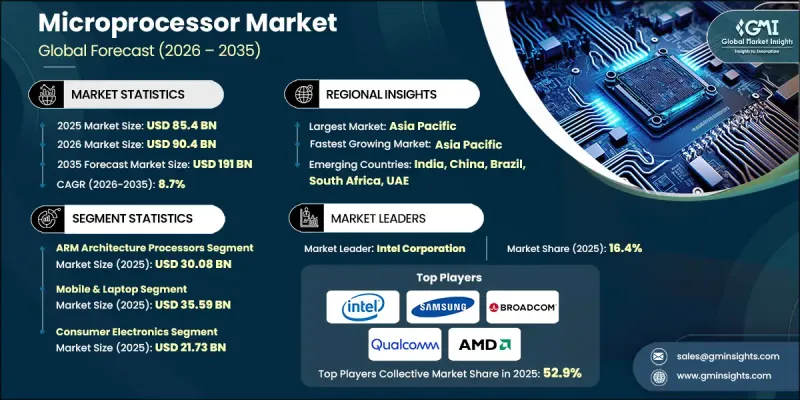
市場成長的驅動力來自各行各業對高效能運算日益成長的需求,以及人工智慧 (AI)、機器學習和數據驅動型應用的快速發展。汽車電子和進階駕駛輔助技術的持續演進提高了對處理器的要求,而家用電子電器和智慧連網設備的普及則加速了市場對處理器的需求。工業自動化和物聯網的普及也為市場的持續成長注入了動力。世界各國政府都在優先發展高效能運算基礎設施,以支持科學研究、數位轉型和經濟競爭。旨在加強國內半導體生態系統的政策舉措進一步推動了家用電子電器和智慧設備領域的成長。微處理器作為電子系統中的中央處理單元,透過處理指令執行算術、邏輯、控制和輸入/輸出操作。這些積體電路能夠解釋軟體和硬體數據,使運算系統、通訊平台、工業機械、汽車系統和連接技術能夠有效率且智慧地運作。
| 市場範圍 | |
|---|---|
| 開始年份 | 2025 |
| 預測年份 | 2026-2035 |
| 起始值 | 854億美元 |
| 預測金額 | 1910億美元 |
| 複合年成長率 | 8.7% |
預計到2025年,ARM架構處理器市場收入將達到300.8億美元。行動裝置和節能電子產品的高普及率鞏固了ARM架構處理器作為領先架構的地位,這得益於其擴充性、整合能力和低功耗。汽車電子、邊緣運算環境和工業IoT系統等領域的不斷擴展部署也持續推動市場需求。製造商正在擴展其基於ARM的產品系列,以滿足行動、物聯網和汽車應用的需求,並專注於效率、整合和成本最佳化。
預計到2025年,行動裝置和筆記型電腦市場規模將達到355.9億美元。高效能且節能的處理器需求日益成長,這主要得益於先進的行動運算需求和不斷完善的用戶體驗。人工智慧功能和圖形密集應用的整合,進一步凸顯了處理器在處理複雜工作負載的同時保持高能效的重要性。為了在智慧型手機和攜帶式運算設備市場保持競爭力,業內相關人員正致力於開發兼具強大運算能力、人工智慧加速和圖形處理能力的處理器。
預計到2025年,北美微處理器市佔率將達到22.9%。在雲端資料中心、企業運算環境、人工智慧處理工作負載以及汽車舉措等強勁需求的推動下,該地區在創新領域持續發揮領導作用。尤其值得一提的是,美國成熟的研發生態系統為高效能和專用處理器的開發提供了有力支援。國內半導體政策促進了本地生產和研發投資,增強了供應鏈的韌性。成熟的行業領導者以及充滿活力的Start-Ups生態系統,進一步加速了下一代處理器的開發及其在多個領域的應用。
目錄
第1章:調查方法和範圍
第2章執行摘要
第3章業界考察
- 生態系分析
- 供應商情況
- 利潤率
- 成本結構
- 每個階段增加的價值
- 影響價值鏈的因素
- 中斷
- 影響產業的因素
- 促進因素
- 各行業對高效能運算的需求不斷成長
- 人工智慧、機器學習和以數據為中心的應用的激增
- 汽車電子產品和高級駕駛輔助系統的發展
- 家用電子電器和智慧型裝置的擴張
- 擴大工業自動化和物聯網解決方案的應用
- 挑戰與困難
- 供應鏈中斷與地緣政治不確定性
- 高昂的研發支出和資本投資需求
- 促進因素
- 成長潛力分析
- 監管環境
- 北美洲
- 歐洲
- 亞太地區
- 拉丁美洲
- 中東和非洲
- 波特的分析
- PESTEL 分析
- 科技與創新趨勢
- 當前技術趨勢
- 新興技術
- 新興經營模式
- 合規要求
- 供應鏈韌性
- 地緣政治分析
第4章 競爭情勢
- 介紹
- 企業市佔率分析
- 按地區
- 北美洲
- 歐洲
- 亞太地區
- 拉丁美洲
- 中東和非洲
- 市場集中度分析
- 按地區
- 主要企業的競爭標竿分析
- 產品系列比較
- 產品線廣度
- 科技
- 創新
- 區域擴張比較
- 全球擴張分析
- 服務網路覆蓋
- 按地區分類的市場滲透率
- 競爭定位矩陣
- 領導企業
- 受讓人
- 追蹤者
- 小眾玩家
- 戰略展望矩陣
- 產品系列比較
- 2022-2025 年重大發展
- 併購
- 合作夥伴關係和合資企業
- 技術進步
- 擴張和投資策略
- 永續發展計劃
- 數位轉型計劃
- 新興/Start-Ups競爭對手的發展趨勢
第5章 市場估算與預測:依CPU架構類型分類,2022-2035年
- x86架構處理器
- ARM架構處理器
- RISC-V架構處理器
- 其他
第6章 市場估計與預測:依應用領域分類,2022-2035年
- 伺服器和資料中心
- 桌上型電腦和工作站
- 手機和筆記型電腦
- 嵌入式設備和物聯網
- 其他
第7章 市場估計與預測:依最終用途產業分類,2022-2035年
- 主要趨勢
- IT 和雲端服務供應商
- 家用電子電器
- 汽車產業
- 工業和製造業
- 電訊和網路
- 醫療及醫療設備
- 航太、國防和政府機構
- 其他
第8章 市場估計與預測:依地區分類,2022-2035年
- 北美洲
- 美國
- 加拿大
- 歐洲
- 德國
- 英國
- 法國
- 西班牙
- 義大利
- 荷蘭
- 亞太地區
- 中國
- 印度
- 日本
- 澳洲
- 韓國
- 拉丁美洲
- 巴西
- 墨西哥
- 阿根廷
- 中東和非洲
- 沙烏地阿拉伯
- 南非
- 阿拉伯聯合大公國
第9章:公司簡介
- 主要企業
- Intel Corporation
- Advanced Micro Devices, Inc.
- NVIDIA Corporation
- Broadcom Inc.
- Qualcomm Technologies, Inc.
- Arm Limited
- Marvell Technology Group Ltd.
- Texas Instruments Incorporated
- 按地區分類的主要企業
- 北美洲
- Analog Devices, Inc.
- Microchip Technology Inc.
- Western Design Centre
- IBM Corporation
- 歐洲
- NXP Semiconductors
- STMicroelectronics NV
- Infineon Technologies AG
- 亞太地區
- Samsung Electronics Co., Ltd.
- Renesas Electronics Corporation
- Seiko Epson Corporation
- 北美洲
- 小眾/顛覆性公司
- Rockchip Electronics Co., Ltd.
- Nuvoton Technology Corporation
The Global Microprocessor Market was valued at USD 85.4 billion in 2025 and is estimated to grow at a CAGR of 8.7% to reach USD 191 billion by 2035.
Market growth is fueled by increasing demand for high-performance computing across diverse industries, alongside the rapid expansion of artificial intelligence, machine learning, and data-driven applications. The continued evolution of automotive electronics and advanced driver assistance technologies is strengthening processor requirements, while the widespread adoption of consumer electronics and connected smart devices is accelerating volume demand. Industrial automation and IoT deployment are also contributing to sustained momentum. Governments worldwide are prioritizing high-performance computing infrastructure to support scientific research, digital transformation, and economic competitiveness. Policy initiatives aimed at strengthening domestic semiconductor ecosystems are further reinforcing growth in consumer electronics and smart device segments. A microprocessor functions as the central processing unit within an electronic system, executing arithmetic, logical, control, and input-output operations by processing instructions. These integrated circuits interpret software and hardware data, enabling computing systems, communication platforms, industrial machinery, automotive systems, and connected technologies to operate efficiently and intelligently.
| Market Scope | |
|---|---|
| Start Year | 2025 |
| Forecast Year | 2026-2035 |
| Start Value | $85.4 Billion |
| Forecast Value | $191 Billion |
| CAGR | 8.7% |
The ARM architecture processors segment generated USD 30.08 billion in 2025. Strong adoption across mobile devices and energy-efficient electronics has positioned ARM-based processors as a dominant architecture due to their scalability, integration capabilities, and low power consumption. Expanding deployment in automotive electronics, edge computing environments, and industrial IoT systems continues to drive additional demand. Manufacturers are increasingly broadening ARM-based product portfolios to address mobile, IoT, and automotive applications, emphasizing efficiency, integration, and cost optimization.
The mobile and laptop segment reached USD 35.59 billion in 2025. Growing demand for high-performance yet power-efficient processors is being driven by advanced mobile computing requirements and increasingly sophisticated user experiences. The integration of AI-enabled features and graphics-intensive applications is reinforcing the need for processors capable of managing complex workloads while maintaining energy efficiency. Industry participants are focusing on developing processors that balance computational performance, AI acceleration, and graphics capabilities to maintain competitiveness in smartphones and portable computing devices.
North America Microprocessor Market accounted for 22.9% share in 2025. The region continues to serve as a major innovation hub, supported by strong demand from cloud data centers, enterprise computing environments, AI processing workloads, and automotive electrification initiatives. A well-established research and development ecosystem, particularly in the United States, underpins the creation of high-performance and specialized processors. Domestic semiconductor policy initiatives are encouraging localized manufacturing and research investment, enhancing supply chain resilience. The presence of established industry leaders alongside dynamic startup ecosystems further accelerates next-generation processor development and adoption across multiple sectors.
Key companies operating in the Global Microprocessor Market include Advanced Micro Devices, Inc., Analog Devices, Inc., Arm Limited, Broadcom Inc., Seiko Epson Corporation, Intel Corporation, Marvell Technology Group Ltd., Microchip Technology Inc., NXP Semiconductors, Qualcomm Technologies, Inc., Renesas Electronics Corporation, Samsung Electronics Co., Ltd., STMicroelectronics N.V., Texas Instruments Incorporated, Western Design Centre, Infineon Technologies AG, Rockchip Electronics Co., Ltd., IBM Corporation, NVIDIA Corporation, and Nuvoton Technology Corporation. Companies in the Microprocessor Market are strengthening their competitive positioning through continuous innovation, advanced node development, and strategic ecosystem partnerships. Leading players are investing heavily in AI-optimized architectures, heterogeneous computing designs, and energy-efficient chip technologies to meet evolving industry demands. Collaborations with cloud providers, automotive manufacturers, and device OEMs are securing long-term supply relationships. Firms are also expanding fabrication capabilities and leveraging advanced packaging techniques to improve performance and yield. Emphasis on software-hardware integration enhances platform differentiation and customer loyalty.
Table of Contents
Chapter 1 Methodology and Scope
- 1.1 Market scope and definition
- 1.2 Research design
- 1.2.1 Research approach
- 1.2.2 Data collection methods
- 1.3 Data mining sources
- 1.3.1 Global
- 1.3.2 Regional/Country
- 1.4 Base estimates and calculations
- 1.4.1 Base year calculation
- 1.4.2 Key trends for market estimation
- 1.5 Primary research and validation
- 1.5.1 Primary sources
- 1.6 Forecast model
- 1.7 Research assumptions and limitations
Chapter 2 Executive Summary
- 2.1 Industry 360° synopsis
- 2.2 Key market trends
- 2.2.1 CPU Architecture Type trends
- 2.2.2 Application trends
- 2.2.3 End-use Industry trends
- 2.2.4 Regional trends
- 2.3 TAM Analysis, 2026 - 2035 (USD Million)
- 2.4 CXO perspectives: Strategic imperatives
- 2.4.1 Executive decision points
- 2.4.2 Critical success factors
- 2.5 Future outlook and strategic recommendations
Chapter 3 Industry Insights
- 3.1 Industry ecosystem analysis
- 3.1.1 Supplier landscape
- 3.1.2 Profit margin
- 3.1.3 Cost structure
- 3.1.4 Value addition at each stage
- 3.1.5 Factor affecting the value chain
- 3.1.6 Disruptions
- 3.2 Industry impact forces
- 3.2.1 Growth drivers
- 3.2.1.1 Rising demand for high-performance computing across industries
- 3.2.1.2 Proliferation of AI, machine learning, and data-centric applications
- 3.2.1.3 Growth of automotive electronics and advanced driver assistance systems
- 3.2.1.4 Expansion of consumer electronics and smart devices
- 3.2.1.5 Increasing adoption of industrial automation and IoT solutions
- 3.2.2 Pitfalls and challenges
- 3.2.2.1 Supply chain disruptions and geopolitical uncertainties
- 3.2.2.2 High R&D and capital investment requirements
- 3.2.1 Growth drivers
- 3.3 Growth potential analysis
- 3.4 Regulatory landscape
- 3.4.1 North America
- 3.4.2 Europe
- 3.4.3 Asia Pacific
- 3.4.4 Latin America
- 3.4.5 Middle East & Africa
- 3.5 Porter’s analysis
- 3.6 PESTEL analysis
- 3.7 Technology and Innovation landscape
- 3.7.1 Current technological trends
- 3.7.2 Emerging technologies
- 3.8 Emerging Business Models
- 3.9 Compliance Requirements
- 3.10 Supply Chain Resilience
- 3.11 Geopolitical Analysis
Chapter 4 Competitive Landscape, 2025
- 4.1 Introduction
- 4.2 Company market share analysis
- 4.2.1 By region
- 4.2.1.1 North America
- 4.2.1.2 Europe
- 4.2.1.3 Asia Pacific
- 4.2.1.4 Latin America
- 4.2.1.5 Middle East & Africa
- 4.2.2 Market concentration analysis
- 4.2.1 By region
- 4.3 Competitive benchmarking of key players
- 4.3.1 Product portfolio comparison
- 4.3.1.1 Product range breadth
- 4.3.1.2 Technology
- 4.3.1.3 Innovation
- 4.3.2 Geographic presence comparison
- 4.3.2.1 Global footprint analysis
- 4.3.2.2 Service network coverage
- 4.3.2.3 Market penetration by region
- 4.3.3 Competitive positioning matrix
- 4.3.3.1 Leaders
- 4.3.3.2 Challengers
- 4.3.3.3 Followers
- 4.3.3.4 Niche players
- 4.3.4 Strategic outlook matrix
- 4.3.1 Product portfolio comparison
- 4.4 Key developments, 2022-2025
- 4.4.1 Mergers and acquisitions
- 4.4.2 Partnerships and collaborations
- 4.4.3 Technological advancements
- 4.4.4 Expansion and investment strategies
- 4.4.5 Sustainability initiatives
- 4.4.6 Digital transformation initiatives
- 4.5 Emerging/ startup competitors landscape
Chapter 5 Market Estimates and Forecast, By CPU Architecture Type, 2022 - 2035 (USD Million)
- 5.1 Key trends
- 5.2 x86 Architecture Processors
- 5.3 ARM Architecture Processors
- 5.4 RISC-V Architecture Processors
- 5.5 Others
Chapter 6 Market Estimates and Forecast, By Application, 2022 - 2035 (USD Million)
- 6.1 Key trends
- 6.2 Server & Data Center
- 6.3 Desktop & Workstation
- 6.4 Mobile & Laptop
- 6.5 Embedded & IoT
- 6.6 Others
Chapter 7 Market Estimates and Forecast, By End-use Industry, 2022 - 2035 (USD Million)
- 7.1 Key Trends
- 7.2 IT & Cloud Service Providers
- 7.3 Consumer Electronics
- 7.4 Automotive Industry
- 7.5 Industrial & Manufacturing
- 7.6 Telecommunications & Networking
- 7.7 Healthcare & Medical Devices
- 7.8 Aerospace, Defense & Government
- 7.9 Others
Chapter 8 Market Estimates and Forecast, By Region, 2022 - 2035 (USD Million)
- 8.1 Key trends
- 8.2 North America
- 8.2.1 U.S.
- 8.2.2 Canada
- 8.3 Europe
- 8.3.1 Germany
- 8.3.2 UK
- 8.3.3 France
- 8.3.4 Spain
- 8.3.5 Italy
- 8.3.6 Netherlands
- 8.4 Asia Pacific
- 8.4.1 China
- 8.4.2 India
- 8.4.3 Japan
- 8.4.4 Australia
- 8.4.5 South Korea
- 8.5 Latin America
- 8.5.1 Brazil
- 8.5.2 Mexico
- 8.5.3 Argentina
- 8.6 Middle East and Africa
- 8.6.1 Saudi Arabia
- 8.6.2 South Africa
- 8.6.3 UAE
Chapter 9 Company Profiles
- 9.1 Global Key Players
- 9.1.1 Intel Corporation
- 9.1.2 Advanced Micro Devices, Inc.
- 9.1.3 NVIDIA Corporation
- 9.1.4 Broadcom Inc.
- 9.1.5 Qualcomm Technologies, Inc.
- 9.1.6 Arm Limited
- 9.1.7 Marvell Technology Group Ltd.
- 9.1.8 Texas Instruments Incorporated
- 9.2 Regional Key Players
- 9.2.1 North America
- 9.2.1.1 Analog Devices, Inc.
- 9.2.1.2 Microchip Technology Inc.
- 9.2.1.3 Western Design Centre
- 9.2.1.4 IBM Corporation
- 9.2.2 Europe
- 9.2.2.1 NXP Semiconductors
- 9.2.2.2 STMicroelectronics N.V.
- 9.2.2.3 Infineon Technologies AG
- 9.2.3 Asia Pacific
- 9.2.3.1 Samsung Electronics Co., Ltd.
- 9.2.3.2 Renesas Electronics Corporation
- 9.2.3.3 Seiko Epson Corporation
- 9.2.1 North America
- 9.3 Niche / Disruptors
- 9.3.1 Rockchip Electronics Co., Ltd.
- 9.3.2 Nuvoton Technology Corporation

 微處理器:市佔率分析、產業趨勢與統計、成長預測(2026-2031)
 微處理器市場預測至2034年—按架構、核心類型、裝置類型、製造技術、應用和地區分類的全球分析
 微處理器市場分析及預測(至2035年):依類型、產品類型、技術、組件、應用、最終用戶、功能、製程及部署類型分類
 2026年全球微處理器市場報告雙介面中央處理器(CPU)卡晶片全球市場報告(2026年)
 微處理器市場-全球產業規模、佔有率、趨勢、競爭格局、機會和預測:按類型、架構、技術格局、最終用戶、地區和競爭情況分類,2021-2031年
 伺服器FCBGA市場按裝置類型、基板類型、應用、I/O數量和最終用戶產業分類,全球預測,2026-2032年
 微處理器市場規模、佔有率、成長及全球產業分析:依類型、應用和地區劃分的洞察與預測(2026-2034)汽車微處理器市場-全球產業規模、佔有率、趨勢、機會及預測(依應用、技術、區域及競爭格局分類,2021-2031年預測)
 微處理器市場規模、佔有率和成長分析(按架構類型、應用、節點和地區分類)-2026-2033年產業預測