

 |
市場調查報告書
商品編碼
1959627
3D NAND快閃記憶體體市場機會、成長要素、產業趨勢分析及2026年至2035年預測3D NAND Flash Memory Market Opportunity, Growth Drivers, Industry Trend Analysis, and Forecast 2026 - 2035 |
||||||

2025 年全球 3D NAND快閃記憶體市場價值為 253.4 億美元,預計到 2035 年將達到 1,930.8 億美元,年複合成長率為 23.1%。
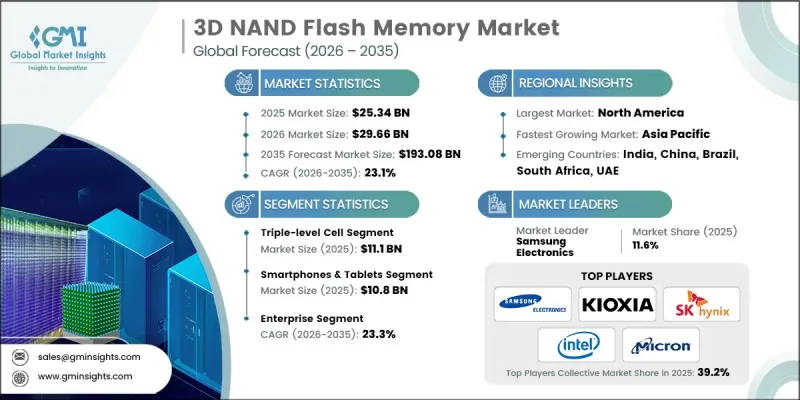
市場成長動能主要受以下因素驅動:家用電子電器對高容量儲存解決方案的需求加速成長、資料中心和雲端運算基礎架構的快速擴張,以及人工智慧、巨量資料和機器學習工作負載日益成長的影響力。企業和汽車領域固態硬碟的廣泛應用進一步推動了市場成長。智慧型手機、物聯網設備和互聯數位生態系統的普及持續產生大量數據,從而推動了對可擴展、高密度儲存技術的需求。隨著全球數位轉型工作的推動,儲存基礎設備正成為各國政府和企業尋求經濟發展、數位主權和提升服務效率的策略重點。對先進數據基礎設施和連接技術的投資,正在創造對可靠、節能、高效能3D NAND快閃記憶體解決方案的持續需求。
| 市場範圍 | |
|---|---|
| 開始年份 | 2025 |
| 預測年份 | 2026-2035 |
| 起始值 | 253.4億美元 |
| 預測金額 | 1930.8億美元 |
| 複合年成長率 | 23.1% |
雲端基礎設施和資料中心的發展在經濟現代化和支援公共數位服務方面發揮核心作用。在包括法國在內的歐洲各國,國家數位化策略都強調採用雲端運算作為現代化服務交付和安全資料管理的基礎。政府主導的措施凸顯了資料中心部署在加強數位生態系統和支援連接技術的戰略重要性。國家數位化框架內物聯網系統的持續擴展,進一步提升了對可擴展、容錯的快閃記憶體解決方案的需求,這些解決方案能夠處理日益成長的資料工作負載。
預計到2025年,三層單元(TLC)快閃記憶體市場規模將達到111億美元。 TLC技術因其成本相對較低且儲存密度高,在大規模儲存應用領域極具吸引力。數位內容消費的不斷成長和數據密集型工作負載的日益增多,正在加速推動對可擴展且經濟高效的TLC NAND解決方案的需求。預計製造商將優先發展TLC快閃記憶體的大量生產,並採用先進的糾錯和耐久性最佳化技術來提高其可靠性和長期性能。
預計到2025年,智慧型手機和平板電腦市場規模將達到108億美元。消費者對能夠支援高階多媒體和資料密集型應用的高效能行動裝置的需求不斷成長,持續推高了對高效、高密度NAND快閃記憶體的需求。開發中國家行動連線和數位服務計畫的擴展,推動了設備出貨量的持續成長,進而帶動了對專為行動平台最佳化的緊湊型、節能型TLC和QLC NAND解決方案的需求。
預計2025年,北美3D NAND快閃記憶體體市佔率將達到36.6%。該地區的主導地位得益於高雲端採用率、資料中心的持續擴張以及不斷成長的企業儲存需求。人工智慧工作負載和企業運算應用正在推動對高密度NAND快閃記憶體的顯著需求。公共部門的數位轉型計畫也在增加對儲存基礎設備的投資。美國和加拿大半導體創新中心的強大研發生態系統正在加速技術進步。邊緣運算和工業IoT的普及應用進一步強化了對專為企業和政府應用量身定做的高效能、低功耗NAND快閃記憶體解決方案的需求。
目錄
第1章:調查方法和範圍
第2章執行摘要
第3章業界考察
- 生態系分析
- 供應商情況
- 利潤率
- 成本結構
- 每個階段增加的價值
- 影響價值鏈的因素
- 中斷
- 影響產業的因素
- 促進因素
- 家用電子電器。
- 資料中心和雲端運算基礎設施的擴展
- 人工智慧、巨量資料和機器學習工作負載的成長
- 固態硬碟 (SSD) 在企業和汽車應用中的普及程度不斷提高
- 智慧型手機、物聯網設備和互聯生態系統的成長
- 挑戰與困難
- 製造流程高度複雜且資本密集。
- 高層建築產量比率管理與可靠性面臨的挑戰
- 促進因素
- 成長潛力分析
- 監管環境
- 北美洲
- 歐洲
- 亞太地區
- 拉丁美洲
- 中東和非洲
- 波特的分析
- PESTEL 分析
- 科技與創新趨勢
- 當前技術趨勢
- 新興技術
- 新興經營模式
- 合規要求
- 供應鏈韌性
- 地緣政治分析
第4章 競爭情勢
- 介紹
- 企業市佔率分析
- 按地區
- 北美洲
- 歐洲
- 亞太地區
- 拉丁美洲
- 中東和非洲
- 市場集中度分析
- 按地區
- 主要企業的競爭標竿分析
- 產品系列比較
- 產品線的廣度
- 科技
- 創新
- 區域擴張比較
- 全球擴張分析
- 服務網路覆蓋
- 按地區分類的市場滲透率
- 競爭定位矩陣
- 領導企業
- 受讓人
- 追蹤者
- 小眾玩家
- 戰略展望矩陣
- 產品系列比較
- 2022-2025 年重大發展
- 併購
- 合作夥伴關係和合資企業
- 技術進步
- 擴張和投資策略
- 永續發展計劃
- 數位轉型計劃
- 新興/Start-Ups競爭對手的發展趨勢
第5章 市場估計與預測:依類型分類,2022-2035年
- 單層細胞
- 多層單元
- 三層電池
第6章 市場估計與預測:依應用領域分類,2022-2035年
- 相機
- 筆記型電腦和桌上型電腦
- 智慧型手機和平板電腦
- 其他
第7章 市場估計與預測:依最終用途產業分類,2022-2035年
- 主要趨勢
- 車
- 家用電子電器
- 對於企業
- 衛生保健
- 其他
第8章 市場估計與預測:依地區分類,2022-2035年
- 北美洲
- 美國
- 加拿大
- 歐洲
- 德國
- 英國
- 法國
- 西班牙
- 義大利
- 荷蘭
- 亞太地區
- 中國
- 印度
- 日本
- 澳洲
- 韓國
- 拉丁美洲
- 巴西
- 墨西哥
- 阿根廷
- 中東和非洲
- 沙烏地阿拉伯
- 南非
- 阿拉伯聯合大公國
第9章:公司簡介
- 主要企業
- Samsung Electronics
- SK Hynix
- Micron Technology
- Intel Corporation
- Kioxia Corporation
- Western Digital Corporation
- 按地區分類的主要企業
- 北美洲
- SanDisk(a division of Western Digital)
- Intel-Micron Flash Technologies(IMFT)
- Netlist, Inc.
- 亞太地區
- Nanya Technology Corporation
- Powerchip Technology Corporation
- YMTC(Yangtze Memory Technologies Co., Ltd.)
- XMC(Xiamen Xinxin Semiconductor Manufacturing Corporation)
- Macronix International
- Transcend Information
- ADATA Technology
- Phison Electronics Corporation
- 北美洲
- 小眾/顛覆性公司
- Silicon Motion Technology Corporation
- SK Hynix System IC, Inc.
- GigaDevice Semiconductor(Beijing)Inc.
The Global 3D NAND Flash Memory Market was valued at USD 25.34 billion in 2025 and is estimated to grow at a CAGR of 23.1% to reach USD 193.08 billion by 2035.
Market momentum is driven by accelerating demand for high-capacity storage solutions across consumer electronics, rapid expansion of data centers and cloud computing infrastructure, and the growing influence of artificial intelligence, big data, and machine learning workloads. The increasing deployment of solid-state drives in enterprise and automotive environments is further strengthening market growth. Rising adoption of smartphones, IoT-enabled devices, and interconnected digital ecosystems continues to generate significant data volumes, reinforcing the need for scalable and high-density memory technologies. As digital transformation initiatives advance worldwide, storage infrastructure is becoming a strategic priority for governments and enterprises seeking to enhance economic development, digital sovereignty, and service efficiency. Investments in advanced data infrastructure and connected technologies are creating sustained demand for reliable, energy-efficient, and high-performance 3D NAND flash memory solutions.
| Market Scope | |
|---|---|
| Start Year | 2025 |
| Forecast Year | 2026-2035 |
| Start Value | $25.34 Billion |
| Forecast Value | $193.08 Billion |
| CAGR | 23.1% |
Cloud infrastructure and data center development play a central role in supporting economic modernization and public digital services. Across Europe, including France, national digital strategies emphasize cloud adoption as a foundation for modern service delivery and secure data management. Government-backed initiatives highlight the strategic importance of data center deployment in strengthening digital ecosystems and supporting connected technologies. The continued expansion of IoT-enabled systems within national digital frameworks further increases demand for scalable and resilient flash memory solutions capable of handling rising data workloads.
The triple-level cell segment reached USD 11.1 billion in 2025. Triple-level cell technology enables high storage density at a comparatively lower cost, making it highly attractive for large-scale storage applications. Growing digital content consumption and data-intensive workloads are accelerating demand for TLC NAND solutions due to their scalability and cost efficiency. Manufacturers are expected to prioritize high-volume TLC production while incorporating advanced error correction and endurance optimization techniques to enhance reliability and long-term performance.
The smartphones and tablets segment generated USD 10.8 billion in 2025. Rising consumer demand for high-performance mobile devices capable of supporting advanced multimedia and data-intensive applications continues to increase the need for efficient and high-density NAND flash memory. Expanding mobile connectivity and digital service initiatives in developing economies are contributing to sustained device shipments, thereby driving demand for compact, power-efficient TLC and QLC NAND solutions optimized for mobile platforms.
North America 3D NAND Flash Memory Market accounted for 36.6% share in 2025. The region's leadership is supported by strong cloud adoption rates, ongoing data center expansion, and rising enterprise storage requirements. Artificial intelligence workloads and enterprise computing applications are generating significant demand for high-density NAND memory. Public sector digital transformation programs are also increasing storage infrastructure investments. A strong research and development ecosystem in semiconductor innovation hubs across the United States and Canada accelerates technological advancements. Growth in edge computing and industrial IoT deployments further reinforces the need for high-performance, energy-efficient NAND flash solutions tailored to enterprise and government applications.
Key companies operating in the Global 3D NAND Flash Memory Market include Samsung Electronics, SK Hynix, Micron Technology, Intel Corporation, Kioxia Corporation (formerly Toshiba Memory Corporation), Western Digital Corporation, SanDisk (a division of Western Digital), Nanya Technology Corporation, Powerchip Technology Corporation, YMTC (Yangtze Memory Technologies Co., Ltd.), Intel-Micron Flash Technologies (IMFT), XMC (Xiamen Xinxin Semiconductor Manufacturing Corporation), Macronix International, Transcend Information, ADATA Technology, Phison Electronics Corporation, Silicon Motion Technology Corporation, Netlist, Inc., SK Hynix System IC, Inc., and GigaDevice Semiconductor (Beijing) Inc. Companies in the Global 3D NAND Flash Memory Market are strengthening their competitive positioning through continuous technological innovation, capacity expansion, and strategic collaborations. Leading players are investing heavily in advanced node development and higher-layer NAND architectures to improve storage density and cost efficiency. Partnerships with cloud service providers and enterprise hardware manufacturers are helping secure long-term supply agreements. Firms are also expanding fabrication capabilities to address rising global demand while improving production yields. Research and development efforts focus on enhancing endurance, speed, and power efficiency to support data-intensive applications.
Table of Contents
Chapter 1 Methodology and Scope
- 1.1 Market scope and definition
- 1.2 Research design
- 1.2.1 Research approach
- 1.2.2 Data collection methods
- 1.3 Data mining sources
- 1.3.1 Global
- 1.3.2 Regional/Country
- 1.4 Base estimates and calculations
- 1.4.1 Base year calculation
- 1.4.2 Key trends for market estimation
- 1.5 Primary research and validation
- 1.5.1 Primary sources
- 1.6 Forecast model
- 1.7 Research assumptions and limitations
Chapter 2 Executive Summary
- 2.1 Industry 360° synopsis
- 2.2 Key market trends
- 2.2.1 Type trends
- 2.2.2 Application trends
- 2.2.3 End use trends
- 2.2.4 Regional trends
- 2.3 TAM Analysis, 2026 - 2035 (USD Million)
- 2.4 CXO perspectives: Strategic imperatives
- 2.4.1 Executive decision points
- 2.4.2 Critical success factors
- 2.5 Future outlook and strategic recommendations
Chapter 3 Industry Insights
- 3.1 Industry ecosystem analysis
- 3.1.1 Supplier landscape
- 3.1.2 Profit margin
- 3.1.3 Cost structure
- 3.1.4 Value addition at each stage
- 3.1.5 Factor affecting the value chain
- 3.1.6 Disruptions
- 3.2 Industry impact forces
- 3.2.1 Growth drivers
- 3.2.1.1 Rising demand for high-capacity storage in consumer electronics
- 3.2.1.2 Expansion of data centers and cloud computing infrastructure
- 3.2.1.3 Growth of artificial intelligence, big data, and machine learning workloads
- 3.2.1.4 Increasing adoption of solid-state drives in enterprise and automotive applications
- 3.2.1.5 Growth in smartphones, IoT devices, and connected ecosystems
- 3.2.2 Pitfalls and challenges
- 3.2.2.1 High manufacturing complexity and capital-intensive fabrication processes
- 3.2.2.2 Yield management and reliability issues at higher layer counts
- 3.2.1 Growth drivers
- 3.3 Growth potential analysis
- 3.4 Regulatory landscape
- 3.4.1 North America
- 3.4.2 Europe
- 3.4.3 Asia Pacific
- 3.4.4 Latin America
- 3.4.5 Middle East & Africa
- 3.5 Porter’s analysis
- 3.6 PESTEL analysis
- 3.7 Technology and Innovation landscape
- 3.7.1 Current technological trends
- 3.7.2 Emerging technologies
- 3.8 Emerging Business Models
- 3.9 Compliance Requirements
- 3.10 Supply Chain Resilience
- 3.11 Geopolitical Analysis
Chapter 4 Competitive Landscape, 2025
- 4.1 Introduction
- 4.2 Company market share analysis
- 4.2.1 By region
- 4.2.1.1 North America
- 4.2.1.2 Europe
- 4.2.1.3 Asia Pacific
- 4.2.1.4 Latin America
- 4.2.1.5 Middle East & Africa
- 4.2.2 Market concentration analysis
- 4.2.1 By region
- 4.3 Competitive benchmarking of key players
- 4.3.1 Product portfolio comparison
- 4.3.1.1 Product range breadth
- 4.3.1.2 Technology
- 4.3.1.3 Innovation
- 4.3.2 Geographic presence comparison
- 4.3.2.1 Global footprint analysis
- 4.3.2.2 Service network coverage
- 4.3.2.3 Market penetration by region
- 4.3.3 Competitive positioning matrix
- 4.3.3.1 Leaders
- 4.3.3.2 Challengers
- 4.3.3.3 Followers
- 4.3.3.4 Niche players
- 4.3.4 Strategic outlook matrix
- 4.3.1 Product portfolio comparison
- 4.4 Key developments, 2022-2025
- 4.4.1 Mergers and acquisitions
- 4.4.2 Partnerships and collaborations
- 4.4.3 Technological advancements
- 4.4.4 Expansion and investment strategies
- 4.4.5 Sustainability initiatives
- 4.4.6 Digital transformation initiatives
- 4.5 Emerging/ startup competitors landscape
Chapter 5 Market Estimates and Forecast, By Type, 2022 - 2035 (USD Million)
- 5.1 Key trends
- 5.2 Single-level cell
- 5.3 Multi-level cell
- 5.4 Triple-level cell
Chapter 6 Market Estimates and Forecast, By Application, 2022 - 2035 (USD Million)
- 6.1 Key trends
- 6.2 Camera
- 6.3 Laptops and PCs
- 6.4 Smartphones & tablets
- 6.5 Others
Chapter 7 Market Estimates and Forecast, By End-use Industry, 2022 - 2035 (USD Million)
- 7.1 Key Trends
- 7.2 Automotive
- 7.3 Consumer electronics
- 7.4 Enterprise
- 7.5 Healthcare
- 7.6 Others
Chapter 8 Market Estimates and Forecast, By Region, 2022 - 2035 (USD Million)
- 8.1 Key trends
- 8.2 North America
- 8.2.1 U.S.
- 8.2.2 Canada
- 8.3 Europe
- 8.3.1 Germany
- 8.3.2 UK
- 8.3.3 France
- 8.3.4 Spain
- 8.3.5 Italy
- 8.3.6 Netherlands
- 8.4 Asia Pacific
- 8.4.1 China
- 8.4.2 India
- 8.4.3 Japan
- 8.4.4 Australia
- 8.4.5 South Korea
- 8.5 Latin America
- 8.5.1 Brazil
- 8.5.2 Mexico
- 8.5.3 Argentina
- 8.6 Middle East and Africa
- 8.6.1 Saudi Arabia
- 8.6.2 South Africa
- 8.6.3 UAE
Chapter 9 Company Profiles
- 9.1 Global Key Players
- 9.1.1 Samsung Electronics
- 9.1.2 SK Hynix
- 9.1.3 Micron Technology
- 9.1.4 Intel Corporation
- 9.1.5 Kioxia Corporation
- 9.1.6 Western Digital Corporation
- 9.2 Regional Key Players
- 9.2.1 North America
- 9.2.1.1 SanDisk (a division of Western Digital)
- 9.2.1.2 Intel-Micron Flash Technologies (IMFT)
- 9.2.1.3 Netlist, Inc.
- 9.2.2 Asia Pacific
- 9.2.2.1 Nanya Technology Corporation
- 9.2.2.2 Powerchip Technology Corporation
- 9.2.2.3 YMTC (Yangtze Memory Technologies Co., Ltd.)
- 9.2.2.4 XMC (Xiamen Xinxin Semiconductor Manufacturing Corporation)
- 9.2.2.5 Macronix International
- 9.2.2.6 Transcend Information
- 9.2.2.7 ADATA Technology
- 9.2.2.8 Phison Electronics Corporation
- 9.2.1 North America
- 9.3 Niche / Disruptors
- 9.3.1 Silicon Motion Technology Corporation
- 9.3.2 SK Hynix System IC, Inc.
- 9.3.3 GigaDevice Semiconductor (Beijing) Inc.

 3D NAND快閃記憶體體市場規模、佔有率和成長分析:按類型、技術、應用、儲存密度、最終用戶、分銷管道和地區分類-2026-2033年產業預測
 2034年3D NAND快閃記憶體快閃記憶體和先進儲存電子產品市場預測-按技術、應用、最終用戶和地區分類的全球分析
 3D NAND快閃記憶體市場分析及至2035年預測:按類型、產品、技術、組件、應用、裝置、製程、最終用戶、安裝、設備分類
 2026年全球3D NAND快閃記憶體體市場報告
 3D NAND快閃記憶體市場-全球產業規模、佔有率、趨勢、機會、預測:按類型、應用、地區和競爭格局分類,2021-2031年
 3D NAND快閃記憶體:全球市佔率和排名、總銷售額和需求預測(2025-2031年)2030 年 3D NAND快閃記憶體快閃記憶體市場預測:按類型、外形規格、記憶體密度、應用、最終用戶和地區進行的全球分析