


 |
市場調查報告書
商品編碼
1959624
軍用帳篷及掩體市場機會、成長要素、產業趨勢分析及預測(2026-2035年)Military Tent and Shelter Market Opportunity, Growth Drivers, Industry Trend Analysis, and Forecast 2026 - 2035 |
||||||

2025 年全球軍用帳篷和住所市場價值 10 億美元,預計到 2035 年將達到 15 億美元,年複合成長率為 4%。
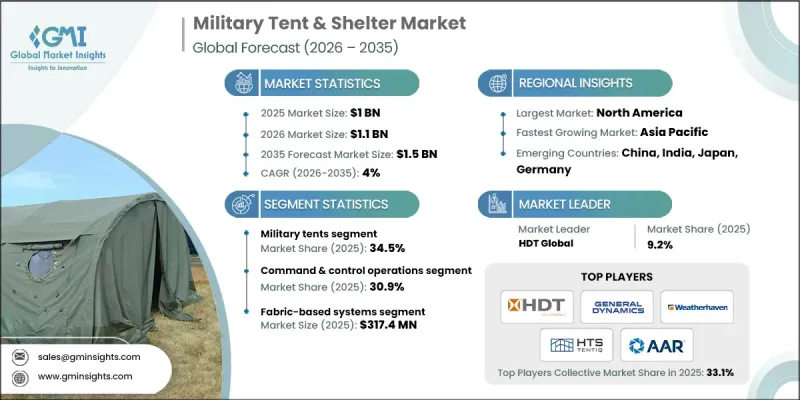
市場成長的主要驅動力是全球國防預算增加導致軍用掩體採購量上升。對遠徵任務快速部署解決方案的需求,以及模組化和智慧掩體技術的進步,進一步加速了其普及。此外,人們對可用於軍事行動和緊急應變的掩體的興趣日益濃厚,也擴大了市場範圍。軍方和政府部門越來越重視柔軟性、節能且可快速部署的基礎設施,以支援作戰準備和人道主義任務。對軍民兩用場景的關注在2020年前後顯著增強,並將持續影響2030年的籌資策略,因為軍事和災害應變機構正在整合物流計劃,以提高作戰韌性和危機應變能力。
| 市場範圍 | |
|---|---|
| 開始年份 | 2025 |
| 預測年份 | 2026-2035 |
| 起始金額 | 10億美元 |
| 預測金額 | 15億美元 |
| 複合年成長率 | 4% |
隨著各國政府將預算分配給行動基礎設施,以支持野戰行動和災害救援,不斷成長的軍事開支推動了對避難所的需求。模組化和智慧避難所設計技術的進步,為軍事任務提供了節能高效且可快速部署的解決方案。同時,緊急應變和人道援助等雙用途應用也拓展了市場潛力。貨櫃式和醫療避難所因其耐用性、適應性以及整合通訊系統、指揮中心和醫療基礎設施的能力而備受關注。這些解決方案能夠支援前沿部署行動、半永久性基地以及在偏遠和衝突地區提供先進的醫療支持,從而提高任務效率和快速反應能力。
預計2026年至2035年間,貨櫃式掩體市場將以5.1%的複合年成長率成長。現代軍事行動中對堅固耐用、防護性能卓越的基礎設施的需求不斷成長,推動了貨櫃式掩體的應用。貨櫃式掩體具有優異的隔熱性和耐久性,並可整合指揮中心、醫療設施和通訊網路等系統。其對惡劣環境的適應性以及對半永久性和永久性用途的適用性,也支撐著市場的持續成長。
預計到2035年,醫療和野戰醫院領域將以5.3%的複合年成長率成長。對前沿部署醫療單元、災害應變和軍事醫療系統的投資增加是推動需求成長的主要因素。這些設施專為偏遠和高風險地區的緊急治療、隔離病房和手術室而設計。日益成長的人道主義援助和快速醫療響應需求正在加速這些解決方案的普及,這些解決方案提供技術先進的醫療基礎設施,可快速部署用於軍事和緊急用途。
預計到2025年,北美軍用帳篷和掩體市場將佔據39.9%的市場。該地區的成長主要得益於美加兩國軍方不斷增加的國防預算以及對遠徵基礎建設的日益重視。具備氣候控制、電力供應和快速部署能力的模組化智慧掩體系統正在廣泛應用。政府和國防相關企業持續投資研發用於軍事行動和救援工作的下一代可部署掩體,不斷推動技術進步。北美將持續引領創新,軍事現代化計劃、聯合演習和作戰需求將持續支撐市場成長至2035年。
目錄
第1章:調查方法和範圍
第2章執行摘要
第3章業界考察
- 生態系分析
- 供應商情況
- 利潤率
- 成本結構
- 每個階段增加的價值
- 影響價值鏈的因素
- 中斷
- 影響產業的因素
- 促進因素
- 由於全球國防預算增加,防空洞採購量也隨之增加。
- 遠徵任務中對快速部署基礎架構的需求
- 模組化智慧住所的技術進步
- 可用於軍事和緊急用途的兩用掩體
- 聯合/盟軍對互通性的需求
- 產業潛在風險與挑戰
- 高昂的採購、維護和生命週期成本
- 偏遠地區或惡劣環境下的複雜物流
- 市場機遇
- 根據特定任務需求客製化模組化設計
- 將可再生能源系統整合到房屋中
- 促進因素
- 成長潛力分析
- 監理情勢
- 北美洲
- 歐洲
- 亞太地區
- 拉丁美洲
- 中東和非洲
- 波特的分析
- PESTEL 分析
- 科技與創新趨勢
- 當前技術趨勢
- 新興技術
- 價格趨勢
- 按地區
- 依產品
- 定價策略
- 新興經營模式
- 合規要求
- 專利和智慧財產權分析
- 地緣政治和貿易趨勢
第4章 競爭情勢
- 介紹
- 企業市佔率分析
- 按地區
- 北美洲
- 歐洲
- 亞太地區
- 拉丁美洲
- 中東和非洲
- 市場集中度分析
- 按地區
- 主要企業的競爭標竿分析
- 財務績效比較
- 收入
- 利潤率
- 研究與開發
- 產品系列比較
- 產品線的廣度
- 科技
- 創新
- 地理位置比較
- 全球擴張分析
- 服務網路覆蓋
- 按地區分類的市場滲透率
- 競爭定位矩陣
- 領導企業
- 挑戰者
- 追蹤者
- 小眾玩家
- 戰略展望矩陣
- 財務績效比較
- 主要進展
- 併購
- 夥伴關係與合作
- 技術進步
- 擴張和投資策略
- 數位轉型計劃
- 新興/Start-Ups競爭對手的發展趨勢
第5章 市場估算與預測:依產品類型分類,2022-2035年
- 軍用帳篷
- 部隊住宿帳篷
- 輕型戰鬥帳篷
- 快速展開式充氣帳篷
- 軟牆模組化庇護所
- 框架支撐式織物庇護所
- 可擴充軟牆系統
- 硬牆可部署式掩體
- 硬質板避難所
- 隔熱硬牆避難所
- 貨櫃式避難所
- ISO貨櫃式遮篷(20英尺/40英尺)
- 可擴展貨櫃式避難所
- 車載式及拖車式遮蔽棚
- 移動指揮所
- 可移動任務庇護所
第6章 市場估算與預測:依部署類型分類,2022-2035年
- 快速部署
- 半永久性
- 攜帶式/可攜式
第7章 市場估計與預測:依保護等級分類,2022-2035年
- 非保護性(僅限環境保護)
- 防彈
- 抗爆性
- 核生化防護
- 電磁脈衝/電磁干擾屏蔽
- 特徵縮減
第8章 市場估算與預測:依材料類型分類,2022-2035年
- 織物底材
- 金屬框架
- 複合材料基體
- 混合結構
第9章 市場估價與預測:依行動平台分類,2022-2035年
- 地面部署類型(可人工運輸或飛機運輸)
- 車上型
- 拖車式
- 容器化
第10章 市場估價與預測:依應用領域分類,2022-2035年
- 部隊營房/基地營地
- 指揮與控制(C2)操作
- 醫療與野戰醫院
- 維護、維修和支援服務
- 通訊、雷達和監視
- 彈藥和裝備儲存
- 訓練和模擬支持
第11章 市場估價與預測:按地區分類,2022-2035年
- 北美洲
- 美國
- 加拿大
- 歐洲
- 德國
- 英國
- 法國
- 西班牙
- 義大利
- 俄羅斯
- 亞太地區
- 中國
- 印度
- 日本
- 澳洲
- 韓國
- 拉丁美洲
- 巴西
- 墨西哥
- 阿根廷
- 中東和非洲
- 南非
- 沙烏地阿拉伯
- 阿拉伯聯合大公國
第12章:公司簡介
- 主要企業
- HDT Global
- General Dynamics Mission Systems
- HTS TENTIQ GmbH
- Losberger De Boer
- AAR Mobility Systems
- 按地區分類的主要企業
- 北美洲
- UTS Systems LLC
- ADS Inc.(Advanced Deployable Systems)
- Celina Military Shelters(Celina Tent, Inc.)
- Outdoor Venture Corp
- 歐洲
- M. Schall
- Rekord Structures Company(RDS)
- Veldeman
- Tentora/New Tents Manufacturing
- 北美洲
- 特殊玩家/干擾者
- Weatherhaven
- Shelter Structures
The Global Military Tent & Shelter Market was valued at USD 1 billion in 2025 and is estimated to grow at a CAGR of 4% to reach USD 1.5 billion in 2035.
Market growth is driven by rising global defense budgets, which are increasing the procurement of military shelters. The demand for rapidly deployable solutions for expeditionary missions and technological advances in modular and smart shelters is further accelerating adoption. Additionally, there is growing interest in shelters that serve dual purposes for military operations and emergency response, broadening the market scope. Military forces and governments are increasingly prioritizing flexible, energy-efficient, and quick-deployment infrastructure to support operational readiness and humanitarian missions. The focus on dual-use scenarios emerged strongly around 2020 and continues to shape procurement strategies through 2030, as military and disaster-response agencies integrate logistics planning to improve operational resilience and crisis response capabilities.
| Market Scope | |
|---|---|
| Start Year | 2025 |
| Forecast Year | 2026-2035 |
| Start Value | $1 Billion |
| Forecast Value | $1.5 Billion |
| CAGR | 4% |
Military expenditure growth is fueling the demand for shelters, as governments allocate budgets to mobile infrastructure to support field operations and disaster relief. Advances in modular and smart shelter designs are enabling energy-efficient, rapid-deployment solutions for military missions, while dual-use applications for emergency response and humanitarian aid are expanding market potential. Containerized and medical shelters are gaining traction for their durability, adaptability, and ability to integrate systems such as communications, command centers, and healthcare infrastructure. These solutions allow for forward-deployed operations, semi-permanent bases, and advanced medical support in remote or conflict-affected areas, enhancing mission effectiveness and rapid-response capabilities.
The containerized shelters segment is expected to grow at a CAGR of 5.1% during 2026-2035. The increasing need for robust, long-lasting, and protective infrastructure for modern military operations is driving adoption. Containerized shelters offer superior insulation, durability, and the ability to integrate systems such as command centers, medical facilities, and communication networks. Their adaptability to harsh environments and suitability for semi-permanent and permanent use are supporting sustained market growth.
The medical and field hospital shelters segment is projected to grow at a CAGR of 5.3% through 2035. Rising investments in forward-deployed medical units, disaster response, and military healthcare readiness are fueling demand. These shelters are designed for emergency treatment, isolation wards, and surgical units in remote or high-risk locations. Humanitarian missions and rapid-response healthcare requirements are accelerating adoption, as these solutions provide quickly deployable and technologically advanced medical infrastructure for military and emergency use.
North America Military Tent & Shelter Market held a 39.9% share in 2025. Growth in the region is driven by rising defense budgets and the U.S. and Canadian militaries' emphasis on expeditionary infrastructure development. Modular and smart shelter systems offering climate control, power, and rapid-deployment capabilities are gaining traction. Investments by governments and defense contractors in next-generation deployable shelters for both military and relief operations continue to drive technological advancement. North America remains at the forefront of innovation, with military modernization projects, joint exercises, and operational needs sustaining market growth through 2035.
Key companies operating in the Global Military Tent & Shelter Market include HDT Global, Shelter Structures, Celina Military Shelters (Celina Tent, Inc.), Rekord Structures Company (RDS), UTS Systems LLC, AAR Mobility Systems, ADS Inc. (Advanced Deployable Systems), Losberger De Boer, Tentora / New Tents Manufacturing, ZTS TENTIQ GmbH, Weatherhaven, Outdoor Venture Corp, M. Schall, Veldeman, and other prominent players. Companies in the Military Tent & Shelter Market are strengthening their foothold through innovation, product diversification, and strategic collaborations. They are developing modular, smart, and energy-efficient shelters that cater to both military and dual-use applications. Partnerships with governments and defense contractors ensure early adoption and long-term contracts. Investments in rapid-deployment technologies, climate-controlled solutions, and integrated communication systems enhance operational relevance.
Table of Contents
Chapter 1 Methodology and Scope
- 1.1 Market scope and definition
- 1.2 Research design
- 1.2.1 Research approach
- 1.2.2 Data collection methods
- 1.3 Data mining sources
- 1.3.1 Global
- 1.3.2 Regional/Country
- 1.4 Base estimates and calculations
- 1.4.1 Base year calculation
- 1.4.2 Key trends for market estimation
- 1.5 Primary research and validation
- 1.5.1 Primary sources
- 1.6 Forecast model
- 1.7 Research assumptions and limitations
Chapter 2 Executive Summary
- 2.1 Industry 360° synopsis, 2022 - 2035
- 2.2 Key market trends
- 2.2.1 Product type trends
- 2.2.2 Deployment type trends
- 2.2.3 Protection level trends
- 2.2.4 Material type trends
- 2.2.5 Mobility platform trends
- 2.2.6 Application trends
- 2.2.7 Regional trends
- 2.3 TAM Analysis, 2026-2035
- 2.4 CXO perspectives: Strategic imperatives
- 2.4.1 Executive decision points
- 2.4.2 critical success factors
- 2.5 Future outlook and strategic recommendations
Chapter 3 Industry Insights
- 3.1 Industry ecosystem analysis
- 3.1.1 Supplier Landscape
- 3.1.2 Profit Margin
- 3.1.3 Cost structure
- 3.1.4 Value addition at each stage
- 3.1.5 Factor affecting the value chain
- 3.1.6 Disruptions
- 3.2 Industry impact forces
- 3.2.1 Growth drivers
- 3.2.1.1 Rising global defense budgets increasing shelter procurements
- 3.2.1.2 Need for rapid deployment infrastructure in expeditionary missions
- 3.2.1.3 Technological advancements in modular and smart shelters
- 3.2.1.4 Dual-use shelters for military and emergency applications
- 3.2.1.5 Interoperability demand from joint/coalition military forces
- 3.2.2 Industry pitfalls and challenges
- 3.2.2.1 High procurement, maintenance and lifecycle costs
- 3.2.2.2 Complex logistics in remote or harsh environments
- 3.2.3 Market opportunities
- 3.2.3.1 Custom modular designs for mission-specific needs
- 3.2.3.2 Integration of renewable energy systems into shelters
- 3.2.1 Growth drivers
- 3.3 Growth potential analysis
- 3.4 Regulatory landscape
- 3.4.1 North America
- 3.4.2 Europe
- 3.4.3 Asia Pacific
- 3.4.4 Latin America
- 3.4.5 Middle East & Africa
- 3.5 Porter’s analysis
- 3.6 PESTEL analysis
- 3.7 Technology and Innovation landscape
- 3.7.1 Current technological trends
- 3.7.2 Emerging technologies
- 3.8 Price trends
- 3.8.1 By region
- 3.8.2 By product
- 3.9 Pricing Strategies
- 3.10 Emerging Business Models
- 3.11 Compliance Requirements
- 3.12 Patent and IP analysis
- 3.13 Geopolitical and trade dynamics
Chapter 4 Competitive Landscape, 2025
- 4.1 Introduction
- 4.2 Company market share analysis
- 4.2.1 By region
- 4.2.1.1 North America
- 4.2.1.2 Europe
- 4.2.1.3 Asia Pacific
- 4.2.1.4 Latin America
- 4.2.1.5 Middle East & Africa
- 4.2.2 Market concentration analysis
- 4.2.1 By region
- 4.3 Competitive benchmarking of key players
- 4.3.1 Financial performance comparison
- 4.3.1.1 Revenue
- 4.3.1.2 Profit margin
- 4.3.1.3 R&D
- 4.3.2 Product portfolio comparison
- 4.3.2.1 Product range breadth
- 4.3.2.2 Technology
- 4.3.2.3 Innovation
- 4.3.3 Geographic presence comparison
- 4.3.3.1 Global footprint analysis
- 4.3.3.2 Service network coverage
- 4.3.3.3 Market penetration by region
- 4.3.4 Competitive positioning matrix
- 4.3.4.1 Leaders
- 4.3.4.2 Challengers
- 4.3.4.3 Followers
- 4.3.4.4 Niche players
- 4.3.5 Strategic outlook matrix
- 4.3.1 Financial performance comparison
- 4.4 Key developments
- 4.4.1 Mergers and acquisitions
- 4.4.2 Partnerships and collaborations
- 4.4.3 Technological advancements
- 4.4.4 Expansion and investment strategies
- 4.4.5 Digital transformation initiatives
- 4.5 Emerging/ startup competitors landscape
Chapter 5 Market Estimates and Forecast, By Product Type, 2022 - 2035 (USD Million)
- 5.1 Key trends
- 5.2 Military tents
- 5.2.1 Troop accommodation tents
- 5.2.2 Lightweight combat tents
- 5.2.3 Rapid-deployment & inflatable tents
- 5.3 Soft-wall modular shelters
- 5.3.1 Frame-supported fabric shelters
- 5.3.2 Expandable soft-wall systems
- 5.4 Hard-wall deployable shelters
- 5.4.1 Rigid panel shelters
- 5.4.2 Insulated hard-wall shelters
- 5.5 Containerized shelters
- 5.5.1 ISO container shelters (20-ft / 40-ft)
- 5.5.2 Expandable containerized shelters
- 5.6 Vehicle-mounted & trailer-mounted shelters
- 5.6.1 Mobile command shelters
- 5.6.2 Transportable mission shelters
Chapter 6 Market Estimates and Forecast, By Deployment Type, 2022 - 2035 (USD Million)
- 6.1 Key trends
- 6.2 Rapid-deployment
- 6.3 Semi-permanent
- 6.4 Relocatable / mobile
Chapter 7 Market Estimates and Forecast, By Protection Level, 2022 - 2035 (USD Million)
- 7.1 Key trends
- 7.2 Non-protected (environmental protection only)
- 7.3 Ballistic-resistant
- 7.4 Blast-resistant
- 7.5 CBRN / NBC-protected
- 7.6 EMP / EMI-shielded
- 7.7 Signature-Reduction
Chapter 8 Market Estimates and Forecast, By Material Type, 2022 - 2035 (USD Million)
- 8.1 Key trends
- 8.2 Fabric-based
- 8.3 Metal-frame
- 8.4 Composite-based
- 8.5 Hybrid construction
Chapter 9 Market Estimates and Forecast, By Mobility Platform, 2022 - 2035 (USD Million)
- 9.1 Key trends
- 9.2 Ground-deployable (man-portable / air-portable)
- 9.3 Vehicle-mounted
- 9.4 Trailer-mounted
- 9.5 Container-transportable
Chapter 10 Market Estimates and Forecast, By Application, 2022 - 2035 (USD Million)
- 10.1 Troop accommodation & base camps
- 10.2 Command & control (C2) operations
- 10.3 Medical & field hospitals
- 10.4 Maintenance, repair & logistics
- 10.5 Communication, radar & surveillance
- 10.6 Ammunition & equipment storage
- 10.7 Training & simulation support
Chapter 11 Market Estimates and Forecast, By Region, 2022 - 2035 (USD Million)
- 11.1 Key trends
- 11.2 North America
- 11.2.1 U.S.
- 11.2.2 Canada
- 11.3 Europe
- 11.3.1 Germany
- 11.3.2 UK
- 11.3.3 France
- 11.3.4 Spain
- 11.3.5 Italy
- 11.3.6 Russia
- 11.4 Asia Pacific
- 11.4.1 China
- 11.4.2 India
- 11.4.3 Japan
- 11.4.4 Australia
- 11.4.5 South Korea
- 11.5 Latin America
- 11.5.1 Brazil
- 11.5.2 Mexico
- 11.5.3 Argentina
- 11.6 Middle East and Africa
- 11.6.1 South Africa
- 11.6.2 Saudi Arabia
- 11.6.3 UAE
Chapter 12 Company Profiles
- 12.1 Global Key Players
- 12.1.1 HDT Global
- 12.1.2 General Dynamics Mission Systems
- 12.1.3 HTS TENTIQ GmbH
- 12.1.4 Losberger De Boer
- 12.1.5 AAR Mobility Systems
- 12.2 Regional key players
- 12.2.1 North America
- 12.2.1.1 UTS Systems LLC
- 12.2.1.2 ADS Inc. (Advanced Deployable Systems)
- 12.2.1.3 Celina Military Shelters (Celina Tent, Inc.)
- 12.2.1.4 Outdoor Venture Corp
- 12.2.2 Europe
- 12.2.2.1 M. Schall
- 12.2.2.2 Rekord Structures Company (RDS)
- 12.2.2.3 Veldeman
- 12.2.2.4 Tentora / New Tents Manufacturing
- 12.2.1 North America
- 12.3 Niche Players/Disruptors
- 12.3.1 Weatherhaven
- 12.3.2 Shelter Structures
