


 |
市場調查報告書
商品編碼
1959618
煙氣排放設備市場機會、成長要素、產業趨勢分析及2026年至2035年預測。Fume Extractor Market Opportunity, Growth Drivers, Industry Trend Analysis, and Forecast 2026 - 2035 |
||||||

2025 年全球排煙設備市場價值為 27 億美元,預計到 2035 年將達到 45 億美元,年複合成長率為 5.4%。
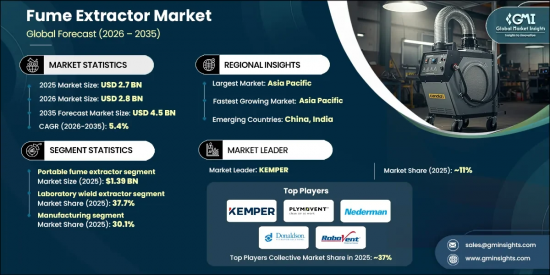
市場成長主要得益於雷射切割和焊接技術在製造業和工業流程中的日益普及。這些操作會產生大量煙霧、有害氣體和超細懸浮微粒,若控制不當,可能引發嚴重的健康問題。相關部門強調,長期接觸焊接煙霧會導致喉嚨和氣道發炎、金屬煙霧熱、急性肺炎、慢性肺病、職業性氣喘,甚至肺癌。煙霧淨化器在維護職場安全方面發揮著至關重要的作用,它能夠去除這些有害排放,確保符合職業健康法規。汽車、電子、航太和金屬加工等行業正擴大採用精密雷射技術,從而推動了對高效煙霧淨化解決方案的需求成長。現代煙霧淨化器旨在處理大量排放物,同時最大限度地減少對營運的影響。隨著企業努力保護員工並遵守法規,以及政府法規和職場空氣品質標準的日益嚴格,市場需求正在進一步加速成長。
| 市場範圍 | |
|---|---|
| 開始年份 | 2025 |
| 預測年份 | 2026-2035 |
| 起始值 | 27億美元 |
| 預測金額 | 45億美元 |
| 複合年成長率 | 5.4% |
攜帶式排煙通風機市場預計到2025年將達到13.9億美元,並在2035年之前以5.1%的複合年成長率成長。該市場憑藉其無與倫比的便攜性和對各種工業及實驗室環境的適應性而佔據主導地位。其緊湊輕巧的設計使其能夠在車間、實驗室和小規模製造工廠之間輕鬆移動,同時保持持續高效的排煙處理。先進的過濾系統能夠有效捕捉焊接煙塵、釬焊煙霧和有害化學顆粒,從而改善整體空氣品質並保護工人健康。電池供電和即插即用型號進一步增強了操作柔軟性,可實現臨時或按需排氣,同時減少停機時間。人們對職業健康標準的日益重視正在推動可攜式排煙通風機在那些移動性、快速部署和可靠性至關重要的環境中得到應用。
預計到2025年,實驗室焊接煙塵通風機市佔率將達到37.7%,並在2026年至2035年間以5.1%的複合年成長率成長。實驗室焊接煙塵通風機對於維持科學研究和測試設施中安全無污染的環境至關重要。這些系統專為捕捉精密實驗室工作中產生的細小焊接煙塵、煙霧和顆粒物而設計。這些排氣系統配備高效能HEPA過濾器和活性碳過濾器,能夠有效去除有害顆粒和有毒氣體,保護實驗室相關人員免受長期呼吸系統和健康風險的影響。科學研究和工業實驗室對職場安全和受控環境日益成長的關注,持續推動對兼具可靠性和高性能的專業排氣解決方案的需求。
預計2025年,中國煙塵淨化設備市場規模將達到2.6億美元,並將以5.7%的複合年成長率持續成長至2035年。快速的工業化進程、製造業的擴張以及雷射和焊接技術的廣泛應用是推動中國市場成長的主要動力。汽車、電子和金屬加工行業需求的成長正在推動攜帶式和固定式煙塵淨化設備的普及。日益嚴格的職場安全法規和人們對室內空氣品質意識提升促使企業投資於先進且高效的過濾系統。政府支持工業現代化、能源效率和自動化的政策進一步加速了市場滲透。此外,城市建設趨勢和小規模DIY項目的增加也為局部使用而設計的緊湊型電動煙塵淨化解決方案創造了穩定的需求。
目錄
第1章:調查方法和範圍
第2章執行摘要
第3章業界考察
- 生態系分析
- 供應商情況
- 利潤率
- 每個階段增加的價值
- 影響價值鏈的因素
- 影響產業的因素
- 促進因素
- 製造業中雷射切割和焊接技術的應用日益廣泛。
- 更嚴格的職業安全與健康法規,以確保符合空氣品質標準。
- 擴大潔淨室及精密製造程序
- 挑戰與困難
- 先進的過濾系統和多級萃取裝置的初始成本很高。
- 頻繁更換濾芯會導致營運成本增加。
- 機會
- 開發節能、低噪音的排氣系統
- 對移動式和模組化抽吸裝置的需求增加
- 促進因素
- 成長潛力分析
- 未來市場趨勢
- 科技與創新趨勢
- 當前技術趨勢
- 新興技術
- 價格趨勢
- 按地區
- 依產品類型
- 監管環境
- 標準和合規要求
- 區域法規結構
- 認證標準
- 貿易統計(HS編碼 - 842199)
- 主要進口國
- 主要出口國
- 波特的分析
- PESTEL 分析
第4章 競爭情勢
- 介紹
- 企業市佔率分析
- 按地區
- 北美洲
- 歐洲
- 亞太地區
- 拉丁美洲
- 中東和非洲
- 按地區
- 公司矩陣分析
- 主要市場公司的競爭分析
- 競爭定位矩陣
- 主要進展
- 併購
- 夥伴關係與合作
- 新產品發布
- 擴張計劃
第5章 市場估算與預測:依產品類型分類,2022-2035年
- 固定式排煙裝置
- 可攜式排煙系統
- 桌上型排煙系統
- 壁掛式排煙系統
第6章 市場估計與預測:依應用領域分類,2022-2035年
- 焊接煙塵抽吸裝置
- 實驗室洗脫和萃取裝置
- 化學萃取裝置
- 藥物溶離度測試裝置
第7章 市場估計與預測:依最終用途分類,2022-2035年
- 車
- 製造業
- 航太工業
- 衛生保健
- 製藥
- 食品/飲料
- 建造
第8章 市場估計與預測:依地區分類,2022-2035年
- 北美洲
- 美國
- 加拿大
- 歐洲
- 德國
- 英國
- 法國
- 義大利
- 西班牙
- 亞太地區
- 中國
- 印度
- 日本
- 韓國
- 澳洲
- 拉丁美洲
- 巴西
- 墨西哥
- 阿根廷
- 中東和非洲
- 沙烏地阿拉伯
- 阿拉伯聯合大公國
- 南非
第9章:公司簡介
- ACT Dust Collectors
- Andersen
- Camfil APC
- Donaldson
- Fumex
- Hastings
- KEMPER
- Lincoln Electric
- Miller Electric
- Nederman
- Peakvac
- Plymovent
- RoboVent
- Ruwac
- Sentry Air Systems
The Global Fume Extractor Market was valued at USD 2.7 billion in 2025 and is estimated to grow at a CAGR of 5.4% to reach USD 4.5 billion by 2035.
The market growth is driven by the increasing adoption of laser cutting and welding technologies across manufacturing and industrial processes. These operations generate significant amounts of smoke, fumes, and ultrafine particles that pose serious health hazards if left unmanaged. Authorities emphasize that prolonged exposure to welding fumes can result in throat and airway irritation, metal fume fever, acute pneumonia, chronic lung disease, occupational asthma, and even lung cancer. Fume extractors play a critical role in maintaining workplace safety by removing these hazardous emissions and ensuring compliance with occupational health regulations. Industries such as automotive, electronics, aerospace, and metal fabrication are increasingly adopting precise laser technologies, which in turn raises the demand for effective extraction solutions. Modern fume extractors are engineered to handle high volumes of emissions while minimizing operational disruption. Stricter government regulations and workplace air quality standards are further accelerating market demand, as companies strive to protect employees and maintain compliance.
| Market Scope | |
|---|---|
| Start Year | 2025 |
| Forecast Year | 2026-2035 |
| Start Value | $2.7 Billion |
| Forecast Value | $4.5 Billion |
| CAGR | 5.4% |
The portable fume extractor segment accounted for USD 1.39 billion in 2025 and is expected to grow at a CAGR of 5.1% through 2035. This segment dominates due to its unmatched portability and adaptability across diverse industrial and laboratory environments. Compact and lightweight designs allow easy relocation between workshops, laboratories, and small-scale manufacturing facilities while maintaining continuous and efficient fume removal. Advanced filtration systems efficiently capture welding fumes, soldering smoke, and harmful chemical particles, improving overall air quality and safeguarding worker health. Battery-operated and plug-and-play models further enhance operational flexibility, enabling temporary or on-demand extraction while reducing downtime. Rising awareness of occupational health standards is supporting the adoption of portable fume extractors in environments where mobility, rapid deployment, and reliability are crucial.
The laboratory welding extractor segment held a 37.7% share in 2025 and is projected to grow at a CAGR of 5.1% from 2026 to 2035. Laboratory welding extractors are essential for maintaining safe and contaminant-free conditions in research and testing facilities. These systems are specifically designed to capture fine welding fumes, smoke, and particulate matter generated during precise laboratory operations. Equipped with high-efficiency HEPA and activated carbon filters, these extractors effectively remove hazardous particles and toxic gases, protecting laboratory personnel from long-term respiratory and health risks. The growing focus on workplace safety and controlled environments in scientific and industrial laboratories continues to drive demand for specialized extraction solutions that provide both reliability and high performance.
China Fume Extractor Market reached USD 260 million in 2025, and is expected to grow at a CAGR of 5.7% through 2035. Rapid industrialization, manufacturing expansion, and increasing adoption of laser and welding technologies are key factors driving market growth in the country. Rising demand from the automotive, electronics, and metal fabrication industries is encouraging the deployment of both portable and stationary fume extractors. Strengthening workplace safety regulations and rising awareness about indoor air quality are motivating businesses to invest in advanced, high-efficiency filtration systems. Government initiatives supporting industrial modernization, energy efficiency, and automation further accelerate market adoption. Additionally, urban construction trends and growing small-scale DIY operations are contributing to steady demand for compact electric fume extraction solutions designed for localized use.
Leading players operating in the Global Fume Extractor Market include Donaldson, Lincoln Electric, Plymovent, RoboVent, Peakvac, Miller Electric, A.C.T. Dust Collectors, Camfil APC, KEMPER, Sentry Air Systems, Ruwac, Hastings, Andersen, Fumex, and Nederman. Companies in the Fume Extractor Market are pursuing multiple strategies to strengthen their market presence and ensure long-term growth. They are investing in research and development to create high-efficiency extraction systems with HEPA, activated carbon, and multi-stage filtration technologies. Product innovation, including portable, battery-operated, and modular designs, is helping them target diverse industrial, laboratory, and small-scale applications. Strategic partnerships with manufacturing, automotive, and electronics companies allow suppliers to secure long-term supply contracts. Firms are also emphasizing compliance with occupational safety standards and energy efficiency to differentiate their offerings.
Table of Contents
Chapter 1 Methodology & Scope
- 1.1 Market scope and definition
- 1.2 Research design
- 1.2.1 Research approach
- 1.2.2 Data collection methods
- 1.3 Data mining sources
- 1.3.1 Global
- 1.3.2 Regional/Country
- 1.4 Base estimates and calculations
- 1.4.1 Base year calculation
- 1.4.2 Key trends for market estimation
- 1.5 Primary research and validation
- 1.5.1 Primary sources
- 1.6 Forecast model
- 1.7 Research assumptions and limitations
Chapter 2 Executive Summary
- 2.1 Industry 360° synopsis
- 2.2 Key market trends
- 2.2.1 Regional
- 2.2.2 Product type
- 2.2.3 Application
- 2.2.4 End use
- 2.3 CXO perspectives: Strategic imperatives
- 2.3.1 Key decision points for industry executives
- 2.3.2 Critical success factors for market players
- 2.4 Future outlook and strategic recommendations
Chapter 3 Industry Insights
- 3.1 Industry ecosystem analysis
- 3.1.1 Supplier landscape
- 3.1.2 Profit margin
- 3.1.3 Value addition at each stage
- 3.1.4 Factor affecting the value chain
- 3.2 Industry impact forces
- 3.2.1 Growth drivers
- 3.2.1.1 Increasing adoption of laser cutting and welding in manufacturing
- 3.2.1.2 Stricter occupational safety regulations for air quality compliance
- 3.2.1.3 Expansion of cleanroom-based and precision production processes
- 3.2.2 Pitfalls & Challenges
- 3.2.2.1 High upfront cost of advanced filtration and multi-stage extraction units
- 3.2.2.2 Frequent filter replacements increase operational expenses
- 3.2.3 Opportunities
- 3.2.3.1 Development of energy-efficient, low-noise extraction systems
- 3.2.3.2 Growing demand for mobile and modular extraction units
- 3.2.1 Growth drivers
- 3.3 Growth potential analysis
- 3.4 Future market trends
- 3.5 Technology and innovation landscape
- 3.5.1 Current technological trends
- 3.5.2 Emerging technologies
- 3.6 Price trends
- 3.6.1 By region
- 3.6.2 By product type
- 3.7 Regulatory landscape
- 3.7.1 Standards and compliance requirements
- 3.7.2 Regional regulatory frameworks
- 3.7.3 Certification standards
- 3.8 Trade statistics (HS Code - 842199)
- 3.8.1 Major importing countries
- 3.8.2 Major exporting countries
- 3.9 Porter’s analysis
- 3.10 PESTEL analysis
Chapter 4 Competitive Landscape, 2025
- 4.1 Introduction
- 4.2 Company market share analysis
- 4.2.1 By Region
- 4.2.1.1 North America
- 4.2.1.2 Europe
- 4.2.1.3 Asia Pacific
- 4.2.1.4 Latin America
- 4.2.1.5 Middle East & Africa
- 4.2.1 By Region
- 4.3 Company matrix analysis
- 4.4 Competitive analysis of major market players
- 4.5 Competitive positioning matrix
- 4.6 Key developments
- 4.6.1 Mergers & acquisitions
- 4.6.2 Partnerships & collaborations
- 4.6.3 New product launches
- 4.6.4 Expansion plans
Chapter 5 Market Estimates & Forecast, By Product Type, 2022 - 2035, (USD Billion) (Thousand Units)
- 5.1 Key trends
- 5.2 Fixed fume extractor
- 5.3 Portable fume extractor
- 5.4 Benchtop fume extractor
- 5.5 Wall mounted fume extractor
Chapter 6 Market Estimates & Forecast, By Application, 2022 - 2035, (USD Billion) (Thousand Units)
- 6.1 Key trends
- 6.2 Welding fume extractor
- 6.3 Laboratory wield extractor
- 6.4 Chemicals wield extractor
- 6.5 Pharmaceutical wield extractor
Chapter 7 Market Estimates & Forecast, By End Use, 2022 - 2035, (USD Billion) (Thousand Units)
- 7.1 Key trends
- 7.2 Automotive
- 7.3 Manufacturing
- 7.4 Aerospace
- 7.5 Healthcare
- 7.6 Pharmaceuticals
- 7.7 Food & beverages
- 7.8 Construction
Chapter 8 Market Estimates & Forecast, By Region, 2022 - 2035, (USD Billion) (Thousand Units)
- 8.1 Key trends
- 8.2 North America
- 8.2.1 U.S.
- 8.2.2 Canada
- 8.3 Europe
- 8.3.1 Germany
- 8.3.2 UK
- 8.3.3 France
- 8.3.4 Italy
- 8.3.5 Spain
- 8.4 Asia Pacific
- 8.4.1 China
- 8.4.2 India
- 8.4.3 Japan
- 8.4.4 South Korea
- 8.4.5 Australia
- 8.5 Latin America
- 8.5.1 Brazil
- 8.5.2 Mexico
- 8.5.3 Argentina
- 8.6 MEA
- 8.6.1 Saudi Arabia
- 8.6.2 UAE
- 8.6.3 South Africa
Chapter 9 Company Profiles
- 9.1 A.C.T. Dust Collectors
- 9.2 Andersen
- 9.3 Camfil APC
- 9.4 Donaldson
- 9.5 Fumex
- 9.6 Hastings
- 9.7 KEMPER
- 9.8 Lincoln Electric
- 9.9 Miller Electric
- 9.10 Nederman
- 9.11 Peakvac
- 9.12 Plymovent
- 9.13 RoboVent
- 9.14 Ruwac
- 9.15 Sentry Air Systems

 噴漆煙霧排放設備市場:依產品類型、淨化技術、最終用戶、通路和應用分類-全球預測,2026-2032年
 全球工業集塵機市場規模、佔有率、趨勢和成長分析報告(2026-2034)全球清潔手推車市場規模、佔有率、趨勢和成長分析報告:2026-2034年
 2026年全球工業濕式集塵機市場報告全球工業除塵器市場:市場規模、佔有率、成長率、產業分析、依類型、應用和地區劃分的分析以及未來預測(2026-2034)
 工業集塵機市場規模、佔有率和成長分析(按類型、過濾器類型、機械結構、移動性、最終用途和地區分類)—產業預測(2026-2033 年)
 工業集塵機:全球市佔率及排名、總收入及需求預測(2025-2031年)焊錫煙霧吸收器:全球市場佔有率和排名、總銷售額和需求預測(2025-2031 年)
 實驗室提取機市場報告:2031 年趨勢、預測和競爭分析
 工業集塵機市場規模、佔有率、趨勢分析報告:按類型、最終用途、機制、流動性、地區和細分市場預測,2025-2030 年