


 |
市場調查報告書
商品編碼
1959614
工業齒輪箱市場機會、成長要素、產業趨勢分析及2026年至2035年預測Industrial Gearbox Market Opportunity, Growth Drivers, Industry Trend Analysis, and Forecast 2026 - 2035 |
||||||

2025年全球工業齒輪箱市場價值為321億美元,預計到2035年將達到521億美元,年複合成長率為5.1%。
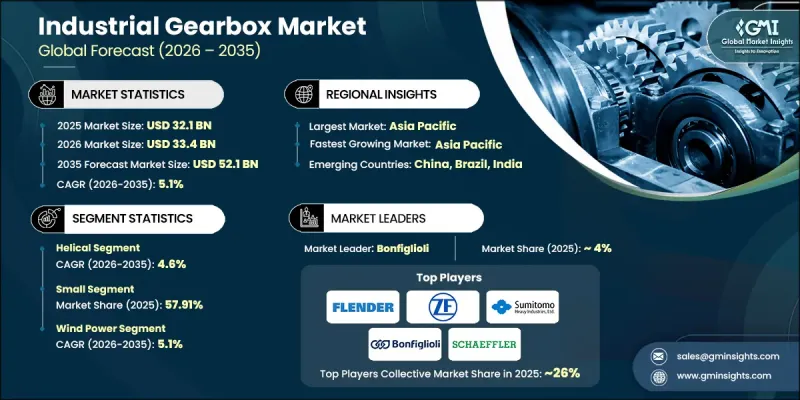
市場成長主要得益於工業自動化和工業4.0技術的快速普及,這些技術需要在整個製造過程中實現精確的扭矩傳輸和可控的機械運動。自動化生產線依賴工業齒輪箱來維持穩定的速度和負載,確保無縫運作。隨著互聯工廠和智慧製造解決方案的擴展,工業齒輪箱在應對機械應力和確保長期耐用性方面的重要性日益凸顯。製造商也優先考慮支援預測性維護和遠端監控的齒輪箱,從而實現機器人系統和自動化機械的高效運作。隨著自動化技術的日益複雜,對可靠的運動控制和節能解決方案的需求不斷成長,導致汽車、食品加工、包裝和重型機械製造等行業對工業齒輪箱的採用率顯著提高。這一趨勢反映了製造業生態系統朝向更智慧、更有效率的方向轉變。
| 市場範圍 | |
|---|---|
| 開始年份 | 2025 |
| 預測年份 | 2026-2035 |
| 起始值 | 321億美元 |
| 預測金額 | 521億美元 |
| 複合年成長率 | 5.1% |
預計到2025年,螺旋變速器市場規模將達到110億美元,並在2026年至2035年間以4.6%的複合年成長率成長。與其他類型的齒輪箱相比,螺旋變速器動力傳輸平穩、振動小、運行噪音低,因此在工業環境中備受青睞。其傾斜的齒形能夠改善扭矩分配,使其成為重型機械和加工設備的理想選擇。高負載能力和長使用壽命可減少運作和維護需求,這也是螺旋齒輪箱在各個工業領域廣受歡迎的原因。螺旋變速器更高的穩定性和能源效率可提高生產力並降低營運成本,從而推動其持續普及。
小型工業動力齒輪箱(通常功率低於500kW)預計在2025年將佔據57.91%的市場佔有率,並在2035年之前以4.3%的複合年成長率成長。這些齒輪箱廣泛應用於製造、包裝和食品加工等行業。其緊湊的設計使其能夠無縫整合到空間有限的設備中,而適中的功率輸出則可滿足連續和間歇運行的需求。經濟實惠、可靠性高和適應性強等優勢共同促成了小型齒輪箱在市場上的主導地位。
德國工業齒輪箱市場預計到2025年將達到18.4億美元,並在2026年至2035年間以4.9%的複合年成長率成長。德國強大的製造業基礎設施支撐著對工業齒輪箱的穩定需求。自動化生產線的日益普及、更嚴格的能源效率標準以及現代化改造舉措,都在推動對精密變速箱系統的需求。重型齒輪箱在汽車、金屬加工和工業設備等領域始終不可或缺。對先進驅動技術和工廠現代化的持續投入,進一步鞏固了德國作為歐洲主要市場的地位。
目錄
第1章:調查方法和範圍
第2章執行摘要
第3章業界考察
- 生態系分析
- 供應商情況
- 利潤率
- 每個階段增加的價值
- 影響價值鏈的因素
- 影響產業的因素
- 促進因素
- 工業自動化和工業4.0技術的應用日益廣泛
- 可再生能源基礎設施的擴張
- 物聯網和感測器等智慧技術的整合
- 挑戰與困難
- 先進變速箱系統的初始成本較高
- 低成本製造商的激烈競爭和價格壓力
- 機會
- 傳統工業設備的維修與現代化
- 開發節能永續齒輪箱設計
- 促進因素
- 成長潛力分析
- 未來市場趨勢
- 科技與創新趨勢
- 當前技術趨勢
- 新興技術
- 價格趨勢
- 按地區
- 依產品
- 監管環境
- 標準和合規要求
- 區域法規結構
- 認證標準
- 波特的分析
- PESTEL 分析
第4章 競爭情勢
- 介紹
- 企業市佔率分析
- 按地區
- 北美洲
- 歐洲
- 亞太地區
- 拉丁美洲
- 中東和非洲
- 按地區
- 公司矩陣分析
- 主要市場公司的競爭分析
- 競爭定位矩陣
- 主要進展
- 併購
- 夥伴關係與合作
- 新產品發布
- 擴張計劃
第5章 市場估計與預測:依類型分類,2022-2035年
- 螺旋
- 斜角
- 蠕蟲
- 行星
- 其他
第6章 市場估計與預測:依產量分類,2022-2035年
- 小型(500kW 或以下)
- 中型規模(500千瓦至10兆瓦)
- 大型(10兆瓦或以上)
第7章 市場估計與預測:依最終用途產業分類,2022-2035年
- 風力
- 物料輸送
- 建設業
- 船
- 能源
- 運輸
- 其他
第8章 市場估算與預測:依通路分類,2022-2035年
- 直銷
- 間接
第9章 市場估計與預測:依地區分類,2022-2035年
- 北美洲
- 美國
- 加拿大
- 歐洲
- 德國
- 英國
- 法國
- 義大利
- 西班牙
- 亞太地區
- 中國
- 印度
- 日本
- 韓國
- 澳洲
- 拉丁美洲
- 巴西
- 墨西哥
- 阿根廷
- 中東和非洲
- 沙烏地阿拉伯
- 阿拉伯聯合大公國
- 南非
第10章:公司簡介
- ABB Ltd.
- Bonfiglioli Riduttori
- Dana Incorporated
- DB Santasalo
- Elecon Engineering Company
- Getriebebau NORD
- Liebherr Group
- Nabtesco Corporation
- Nidec Motor Corporation
- Regal Rexnord Corporation
- Rossi
- SEW-EURODRIVE
- Siemens
- Sumitomo Heavy Industries, Ltd.
- ZF Friedrichshafen
The Global Industrial Gearbox Market was valued at USD 32.1 billion in 2025 and is estimated to grow at a CAGR of 5.1% to reach USD 52.1 billion by 2035.
Market growth is driven by the rapid adoption of industrial automation and Industry 4.0 technologies, which demand precise torque transmission and controlled mechanical motion across manufacturing processes. Automated production lines rely on industrial gearboxes to maintain consistent speed and load, ensuring seamless operations. As connected factories and smart manufacturing solutions expand, industrial gearboxes are increasingly critical for handling mechanical stress and ensuring long-term durability. Manufacturers are also prioritizing gearboxes that support predictive maintenance and remote monitoring, enabling efficient operation of robotic systems and automated machinery. The rising intensity of automation, coupled with the need for reliable motion control and energy-efficient solutions, has significantly increased the installation rates of industrial gearboxes across sectors such as automotive, food processing, packaging, and heavy machinery production. This trend reflects the broader move toward smarter, more efficient manufacturing ecosystems.
| Market Scope | |
|---|---|
| Start Year | 2025 |
| Forecast Year | 2026-2035 |
| Start Value | $32.1 Billion |
| Forecast Value | $52.1 Billion |
| CAGR | 5.1% |
The helical gearbox segment accounted for USD 11 billion in 2025 and is anticipated to grow at a CAGR of 4.6% between 2026 and 2035. Helical gearboxes are favored in industrial settings due to their smooth power transmission, reduced vibration, and quieter operation compared to other gearbox types. Angled gear teeth allow for better torque distribution, making them ideal for heavy-duty machinery and processing equipment. Their efficiency in handling high loads and extending operational longevity reduces downtime and maintenance requirements, making them a preferred choice across multiple industrial sectors. The improved stability and energy efficiency of helical gearboxes enhance productivity while lowering operational costs, driving continued adoption.
The small power industrial gearboxes, typically up to 500 kW, held 57.91% share in 2025 and are expected to grow at a CAGR of 4.3% through 2035. These gearboxes are popular due to their versatile applications in manufacturing, packaging, and food processing industries. Their compact design allows seamless integration into equipment with limited space, while moderate power output meets the needs of both continuous and intermittent operations. The combination of affordability, reliability, and adaptability contributes to the dominance of the small gearbox segment within the market.
Germany Industrial Gearbox Market generated USD 1.84 billion in 2025 and is projected to grow at a CAGR of 4.9% from 2026 to 2035. Germany's strong manufacturing infrastructure supports the stable demand for industrial gearboxes. The rising adoption of automated production lines, energy efficiency standards, and modernization initiatives has increased demand for precision gearbox systems. Heavy-duty gearboxes are consistently required in automotive, metal processing, and industrial equipment applications. Continuous investments in advanced drive technologies and factory modernization efforts further support Germany's position as a key market in Europe.
Major companies operating in the Global Industrial Gearbox Market include Siemens, ZF Friedrichshafen, SEW-EURODRIVE, ABB Ltd., Dana Incorporated, Liebherr Group, Getriebebau NORD, Bonfiglioli Riduttori, Nabtesco Corporation, Rossi, Elecon Engineering Company, DB Santasalo, Nidec Motor Corporation, Sumitomo Heavy Industries, Ltd., and Regal Rexnord Corporation. Companies in the Industrial Gearbox Market are leveraging several strategies to strengthen their market presence and maintain a competitive advantage. Innovation in product design, including higher precision, durability, and energy-efficient gearboxes, is central to their strategy. Firms are expanding distribution networks and forming strategic partnerships with manufacturing and automation companies to increase market penetration. Investment in research and development supports the creation of smart, connected gearboxes compatible with predictive maintenance and remote monitoring.
Table of Contents
Chapter 1 Methodology & Scope
- 1.1 Market scope and definition
- 1.2 Research design
- 1.2.1 Research approach
- 1.2.2 Data collection methods
- 1.3 Data mining sources
- 1.3.1 Global
- 1.3.2 Regional/Country
- 1.4 Base estimates and calculations
- 1.4.1 Base year calculation
- 1.4.2 Key trends for market estimation
- 1.5 Primary research and validation
- 1.5.1 Primary sources
- 1.6 Forecast model
- 1.7 Research assumptions and limitations
Chapter 2 Executive Summary
- 2.1 Industry 360° synopsis
- 2.2 Key market trends
- 2.2.1 Regional
- 2.2.2 Burner design
- 2.2.3 Installation
- 2.2.4 Power Range
- 2.2.5 End Use Industry
- 2.3 CXO perspectives: Strategic imperatives
- 2.3.1 Key decision points for industry executives
- 2.3.2 Critical success factors for market players
- 2.4 Future outlook and strategic recommendations
Chapter 3 Industry Insights
- 3.1 Industry ecosystem analysis
- 3.1.1 Supplier landscape
- 3.1.2 Profit margin
- 3.1.3 Value addition at each stage
- 3.1.4 Factor affecting the value chain
- 3.2 Industry impact forces
- 3.2.1 Growth drivers
- 3.2.1.1 Rising adoption of industrial automation and Industry 4.0 technologies
- 3.2.1.2 Expansion of renewable energy infrastructure
- 3.2.1.3 Integration of smart technologies such as IoT and sensors
- 3.2.2 Pitfalls & Challenges
- 3.2.2.1 High initial cost of advanced gearbox systems
- 3.2.2.2 Intense competition and pricing pressure from low-cost manufacturers
- 3.2.3 Opportunities
- 3.2.3.1 Retrofit and modernization of legacy industrial equipment
- 3.2.3.2 Development of energy-efficient and sustainable gearbox designs
- 3.2.1 Growth drivers
- 3.3 Growth potential analysis
- 3.4 Future market trends
- 3.5 Technology and innovation landscape
- 3.5.1 Current technological trends
- 3.5.2 Emerging technologies
- 3.6 Price trends
- 3.6.1 By region
- 3.6.2 By product
- 3.7 Regulatory landscape
- 3.7.1 Standards and compliance requirements
- 3.7.2 Regional regulatory frameworks
- 3.7.3 Certification standards
- 3.8 Porter’s analysis
- 3.9 PESTEL analysis
Chapter 4 Competitive Landscape, 2025
- 4.1 Introduction
- 4.2 Company market share analysis
- 4.2.1 By Region
- 4.2.1.1 North America
- 4.2.1.2 Europe
- 4.2.1.3 Asia Pacific
- 4.2.1.4 Latin America
- 4.2.1.5 Middle East & Africa
- 4.2.1 By Region
- 4.3 Company matrix analysis
- 4.4 Competitive analysis of major market players
- 4.5 Competitive positioning matrix
- 4.6 Key developments
- 4.6.1 Mergers & acquisitions
- 4.6.2 Partnerships & collaborations
- 4.6.3 New product launches
- 4.6.4 Expansion plans
Chapter 5 Market Estimates & Forecast, By Type, 2022 - 2035, (USD Billion) (Thousand Units)
- 5.1 Key trends
- 5.2 Helical
- 5.3 Bevel
- 5.4 Worm
- 5.5 Planetary
- 5.6 Others
Chapter 6 Market Estimates & Forecast, By Power, 2022 - 2035, (USD Billion) (Thousand Units)
- 6.1 Key trends
- 6.2 Small (up to 500 kW)
- 6.3 Medium (500 kW to 10 MW)
- 6.4 Large (above 10 MW)
Chapter 7 Market Estimates & Forecast, By End Use Industry, 2022 - 2035, (USD Billion) (Thousand Units)
- 7.1 Key trends
- 7.2 Wind power
- 7.3 Material handling
- 7.4 Construction
- 7.5 Marine
- 7.6 Energy
- 7.7 Transportation
- 7.8 Others
Chapter 8 Market Estimates & Forecast, By Distribution Channel, 2022 - 2035, (USD Billion) (Thousand Units)
- 8.1 Key trends
- 8.2 Direct
- 8.3 Indirect
Chapter 9 Market Estimates & Forecast, By Region, 2022 - 2035, (USD Billion) (Thousand Units)
- 9.1 Key trends
- 9.2 North America
- 9.2.1 U.S.
- 9.2.2 Canada
- 9.3 Europe
- 9.3.1 Germany
- 9.3.2 UK
- 9.3.3 France
- 9.3.4 Italy
- 9.3.5 Spain
- 9.4 Asia Pacific
- 9.4.1 China
- 9.4.2 India
- 9.4.3 Japan
- 9.4.4 South Korea
- 9.4.5 Australia
- 9.5 Latin America
- 9.5.1 Brazil
- 9.5.2 Mexico
- 9.5.3 Argentina
- 9.6 MEA
- 9.6.1 Saudi Arabia
- 9.6.2 UAE
- 9.6.3 South Africa
Chapter 10 Company Profiles
- 10.1 ABB Ltd.
- 10.2 Bonfiglioli Riduttori
- 10.3 Dana Incorporated
- 10.4 DB Santasalo
- 10.5 Elecon Engineering Company
- 10.6 Getriebebau NORD
- 10.7 Liebherr Group
- 10.8 Nabtesco Corporation
- 10.9 Nidec Motor Corporation
- 10.10 Regal Rexnord Corporation
- 10.11 Rossi
- 10.12 SEW-EURODRIVE
- 10.13 Siemens
- 10.14 Sumitomo Heavy Industries, Ltd.
- 10.15 ZF Friedrichshafen

 2026年全球汽車變速箱市場報告
 工業行星齒輪減速器市場:按級數、扭力容量、銷售管道、應用和終端用戶產業分類-2026-2032年全球市場預測
 汽車變速箱市場規模、佔有率、成長及全球產業分析:按類型、應用和地區分類,並提供2026-2034年的洞察和預測電動駐煞車系統煞車變速箱市場:按車輛類型、驅動方式和銷售管道- 全球預測 2026-2032
 齒輪箱和齒輪馬達市場分析及預測(至2035年):按類型、產品、服務、技術、組件、應用、材料類型、最終用戶、功能和安裝類型分類全球工業齒輪箱和齒輪馬達市場規模、佔有率、趨勢和成長分析報告:2026-2034年全球工業齒輪箱市場規模、佔有率、趨勢和成長分析報告(2026-2034年)
 工業齒輪箱市場報告:按類型、設計、應用和地區分類(2026-2034 年)日本變速箱市場規模、佔有率、趨勢和預測:按類型、齒輪類型、最終用戶和地區分類,2026-2034年2026年全球工業齒輪箱市場報告