


 |
市場調查報告書
商品編碼
1959605
空中交通管理市場機會、成長要素、產業趨勢分析以及 2026 年至 2035 年的預測。Air Traffic Management Market Opportunity, Growth Drivers, Industry Trend Analysis, and Forecast 2026 - 2035 |
||||||

2025 年全球空中交通管理市場價值 147 億美元,預計到 2035 年將達到 371 億美元,年複合成長率為 9.7%。
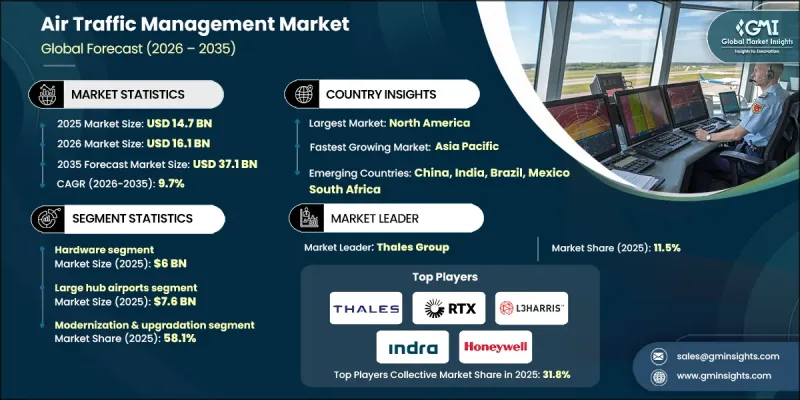
市場成長的驅動力來自商業、國防和混合用途空域空中作業的快速發展。空中交通管理解決方案在協調飛行路徑、管理交通流量以及支援通訊、導航和監視功能方面發揮核心作用,確保飛機在擁擠空域安全且有效率地運作。隨著全球空中交通量的成長和飛行模式的日益複雜,航空生態系統中的各相關人員都在大力投資於先進系統,以提供貫穿所有飛行階段的即時情境察覺。隨著對數位化航空基礎設施的依賴性不斷增強,對即使在擁擠空域條件下也能保持性能的精準空中交通管理平台的需求也日益成長。提高安全性、營運效率和增強交通可預測性仍然是核心優先事項,因此航空當局和服務供應商正在推動採用技術先進且具有彈性的空中交通管理架構,以滿足未來的空域需求。
| 市場範圍 | |
|---|---|
| 開始年份 | 2025 |
| 預測年份 | 2026-2035 |
| 起始值 | 147億美元 |
| 預測金額 | 371億美元 |
| 複合年成長率 | 9.7% |
預計到2025年,硬體領域將創造60億美元的收入。硬體仍然是空中交通管制基礎設施的關鍵組成部分,為雷達系統、通訊網路、導航設備和監視技術提供支援。這些組件對民用和國防航空運營都至關重要,並因其在惡劣環境下的耐用性、可靠性和長運作而備受重視。與現有系統的高度相容性和成熟的擴充性正在推動機場、空中交通服務供應商和政府機構的廣泛採用,從而增強了對空中交通管理硬體投資的持續需求。
預計到2025年,大型樞紐機場市場規模將達到76億美元,這反映了其在全球航空網路中的核心地位。這些機場需要處理大量航班和複雜的空域互通性,因此先進的空中交通管理平台對於維持效率和安全至關重要。高容量雷達、數位化控制塔、整合通訊系統和先進的軟體工具對於管理持續不斷的交通流量不可或缺。持續的現代化改造項目,以及各國政府和航空公司的大力投資,將繼續推動主要國際樞紐機場採用先進的空中交通管理技術。
預計2025年,美國空中交通管理市場規模將達61億美元。這一成長主要得益於美國對機場升級、國防航空能力建設以及下一代空中交通管制解決方案的持續投資。數位化塔台系統、預測分析和即時空域最佳化平台的日益普及,進一步推動了市場發展。透過先進的自動化和數據驅動的交通管理框架,國家空域基礎設施正在進行轉型,這凸顯了空中交通管理技術強勁的長期成長前景。
目錄
第1章:調查方法和範圍
第2章執行摘要
第3章業界考察
- 生態系分析
- 供應商情況
- 利潤率分析
- 成本結構
- 每個階段增加的價值
- 影響價值鏈的因素
- 中斷
- 影響產業的因素
- 促進因素
- 對先進航太系統的需求不斷成長
- 無人機安全和法規正在推動對即時空中交通管理 (ATM) 的需求。
- 民用航空業的擴張
- 專注於維護和升級
- 小型化和先進感測器技術
- 產業潛在風險與挑戰
- 高昂的營運成本和惡劣的營運環境
- 複雜的身份驗證、整合和漫長的開發週期。
- 市場機遇
- 海上石油計劃的成長
- 對快速啟動和靈活發電廠的需求不斷成長
- 促進因素
- 成長潛力分析
- 監管環境
- 北美洲
- 歐洲
- 亞太地區
- 拉丁美洲
- 中東和非洲
- 波特的分析
- PESTEL 分析
- 科技與創新趨勢
- 當前技術趨勢
- 新興技術
- 價格趨勢
- 按地區
- 依產品
- 定價策略
- 新興經營模式
- 合規要求
第4章 競爭情勢
- 介紹
- 企業市佔率分析
- 按地區
- 北美洲
- 歐洲
- 亞太地區
- 拉丁美洲
- 中東和非洲
- 按地區
- 主要企業的競爭標竿分析
- 財務績效比較
- 收入
- 利潤率
- 研究與開發
- 產品系列比較
- 產品線的廣度
- 科技
- 創新
- 區域分佈比較
- 全球擴張分析
- 服務網路覆蓋
- 按地區分類的市場滲透率
- 競爭定位矩陣
- 領導企業
- 受讓人
- 追蹤者
- 小眾玩家
- 戰略展望矩陣
- 財務績效比較
- 2022-2025 年重大發展
- 併購
- 合作夥伴關係和合資企業
- 技術進步
- 擴張和投資策略
- 數位轉型計劃
- 新興/Start-Ups競爭對手的發展趨勢
第5章 市場估算與預測:依產品類型分類,2022-2035年
- 硬體
- 雷達和監視系統
- 通訊與導航
- 控制器工作位置/顯示設備
- 天氣硬體
- 其他
- 軟體系統
- 空中交通管制自動化
- 空中交通流量管理(ATFM)
- 空域管理(ASM)
- 航空資訊管理(AIM)
- 其他
- 服務
- 整合和實施服務
- 管理和支援服務
- 訓練和模擬服務
第6章 市場估計與預測:依空域類型分類,2022-2035年
- 航廈區域
- 路線區域
- 海洋和偏遠地區
第7章 市場估計與預測:依機場規模分類,2022-2035年
- 小規模機場(年旅客吞吐量低於200萬人次)
- 中型機場(年旅客吞吐量200萬至1500萬人次)
- 大型樞紐機場(年旅客吞吐量超過1500萬人次)
第8章 市場估計與預測:依應用領域分類,2022-2035年
- 溝通管理
- 導航支援
- 監測
- 自動化支援
第9章 市場估價與預測:依安裝類型分類,2022-2035年
- 新安裝
- 現代化和升級
第10章 市場估價與預測:依最終用戶分類,2022-2035年
- 商業航空
- 適用於軍事和政府機構
- 城市空中運輸(UAM) 營運商
第11章 市場估價與預測:按地區分類,2022-2035年
- 北美洲
- 美國
- 加拿大
- 歐洲
- 德國
- 英國
- 法國
- 西班牙
- 義大利
- 荷蘭
- 亞太地區
- 中國
- 印度
- 日本
- 澳洲
- 韓國
- 拉丁美洲
- 巴西
- 墨西哥
- 阿根廷
- 中東和非洲
- 南非
- 沙烏地阿拉伯
- 阿拉伯聯合大公國
第12章:公司簡介
- Adacel Technologies Limited
- Aireon LLC
- BAE Systems plc
- Frequentis AG
- Honeywell International Inc.
- Indra Sistemas, SA
- L3Harris Technologies, Inc.
- Leonardo SpA
- NATS Holdings Limited
- Nav Canada
- Northrop Grumman Corporation
- Raytheon Technologies Corporation
- Saab AB
- SITA
- Thales Group
The Global Air Traffic Management Market was valued at USD 14.7 billion in 2025 and is estimated to grow at a CAGR of 9.7% to reach USD 37.1 billion by 2035.
Market growth is driven by the rapid evolution of aviation operations across commercial, defense, and mixed-use airspace. Air traffic management solutions are central to coordinating flight trajectories, managing traffic flows, and supporting communication, navigation, and surveillance functions that ensure safe and efficient aircraft movement in increasingly crowded skies. As global air traffic volumes rise and flight patterns become more complex, stakeholders across the aviation ecosystem are investing heavily in advanced systems that deliver real-time situational awareness across all flight phases. The growing dependence on digital aviation infrastructure has heightened demand for precision-based ATM platforms capable of maintaining performance under congested airspace conditions. Safety enhancement, operational efficiency, and improved traffic predictability remain core priorities, pushing aviation authorities and service providers toward technologically advanced and resilient air traffic management architectures designed to support future airspace requirements.
| Market Scope | |
|---|---|
| Start Year | 2025 |
| Forecast Year | 2026-2035 |
| Start Value | $14.7 Billion |
| Forecast Value | $37.1 Billion |
| CAGR | 9.7% |
The hardware segment generated USD 6 billion in 2025. Hardware remains essential to air traffic control infrastructure, supporting radar systems, communication networks, navigation equipment, and surveillance technologies. These components are critical for both civil and defense aviation operations and are valued for their durability, reliability, and long operational life in demanding environments. Strong compatibility with existing systems and proven scalability have driven widespread deployment across airports, air navigation service providers, and government agencies, reinforcing sustained demand for ATM hardware investments.
The large hub airports segment accounted for USD 7.6 billion in 2025, reflecting their central role in global aviation networks. These airports manage high flight volumes and complex airspace interactions, requiring advanced ATM platforms to maintain efficiency and safety. High-capacity radars, digital control towers, integrated communication systems, and advanced software tools are essential for managing continuous traffic flows. Ongoing modernization programs, combined with strong government and airline investment, continue to support the adoption of advanced air traffic management technologies across major international hubs.
U.S. Air Traffic Management Market reached USD 6.1 billion in 2025. Growth in the country is supported by sustained investment in airport upgrades, defense aviation capabilities, and next-generation air traffic control solutions. Increasing deployment of digital tower systems, predictive analytics, and real-time airspace optimization platforms is further strengthening market momentum. Continued transformation of national airspace infrastructure through advanced automation and data-driven traffic management frameworks highlights the strong long-term growth outlook for ATM technologies.
Key companies active in the Global Air Traffic Management Market include Thales Group, Raytheon Technologies Corporation, Honeywell International Inc., Indra Sistemas, S.A., Saab AB, Leonardo S.p.A., L3Harris Technologies, Inc., BAE Systems plc, Frequentis AG, Northrop Grumman Corporation, Adacel Technologies Limited, Aireon LLC, Nav Canada, NATS Holdings Limited, and SITA. Companies operating in the air traffic management market are focusing on long-term strategies that emphasize innovation, system modernization, and global collaboration. Major players invest heavily in research and development to enhance automation, cybersecurity, predictive analytics, and AI-driven traffic optimization. Strategic partnerships with aviation authorities, defense agencies, and airport operators help accelerate system deployment and ensure regulatory alignment. Firms also prioritize modular and scalable solutions that integrate seamlessly with legacy infrastructure. Expanding service portfolios, offering lifecycle support, and providing digital upgrades enable vendors to strengthen customer retention.
Table of Contents
Chapter 1 Methodology and Scope
- 1.1 Market scope and definition
- 1.2 Research design
- 1.2.1 Research approach
- 1.2.2 Data collection methods
- 1.3 Data mining sources
- 1.3.1 Global
- 1.3.2 Regional/Country
- 1.4 Base estimates and calculations
- 1.4.1 Base year calculation
- 1.4.2 Key trends for market estimation
- 1.5 Primary research and validation
- 1.5.1 Primary sources
- 1.6 Forecast model
- 1.7 Research assumptions and limitations
Chapter 2 Executive Summary
- 2.1 Industry 360° synopsis, 2022 - 2035
- 2.2 Key market trends
- 2.2.1 Offering trends
- 2.2.2 Airspace Type trends
- 2.2.3 Airport Size trends
- 2.2.4 Application trends
- 2.2.5 Installation Type trends
- 2.2.6 End user trends
- 2.2.7 Regional trends
- 2.3 TAM analysis, 2025-2035
- 2.4 CXO perspectives: Strategic imperatives
- 2.4.1 Executive decision points
- 2.4.2 Critical success factors
- 2.5 Future outlook and strategic recommendations
Chapter 3 Industry Insights
- 3.1 Industry ecosystem analysis
- 3.1.1 Supplier landscape
- 3.1.2 Profit margin analysis
- 3.1.3 Cost structure
- 3.1.4 Value addition at each stage
- 3.1.5 Factor affecting the value chain
- 3.1.6 Disruptions
- 3.2 Industry impact forces
- 3.2.1 Growth drivers
- 3.2.1.1 Increasing demand for advanced aerospace systems
- 3.2.1.2 Drone safety and regulations are driving demand for real-time Air Traffic Managements
- 3.2.1.3 Expansion of commercial aviation
- 3.2.1.4 Focus on maintenance and upgrades
- 3.2.1.5 Miniaturization & advanced sensor technologies
- 3.2.2 Industry pitfalls and challenges
- 3.2.2.1 High operating costs and harsh operating environments
- 3.2.2.2 Complex certification, integration, and long development cycles
- 3.2.3 Market opportunities
- 3.2.3.1 Growth in offshore oil and gas projects
- 3.2.3.2 Rising need for fast-start and flexible power plants
- 3.2.1 Growth drivers
- 3.3 Growth potential analysis
- 3.4 Regulatory landscape
- 3.4.1 North America
- 3.4.2 Europe
- 3.4.3 Asia Pacific
- 3.4.4 Latin America
- 3.4.5 Middle East & Africa
- 3.5 Porter’s analysis
- 3.6 PESTEL analysis
- 3.7 Technology and innovation landscape
- 3.7.1 Current technological trends
- 3.7.2 Emerging technologies
- 3.8 Price trends
- 3.8.1 By region
- 3.8.2 By product
- 3.9 Pricing Strategies
- 3.10 Emerging Business Models
- 3.11 Compliance Requirements
Chapter 4 Competitive Landscape, 2025
- 4.1 Introduction
- 4.2 Company market share analysis
- 4.2.1 By region
- 4.2.1.1 North America
- 4.2.1.2 Europe
- 4.2.1.3 Asia Pacific
- 4.2.1.4 Latin America
- 4.2.1.5 Middle East & Africa
- 4.2.1 By region
- 4.3 Competitive benchmarking of key players
- 4.3.1 Financial performance comparison
- 4.3.1.1 Revenue
- 4.3.1.2 Profit margin
- 4.3.1.3 R&D
- 4.3.2 Product portfolio comparison
- 4.3.2.1 Product range breadth
- 4.3.2.2 Technology
- 4.3.2.3 Innovation
- 4.3.3 Geographic presence comparison
- 4.3.3.1 Global footprint analysis
- 4.3.3.2 Service network coverage
- 4.3.3.3 Market penetration by region
- 4.3.4 Competitive positioning matrix
- 4.3.4.1 Leaders
- 4.3.4.2 Challengers
- 4.3.4.3 Followers
- 4.3.4.4 Niche players
- 4.3.5 Strategic outlook matrix
- 4.3.1 Financial performance comparison
- 4.4 Key developments, 2022-2025
- 4.4.1 Mergers and acquisitions
- 4.4.2 Partnerships and collaborations
- 4.4.3 Technological advancements
- 4.4.4 Expansion and investment strategies
- 4.4.5 Digital transformation initiatives
- 4.5 Emerging/ startup competitors landscape
Chapter 5 Market Estimates and Forecast, By Offering, 2022 - 2035 (USD Million)
- 5.1 Key trends
- 5.2 Hardware
- 5.2.1 Radars & Surveillance
- 5.2.2 Communication & Navigation
- 5.2.3 Controller Working Positions & Displays
- 5.2.4 Meteorological Hardware
- 5.2.5 Others
- 5.3 Software & Systems
- 5.3.1 ATC Automation
- 5.3.2 Air Traffic Flow Management (ATFM)
- 5.3.3 Airspace Management (ASM)
- 5.3.4 Aeronautical Information Management (AIM)
- 5.3.5 Others
- 5.4 Services
- 5.4.1 Integration & Deployment Services
- 5.4.2 Managed & Support Services
- 5.4.3 Training & Simulation Services
Chapter 6 Market Estimates and Forecast, By Airspace Type, 2022 - 2035 (USD Million)
- 6.1 Key trends
- 6.2 Terminal Area
- 6.3 En-Route
- 6.4 Oceanic & Remote
Chapter 7 Market Estimates and Forecast, By Airport Size, 2022 - 2035 (USD Million)
- 7.1 Key trends
- 7.2 Small Airports (<2M Passengers Annually)
- 7.3 Medium Airports (2-15M Passengers Annually)
- 7.4 Large Hub Airports (>15M Passengers Annually)
Chapter 8 Market Estimates and Forecast, By Application, 2022 - 2035 (USD Million)
- 8.1 Key trends
- 8.2 Communication Management
- 8.3 Navigation Support
- 8.4 Surveillance & Monitoring
- 8.5 Automation Support
Chapter 9 Market Estimates and Forecast, By Installation Type, 2022 - 2035 (USD Million)
- 9.1 Key trends
- 9.2 New Installation
- 9.3 Modernisation & Upgradation
Chapter 10 Market Estimates and Forecast, By End-User, 2022 - 2035 (USD Million)
- 10.1 Key trends
- 10.2 Commercial Aviation
- 10.3 Military and Government
- 10.4 Urban Air Mobility (UAM) Operators
Chapter 11 Market Estimates and Forecast, By Region, 2022 - 2035 (USD Million)
- 11.1 Key trends
- 11.2 North America
- 11.2.1 U.S.
- 11.2.2 Canada
- 11.3 Europe
- 11.3.1 Germany
- 11.3.2 UK
- 11.3.3 France
- 11.3.4 Spain
- 11.3.5 Italy
- 11.3.6 Netherlands
- 11.4 Asia Pacific
- 11.4.1 China
- 11.4.2 India
- 11.4.3 Japan
- 11.4.4 Australia
- 11.4.5 South Korea
- 11.5 Latin America
- 11.5.1 Brazil
- 11.5.2 Mexico
- 11.5.3 Argentina
- 11.6 Middle East and Africa
- 11.6.1 South Africa
- 11.6.2 Saudi Arabia
- 11.6.3 UAE
Chapter 12 Company Profiles
- 12.1 Adacel Technologies Limited
- 12.2 Aireon LLC
- 12.3 BAE Systems plc
- 12.4 Frequentis AG
- 12.5 Honeywell International Inc.
- 12.6 Indra Sistemas, S.A.
- 12.7 L3Harris Technologies, Inc.
- 12.8 Leonardo S.p.A.
- 12.9 NATS Holdings Limited
- 12.10 Nav Canada
- 12.11 Northrop Grumman Corporation
- 12.12 Raytheon Technologies Corporation
- 12.13 Saab AB
- 12.14 SITA
- 12.15 Thales Group

 空中交通解決方案市場:全球市場預測,2026-2032年
 傑普森全球船員組建市場報告(2026 年)空中交通流量和容量管理市場:按類型、功能、空域類型、應用和最終用戶分類-2026-2032年全球市場預測空中交通管理市場:按組件、應用、最終用戶和部署模式分類-2026-2032年全球市場預測2026年全球貂型機芯管理市場報告2026年全球空中交通管理(ATM)市場報告(頻繁馬賽克)2026年Indra互通性(ITEC)機場交通管理(ATM)系統歐洲合作全球市場報告飛機序列系統市場:依系統類型、技術、部署模式、應用程式和最終用戶分類-2026-2032年全球市場預測
 空中交通管理市場:依空域功能、技術、區域分類
 2026-2034年全球空中交通管理市場規模、佔有率、趨勢和成長分析報告