


 |
市場調查報告書
商品編碼
1959604
質量流量控制器市場:機會、成長要素、產業趨勢分析及2026年至2035年預測Mass Flow Controller Market Opportunity, Growth Drivers, Industry Trend Analysis, and Forecast 2026 - 2035 |
||||||

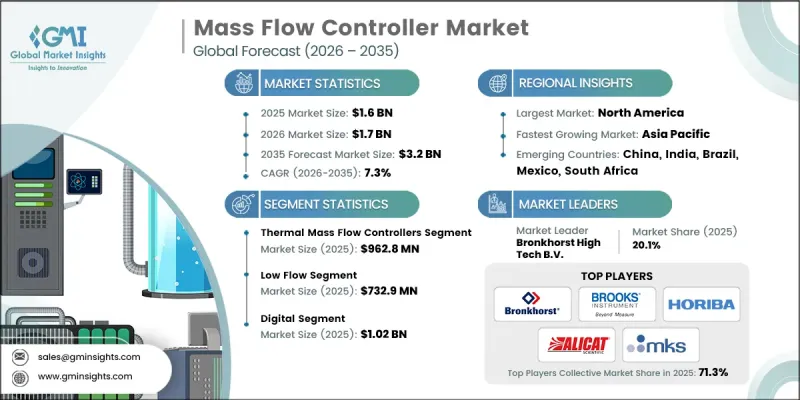
2025 年全球質量流量控制器市場價值為 16 億美元,預計到 2035 年將達到 32 億美元,年複合成長率為 7.3%。
這一成長主要得益於半導體、航太、化學、能源和製造等工業領域對自動化和精密控制技術的日益普及。隨著工業流程日益複雜,生產量需求不斷成長,對精確可靠的流量測量系統的需求也日益增加。質量流量控制器對於精確調節氣體和液體流量至關重要,能夠確保製程穩定性、品質一致性並符合安全標準。半導體製造和先進製造業務的擴張進一步加速了市場發展。薄膜沉積、蝕刻和化學氣相沉積等關鍵製程需要高重複性和緊湊的整合度。此外,向工業4.0和智慧製造的轉型也推動了對數位化和工業物聯網相容的質量流量控制器的需求,最終透過實現即時監控、減少停機時間和提高營運效率,進一步凸顯了質量流量控制器在高精度產業中的應用價值。
| 市場範圍 | |
|---|---|
| 開始年份 | 2025 |
| 預測年份 | 2026-2035 |
| 起始值 | 16億美元 |
| 預測金額 | 32億美元 |
| 複合年成長率 | 7.3% |
預計2025年,熱式質量流量控制器(Thermal MFC)市場規模將達到9.628億美元。這些控制器憑藉其在半導體製造、化學品生產和潔淨科技操作中保持精確流量測量的能力,佔據了市場主導地位。即使在嚴苛的製程環境下,熱式MFC也能提供快速反應、一致的重複性和長期耐用性。在各種條件下精確控制氣體流量的能力對於維持關鍵應用中的製程穩定性和運作效率至關重要。
預計到2025年,低流量微生物燃料電池(MFC)市場規模將達到7.329億美元,憑藉其在半導體製造、製藥和分析流程等關鍵領域的應用,將維持最大的市場佔有率。低流量MFC適用於高精度操作,在調節少量液體和氣體時,能夠提供快速響應、高精度和重複性。這些特性使其在即使是微小偏差也會影響品質和產量比率的製程流程中至關重要。
預計到2025年,北美質量流量控制器市佔率將達到31.4%,主要得益於自動化、智慧製造和數位化製程控制的高普及率。半導體、化學、能源和製藥等產業部門正在利用工業物聯網(IIoT)賦能的質量流量控制器、預測性維護和高級分析技術來最佳化營運、減少停機時間並保持製程穩定性。此外,人們對能源效率、永續性和合規性的日益關注也進一步推動了全部區域對可靠、高精度品質流量控制器的需求。
目錄
第1章:調查方法和範圍
第2章執行摘要
第3章業界考察
- 生態系分析
- 供應商情況
- 利潤率分析
- 成本結構
- 每個階段增加的價值
- 影響價值鏈的因素
- 中斷
- 影響產業的因素
- 促進因素
- 半導體和電子製造業的擴張
- 數位化與工業4.0技術的融合
- 可再生能源和潔淨科技應用的成長
- 在製藥、化學加工和生物技術領域的擴張
- 區域工業化和製造業投資
- 產業潛在風險與挑戰
- 先進MFC高成本
- 與現有系統進行複雜整合
- 市場機遇
- 支援物聯網的智慧MFC解決方案
- 新興市場的擴張
- 促進因素
- 成長潛力分析
- 監管環境
- 北美洲
- 歐洲
- 亞太地區
- 拉丁美洲
- 中東和非洲
- 波特的分析
- PESTEL 分析
- 科技與創新趨勢
- 當前技術趨勢
- 新興技術
- 價格趨勢
- 按地區
- 依產品
- 定價策略
- 新興經營模式
- 合規要求
- 地緣政治和貿易趨勢
第4章 競爭情勢
- 介紹
- 企業市佔率分析
- 按地區
- 北美洲
- 歐洲
- 亞太地區
- 拉丁美洲
- 中東和非洲
- 按地區
- 主要企業的競爭標竿分析
- 財務績效比較
- 收入
- 利潤率
- 研究與開發
- 產品系列比較
- 產品線的廣度
- 科技
- 創新
- 地理位置比較
- 全球擴張分析
- 服務網路覆蓋
- 按地區分類的市場滲透率
- 競爭定位矩陣
- 領導企業
- 受讓人
- 追蹤者
- 小眾玩家
- 財務績效比較
- 2022-2025 年重大發展
- 併購
- 合作夥伴關係和合資企業
- 技術進步
- 擴張和投資策略
- 數位轉型計劃
- 新興/Start-Ups競爭對手的發展趨勢
第5章 市場估計與預測:依技術分類,2022-2035年
- 熱式質量流量計
- 科里奧利質量流量計
- 差壓質量流量控制器
- 超音波/新興質量流量控制器
第6章 市場估算與預測:以連結方式分類,2022-2035年
- 模擬
- 數位的
第7章 市場估價與預測:依媒體類型分類,2022-2035年
- 氣體
- 液體
第8章 市場估算與預測:依流量與容量分類,2022-2035年
- 低流速
- 中等流速
- 高流速
第9章 市場估計與預測:依最終用途分類,2022-2035年
- 半導體和電子學
- 化學氣相沉積(CVD)
- 物理氣相沉積(PVD)
- 熱處理和擴散
- 其他
- 化學品/特用化學品
- 控制化學反應
- 噴塗工藝
- 氣體混合與攪拌
- 其他
- 環境與公用事業
- 水處理和污水處理
- 空氣品質監測和排放氣體管理
- 其他
- 製藥和生物技術
- 能源與先進材料
- 金屬和採礦
- 食品/飲料
- 航太/國防
- 醫療保健
- 其他
第10章 市場估價與預測:依地區分類,2022-2035年
- 北美洲
- 美國
- 加拿大
- 歐洲
- 德國
- 英國
- 法國
- 西班牙
- 義大利
- 荷蘭
- 亞太地區
- 中國
- 印度
- 日本
- 澳洲
- 韓國
- 拉丁美洲
- 巴西
- 墨西哥
- 阿根廷
- 中東和非洲
- 南非
- 沙烏地阿拉伯
- 阿拉伯聯合大公國
第11章:公司簡介
- Alicat Scientific, Inc.
- Azbil Corporation
- Bronkhorst High-Tech BV
- Brooks Instrument
- Christian Burkert GmbH &Co. KG
- Fujikin Incorporated
- HORIBA Ltd.
- KOFLOC Corporation
- MKS Instruments, Inc.
- Parker Hannifin Corporation
- Sensirion AG
- Sierra Instruments, Inc.
- Teledyne Hastings Instruments
- Tokyo Keiso Co., Ltd.
- Vogtlin Instruments GmbH
The Global Mass Flow Controller Market was valued at USD 1.6 billion in 2025 and is estimated to grow at a CAGR of 7.3% to reach USD 3.2 billion by 2035.
The growth is fueled by increasing adoption of automation and precision control technologies across industries such as semiconductors, aerospace, chemicals, energy, and manufacturing. As industrial processes become more complex and output demands rise, the need for precise, reliable flow measurement systems has intensified. Mass flow controllers are essential for accurately regulating gas and liquid flows, ensuring process stability, quality consistency, and adherence to safety standards. The expansion of semiconductor fabrication and advanced manufacturing operations is further accelerating the market. Critical processes such as deposition, etching, and chemical vapor applications require high repeatability and compact integration. In addition, the push toward Industry 4.0 and smart manufacturing drives demand for digitally enabled and IIoT-compatible mass flow controllers, offering real-time monitoring, reduced downtime, and increased operational efficiency, ultimately reinforcing the value of MFC adoption across high-precision industries.
| Market Scope | |
|---|---|
| Start Year | 2025 |
| Forecast Year | 2026-2035 |
| Start Value | $1.6 Billion |
| Forecast Value | $3.2 Billion |
| CAGR | 7.3% |
The thermal mass flow controllers segment generated USD 962.8 million in 2025. These controllers dominate because of their ability to maintain precise flow measurements in semiconductor fabrication, chemical production, and clean technology operations. Thermal MFCs provide rapid response times, consistent repeatability, and long-term durability even in demanding process environments. Their capability to control gas flows accurately under varying conditions makes them indispensable for maintaining process stability and operational efficiency in critical applications.
The low flow segment accounted for USD 732.9 million in 2025, maintaining the largest market share due to its critical applications in semiconductor manufacturing, pharmaceuticals, and analytical processes. Low flow MFCs are preferred for high-precision tasks, offering fast response, accuracy, and repeatability when regulating small volumes of liquids or gases. These features make them essential for processes where even minor deviations can affect quality and yield.
North America Mass Flow Controller Market held a 31.4% share in 2025, driven by high adoption of automation, smart manufacturing, and digital process control. Industrial sectors, including semiconductors, chemicals, energy, and pharmaceuticals, leverage IIoT-enabled MFCs, predictive maintenance, and advanced analytics to optimize operations, reduce downtime, and maintain process stability. Growing emphasis on energy efficiency, sustainability, and regulatory compliance is further boosting demand for reliable, high-precision mass flow controllers across the region.
Key players in the Global Mass Flow Controller Market include Brooks Instrument, Alicat Scientific, Inc., MKS Instruments, Inc., Azbil Corporation, Bronkhorst High Tech B.V., Christian Burkert GmbH & Co. KG, Fujikin Incorporated, HORIBA Ltd., KOFLOC Corporation, Parker Hannifin Corporation, Sensirion AG, Sierra Instruments, Inc., Teledyne Hastings Instruments, Tokyo Keiso Co., Ltd., and Vogtlin Instruments GmbH. Companies are strengthening their Global Mass Flow Controller Market presence through continuous R&D and technology development, focusing on high-precision, reliable, and digitally compatible controllers. Strategic partnerships with semiconductor, chemical, and energy firms enable tailored solutions for complex industrial applications. Firms are investing in IIoT-enabled controllers, real-time monitoring, predictive maintenance, and analytics to enhance operational efficiency and minimize downtime. Expansion into emerging markets, flexible pricing models, and customer support services improve accessibility. Companies are also emphasizing sustainability, energy efficiency, and compact designs for space-limited applications.
Table of Contents
Chapter 1 Methodology and Scope
- 1.1 Market scope and definition
- 1.2 Research design
- 1.2.1 Research approach
- 1.2.2 Data collection methods
- 1.3 Data mining sources
- 1.3.1 Global
- 1.3.2 Regional/Country
- 1.4 Base estimates and calculations
- 1.4.1 Base year calculation
- 1.4.2 Key trends for market estimation
- 1.5 Primary research and validation
- 1.5.1 Primary sources
- 1.6 Forecast model
- 1.7 Research assumptions and limitations
Chapter 2 Executive Summary
- 2.1 Industry 360° synopsis, 2022 - 2035
- 2.2 Key market trends
- 2.2.1 Sensor type trends
- 2.2.2 Technology trends
- 2.2.3 Connectivity trends
- 2.2.4 End Use industry trends
- 2.2.5 Regional trends
- 2.3 TAM analysis, 2025-2035
- 2.4 CXO perspectives: Strategic imperatives
Chapter 3 Industry Insights
- 3.1 Industry ecosystem analysis
- 3.1.1 Supplier landscape
- 3.1.2 Profit margin analysis
- 3.1.3 Cost structure
- 3.1.4 Value addition at each stage
- 3.1.5 Factor affecting the value chain
- 3.1.6 Disruptions
- 3.2 Industry impact forces
- 3.2.1 Growth drivers
- 3.2.1.1 Expansion of Semiconductor and Electronics Manufacturing
- 3.2.1.2 Integration of Digitalization and Industry 4.0 Technologies
- 3.2.1.3 Growth in Renewable Energy and Clean Technology Applications
- 3.2.1.4 Expansion in Pharmaceuticals, Chemical Processing and Biotechnology Sectors
- 3.2.1.5 Regional Industrialization & Manufacturing Investment
- 3.2.2 Industry pitfalls and challenges
- 3.2.2.1 High Cost of Advanced MFCs
- 3.2.2.2 Complex Integration with Existing Systems
- 3.2.3 Market opportunities
- 3.2.3.1 IoT-Enabled and Smart MFC Solutions
- 3.2.3.2 Expansion in Emerging Markets
- 3.2.1 Growth drivers
- 3.3 Growth potential analysis
- 3.4 Regulatory landscape
- 3.4.1 North America
- 3.4.2 Europe
- 3.4.3 Asia Pacific
- 3.4.4 Latin America
- 3.4.5 Middle East & Africa
- 3.5 Porter’s analysis
- 3.6 PESTEL analysis
- 3.7 Technology and innovation landscape
- 3.7.1 Current technological trends
- 3.7.2 Emerging technologies
- 3.8 Price trends
- 3.8.1 By region
- 3.8.2 By product
- 3.9 Pricing Strategies
- 3.10 Emerging Business Models
- 3.11 Compliance Requirements
- 3.12 Geopolitical and trade dynamics
Chapter 4 Competitive Landscape, 2025
- 4.1 Introduction
- 4.2 Company market share analysis
- 4.2.1 By region
- 4.2.1.1 North America
- 4.2.1.2 Europe
- 4.2.1.3 Asia Pacific
- 4.2.1.4 Latin America
- 4.2.1.5 Middle East & Africa
- 4.2.1 By region
- 4.3 Competitive benchmarking of key players
- 4.3.1 Financial performance comparison
- 4.3.1.1 Revenue
- 4.3.1.2 Profit margin
- 4.3.1.3 R&D
- 4.3.2 Product portfolio comparison
- 4.3.2.1 Product range breadth
- 4.3.2.2 Technology
- 4.3.2.3 Innovation
- 4.3.3 Geographic presence comparison
- 4.3.3.1 Global footprint analysis
- 4.3.3.2 Service network coverage
- 4.3.3.3 Market penetration by region
- 4.3.4 Competitive positioning matrix
- 4.3.4.1 Leaders
- 4.3.4.2 Challengers
- 4.3.4.3 Followers
- 4.3.4.4 Niche players
- 4.3.1 Financial performance comparison
- 4.4 Key developments, 2022-2025
- 4.4.1 Mergers and acquisitions
- 4.4.2 Partnerships and collaborations
- 4.4.3 Technological advancements
- 4.4.4 Expansion and investment strategies
- 4.4.5 Digital transformation initiatives
- 4.5 Emerging/ startup competitors landscape
Chapter 5 Market Estimates and Forecast, By Technology, 2022 - 2035 (USD Million)
- 5.1 Key trends
- 5.2 Thermal mass flow controllers
- 5.3 Coriolis mass flow controllers
- 5.4 Differential pressure mass flow controllers
- 5.5 Ultrasonic / emerging mass flow controllers
Chapter 6 Market Estimates and Forecast, By Connectivity, 2022 - 2035 (USD Million)
- 6.1 Key trends
- 6.2 Analog
- 6.3 Digital
Chapter 7 Market Estimates and Forecast, By Media Type, 2022 - 2035 (USD Million)
- 7.1 Key trends
- 7.2 Gas
- 7.3 Liquid
Chapter 8 Market Estimates and Forecast, By Flow Rate Capacity, 2022 - 2035 (USD Million)
- 8.1 Key trends
- 8.2 Low flow
- 8.3 Medium flow
- 8.4 High flow
Chapter 9 Market Estimates and Forecast, By End-use Application, 2022 - 2035 (USD Million)
- 9.1 Key trends
- 9.2 Semiconductor & Electronics
- 9.2.1 Chemical Vapor Deposition (CVD)
- 9.2.2 Physical Vapor Deposition (PVD)
- 9.2.3 Thermal processing & diffusion
- 9.2.4 Others
- 9.3 Chemicals & specialty chemicals
- 9.3.1 Chemical reaction control
- 9.3.2 Spray & coating processes
- 9.3.3 Gas blending & mixing
- 9.3.4 Others
- 9.4 Environmental & utilities
- 9.4.1 Water & wastewater treatment
- 9.4.2 Air quality monitoring & emissions
- 9.4.3 Others
- 9.5 Pharmaceuticals & biotechnology
- 9.6 Energy & advanced materials
- 9.7 Metals & mining
- 9.8 Food & beverage
- 9.9 Aerospace & defense
- 9.10 Medical & healthcare
- 9.11 Others
Chapter 10 Market Estimates and Forecast, By Region, 2022 - 2035 (USD Million)
- 10.1 Key trends
- 10.2 North America
- 10.2.1 U.S.
- 10.2.2 Canada
- 10.3 Europe
- 10.3.1 Germany
- 10.3.2 UK
- 10.3.3 France
- 10.3.4 Spain
- 10.3.5 Italy
- 10.3.6 Netherlands
- 10.4 Asia Pacific
- 10.4.1 China
- 10.4.2 India
- 10.4.3 Japan
- 10.4.4 Australia
- 10.4.5 South Korea
- 10.5 Latin America
- 10.5.1 Brazil
- 10.5.2 Mexico
- 10.5.3 Argentina
- 10.6 Middle East and Africa
- 10.6.1 South Africa
- 10.6.2 Saudi Arabia
- 10.6.3 UAE
Chapter 11 Company Profiles
- 11.1 Alicat Scientific, Inc.
- 11.2 Azbil Corporation
- 11.3 Bronkhorst High-Tech B.V.
- 11.4 Brooks Instrument
- 11.5 Christian Burkert GmbH & Co. KG
- 11.6 Fujikin Incorporated
- 11.7 HORIBA Ltd.
- 11.8 KOFLOC Corporation
- 11.9 MKS Instruments, Inc.
- 11.10 Parker Hannifin Corporation
- 11.11 Sensirion AG
- 11.12 Sierra Instruments, Inc.
- 11.13 Teledyne Hastings Instruments
- 11.14 Tokyo Keiso Co., Ltd.
- 11.15 Vogtlin Instruments GmbH

 2026-2032 年全球質量流量控制器市場佔有率、排名、總收入和需求預測。
 2026-2032年全球氫氣質量流量控制器及流量計市場報告:競爭分析及區域商機
 質量流量控制器市場-2026-2032年全球市場預測
 藥物質譜市場規模、佔有率和成長分析:按技術採用、業務應用、最終用戶和地區分類-2026-2033年產業預測
 全球質量流量控制器市場規模、佔有率、趨勢和成長分析報告(2026-2034年)
 質量流量控制器市場分析及預測(至2035年):按類型、產品類型、技術、組件、應用、材質、最終用戶、功能及安裝類型分類
 2026年全球質量流量控制器市場報告
 2026-2030年全球質量流量控制器(MFC)市場
 半導體用質量流量控制器(MFC):全球市場佔有率和排名、總收入和需求預測(2025-2031 年)熱感質量流量控制器:全球市場佔有率和排名、總銷售額和需求預測(2025-2031 年)