


 |
市場調查報告書
商品編碼
1959598
智慧玻璃市場機會、成長要素、產業趨勢分析及預測(2026-2035年)Smart Glass Market Opportunity, Growth Drivers, Industry Trend Analysis, and Forecast 2026 - 2035 |
||||||

2025 年全球智慧玻璃市場價值 46 億美元,預計到 2035 年將達到 103 億美元,年複合成長率為 8.4%。
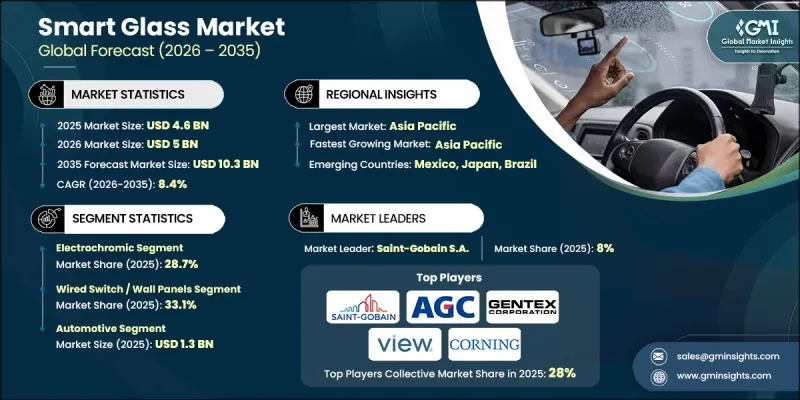
全球環保意識的增強以及對降低建築和車輛能耗的日益重視,正在加速市場成長。由於傳統的照明控制方案往往缺乏柔軟性,且會增加能源消耗,智慧玻璃作為動態替代方案正獲得越來越多的支持。這種先進的玻璃技術能夠透過調節透明度來自動適應不斷變化的環境條件,從而有效控制熱傳遞和陽光傳輸,而無需過度依賴人工照明或空調系統。隨著永續性成為現代設計和建造的核心要素,智慧玻璃與淨零排放和節能發展目標日益契合。此外,技術供應商、建築師和開發商之間的緊密合作正在推動智慧玻璃在住宅、商業和運輸領域的應用,進一步促進市場發展。材料科學和自動化技術的持續創新正在不斷提升智慧玻璃的性能可靠性、成本效益和擴充性,使其成為全球節能基礎設施的長期可行解決方案。
| 市場範圍 | |
|---|---|
| 開始年份 | 2025 |
| 預測年份 | 2026-2035 |
| 起始金額 | 46億美元 |
| 預測金額 | 103億美元 |
| 複合年成長率 | 8.4% |
智慧玻璃的商業性前景日益光明,這主要得益於北美地區對永續城市發展投資的增加,以及歐洲和亞太地區綠色建築政策的推廣。設計師和業主正逐漸從靜態遮陽方案轉向能夠提供響應式性能的自動化氣候控制解決方案。智慧玻璃逐漸成為先進建築外圍護結構的首選解決方案,它不僅注重舒適性、效率和環保性,還能實現高度自適應的光熱管理,並契合現代建築美學。
截至2025年,電致變色材料將佔據28.7%的市場佔有率,並持續維持其作為最大技術領域的地位。該領域持續受到關注,因為它能夠在大規模安裝環境中實現精確的調光和能源控制。此外,其與智慧建築系統的高度相容性以及在各種條件下穩定的性能,也推動了其在商業和公共建築計劃中的廣泛應用。
預計到2025年,汽車領域將佔據28.3%的市場佔有率,市場規模將達到13億美元。該領域的成長主要得益於智慧嵌裝玻璃解決方案在先進車輛設計中日益廣泛的應用。光線傳輸控制有助於提高隔熱性能、提升乘客舒適度並最佳化整體能源消耗。車輛電氣化和內裝設計的持續創新正在推動整個汽車產業對智慧玻璃解決方案的需求。
預計到2025年,北美智慧玻璃市場規模將達到11億美元,並在2035年之前以8.7%的複合年成長率成長。先進玻璃技術的早期應用、對節能建築的高度重視以及在高階建築和交通應用領域的不斷擴展,是推動該地區市場成長的主要因素。監管機構對永續建築和能源效率的關注也持續增強了該地區的需求。
目錄
第1章:調查方法和範圍
第2章執行摘要
第3章業界考察
- 生態系分析
- 供應商情況
- 利潤率
- 每個階段增加的價值
- 影響價值鏈的因素
- 影響產業的因素
- 促進因素
- 節能建築的需求日益成長
- 汽車整合技術的進步
- 物聯網和智慧家庭生態系統整合
- 產業潛在風險與挑戰
- 高昂的初始設置成本和材料成本
- 技術複雜性和可靠性問題
- 機會
- 電動和人工智慧驅動的調光功能
- 醫療和酒店業的擴張
- 促進因素
- 成長潛力分析
- 未來市場趨勢
- 科技與創新趨勢
- 當前技術趨勢
- 新興技術
- 價格趨勢
- 按地區
- 按類型
- 監理情勢
- 標準和合規要求
- 區域法規結構
- 認證標準
- 波特的分析
- PESTEL 分析
第4章 競爭情勢
- 介紹
- 企業市佔率分析
- 按地區
- 公司矩陣分析
- 主要市場公司的競爭分析
- 競爭定位矩陣
- 主要進展
- 併購
- 夥伴關係與合作
- 新產品發布
- 擴張計劃
第5章 市場估計與預測:依技術類型分類,2022-2035年
- 電致變色
- 懸浮顆粒裝置(SPD)
- 聚合物分散液晶(PDLC)
- 感溫變色
- 光致變色
- 混合太陽能發電
第6章 市場估計與預測:依控制方法分類,2022-2035年
- 有線開關/牆板
- 遙控器/射頻控制器
- 調光面板/滑桿
- 智慧型手機/語音助手
- 基於感測器的自動控制
第7章 市場估計與預測:依應用領域分類,2022-2035年
- 建築幕牆
- 室內隔間和隱私面板
- 天窗、天窗、車頂玻璃
- 鏡面顯示
第8章 市場估算與預測:依最終使用者分類,2022-2035年
- 車
- 建築學
- 航空電子設備
- 船
- 鐵路
- 消費性電子產品
- 醫療設施
- 其他
第9章 市場估計與預測:依地區分類,2022-2035年
- 北美洲
- 美國
- 加拿大
- 歐洲
- 德國
- 英國
- 法國
- 義大利
- 西班牙
- 亞太地區
- 中國
- 日本
- 印度
- 澳洲
- 韓國
- 拉丁美洲
- 巴西
- 墨西哥
- 阿根廷
- 中東和非洲
- 南非
- 沙烏地阿拉伯
- 阿拉伯聯合大公國
第10章:公司簡介
- AGC Inc.
- ChromoGenics AB
- Corning Incorporated
- EControl-Glas GmbH
- Fuyao Glass Industry Group
- Gauzy Ltd.
- Gentex Corporation
- Guardian Industries Holdings, LLC
- Halio, Inc.
- Nippon Sheet Glass Co., Ltd.(NSG Group)
- Pleotint, LLC
- Polytronix, Inc.
- Research Frontiers Inc.
- Saint-Gobain SA
- View, Inc.
The Global Smart Glass Market was valued at USD 4.6 billion in 2025 and is estimated to grow at a CAGR of 8.4% to reach USD 10.3 billion by 2035.
Market growth is accelerated by rising global awareness of environmental responsibility and the increasing focus on reducing energy consumption in buildings and vehicles. Smart glass is gaining preference as a dynamic alternative to traditional light-control solutions, which often lack flexibility and contribute to higher energy usage. This advanced glazing technology adapts automatically to changing environmental conditions by modifying transparency levels, helping to control heat transfer and daylight penetration without relying heavily on artificial lighting or climate control systems. As sustainability becomes a central pillar in modern design and construction, smart glass is increasingly aligned with net-zero and energy-efficient development goals. The market is also benefiting from strong collaboration across technology providers, architects, and developers, enabling broader adoption across residential, commercial, and transportation sectors. Continuous innovation in material science and automation capabilities is further enhancing performance reliability, cost efficiency, and scalability, making smart glass a viable long-term solution for energy-conscious infrastructure worldwide.
| Market Scope | |
|---|---|
| Start Year | 2025 |
| Forecast Year | 2026-2035 |
| Start Value | $4.6 Billion |
| Forecast Value | $10.3 Billion |
| CAGR | 8.4% |
Rising investments in sustainable urban development across North America, coupled with expanding green construction policies in Europe and Asia-Pacific, are strengthening the commercial outlook for smart glass adoption. Designers and property owners are shifting toward automated climate-control solutions that offer responsive performance rather than static shading alternatives. Smart glass delivers adaptable light and heat management while supporting modern architectural aesthetics, positioning it as a preferred solution for advanced building envelopes that prioritize comfort, efficiency, and environmental accountability.
The electrochromic segment accounted for 28.7% share in 2025, maintaining the largest share among technologies. This segment continues to gain traction due to its ability to deliver precise light modulation and energy control across large installations. Strong compatibility with intelligent building systems and consistent performance under varying conditions support its growing deployment in both commercial and institutional projects.
The automotive segment held a 28.3% share in 2025, generating USD 1.3 billion. Growth in this segment is driven by the increasing integration of smart glazing solutions into advanced vehicle designs, where controlled light transmission supports thermal efficiency, passenger comfort, and overall energy optimization. Continued innovation in vehicle electrification and interior design is reinforcing demand for smart glass solutions across the automotive industry.
North America Smart Glass Market reached USD 1.1 billion in 2025 and is projected to grow at a CAGR of 8.7% through 2035. Regional growth is supported by early adoption of advanced glazing technologies, strong emphasis on energy-efficient construction, and increasing deployment in premium architectural and mobility applications. Regulatory focus on sustainable buildings and energy conservation continues to reinforce regional demand.
Key players active in the Global Smart Glass Market include Saint-Gobain S.A., AGC Inc., View, Inc., Gentex Corporation, Gauzy Ltd., Corning Incorporated, Research Frontiers Inc., Nippon Sheet Glass Co., Ltd. (NSG Group), Fuyao Glass Industry Group, Halio, Inc., Pleotint, LLC, Polytronix, Inc., ChromoGenics AB, and EControl-Glas GmbH, with competition driven by technological differentiation and global expansion strategies. Companies operating in the smart glass market are strengthening their market position through continuous investment in research, product innovation, and strategic partnerships. Manufacturers are focusing on improving switching speed, durability, and energy efficiency to meet evolving architectural and automotive requirements. Expansion into emerging construction and electric mobility markets is supporting long-term growth, while collaborations with developers and system integrators are enhancing adoption across large projects.
Table of Contents
Chapter 1 Methodology and Scope
- 1.1 Market scope and definition
- 1.2 Research design
- 1.2.1 Research approach
- 1.2.2 Data collection methods
- 1.3 Data mining sources
- 1.3.1 Global
- 1.3.2 Regional/Country
- 1.4 Base estimates and calculations
- 1.4.1 Base year calculation
- 1.4.2 Key trends for market estimation
- 1.5 Primary research and validation
- 1.5.1 Primary sources
- 1.6 Forecast model
- 1.7 Research assumptions and limitations
Chapter 2 Executive Summary
- 2.1 Industry 360° synopsis
- 2.2 Key market trends
- 2.2.1 Regional
- 2.2.2 Technology Type
- 2.2.3 Control Mode
- 2.2.4 Application
- 2.2.5 End-Use
- 2.3 CXO perspectives: Strategic imperatives
- 2.3.1 Key decision points for industry executives
- 2.3.2 Critical success factors for market players
- 2.4 Future outlook and strategic recommendations
Chapter 3 Industry Insights
- 3.1 Industry ecosystem analysis
- 3.1.1 Supplier landscape
- 3.1.2 Profit margin
- 3.1.3 Value addition at each stage
- 3.1.4 Factor affecting the value chain
- 3.2 Industry impact forces
- 3.2.1 Growth drivers
- 3.2.1.1 Rise in energy-efficient building demand
- 3.2.1.2 Advancements in automotive integration
- 3.2.1.3 IoT and smart home ecosystem integration
- 3.2.2 Industry pitfalls & challenges
- 3.2.2.1 High initial installation and material costs
- 3.2.2.2 Technical complexity and reliability issues
- 3.2.3 Opportunities
- 3.2.3.1 Electrification and AI-driven tinting
- 3.2.3.2 Expansion of the healthcare and hospitality sectors
- 3.2.1 Growth drivers
- 3.3 Growth potential analysis
- 3.4 Future market trends
- 3.5 Technology and innovation landscape
- 3.5.1 Current technological trends
- 3.5.2 Emerging technologies
- 3.6 Price trends
- 3.6.1 By region
- 3.6.2 By type
- 3.7 Regulatory landscape
- 3.7.1 Standards and compliance requirements
- 3.7.2 Regional regulatory frameworks
- 3.7.3 Certification standards
- 3.8 Porter’s analysis
- 3.9 PESTEL analysis
Chapter 4 Competitive Landscape, 2025
- 4.1 Introduction
- 4.2 Company market share analysis
- 4.2.1 By region
- 4.2.1.1 North America
- 4.2.1.2 Europe
- 4.2.1.3 Asia Pacific
- 4.2.1.4 Latin America
- 4.2.1.5 Middle East and Africa
- 4.2.1 By region
- 4.3 Company matrix analysis
- 4.4 Competitive analysis of major market players
- 4.5 Competitive positioning matrix
- 4.6 Key developments
- 4.6.1 Mergers & acquisitions
- 4.6.2 Partnerships & collaborations
- 4.6.3 New product launches
- 4.6.4 Expansion plans
Chapter 5 Market Estimates and Forecast, By Technology Type, 2022 - 2035 (USD Billion) (Thousand Units)
- 5.1 Key trends
- 5.2 Electrochromic
- 5.3 Suspended Particle Device (SPD)
- 5.4 Polymer-Dispersed Liquid Crystal (PDLC)
- 5.5 Thermochromic
- 5.6 Photochromic
- 5.7 Hybrid and Photovoltaic
Chapter 6 Market Estimates and Forecast, By Control Mode, 2022 - 2035 (USD Billion) (Thousand Units)
- 6.1 Key trends
- 6.2 Wired Switch / Wall Panel
- 6.3 Remote / RF Controller
- 6.4 Dimming Panel / Slider
- 6.5 Smartphone / Voice Assistant
- 6.6 Sensor-Based Automatic Control
Chapter 7 Market Estimates and Forecast, By Application, 2022 - 2035 (USD Billion) (Thousand Units)
- 7.1 Key trends
- 7.2 Facades and Curtain Walls
- 7.3 Interior Partitions and Privacy Panels
- 7.4 Sunroofs, Skylights and Roof Glazing
- 7.5 Mirrors and Displays
Chapter 8 Market Estimates and Forecast, By End User, 2022 - 2035 (USD Billion) (Thousand Units)
- 8.1 Key trends
- 8.2 Automotive
- 8.3 Architectural
- 8.4 Avionics
- 8.5 Marine
- 8.6 Rail
- 8.7 Consumer Electronics
- 8.8 Healthcare Facilities
- 8.9 Other
Chapter 9 Market Estimates and Forecast, By Region, 2022 - 2035 (USD Billion) (Thousand Units)
- 9.1 Key trends
- 9.2 North America
- 9.2.1 U.S.
- 9.2.2 Canada
- 9.3 Europe
- 9.3.1 Germany
- 9.3.2 UK
- 9.3.3 France
- 9.3.4 Italy
- 9.3.5 Spain
- 9.4 Asia Pacific
- 9.4.1 China
- 9.4.2 Japan
- 9.4.3 India
- 9.4.4 Australia
- 9.4.5 South Korea
- 9.5 Latin America
- 9.5.1 Brazil
- 9.5.2 Mexico
- 9.5.3 Argentina
- 9.6 Middle East and Africa
- 9.6.1 South Africa
- 9.6.2 Saudi Arabia
- 9.6.3 UAE
Chapter 10 Company Profiles
- 10.1 AGC Inc.
- 10.2 ChromoGenics AB
- 10.3 Corning Incorporated
- 10.4 EControl-Glas GmbH
- 10.5 Fuyao Glass Industry Group
- 10.6 Gauzy Ltd.
- 10.7 Gentex Corporation
- 10.8 Guardian Industries Holdings, LLC
- 10.9 Halio, Inc.
- 10.10 Nippon Sheet Glass Co., Ltd. (NSG Group)
- 10.11 Pleotint, LLC
- 10.12 Polytronix, Inc.
- 10.13 Research Frontiers Inc.
- 10.14 Saint-Gobain S.A.
- 10.15 View, Inc.

 智慧眼鏡市場:按類型、功能、應用和最終用戶分類-2026-2032年全球市場預測
 智慧玻璃市場報告:按技術、控制方法、應用和地區分類(2026-2034 年)
 2026年全球智慧玻璃市場報告2026年全球電致變色智慧玻璃與窗戶市場報告透明星屋市場:依產品類型、部署方式、應用程式、通路和最終用戶產業分類-2026-2032年全球預測2026年全球智慧自適應樓梯升降機市場報告
 半導體自適應智慧眼鏡市場分析及預測(至2035年):按類型、產品、技術、組件、應用、材質、最終用戶、功能、安裝類型和解決方案分類智慧玻璃與智慧窗戶市場分析及預測(至2035年):類型、產品類型、技術、組件、應用、形式、材質類型、安裝類型、最終用戶、功能
 全球智慧玻璃市場:預測(至2034年)-按技術、控制模式、材料類型、功能、安裝類型、應用、最終用戶、分銷管道和地區進行分析2026年全球智慧玻璃與智慧窗戶市場報告