


 |
市場調查報告書
商品編碼
1959597
汽車皮帶張緊輪市場:機會、成長要素、產業趨勢分析及2026年至2035年預測Automotive Belt Tensioner Pulleys Market Opportunity, Growth Drivers, Industry Trend Analysis, and Forecast 2026 - 2035 |
||||||

2025 年全球汽車皮帶張緊輪市場價值為 34 億美元,預計到 2035 年將達到 54 億美元,年複合成長率為 4.6%。
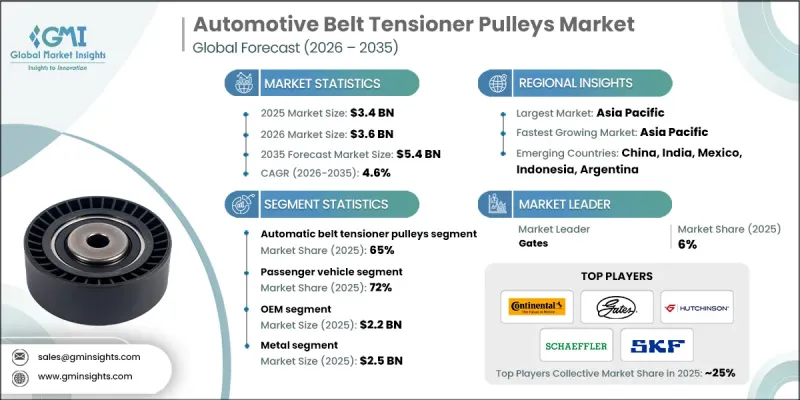
市場成長依賴內燃機和混合動力汽車的持續主導地位,在中期內,它們將佔據全球車輛運作的大多數。這些汽車平臺依靠皮帶傳動系統來實現穩定的機械性能,而皮帶張緊輪是確保可靠性和效率的關鍵部件。儘管電動車的市場佔有率持續成長,但混合動力平台仍保留了傳統的皮帶結構,這有助於整體需求的穩定性。較長的車輛生命週期、穩定的更換需求以及不斷提升耐久性和性能的技術進步,都為市場帶來了益處。現代動力傳動系統的機械複雜性日益增加,對皮帶系統提出了更高的運行負荷,因此需要更精確設計的張力解決方案。因此,即使不同地區的車輛產量有所波動,在整車製造商需求和穩健的更換週期支撐下,市場仍保持穩定成長。
| 市場範圍 | |
|---|---|
| 開始年份 | 2025 |
| 預測年份 | 2026-2035 |
| 起始值 | 34億美元 |
| 預測金額 | 54億美元 |
| 複合年成長率 | 4.6% |
汽車皮帶張緊輪由於持續的運轉應力而逐漸發生機械劣化,因此在車輛的整個使用壽命期間都需要更換。全球汽車保有量的成長,尤其是在已開發國家和新興國家老舊車輛的增多,為售後市場需求提供了持續的支撐。這種更換需求能夠帶來穩定的收入,並抵消新車產量短期波動的影響,從而增強長期成長前景。
自動皮帶張緊輪細分市場預計在2025年將佔據65%的市場佔有率,並在2035年之前以5.1%的複合年成長率成長。這些系統能夠自動維持最佳皮帶張力,正逐漸成為現代內燃機和混合動力汽車的標準配備。這有助於降低駕駛風險、延長零件壽命並提高系統整體可靠性。
預計到 2025 年,OEM 市場規模將達到 22 億美元。 OEM 需求與全球內燃機和混合動力汽車的生產保持同步,這主要得益於長期供應商契約,這些合約強調工程合作、成本效益、品質合規性以及早期融入車輛開發計劃。
預計2025年,美國汽車皮帶張緊輪市場規模將達7.931億美元。車輛在高機械負載下運作的需求推動了市場成長,進而帶動了對先進張緊輪設計和高價值零件的需求。此外,完善的售後市場基礎也進一步增強了替換需求,並提升了全國市場的穩定性。
目錄
第1章:調查方法和範圍
第2章執行摘要
第3章業界考察
- 生態系分析
- 供應商情況
- 製造商
- 零件供應商
- 服務供應商
- 銷售代理
- 最終用戶
- 成本結構
- 利潤率
- 每個階段增加的價值
- 影響供應鏈的因素
- 顛覆者
- 供應商情況
- 影響因素
- 促進因素
- 內燃機汽車和混合動力汽車。
- 全球龐大且老化的汽車保有量正在推動售後市場需求。
- 附件負載增加和引擎複雜性增加
- 原始設備製造商 (OEM) 專注於降低噪音、振動與聲振粗糙度 (NVH) 並提高耐久性
- 產業潛在風險與挑戰
- 加速汽車動力傳動系統的電氣化
- 液壓動力方向盤系統的迅速衰落
- 市場機遇
- 擴大混合動力汽車生產
- 售後維修套件和系統解決方案的成長
- 新興市場汽車產量成長
- 輕量化低摩擦滑輪設計創新
- 促進因素
- 成長潛力分析
- 監管環境
- 北美洲
- FMVSS(聯邦機動車輛安全標準)
- 美國環保署排放法規
- 加州空氣資源委員會 (CARB)排放標準
- 歐洲
- 歐盟型式認可架構(歐盟法規 2018/858)
- 歐6和歐7排放氣體法規
- 報廢車輛(ELV)指令
- REACH法規
- OEM 特定 NVH 和耐久性合規標準
- 亞太地區
- 印度第六階段排放氣體標準(BS VI)
- 印度汽車產業標準 (AIS)
- 中國第六版排放氣體法規
- 中國強制產品安全監督管理委員會認證(CCC)
- 日本汽車標準與法規(JASO/國土交通省)
- 拉丁美洲
- PROCONVE排放標準 - 巴西
- InMetro汽車認證 - 巴西
- 墨西哥國家車輛安全與排放氣體標準
- 南方共同市場汽車產業法規結構
- 中東和非洲
- 海灣合作理事會標準化組織(GSO)車輛法規
- 沙烏地阿拉伯標準、計量和品質組織(SASO)
- 南非標準局(SABS)汽車法規
- 北美洲
- 波特的分析
- PESTEL 分析
- 科技與創新趨勢
- 當前技術趨勢
- 新興技術
- 價格分析
- 依產品
- 按地區
- 成本細分分析
- 供應商成本結構
- 成本構成要素的引入
- 持續營運成本
- 間接客戶成本
- 生產統計
- 生產基地
- 消費者群體
- 出口和進口
- 專利分析
- 電氣化的影響
- 減少電池電動車中的皮帶傳動部件
- 對混合動力和輕度混合動力傳動系統的持續需求
- 輔助系統的電氣化導致滑輪的使用量減少。
- 電氣化影響的區域差異
- 大型內燃機售後市場需求支持
- 永續性和環境方面
- 永續努力
- 減少廢棄物策略
- 生產中的能源效率
- 具有環保意識的舉措
- 碳足跡考量
- 未來前景與機遇
第4章 競爭情勢
- 介紹
- 企業市佔率分析
- 北美洲
- 歐洲
- 亞太地區
- 拉丁美洲
- 中東和非洲
- 主要市場公司的競爭分析
- 競爭定位矩陣
- 戰略展望矩陣
- 主要進展
- 併購
- 夥伴關係與合作
- 新產品發布
- 業務拓展計劃及資金籌措
第5章 市場估價與預測:依產品分類,2022-2035年
- 自動皮帶張緊輪
- 手動皮帶張緊輪
第6章 市場估價與預測:依車輛類型分類,2022-2035年
- 搭乘用車
- 掀背車
- 轎車
- SUV
- 商用車輛
- 輕型商用車(LCV)
- 中型商用車(MCV)
- 重型商用車(HCV)
第7章 市場估計與預測:依材料分類,2022-2035年
- 金屬
- 塑膠
第8章 市場估計與預測:依應用領域分類,2022-2035年
- 引擎正時系統
- 交流發電機系統
- 動力方向盤系統
- 空調系統
- 水泵系統
- 其他
第9章 市場估價與預測:依銷售管道分類,2022-2035年
- OEM
- 售後市場
第10章 市場估價與預測:依地區分類,2022-2035年
- 北美洲
- 美國
- 加拿大
- 歐洲
- 德國
- 英國
- 法國
- 義大利
- 西班牙
- 俄羅斯
- 挪威
- 丹麥
- 比利時
- 荷蘭
- 亞太地區
- 中國
- 印度
- 日本
- 澳洲
- 韓國
- 泰國
- 印尼
- 新加坡
- 拉丁美洲
- 巴西
- 墨西哥
- 阿根廷
- 智利
- 中東和非洲
- 南非
- 沙烏地阿拉伯
- 阿拉伯聯合大公國
第11章:公司簡介
- Global leaders
- Aisin Seiki
- Continental
- Dayco Products
- Gates
- Hutchinson
- NSK
- NTN
- Schaeffler
- SKF
- The Timken Company
- 本地製造商
- Tsubaki Automotive
- Bando Chemical Industries
- Federal-Mogul Motorparts
- Mevotech
- Delphi
- VDO
- NTN-SNR
- Marelli
- Mahle
- Febi Bilstein
- Cloyes Gear &Products
- Denso
- 新興企業
- Litens Automotive
- Mubea
- GMB
- Roulunds Braking
- Cloyes Gear &Products
The Global Automotive Belt Tensioner Pulleys Market was valued at USD 3.4 billion in 2025 and is estimated to grow at a CAGR of 4.6% to reach USD 5.4 billion by 2035.
Market growth remains tied to the continued dominance of internal combustion engines and hybrid vehicles, which together represent many vehicles in operation worldwide over the medium term. These vehicle platforms depend on belt-driven systems for consistent mechanical performance, making belt tensioner pulleys a critical component for reliability and efficiency. While electric vehicles continue to expand their presence, hybrid platforms retain conventional belt architectures, helping stabilize overall demand. The market benefits from long vehicle life cycles, steady replacement requirements, and ongoing engineering refinements that improve durability and performance. Growing mechanical complexity within modern powertrains places higher operational stress on belt systems, increasing the need for accurately engineered tensioning solutions. As a result, the market continues to show steady expansion supported by both original equipment demand and a resilient replacement cycle, even as vehicle production volumes fluctuate across regions.
| Market Scope | |
|---|---|
| Start Year | 2025 |
| Forecast Year | 2026-2035 |
| Start Value | $3.4 Billion |
| Forecast Value | $5.4 Billion |
| CAGR | 4.6% |
Automotive belt tensioner pulleys experience gradual mechanical degradation due to constant operational stress, making replacement essential over a vehicle's lifetime. An expanding global vehicle population, particularly aging fleets in developed and emerging regions, continues to support consistent aftermarket demand. This replacement-driven consumption provides revenue stability and offsets short-term variations in new vehicle output, reinforcing the long-term growth outlook.
The automatic belt tensioner pulleys segment accounted for 65% share in 2025 and is projected to grow at a CAGR of 5.1% through 2035. These systems have become standard across modern internal combustion and hybrid vehicles due to their ability to maintain optimal belt force automatically, reducing operational risk and extending component lifespan while improving overall system reliability.
The OEM segment reached USD 2.2 billion in 2025. OEM demand remains aligned with global production of internal combustion and hybrid vehicles, supported by long-term supplier agreements that emphasize engineering collaboration, cost efficiency, quality compliance, and early-stage integration into vehicle development programs.
United States Automotive Belt Tensioner Pulleys Market generated USD 793.1 million in 2025. Demand is supported by vehicles operating under higher mechanical loads, which increases requirements for advanced tensioner designs and higher-value components. A well-developed aftermarket infrastructure further strengthens replacement demand and enhances market stability nationwide.
Key companies operating in the Global Automotive Belt Tensioner Pulleys Market include Schaeffler, Gates, Continental, SKF, NTN, Dayco Products, Hutchinson, Aisin Seiki, Litens Automotive, and NSK Automation. Companies in the automotive belt tensioner pulleys market are reinforcing their market position through product innovation, material advancements, and close collaboration with vehicle manufacturers. Many suppliers are investing in next-generation designs that enhance durability, reduce noise, and improve thermal performance. Expansion of manufacturing capacity in key automotive regions is helping companies optimize costs and ensure supply reliability. Firms are also strengthening aftermarket distribution networks to capture recurring replacement demand.
Table of Contents
Chapter 1 Methodology & Scope
- 1.1 Research approach
- 1.2 Quality Commitments
- 1.2.1 GMI AI policy & data integrity commitment
- 1.3 Research Trail & Confidence Scoring
- 1.3.1 Research trail components
- 1.3.2 Scoring components
- 1.4 Data Collection
- 1.4.1 Partial list of primary sources
- 1.5 Data mining sources
- 1.5.1 Paid sources
- 1.6 Base estimates and calculations
- 1.6.1 Base year calculation
- 1.7 Forecast model
- 1.8 Research transparency addendum
Chapter 2 Executive Summary
- 2.1 Industry 360° synopsis, 2022-2035
- 2.2 Key market trends
- 2.2.1 Regional
- 2.2.2 Product
- 2.2.3 Vehicle
- 2.2.4 Material
- 2.2.5 Application
- 2.2.6 Sales Channel
- 2.3 TAM Analysis, 2026-2035
- 2.4 CXO perspectives: Strategic imperatives
- 2.4.1 Key decision points for industry executives
- 2.4.2 Critical success factors for market players
- 2.5 Future outlook and strategic recommendations
Chapter 3 Industry Insights
- 3.1 Industry ecosystem analysis
- 3.1.1 Supplier landscape
- 3.1.1.1 Manufacturers
- 3.1.1.2 Component suppliers
- 3.1.1.3 Service providers
- 3.1.1.4 Distributors
- 3.1.1.5 End-users
- 3.1.2 Cost structure
- 3.1.3 Profit margin
- 3.1.4 Value addition at each stage
- 3.1.5 Factors impacting the supply chain
- 3.1.6 Disruptors
- 3.1.1 Supplier landscape
- 3.2 Impact on forces
- 3.2.1 Growth drivers
- 3.2.1.1 Continued dominance of ICE and hybrid vehicle parcels
- 3.2.1.2 Large and aging global vehicle fleet driving aftermarket demand
- 3.2.1.3 Increasing accessory load and engine complexity
- 3.2.1.4 OEM focus on NVH reduction and durability
- 3.2.2 Industry pitfalls & challenges
- 3.2.2.1 Accelerating electrification of vehicle powertrains
- 3.2.2.2 Rapid decline of hydraulic power steering systems
- 3.2.3 Market opportunities
- 3.2.3.1 Expansion of hybrid vehicle production
- 3.2.3.2 Growth in aftermarket repair kits and system solutions
- 3.2.3.3 Vehicle production growth in emerging markets
- 3.2.3.4 Innovation in lightweight and low-friction pulley designs
- 3.2.1 Growth drivers
- 3.3 Growth potential analysis
- 3.4 Regulatory landscape
- 3.4.1 North America
- 3.4.1.1 FMVSS (Federal Motor Vehicle Safety Standards - United States)
- 3.4.1.2 EPA Emission Regulations (United States)
- 3.4.1.3 CARB Emission Standards (California Air Resources Board)
- 3.4.2 Europe
- 3.4.2.1 EU Type Approval Framework (Regulation (EU) 2018/858)
- 3.4.2.2 Euro 6 and Euro 7 Emission Standards
- 3.4.2.3 End-of-Life Vehicles (ELV) Directive
- 3.4.2.4 REACH Regulation
- 3.4.2.5 OEM-Specific NVH and Durability Compliance Standards
- 3.4.3 Asia Pacific
- 3.4.3.1 Bharat Stage VI (BS VI) Emission Norms - India
- 3.4.3.2 Automotive Industry Standards (AIS) - India
- 3.4.3.3 China VI Emission Standards
- 3.4.3.4 China Compulsory Certification (CCC)
- 3.4.3.5 Japan Automotive Standards and Regulations (JASO / MLIT)
- 3.4.4 Latin America
- 3.4.4.1 PROCONVE Emission Standards - Brazil
- 3.4.4.2 Inmetro Automotive Certification - Brazil
- 3.4.4.3 NOM Vehicle Safety and Emission Standards - Mexico
- 3.4.4.4 Mercosur Automotive Regulatory Framework
- 3.4.5 Middle East & Africa
- 3.4.5.1 GCC Standardization Organization (GSO) Vehicle Regulations
- 3.4.5.2 Saudi Standards, Metrology and Quality Organization (SASO)
- 3.4.5.3 South African Bureau of Standards (SABS) Automotive Regulations
- 3.4.1 North America
- 3.5 Porter’s analysis
- 3.6 PESTEL analysis
- 3.7 Technology and innovation landscape
- 3.7.1 Current technological trends
- 3.7.2 Emerging technologies
- 3.8 Pricing analysis
- 3.8.1 By product
- 3.8.2 By region
- 3.9 Cost breakdown analysis
- 3.9.1 Vendor cost structure
- 3.9.2 Implementation of cost components
- 3.9.3 Ongoing operational costs
- 3.9.4 Indirect customer costs
- 3.10 Production statistics
- 3.10.1 Production hubs
- 3.10.2 Consumption hubs
- 3.10.3 Export and import
- 3.11 Patent analysis
- 3.12 Impact of Electrification
- 3.12.1 Reduction of belt-driven components in battery electric vehicles
- 3.12.2 Sustained demand from hybrid and mild-hybrid powertrains
- 3.12.3 Electrification of auxiliary systems reducing pulley applications
- 3.12.4 Regional variation in electrification impact
- 3.12.5 Aftermarket demand support from large ICE vehicle
- 3.13 Sustainability and environmental aspects
- 3.13.1 Sustainable practices
- 3.13.2 Waste reduction strategies
- 3.13.3 Energy efficiency in production
- 3.13.4 Eco-friendly initiatives
- 3.13.5 Carbon footprint considerations
- 3.14 Future outlook and opportunities
Chapter 4 Competitive Landscape, 2025
- 4.1 Introduction
- 4.2 Company market share analysis
- 4.2.1 North America
- 4.2.2 Europe
- 4.2.3 Asia Pacific
- 4.2.4 LATAM
- 4.2.5 MEA
- 4.3 Competitive analysis of major market players
- 4.4 Competitive positioning matrix
- 4.5 Strategic outlook matrix
- 4.6 Key developments
- 4.6.1 Mergers & acquisitions
- 4.6.2 Partnerships & collaborations
- 4.6.3 New product launches
- 4.6.4 Expansion plans and funding
Chapter 5 Market Estimates & Forecast, By Product, 2022 - 2035 ($Bn, Units)
- 5.1 Key trends
- 5.2 Automatic belt tensioner pulleys
- 5.3 Manual belt tensioner pulleys
Chapter 6 Market Estimates & Forecast, By Vehicle, 2022 - 2035 ($Bn, Units)
- 6.1 Key trends
- 6.2 Passenger vehicle
- 6.2.1 Hatchback
- 6.2.2 Sedan
- 6.2.3 SUVs
- 6.3 Commercial vehicle
- 6.3.1 Light commercial vehicles (LCVs)
- 6.3.2 Medium commercial vehicles (MCVs)
- 6.3.3 Heavy commercial vehicles (HCVs)
Chapter 7 Market Estimates & Forecast, By Material, 2022 - 2035 ($Bn, Units)
- 7.1 Key trends
- 7.2 Metal
- 7.3 Plastic
Chapter 8 Market Estimates & Forecast, By Application, 2022 - 2035 ($Bn, Units)
- 8.1 Key trends
- 8.2 Engine timing system
- 8.3 Alternator system
- 8.4 Power steering system
- 8.5 Air conditioning system
- 8.6 Water pump system
- 8.7 Others
Chapter 9 Market Estimates & Forecast, By Sales Channel, 2022 - 2035 ($Bn, Units)
- 9.1 Key trends
- 9.2 OEM
- 9.3 Aftermarket
Chapter 10 Market Estimates & Forecast, By Region, 2022 - 2035 ($Bn, Units)
- 10.1 Key trends
- 10.2 North America
- 10.2.1 US
- 10.2.2 Canada
- 10.3 Europe
- 10.3.1 Germany
- 10.3.2 UK
- 10.3.3 France
- 10.3.4 Italy
- 10.3.5 Spain
- 10.3.6 Russia
- 10.3.7 Norway
- 10.3.8 Denmark
- 10.3.9 Belgium
- 10.3.10 Netherlands
- 10.4 Asia Pacific
- 10.4.1 China
- 10.4.2 India
- 10.4.3 Japan
- 10.4.4 Australia
- 10.4.5 South Korea
- 10.4.6 Thailand
- 10.4.7 Indonesia
- 10.4.8 Singapore
- 10.5 Latin America
- 10.5.1 Brazil
- 10.5.2 Mexico
- 10.5.3 Argentina
- 10.5.4 Chile
- 10.6 MEA
- 10.6.1 South Africa
- 10.6.2 Saudi Arabia
- 10.6.3 UAE
Chapter 11 Company Profiles
- 11.1 Global leaders
- 11.1.1 Aisin Seiki
- 11.1.2 Continental
- 11.1.3 Dayco Products
- 11.1.4 Gates
- 11.1.5 Hutchinson
- 11.1.6 NSK
- 11.1.7 NTN
- 11.1.8 Schaeffler
- 11.1.9 SKF
- 11.1.10 The Timken Company
- 11.2 Regional players
- 11.2.1 Tsubaki Automotive
- 11.2.2 Bando Chemical Industries
- 11.2.3 Federal-Mogul Motorparts
- 11.2.4 Mevotech
- 11.2.5 Delphi
- 11.2.6 VDO
- 11.2.7 NTN-SNR
- 11.2.8 Marelli
- 11.2.9 Mahle
- 11.2.10 Febi Bilstein
- 11.2.11 Cloyes Gear & Products
- 11.2.12 Denso
- 11.3 Emerging players
- 11.3.1 Litens Automotive
- 11.3.2 Mubea
- 11.3.3 GMB
- 11.3.4 Roulunds Braking
- 11.3.5 Cloyes Gear & Products


