


 |
市場調查報告書
商品編碼
1959595
氫氣發生器市場機會、成長要素、產業趨勢分析及2026年至2035年預測Hydrogen Generator Market Opportunity, Growth Drivers, Industry Trend Analysis, and Forecast 2026 - 2035 |
||||||

2025 年全球氫氣發生器市場價值為 7.68 億美元,預計到 2035 年將達到 15 億美元,年複合成長率為 7.2%。
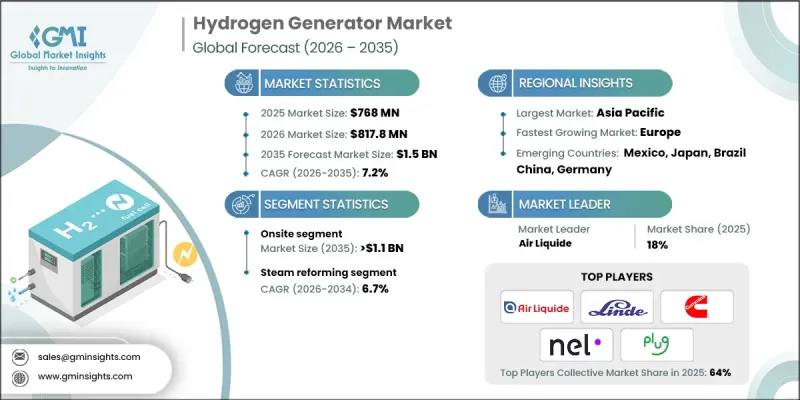
隨著世界向清潔能源和低碳產業轉型,市場正經歷重大變革時期。推動這一成長的主要動力包括電解效率的提升、製造成本的降低以及政府為支持氫能應用而提供的強力的獎勵。針對住宅和商業用電需求的可再生能源項目也進一步促進了這一趨勢。各產業對清潔電力的需求不斷成長,尤其是在玻璃、金屬、化學和食品加工等能源密集產業,這推動了排放的普及應用,而嚴格的減排目標也加速了投資。實驗室、電子製造廠和其他工業設施正在擴大氫氣產生器的部署規模,以確保可靠、永續且經濟高效的能源解決方案。印度、巴西和中東等新興經濟體正大力投資氫氣生產,以滿足國內需求和出口目標。先進的監控系統、預測性維護和人工智慧驅動的即時最佳化正在提高營運效率,並實現與分散式和微電網系統中風能和太陽能等再生能源來源的無縫整合。
| 市場範圍 | |
|---|---|
| 開始年份 | 2025 |
| 預測年份 | 2026-2035 |
| 起始值 | 7.68億美元 |
| 預測金額 | 15億美元 |
| 複合年成長率 | 7.2% |
預計到2025年,現場氫氣生產機市場規模將達到5.58億美元,2035年將達11億美元。現場氫氣產生系統因其無需運輸、儲存和管理氫氣瓶而日益普及。這些氫氣製造機直接安裝在用氫點,可提供可靠的按需供氫,同時降低營運成本和易燃風險。維護需求低、易於操作等特點也推動了其進一步普及。加油站和電能轉氣系統對氫氣供應需求的不斷成長預計將進一步促進該領域的成長。現場氫氣生產機性能穩定、運作安全,是優先考慮效率、成本降低和環境影響減少的產業的理想選擇。
預計到2035年,電解領域將以8.3%的複合年成長率成長,這主要得益於人們對綠色氫能日益成長的關注、雄心勃勃的脫碳舉措以及技術的不斷進步。電解是一種利用電力將水分解成氫氣和氧氣的技術,其排放取決於電源供應器的碳排放強度。主要金融機構加大投資,以及質子交換膜(PEM)、鹼性電解和固體氧化物(SOE)電解技術的不斷進步,正在提高效率、降低成本並加速其應用。在工業、商業和研究領域,基於電解的系統正被擴大部署,以確保可靠的氫氣生產並實現永續性目標。利用再生能源生產綠色氫能的能力,使電解成為低碳能源轉型的基礎,進一步推動了市場的長期擴張。
預計到2025年,北美氫氣發生器市場將佔據19.7%的佔有率,這主要得益於監管要求和政府主導的旨在建構安全高效氫能基礎設施的各項舉措。清潔交通領域氫燃料網路的擴張正在推動市場成長,氫能技術的日益普及也協助該地區向永續能源轉型。各公司正不斷提升其發生器技術,以滿足不斷變化的監管要求,力求減少石化燃料消耗並提高能源效率。對先進監控系統、人工智慧最佳化和系統自動化的投資進一步鞏固了市場格局,為工業、商業和能源應用提供可靠的按需氫氣供應。
目錄
第1章:調查方法和範圍
第2章執行摘要
第3章業界考察
- 產業生態系統
- 原物料供應及採購分析
- 製造能力評估
- 供應鏈韌性與風險因素
- 配電網路分析
- 監管環境
- 影響產業的因素
- 促進因素
- 產業潛在風險與挑戰
- 成長潛力分析
- 價格趨勢分析
- 按產能
- 按地區
- 成本結構分析
- 波特五力分析
- PESTEL 分析
- 新機會與趨勢
- 數位化和物聯網整合
- 進入新興市場
- 投資分析及未來展望
第4章 競爭情勢
- 介紹
- 企業市佔率分析
- 北美洲
- 歐洲
- 亞太地區
- 中東和非洲
- 拉丁美洲
- 戰略儀錶板
- 策略舉措
- 創新與科技趨勢
第5章 市場規模及預測:依類型分類,2022-2035年
- 現場
- 可攜式的
第6章 市場規模及預測:依製程分類,2022-2035年
- 蒸氣重組
- 電解
- 其他
第7章 市場規模及預測:依應用領域分類,2022-2035年
- 化學處理
- 採油
- 燃料電池
- 煉油廠
- 其他
第8章 市場規模及預測:依產能分類,2022-2035年
- <100 Nm3/h
- 100~2,000Nm3/h
- 超過2000牛頓米/小時
第9章 市場規模及預測:依地區分類,2022-2035年
- 北美洲
- 美國
- 加拿大
- 歐洲
- 德國
- 英國
- 法國
- 瑞典
- 義大利
- 荷蘭
- 亞太地區
- 日本
- 韓國
- 中國
- 印度
- 中東和非洲
- 拉丁美洲
- 巴西
第10章:公司簡介
- Air Liquide
- Air Products &Chemicals
- Cummins
- Element 1 Corp
- EPOCH Energy Technology Corp
- F-DGSi
- Idroenergy
- ITM Power
- Linde plc
- LNI Swissgas AG
- McPhy Energy
- Nel ASA
- Plug Power
- Peak Scientific Instruments
- Praxair Technology
- Proton Onsite
- Siemens Energy
- Teledyne Energy Systems
- Toshiba Energy Systems &Solutions Corp.
- Xebec Adsorption Inc.
The Global Hydrogen Generator Market was valued at USD 768 million in 2025 and is estimated to grow at a CAGR of 7.2% to reach USD 1.5 billion by 2035.
The market is undergoing significant transformation as the world transitions toward clean energy and industrial decarbonization. Growth is driven by advancements in electrolyzer efficiency, reductions in production costs, and robust government incentives supporting hydrogen deployment. Renewable energy programs targeting residential and commercial electricity needs are providing additional momentum. Rising demand for clean power across industrial sectors, particularly in energy-intensive industries like glass, metals, chemicals, and food processing, is boosting adoption, while strict emissions-reduction targets accelerate investment. Laboratories, electronics manufacturing facilities, and other industrial operations are increasingly integrating hydrogen generators to ensure reliable, sustainable, and cost-effective energy solutions. Emerging economies, including India, Brazil, and nations in the Middle East, are investing heavily in hydrogen production to meet both domestic needs and export ambitions. Advanced monitoring systems, predictive maintenance, and AI-driven real-time optimization are improving operational efficiency, enabling seamless integration with renewable sources such as wind and solar in distributed and microgrid systems.
| Market Scope | |
|---|---|
| Start Year | 2025 |
| Forecast Year | 2026-2035 |
| Start Value | $768 Million |
| Forecast Value | $1.5 Billion |
| CAGR | 7.2% |
The on-site hydrogen generator segment generated USD 558 million in 2025 and is expected to reach USD 1.1 billion by 2035. On-site systems are increasingly favored because they eliminate the need for transporting, storing, and managing hydrogen cylinders. Installed directly at the point of use, these generators provide a reliable, on-demand supply while reducing operational costs and flammability risks. Minimal maintenance requirements and easy handling further enhance adoption. The growing demand for continuous hydrogen supply in applications such as fueling stations and power-to-gas systems is expected to strengthen the segment's growth. On-site generators offer consistent performance and operational safety, making them the preferred choice for industries prioritizing efficiency, cost savings, and reduced environmental impact.
The electrolysis segment is projected to grow at a CAGR of 8.3% by 2035, driven by the rising emphasis on green hydrogen, ambitious decarbonization initiatives, and ongoing technological improvements. Electrolysis splits water into hydrogen and oxygen using electricity, with emissions determined by the carbon intensity of the power source. Increasing investments from major financial institutions and continuous advancements in PEM, Alkaline, and SOE electrolyzer technologies are improving efficiency and reducing costs, accelerating adoption. Industrial, commercial, and laboratory applications are increasingly deploying electrolysis-based systems to meet sustainability targets while ensuring reliable hydrogen production. The ability to generate green hydrogen from renewable electricity positions electrolysis as a cornerstone of the low-carbon energy transition, further supporting long-term market expansion.
North America Hydrogen Generator Market accounted for 19.7% share in 2025, driven by regulatory mandates and government initiatives aimed at creating safe and efficient hydrogen infrastructure. Expansion of hydrogen fueling networks for clean transportation is boosting market growth, while increased adoption of hydrogen technologies supports the region's shift toward sustainable energy. Companies are enhancing generator technologies to meet evolving regulatory requirements, targeting reduced fossil fuel consumption and improved energy efficiency. Investments in advanced monitoring, AI-enabled optimization, and system automation further strengthen the market landscape, enabling reliable, on-demand hydrogen supply for industrial, commercial, and energy applications.
Key players in the Global Hydrogen Generator Market include Linde plc, ITM Power, McPhy Energy, Air Liquide, Cummins, Plug Power, Nel ASA, Proton Onsite, Siemens Energy, Teledyne Energy Systems, Toshiba Energy Systems & Solutions, Air Products & Chemicals, Peak Scientific Instruments, EPOCH Energy Technology, Element 1, F-DGSi, Idroenergy, LNI Swissgas, and Praxair Technology. Companies in the Hydrogen Generator Market are leveraging multiple strategies to reinforce their presence and expand market share. Product innovation is central, with firms developing high-capacity, energy-efficient, and AI-integrated hydrogen generators to meet industrial, commercial, and laboratory demands. Strategic partnerships with renewable energy providers, electrolyzer manufacturers, and infrastructure developers enable broader market penetration. Geographic expansion into emerging economies allows companies to capitalize on growing energy and export needs. Investment in research and development is focused on improving electrolyzer efficiency, reducing operating costs, and enhancing system reliability.
Table of Contents
Chapter 1 Methodology & Scope
- 1.1 Research design
- 1.1.1 Research approach
- 1.1.2 Data collection methods
- 1.2 Base estimates and calculations
- 1.2.1 Base year calculation
- 1.2.2 Key trends for market estimates
- 1.3 Forecast model
- 1.3.1 Key trends for market estimates
- 1.3.1.1 Quantified market impact analysis
- 1.3.1.2 Mathematical impact of growth parameters on forecast
- 1.3.2 Scenario analysis framework
- 1.3.1 Key trends for market estimates
- 1.4 Primary research and validation
- 1.4.1 Some of the primary sources (but not limited to)
- 1.5 Data mining sources
- 1.5.1 Paid Sources
- 1.5.2 Sources, by region
- 1.6 Research trail & scoring components
- 1.6.1 Research trail components
- 1.6.2 Scoring components
- 1.7 Research transparency addendum
- 1.7.1 Source attribution framework
- 1.7.2 Quality assurance metrics
- 1.7.3 Our commitment to trust
- 1.8 Market definitions
Chapter 2 Executive Summary
- 2.1 Industry 360-degree synopsis, 2022 - 2035
- 2.2 Business trends
- 2.3 Type trends
- 2.4 Process trends
- 2.5 Application trends
- 2.6 Capacity trends
- 2.7 Regional trends
Chapter 3 Industry Insights
- 3.1 Industry ecosystem
- 3.1.1 Raw material availability & sourcing analysis
- 3.1.2 Manufacturing capacity assessment
- 3.1.3 Supply chain resilience & risk factors
- 3.1.4 Distribution network analysis
- 3.2 Regulatory landscape
- 3.3 Industry impact forces
- 3.3.1 Growth drivers
- 3.3.2 Industry pitfalls & challenges
- 3.4 Growth potential analysis
- 3.5 Price trend analysis
- 3.5.1 By capacity
- 3.5.2 By region
- 3.6 Cost structure analysis
- 3.7 Porter's analysis
- 3.7.1 Bargaining power of suppliers
- 3.7.2 Bargaining power of buyers
- 3.7.3 Threat of new entrants
- 3.7.4 Threat of substitutes
- 3.8 PESTEL analysis
- 3.8.1 Political factors
- 3.8.2 Economic factors
- 3.8.3 Social factors
- 3.8.4 Technological factors
- 3.8.5 Legal factors
- 3.8.6 Environmental factors
- 3.9 Emerging opportunities & trends
- 3.9.1 Digitalization & IoT integration
- 3.9.2 Emerging market penetration
- 3.10 Investment analysis and future outlook
Chapter 4 Competitive landscape, 2026
- 4.1 Introduction
- 4.2 Company market share analysis, 2025
- 4.2.1 North America
- 4.2.2 Europe
- 4.2.3 Asia Pacific
- 4.2.4 Middle East & Africa
- 4.2.5 Latin America
- 4.3 Strategic dashboard
- 4.4 Strategic initiatives
- 4.5 Innovation & technology landscape
Chapter 5 Market Size and Forecast, By Type, 2022 - 2035 (USD Million)
- 5.1 Key trends
- 5.2 Onsite
- 5.3 Portable
Chapter 6 Market Size and Forecast, By Process, 2022 - 2035 (USD Million)
- 6.1 Key trends
- 6.2 Steam Reforming
- 6.3 Electrolysis
- 6.4 Others
Chapter 7 Market Size and Forecast, By Application, 2022 - 2035 (USD Million)
- 7.1 Key trends
- 7.2 Chemical Processing
- 7.3 Petroleum Recovery
- 7.4 Fuel Cells
- 7.5 Refinery
- 7.6 Others
Chapter 8 Market Size and Forecast, By Capacity, 2022 - 2035 (USD Million)
- 8.1 Key trends
- 8.2 <100 Nm3/h
- 8.3 100-2,000Nm3/h
- 8.4 >2,000Nm3/h
Chapter 9 Market Size and Forecast, By Region, 2022 - 2035 (USD Million)
- 9.1 Key trends
- 9.2 North America
- 9.2.1 U.S.
- 9.2.2 Canada
- 9.3 Europe
- 9.3.1 Germany
- 9.3.2 UK
- 9.3.3 France
- 9.3.4 Sweden
- 9.3.5 Italy
- 9.3.6 Netherlands
- 9.4 Asia Pacific
- 9.4.1 Japan
- 9.4.2 South Korea
- 9.4.3 China
- 9.4.4 India
- 9.5 Middle East & Africa
- 9.6 Latin America
- 9.6.1 Brazil
Chapter 10 Company Profiles
- 10.1 Air Liquide
- 10.2 Air Products & Chemicals
- 10.3 Cummins
- 10.4 Element 1 Corp
- 10.5 EPOCH Energy Technology Corp
- 10.6 F-DGSi
- 10.7 Idroenergy
- 10.8 ITM Power
- 10.9 Linde plc
- 10.10 LNI Swissgas AG
- 10.11 McPhy Energy
- 10.12 Nel ASA
- 10.13 Plug Power
- 10.14 Peak Scientific Instruments
- 10.15 Praxair Technology
- 10.16 Proton Onsite
- 10.17 Siemens Energy
- 10.18 Teledyne Energy Systems
- 10.19 Toshiba Energy Systems & Solutions Corp.
- 10.20 Xebec Adsorption Inc.

 2026年全球氫氣發生器市場報告
 氫氣發生器市場(按生產方法、技術、應用、壓力和分佈)—2025-2032 年全球預測
 2032 年氫氣發生器市場預測:按產品類型、製程、供應模式、產能、來源、應用和地區進行的全球分析
 氫氣發生器市場規模、佔有率、趨勢分析報告:按產品、製程、應用、地區和細分市場預測,2025 年至 2030 年
 氫氣發生器市場規模、佔有率及成長分析(按類型、來源、技術、供應模式、應用和地區)-2025-2032 年產業預測
 氫氣發生器市場:成長、未來展望與競爭分析,2025-2033 年
 攜帶式氫氣發生器市場、機會、成長動力、產業趨勢分析與預測,2024-2032現場氫氣發生器市場 - 按製程(蒸汽甲烷重整、電解)、按容量、按應用(化學加工、石油回收、燃料電池、煉油廠)、區域預測和展望,2024 - 2032 年