


 |
市場調查報告書
商品編碼
1959586
自動瓦楞紙板組裝機市場機會、成長要素、產業趨勢分析及2026年至2035年預測。Automatic Carton Erector Market Opportunity, Growth Drivers, Industry Trend Analysis, and Forecast 2026 - 2035 |
||||||

2025 年全球自動化瓦楞紙板組裝機市場價值 14 億美元,預計到 2035 年將達到 22 億美元,年複合成長率為 4.9%。
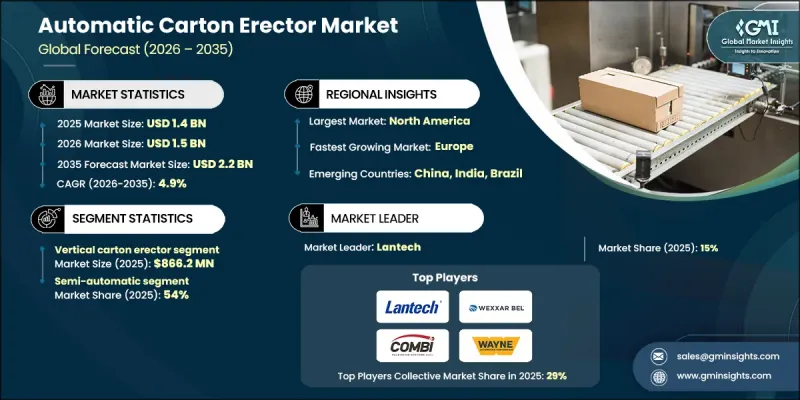
食品飲料、醫藥和電商等行業對更快、更精準、更可靠的包裝解決方案的需求不斷成長,推動了這個市場的發展。各公司正在加速採用自動化瓦楞紙板組裝機,以在維持品質和效率穩定的同時,實現大規模生產。自動化不僅提高了生產效率,也符合永續性目標,因為製造商正在開發能夠處理環保材料並減少廢棄物的機器。現代紙箱組裝機將使用者友善的介面與智慧技術相結合,能夠在大規模生產環境中實現即時監控、自適應運行和無縫連接。雖然大型企業主導了這一趨勢,但緊湊靈活的機型也使中小企業能夠採用自動化,這表明整個行業正在向智慧化和整合的包裝系統轉變,這些系統能夠提高營運效率並滿足不斷變化的客戶期望。
| 市場範圍 | |
|---|---|
| 開始年份 | 2025 |
| 預測年份 | 2026-2035 |
| 起始值 | 14億美元 |
| 預測金額 | 22億美元 |
| 複合年成長率 | 4.9% |
預計到2025年,立式紙盒組裝機市場規模將達到8.662億美元。這類機器能夠柔軟性處理各種尺寸和類型的紙盒,同時還具有維護簡單、停機時間短、整體成本低等優點。由於立式組裝機能夠快速切換不同類型的紙盒,因此特別適用於產品頻繁更換的生產環境。
到2025年,半自動紙箱組裝機將佔據54%的市場。半自動紙箱組裝機因其成本低、用途廣泛而日益普及,彌合了手動和全自動系統之間的差距。它們無需大量初始投資即可提高效率,並且能夠適應各種紙箱尺寸和季節性生產需求。
預計到2025年,美國自動化瓦楞紙板組裝機市場將佔據77%的市場佔有率,市場規模將達到3.517億美元。電子商務產業的強勁需求、先進的製造業基礎以及伺服驅動和機器人送紙系統等技術創新,正在提升生產的柔軟性和速度。在北美,對符合環保法規的節能高效設備的重視,進一步鞏固了該地區在包裝自動化領域的主導地位。
目錄
第1章:調查方法和範圍
第2章執行摘要
第3章業界考察
- 生態系分析
- 供應商情況
- 利潤率
- 每個階段增加的價值
- 影響價值鏈的因素
- 影響產業的因素
- 促進因素
- 整個產業對包裝自動化的需求不斷成長
- 電子商務和物流行業的成長
- 專注於營運效率和成本最佳化
- 產業潛在風險與挑戰
- 較高的初始投資和維護成本
- 與現有生產線整合的複雜性
- 機會
- 推出智慧化的物聯網包裝解決方案。
- 對永續和環保包裝的需求日益成長
- 促進因素
- 成長潛力分析
- 關鍵市場趨勢與顛覆性因素
- 未來市場趨勢
- 風險分析及緩解措施
- 科技與創新趨勢
- 當前技術趨勢
- 新興技術
- 價格趨勢
- 按地區
- 依產品類型
- 監管環境
- 北美洲
- 歐洲
- 亞太地區
- 中東和非洲
- 拉丁美洲
- 波特的分析
- PESTEL 分析
第4章 競爭情勢
- 介紹
- 企業市佔率分析
- 按地區
- 公司矩陣分析
- 主要市場公司的競爭分析
- 競爭定位矩陣
- 主要進展
- 併購
- 夥伴關係與合作
- 新產品發布
- 擴張計劃
第5章 市場估算與預測:依產品類型分類,2022-2035年
- 水平瓦楞紙板組裝機
- 立式紙箱組裝機
第6章 市場估算與預測:依自動化類型分類,2022-2035年
- 半自動
- 全自動
第7章 市場估計與預測:以驅動速度分類,2022-2035年
- 每分鐘少於 10 例
- 每分鐘 11-20 例
- 每分鐘 21-60 例
- 每分鐘超過 60 例
第8章 市場估計與預測:依應用領域分類,2022-2035年
- 食品/飲料
- 製藥
- 個人護理和化妝品
- 電子設備/消費品
- 其他
第9章 市場估價與預測:依通路分類,2022-2035年
- 直銷
- 間接銷售
第10章 市場估價與預測:依地區分類,2022-2035年
- 北美洲
- 美國
- 加拿大
- 歐洲
- 德國
- 英國
- 法國
- 義大利
- 西班牙
- 土耳其
- 亞太地區
- 中國
- 日本
- 印度
- 澳洲
- 韓國
- 拉丁美洲
- 巴西
- 墨西哥
- 阿根廷
- 中東和非洲
- 南非
- 沙烏地阿拉伯
- 阿拉伯聯合大公國
第11章:公司簡介
- ABC Packaging Machine
- Combi Packaging Systems LLC
- Duetti Packaging SRL
- Hamrick Manufacturing and Services
- Jacob White
- Lantech
- Marq Packaging Systems
- Pearson Packaging Systems
- Smurfit Kappa
- Wexxar/BEL Packaging
- Wayne Automation Corporation
- WestRock Company
- EndFlex Packaging
- Econocorp Inc.
- Loveshaw(Little David)
The Global Automatic Carton Erector Market was valued at USD 1.4 billion in 2025 and is estimated to grow at a CAGR of 4.9% to reach USD 2.2 billion by 2035.
The market is driven by the rising demand for faster, more accurate, and reliable packaging solutions across industries such as food & beverage, pharmaceuticals, and e-commerce. Companies are increasingly adopting automated carton erectors to manage high production volumes while maintaining consistent quality and efficiency. Automation not only enhances productivity but also aligns with sustainability goals, as manufacturers develop machines capable of handling eco-friendly materials and reducing waste. Modern carton erectors are equipped with user-friendly interfaces and smart technology integration for real-time monitoring, adaptive operations, and seamless connectivity within larger production environments. While large enterprises dominate adoption, compact and flexible models are now making automation accessible to smaller companies, demonstrating a clear industry shift toward intelligent, integrated packaging systems that improve operational performance and support evolving customer expectations.
| Market Scope | |
|---|---|
| Start Year | 2025 |
| Forecast Year | 2026-2035 |
| Start Value | $1.4 Billion |
| Forecast Value | $2.2 Billion |
| CAGR | 4.9% |
The vertical carton erectors segment reached USD 866.2 million in 2025. These machines provide manufacturers with the flexibility to handle a wide range of carton sizes and types while offering easy maintenance, reduced downtime, and lower overall costs. Rapid changeovers between different carton types make vertical erectors particularly suitable for production environments with frequent product transitions.
The semi-automatic segment accounted for 54% share in 2025. Semi-automatic carton erectors are increasingly popular due to their lower cost and versatility, bridging the gap between manual and fully automated systems. They enable efficiency improvements without requiring high upfront investment and can accommodate varying carton sizes and seasonal production demands.
U.S. Automatic Carton Erector Market held 77% share, generating USD 351.7 million in 2025. Strong demand from the e-commerce sector, an advanced manufacturing base, and technological innovations such as servo-driven and robotic in-feed systems have enhanced production flexibility and speed. North America's focus on energy-efficient, high-performance equipment in compliance with environmental regulations has further reinforced the region's leadership in packaging automation.
Key companies operating in the Global Automatic Carton Erector Market include Lantech, Smurfit Kappa, Combi Packaging Systems LLC, Duetti Packaging SRL, Marq Packaging Systems, Wayne Automation Corporation, WestRock Company, EndFlex Packaging, A-B-C Packaging Machine, Pearson Packaging Systems, Hamrick Manufacturing and Services, Wexxar/BEL Packaging, Jacob White, Econocorp Inc., and Loveshaw (Little David). Companies in the Automatic Carton Erector Market are focusing on technological innovation, strategic partnerships, and global expansion to strengthen their market presence. Key strategies include developing energy-efficient and eco-friendly machines, integrating smart sensors and IoT-enabled monitoring, and offering flexible models suitable for both small and large-scale operations. Firms are investing in R&D for faster, more reliable, and versatile systems, enhancing service networks, and providing customizable solutions tailored to client production lines.
Table of Contents
Chapter 1 Methodology and Scope
- 1.1 Market scope and definition
- 1.2 Research design
- 1.2.1 Research approach
- 1.2.2 Data collection methods
- 1.3 Data mining sources
- 1.3.1 Global
- 1.3.2 Regional/Country
- 1.4 Base estimates and calculations
- 1.4.1 Base year calculation
- 1.4.2 Key trends for market estimation
- 1.5 Primary research and validation
- 1.5.1 Primary sources
- 1.6 Forecast model
- 1.7 Research assumptions and limitations
Chapter 2 Executive Summary
- 2.1 Industry 360° synopsis
- 2.2 Key market trends
- 2.2.1 By regional
- 2.2.2 By product type
- 2.2.3 By automation type
- 2.2.4 By operating speed
- 2.2.5 By application
- 2.2.6 By distribution channel
- 2.3 CXO perspectives: Strategic imperatives
- 2.3.1 Key decision points for industry executives
- 2.3.2 Critical success factors for market players
- 2.4 Future outlook and strategic recommendations
Chapter 3 Industry Insights
- 3.1 Industry ecosystem analysis
- 3.1.1 Supplier landscape
- 3.1.2 Profit margin
- 3.1.3 Value addition at each stage
- 3.1.4 Factor affecting the value chain
- 3.2 Industry impact forces
- 3.2.1 Growth drivers
- 3.2.1.1 Rising demand for packaging automation across industries
- 3.2.1.2 Growth of e-commerce and logistics sector
- 3.2.1.3 Focus on operational efficiency and cost optimization
- 3.2.2 Industry pitfalls & challenges
- 3.2.2.1 High initial investment and maintenance costs
- 3.2.2.2 Complexity in integration with existing production lines
- 3.2.3 Opportunities
- 3.2.3.1 Adoption of smart and IoT-enabled packaging solutions
- 3.2.3.2 Growing demand for sustainable and eco-friendly packaging
- 3.2.1 Growth drivers
- 3.3 Growth potential analysis
- 3.4 Major market trends and Disruptions
- 3.5 Future market trends
- 3.6 Risk and mitigation Analysis
- 3.7 Technology and innovation landscape
- 3.7.1 Current technological trends
- 3.7.2 Emerging technologies
- 3.8 Price trends
- 3.8.1 By region
- 3.8.2 By product type
- 3.9 Regulatory landscape
- 3.9.1 North America
- 3.9.2 Europe
- 3.9.3 Asia-Pacific
- 3.9.4 Middle East and Africa
- 3.9.5 Latin America
- 3.10 Porter’s analysis
- 3.11 PESTEL analysis
Chapter 4 Competitive Landscape, 2025
- 4.1 Introduction
- 4.2 Company market share analysis
- 4.2.1 By region
- 4.2.1.1 North America
- 4.2.1.2 Europe
- 4.2.1.3 Asia Pacific
- 4.2.1.4 Latin America
- 4.2.1.5 Middle East and Africa
- 4.2.1 By region
- 4.3 Company matrix analysis
- 4.4 Competitive analysis of major market players
- 4.5 Competitive positioning matrix
- 4.6 Key developments
- 4.6.1 Mergers & acquisitions
- 4.6.2 Partnerships & collaborations
- 4.6.3 New product launches
- 4.6.4 Expansion plans
Chapter 5 Market Estimates & Forecast, By Product Type, 2022-2035 (USD Billion) (Thousand Units)
- 5.1 Key trends
- 5.2 Horizontal carton erector
- 5.3 Vertical carton erector
Chapter 6 Market Estimates & Forecast, By Automation Type, 2022-2035 (USD Billion) (Thousand Units)
- 6.1 Key trends
- 6.2 Semi-automatic
- 6.3 Fully Automatic
Chapter 7 Market Estimates & Forecast, By Operating Speed, 2022-2035 (USD Billion) (Thousand Units)
- 7.1 Key trends
- 7.2 Up to 10 cases/minute
- 7.3 11 to 20 cases/minute
- 7.4 21 to 60 cases/minute
- 7.5 Over 60 cases/minute
Chapter 8 Market Estimates & Forecast, By Application, 2022-2035 (USD Billion) (Thousand Units)
- 8.1 Key trends
- 8.2 Food and beverage
- 8.3 Pharmaceuticals
- 8.4 Personal care & cosmetics
- 8.5 Electronics & consumer goods
- 8.6 Others
Chapter 9 Market Estimates & Forecast, By Distribution Channel, 2022-2035 (USD Billion) (Thousand Units)
- 9.1 Key trends
- 9.2 Direct sales
- 9.3 Indirect sales
Chapter 10 Market Estimates and Forecast, By Region, 2022 - 2035 (USD Billion) (Thousand Units)
- 10.1 Key trends
- 10.2 North America
- 10.2.1 U.S.
- 10.2.2 Canada
- 10.3 Europe
- 10.3.1 Germany
- 10.3.2 UK
- 10.3.3 France
- 10.3.4 Italy
- 10.3.5 Spain
- 10.3.6 Turkey
- 10.4 Asia Pacific
- 10.4.1 China
- 10.4.2 Japan
- 10.4.3 India
- 10.4.4 Australia
- 10.4.5 South Korea
- 10.5 Latin America
- 10.5.1 Brazil
- 10.5.2 Mexico
- 10.5.3 Argentina
- 10.6 Middle East and Africa
- 10.6.1 South Africa
- 10.6.2 Saudi Arabia
- 10.6.3 UAE
Chapter 11 Company Profiles
- 11.1 A-B-C Packaging Machine
- 11.2 Combi Packaging Systems LLC
- 11.3 Duetti Packaging SRL
- 11.4 Hamrick Manufacturing and Services
- 11.5 Jacob White
- 11.6 Lantech
- 11.7 Marq Packaging Systems
- 11.8 Pearson Packaging Systems
- 11.9 Smurfit Kappa
- 11.10 Wexxar/BEL Packaging
- 11.11 Wayne Automation Corporation
- 11.12 WestRock Company
- 11.13 EndFlex Packaging
- 11.14 Econocorp Inc.
- 11.15 Loveshaw (Little David)

 移動物流機器人市場規模、佔有率和成長分析:按類型、有效載荷能力、電池類型、應用、最終用戶產業、部署模式和地區分類-2026-2033年產業預測
 物流機器人市場機會、成長要素、產業趨勢分析及2026-2035年預測。
 物流機器人市場:機器人類型、功能、負載容量、動力來源、應用及最終用途-2026-2032年全球市場預測
 物流機器人市場報告:按組件、機器人類型、功能、運作領域、最終用戶產業和地區分類(2026-2034 年)
 全球物流機器人市場規模、佔有率、趨勢和成長分析報告(2026-2034年)
 北美自動化紙箱組裝機:市佔率分析、產業趨勢與統計及成長預測(2026-2031 年)托盤轉移模組市場:按類型、應用、終端用戶產業、自動化程度、負載能力和分銷管道分類-全球預測,2026-2032年全球箱體安裝機市場規模、佔有率、趨勢及成長分析報告(2026-2034)全球自動化瓦楞紙板組裝機市場規模、佔有率、趨勢及成長分析報告(2026-2034)
 物流機器人市場:依組件、產業、應用、國家及地區分類-全球產業分析、市場規模、市場佔有率及2025年至2032年預測