

 |
市場調查報告書
商品編碼
1959578
單板電腦市場機會、成長要素、產業趨勢分析及2026年至2035年預測。Single Board Computer Market Opportunity, Growth Drivers, Industry Trend Analysis, and Forecast 2026 - 2035 |
||||||

2025 年全球單板電腦市場價值為 43 億美元,預計到 2035 年將達到 73 億美元,年複合成長率為 5.7%。
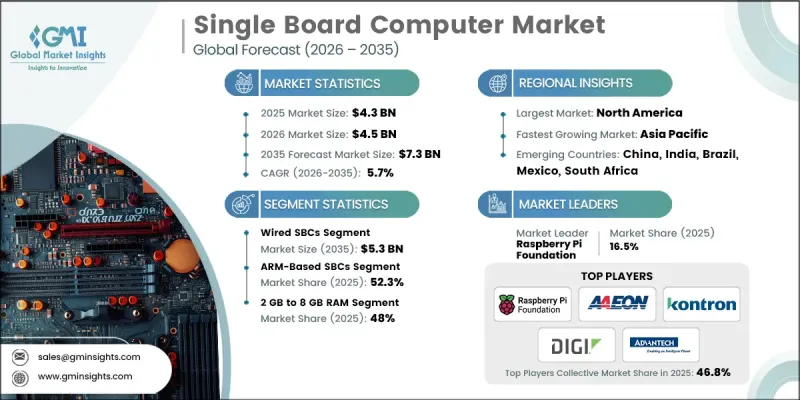
由於物聯網設備在工業領域的應用日益廣泛,市場正經歷快速成長。隨著企業將物聯網融入運營,對緊湊、高效且功能多樣的運算解決方案(例如單板電腦)的需求也在加速成長。教育機構和DIY計劃也在推動這一成長,教育機構利用單板電腦教導學生程式設計、電子學和其他技術技能。單板電腦在培養新一代技術人才的同時,也創造了長期的市場機會。此外,人工智慧、機器視覺和邊緣運算領域的應用也推動了市場需求,因為這些應用需要低延遲、高效能的即時數據處理能力。隨著機器人、自主系統、安防和工業自動化的擴展,單板電腦正成為現代技術基礎設施的關鍵基礎。
| 市場範圍 | |
|---|---|
| 開始年份 | 2025 |
| 預測年份 | 2026-2035 |
| 起始值 | 43億美元 |
| 預測金額 | 73億美元 |
| 複合年成長率 | 5.7% |
預計2035年,有線單板電腦(SBC)市場規模將達53億美元。有線SBC因其高速、穩定的連接性能,以及在關鍵任務應用中確保不間斷資料傳輸的能力,在工業和企業環境中日益受到青睞。這些闆卡在製造自動化、即時監控系統和工業IoT)網路中至關重要,因為即使是輕微的停機也會中斷運作並危及安全。有線SBC在持續使用下的可靠性、抗干擾能力以及與現有有線網路的兼容性,使其成為在複雜系統中需要高精度、低延遲和穩定性能的領域的基礎技術。
預計到2025年,基於ARM架構的單板電腦(SBC)市場佔有率將達到52.3%,其發展勢頭強勁,這得益於其高效的節能架構以及對人工智慧、嵌入式電腦和邊緣運算的良好適應性。這些闆卡因其無風扇設計和緊湊的尺寸而備受青睞,使其能夠在空間受限的環境中部署,同時又不犧牲性能。它們兼具低功耗和高運算效率,支援長時間運作,降低能源成本,是機器人、行動設備和自動化工業設備的理想選擇。
預計到2025年,北美單板電腦(SBC)市佔率將達到36.7%。該地區積極採用工業自動化、物聯網整合和邊緣運算解決方案,推動了對SBC的需求。企業和政府機構正依靠這些緊湊型運算系統進行即時數據採集、製程監控,並與現有工業網路無縫整合。先進的技術基礎設施、強大的供應鏈以及對智慧製造和互聯系統的持續投資,正在鞏固北美在SBC市場的領先地位,並使其成為創新和大規模部署的中心。
目錄
第1章:調查方法和範圍
第2章執行摘要
第3章業界考察
- 生態系分析
- 供應商情況
- 利潤率分析
- 成本結構
- 每個階段增加的價值
- 影響價值鏈的因素
- 中斷
- 影響產業的因素
- 促進因素
- 物聯網和邊緣運算應用的快速普及
- 單板電腦 (SBC) 在教育和 DIY計劃中的廣泛應用
- 在人工智慧和機器視覺系統中的應用日益廣泛
- 增加對國防和航太計畫的投資
- 拓展教育與創客社區
- 產業潛在風險與挑戰
- 供應鏈中斷和零件短缺
- 與替代計算技術的競爭
- 市場機遇
- 自動駕駛汽車和無人機領域的新興應用
- 能源管理和智慧電網領域的機遇
- 促進因素
- 監理情勢
- 北美洲
- 歐洲
- 亞太地區
- 拉丁美洲
- 中東和非洲
- 波特的分析
- PESTEL 分析
- 科技與創新趨勢
- 當前技術趨勢
- 新興技術
- 新興經營模式
- 合規要求
- 專利和智慧財產權分析
- 地緣政治和貿易趨勢
第4章 競爭情勢
- 介紹
- 企業市佔率分析
- 按地區
- 北美洲
- 歐洲
- 亞太地區
- 拉丁美洲
- 中東和非洲
- 按地區
- 主要企業的競爭標竿分析
- 財務績效比較
- 收入
- 利潤率
- 研究與開發
- 產品系列比較
- 產品線的廣度
- 科技
- 創新
- 區域分佈比較
- 全球擴張分析
- 服務網路覆蓋
- 按地區分類的市場滲透率
- 競爭定位矩陣
- 領導企業
- 受讓人
- 追蹤者
- 小眾玩家
- 戰略展望矩陣
- 財務績效比較
- 2022-2025 年重大發展
- 併購
- 合作夥伴關係和合資企業
- 技術進步
- 擴張和投資策略
- 數位轉型計劃
- 新興/Start-Ups競爭對手的發展趨勢
第5章 市場估算與預測:依處理器架構分類,2022-2035年
- 基於ARM的單板電腦(SBC)
- 基於 x86/x64 的單板電腦
- 基於 RISC-V 的單板電腦
- 其他
第6章 市場估算與預測:依記憶體配置分類,2022-2035年
- 2 GB RAM
- 2 GB~8 GB RAM
- 8 GB~16 GB RAM
- 16 GB~32 GB RAM
第7章 市場估算與預測:依連接介面分類,2022-2035年
- 有線SBC
- 工業現場匯流排通訊協定
- 標準乙太網路
- USB/串口
- 其他
- 無線單板電腦
- Wi-Fi
- 細胞
- 其他
第8章 市場估算與預測:依最終用途分類,2022-2035年
- 車
- 車載資訊娛樂和遠端資訊處理
- 進階駕駛輔助系統與自動駕駛系統
- 其他
- 食品/飲料
- 流程自動化和控制
- 品質監控和安全系統
- 其他
- 醫療保健
- 醫療設備及診斷設備
- 遠端醫療和遠距健康監測
- 其他
- 國防、航太和公共
- 能源與公共產業
- 化學和製藥製造
- 通訊與網路
- 其他
第9章 市場估計與預測:依地區分類,2022-2035年
- 北美洲
- 美國
- 加拿大
- 歐洲
- 德國
- 英國
- 法國
- 西班牙
- 義大利
- 荷蘭
- 亞太地區
- 中國
- 印度
- 日本
- 澳洲
- 韓國
- 拉丁美洲
- 巴西
- 墨西哥
- 阿根廷
- 中東和非洲
- 南非
- 沙烏地阿拉伯
- 阿拉伯聯合大公國
第10章:公司簡介
- 主要企業
- Advantech Co., Ltd.
- Kontron AG
- Digi International Inc.
- Texas Instruments Incorporated
- 按地區分類的主要企業
- 北美洲
- Abaco Systems, Inc.
- Radisys Corporation
- IEI Integration Corp.
- 歐洲
- Congatec AG
- Eurotech SpA
- DFI Inc.(Diamond Flower Inc.)
- 亞太地區
- AAEON Technology Inc.
- ADLINK Technology Inc.
- ASUSTeK Computer Inc.
- 北美洲
- 特殊玩家/干擾者
- Raspberry Pi Foundation
- Axiomtek Co., Ltd.
The Global Single Board Computer Market was valued at USD 4.3 billion in 2025 and is estimated to grow at a CAGR of 5.7% to reach USD 7.3 billion by 2035.
The market is witnessing rapid expansion due to the rising adoption of IoT devices across industries. As businesses increasingly integrate IoT into operations, the demand for compact, efficient, and versatile computing solutions such as SBCs is accelerating. Educational and DIY projects are further supporting growth, with institutions using SBCs to train students in programming, electronics, and other tech skills. SBCs are shaping a new generation of tech-savvy individuals while creating long-term market opportunities. Additionally, the use of SBCs in AI, machine vision, and edge computing is fueling demand, as these applications require low-latency, high-performance computing capable of real-time data processing. As robotics, autonomous systems, security, and industrial automation expand, SBCs are becoming a critical backbone of modern technological infrastructure.
| Market Scope | |
|---|---|
| Start Year | 2025 |
| Forecast Year | 2026-2035 |
| Start Value | $4.3 Billion |
| Forecast Value | $7.3 Billion |
| CAGR | 5.7% |
The wired SBC segment is projected to reach USD 5.3 billion by 2035. Wired SBCs are increasingly preferred in industrial and enterprise environments because they deliver high-speed, stable connectivity and ensure uninterrupted data transmission for mission-critical applications. These boards are essential for manufacturing automation, real-time monitoring systems, and industrial IoT networks, where even minimal downtime can disrupt operations or compromise safety. Their reliability under continuous use, resistance to interference, and compatibility with existing wired networks make them a cornerstone for sectors that demand precision, low latency, and consistent performance across complex systems.
The ARM-based SBC segment held a 52.3% share in 2025, gaining traction due to its power-efficient architecture and adaptability for AI, embedded computing, and edge processing. These boards are especially valued for fanless designs and compact footprints, allowing deployment in space-constrained environments without sacrificing performance. Their low power consumption, combined with high computational efficiency, supports long-term operation and reduces energy costs, making them ideal for robotics, mobile devices, and automated industrial equipment.
North America Single Board Computer Market contributed 36.7% share in 2025. The region's strong adoption of industrial automation, IoT integration, and edge computing solutions has propelled SBC demand. Enterprises and government agencies rely on these compact computing systems for real-time data acquisition, process monitoring, and seamless integration with existing industrial networks. Advanced technology infrastructure, robust supply chains, and ongoing investments in smart manufacturing and connected systems have reinforced North America's leadership in the Single Board Computer Market, positioning it as a hub for innovation and large-scale deployment.
Prominent players in the Global Single Board Computer Market include Advantech Co., Ltd., DFI Inc. (Diamond Flower Inc.), AAEON Technology Inc., Abaco Systems, Inc., ADLINK Technology Inc., ASUSTeK Computer Inc., Axiomtek Co., Ltd., Congatec AG, Digi International Inc., IEI Integration Corp., Eurotech S.p.A., Kontron AG, Radisys Corporation, Raspberry Pi Foundation, and Texas Instruments Incorporated. Key strategies adopted by companies in the Single Board Computer Market include expanding product portfolios to cover diverse applications from AI and industrial automation to education and embedded systems. Firms focus on enhancing processing power while maintaining energy efficiency and compact form factors. Companies invest heavily in R&D to develop specialized SBCs for edge computing, robotics, and AI workloads. Strategic partnerships, collaborations, and acquisitions are used to enter new markets and access innovative technologies. Manufacturers also emphasize reliability, high-speed connectivity, and long-term technical support to strengthen customer loyalty.
Table of Contents
Chapter 1 Methodology and Scope
- 1.1 Market scope and definition
- 1.2 Research design
- 1.2.1 Research approach
- 1.2.2 Data collection methods
- 1.3 Data mining sources
- 1.3.1 Global
- 1.3.2 Regional/Country
- 1.4 Base estimates and calculations
- 1.4.1 Base year calculation
- 1.4.2 Key trends for market estimation
- 1.5 Primary research and validation
- 1.5.1 Primary sources
- 1.6 Forecast model
- 1.7 Research assumptions and limitations
Chapter 2 Executive Summary
- 2.1 Industry 360° synopsis, 2022 - 2035
- 2.2 Key market trends
- 2.2.1 Processor architecture trends
- 2.2.2 Memory configuration trends
- 2.2.3 Connectivity interface trends
- 2.2.4 End-use application trends
- 2.2.5 Regional trends
- 2.3 TAM analysis, 2026-2035
- 2.4 CXO perspectives: Strategic imperatives
- 2.4.1 Executive decision points
- 2.4.2 Critical success factors
- 2.5 Future outlook and strategic recommendations
Chapter 3 Industry Insights
- 3.1 Industry ecosystem analysis
- 3.1.1 Supplier landscape
- 3.1.2 Profit margin analysis
- 3.1.3 Cost structure
- 3.1.4 Value addition at each stage
- 3.1.5 Factor affecting the value chain
- 3.1.6 Disruptions
- 3.2 Industry impact forces
- 3.2.1 Growth drivers
- 3.2.1.1 Rapid adoption of IoT and edge computing applications
- 3.2.1.2 Widespread use of SBCs in educational and DIY projects
- 3.2.1.3 Rising utilization in AI and machine vision systems
- 3.2.1.4 Increasing investments in defense and aerospace programs
- 3.2.1.5 Expansion of educational and maker communities
- 3.2.2 Industry pitfalls and challenges
- 3.2.2.1 Supply chain disruptions and component shortages
- 3.2.2.2 Competition from alternative computing technologies
- 3.2.3 Market opportunities
- 3.2.3.1 Emerging applications in autonomous vehicles and drones
- 3.2.3.2 Opportunities in energy management and smart grids
- 3.2.1 Growth drivers
- 3.3 Regulatory landscape
- 3.3.1 North America
- 3.3.2 Europe
- 3.3.3 Asia Pacific
- 3.3.4 Latin America
- 3.3.5 Middle East & Africa
- 3.4 Porter’s analysis
- 3.5 PESTEL analysis
- 3.6 Technology and innovation landscape
- 3.6.1 Current technological trends
- 3.6.2 Emerging technologies
- 3.7 Emerging business models
- 3.8 Compliance requirements
- 3.9 Patent and IP analysis
- 3.10 Geopolitical and trade dynamics
Chapter 4 Competitive Landscape, 2025
- 4.1 Introduction
- 4.2 Company market share analysis
- 4.2.1 By region
- 4.2.1.1 North America
- 4.2.1.2 Europe
- 4.2.1.3 Asia Pacific
- 4.2.1.4 Latin America
- 4.2.1.5 Middle East & Africa
- 4.2.1 By region
- 4.3 Competitive benchmarking of key players
- 4.3.1 Financial performance comparison
- 4.3.1.1 Revenue
- 4.3.1.2 Profit margin
- 4.3.1.3 R&D
- 4.3.2 Product portfolio comparison
- 4.3.2.1 Product range breadth
- 4.3.2.2 Technology
- 4.3.2.3 Innovation
- 4.3.3 Geographic presence comparison
- 4.3.3.1 Global footprint analysis
- 4.3.3.2 Service network coverage
- 4.3.3.3 Market penetration by region
- 4.3.4 Competitive positioning matrix
- 4.3.4.1 Leaders
- 4.3.4.2 Challengers
- 4.3.4.3 Followers
- 4.3.4.4 Niche players
- 4.3.5 Strategic outlook matrix
- 4.3.1 Financial performance comparison
- 4.4 Key developments, 2022-2025
- 4.4.1 Mergers and acquisitions
- 4.4.2 Partnerships and collaborations
- 4.4.3 Technological advancements
- 4.4.4 Expansion and investment strategies
- 4.4.5 Digital transformation initiatives
- 4.5 Emerging/ startup competitors landscape
Chapter 5 Market Estimates and Forecast, By Processor Architecture, 2022 - 2035 ($ Mn)
- 5.1 Key trends
- 5.2 ARM-Based SBCs
- 5.3 x86 / x64-Based SBCs
- 5.4 RISC-V-Based SBCs
- 5.5 Others
Chapter 6 Market Estimates and Forecast, By Memory Configuration, 2022 - 2035 ($ Mn)
- 6.1 Key trends
- 6.2 2 GB RAM
- 6.3 2 GB to 8 GB RAM
- 6.4 8 GB to 16 GB RAM
- 6.5 16 GB to 32 GB RAM
Chapter 7 Market Estimates and Forecast, By Connectivity Interface, 2022 - 2035 ($ Mn)
- 7.1 Key trends
- 7.2 Wired SBCs
- 7.2.1 Industrial fieldbus protocols
- 7.2.2 Standard ethernet
- 7.2.3 Usb / Serial
- 7.2.4 Others
- 7.3 Wireless SBCs
- 7.3.1 Wi-Fi
- 7.3.2 Cellular
- 7.3.3 Others
Chapter 8 Market Estimates and Forecast, By End-use Application, 2022 - 2035 ($ Mn)
- 8.1 Key trends
- 8.2 Automotive
- 8.2.1 In-vehicle infotainment & telematics
- 8.2.2 ADAS & autonomous driving systems
- 8.2.3 Others
- 8.3 Food & beverage
- 8.3.1 Process automation & control
- 8.3.2 Quality monitoring & safety systems
- 8.3.3 Others
- 8.4 Medical & healthcare
- 8.4.1 Medical devices & diagnostics
- 8.4.2 Telemedicine & remote health monitoring
- 8.4.3 Others
- 8.5 Defense, aerospace & public safety
- 8.6 Energy & utilities
- 8.7 Chemical & pharmaceutical manufacturing
- 8.8 Telecommunications & networking
- 8.9 Others
Chapter 9 Market Estimates and Forecast, By Region, 2022 - 2035 ($ Mn)
- 9.1 Key trends
- 9.2 North America
- 9.2.1 U.S.
- 9.2.2 Canada
- 9.3 Europe
- 9.3.1 Germany
- 9.3.2 UK
- 9.3.3 France
- 9.3.4 Spain
- 9.3.5 Italy
- 9.3.6 Netherlands
- 9.4 Asia Pacific
- 9.4.1 China
- 9.4.2 India
- 9.4.3 Japan
- 9.4.4 Australia
- 9.4.5 South Korea
- 9.5 Latin America
- 9.5.1 Brazil
- 9.5.2 Mexico
- 9.5.3 Argentina
- 9.6 Middle East and Africa
- 9.6.1 South Africa
- 9.6.2 Saudi Arabia
- 9.6.3 UAE
Chapter 10 Company Profiles
- 10.1 Global Key Players
- 10.1.1 Advantech Co., Ltd.
- 10.1.2 Kontron AG
- 10.1.3 Digi International Inc.
- 10.1.4 Texas Instruments Incorporated
- 10.2 Regional Key Players
- 10.2.1 North America
- 10.2.1.1 Abaco Systems, Inc.
- 10.2.1.2 Radisys Corporation
- 10.2.1.3 IEI Integration Corp.
- 10.2.2 Europe
- 10.2.2.1 Congatec AG
- 10.2.2.2 Eurotech S.p.A.
- 10.2.2.3 DFI Inc. (Diamond Flower Inc.)
- 10.2.3 APAC
- 10.2.3.1 AAEON Technology Inc.
- 10.2.3.2 ADLINK Technology Inc.
- 10.2.3.3 ASUSTeK Computer Inc.
- 10.2.1 North America
- 10.3 Niche Players / Disruptors
- 10.3.1 Raspberry Pi Foundation
- 10.3.2 Axiomtek Co., Ltd.


