


 |
市場調查報告書
商品編碼
1959573
工業標籤印表機市場機會、成長要素、產業趨勢分析及2026年至2035年預測Industrial Label Printer Market Opportunity, Growth Drivers, Industry Trend Analysis, and Forecast 2026 - 2035 |
||||||

2025 年全球工業標籤印表機市場價值為 238 億美元,預計到 2035 年將達到 388 億美元,年複合成長率為 5.1%。
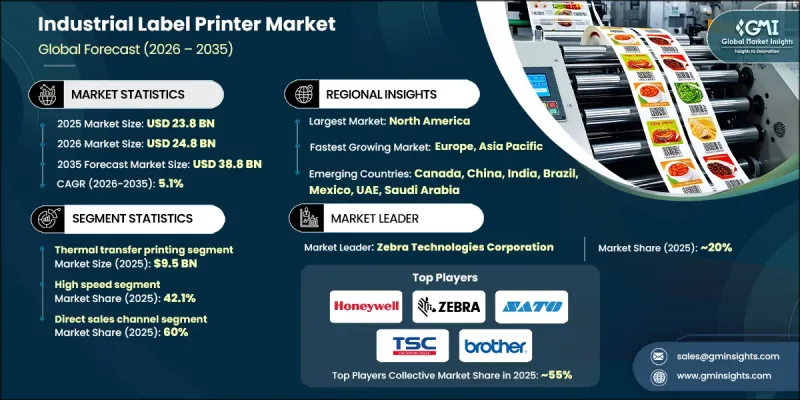
市場成長與整個生產環境中工業自動化和數位化製造方法的加速普及密切相關。隨著製造商擴大營運規模並實現設施現代化,對能夠提供穩定品質、運作可靠性和長期耐用性的標籤系統的需求日益成長。工業標籤印表機正逐漸被視為自動化生產生態系統中不可或缺的基礎設施,有助於提高識別準確性、資產可視性和簡化工作流程管理。向互聯製造環境的轉變進一步增加了對能夠與數據驅動系統和即時監控平台整合的智慧標籤解決方案的需求。隨著產量的增加和品質要求的日益嚴格,製造商不得不投資先進的列印技術,以提高整個工業運營的效率、準確性和可追溯性。
| 市場範圍 | |
|---|---|
| 開始年份 | 2025 |
| 預測年份 | 2026-2035 |
| 起始值 | 238億美元 |
| 預測金額 | 388億美元 |
| 複合年成長率 | 5.1% |
熱轉印列印市場預計在2025年達到95億美元,並在2026年至2035年間以5%的複合年成長率成長。這種列印方法之所以被廣泛採用,是因為它能夠製作高清標籤,即使在惡劣的環境條件下也能保持效能。其耐用性滿足長期識別和合規性要求,持續推動受監管行業和高性能工業應用的需求。
預計到2025年,高速工業標籤印表機市場佔有率將達到42.1%,並在2035年之前以5.7%的複合年成長率成長。對更快生產速度和更短交貨週期的需求推動了高功率印表機的普及,這類印表機能夠在保持精度的同時最大限度地減少停機時間。物流密集型業務訂單量的成長進一步鞏固了該細分市場的主導地位。
美國工業標籤印表機市場預計到 2025 年將達到 76 億美元,並從 2026 年到 2035 年以 4.9% 的複合年成長率成長。這一市場擴張的驅動力是先進的製造能力、強大的物流基礎設施以及越來越多依賴工業級標籤解決方案的整合自動化系統。
目錄
第1章:調查方法和範圍
第2章執行摘要
第3章業界考察
- 生態系分析
- 供應商情況
- 利潤率
- 每個階段增加的價值
- 影響價值鏈的因素
- 影響產業的因素
- 促進因素
- 製造業和工業自動化的擴張
- 物流、倉儲業和電子商務的快速成長
- 人們越來越關注產品可追溯性和序列化
- 產業潛在風險與挑戰
- 對消耗品和價格波動的依賴
- 激烈的競爭和利潤率壓力
- 促進因素
- 成長潛力分析
- 未來市場趨勢
- 科技與創新趨勢
- 當前技術趨勢
- 新興技術
- 價格趨勢
- 按地區
- 透過印刷技術
- 監理情勢
- 標準和合規要求
- 區域法規結構
- 認證標準
- 貿易統計
- 主要進口國
- 主要出口國
- 波特的分析
- PESTEL 分析
第4章 競爭情勢
- 介紹
- 企業市佔率分析
- 按地區
- 北美洲
- 歐洲
- 亞太地區
- 拉丁美洲
- 中東和非洲
- 按地區
- 公司矩陣分析
- 主要市場公司的競爭分析
- 競爭定位矩陣
- 主要進展
- 併購
- 夥伴關係與合作
- 新產品發布
- 擴張計劃
第5章 市場估價與預測:依印刷技術分類,2022-2035年
- 熱轉印
- 直接熱感列印
- 雷射列印
- 噴墨列印
- 特殊印刷技術
第6章 市場估算與預測:依自動化程度分類,2022-2035年
- 手動的
- 半自動
- 全自動
第7章 市場估計與預測:依速度分類,2022-2035年
- 慢速
- 高速
- 中速
第8章 市場估算與預測:以連結方式分類,2022-2035年
- 有線連接
- USB
- 乙太網路
- 序號
- 無線的
- Wi-Fi
- Bluetooth
- NFC
第9章 市場估計與預測:依最終用途分類,2022-2035年
- 消費品/家居用品
- 醫療和製藥領域
- 化學品和危險材料
- 食品/飲料
- 對於汽車和航太行業
- 電子設備
- 紡織服裝
- 其他
第10章 市場估價與預測:依通路分類,2022-2035年
- 直銷
- 間接銷售
第11章 市場估價與預測:按地區分類,2022-2035年
- 北美洲
- 美國
- 加拿大
- 歐洲
- 德國
- 英國
- 法國
- 義大利
- 西班牙
- 亞太地區
- 中國
- 印度
- 日本
- 韓國
- 澳洲
- 印尼
- 馬來西亞
- 拉丁美洲
- 巴西
- 墨西哥
- 阿根廷
- 中東和非洲
- 沙烏地阿拉伯
- 阿拉伯聯合大公國
- 南非
第12章:公司簡介
- Avery Dennison Corporation
- Brady Corporation
- Brother Industries, Ltd.
- Datalogic SpA
- Godex International Co., Ltd.
- Honeywell International Inc.
- Oki Electric Industry Co., Ltd.
- Primera Technology, Inc.
- Printronix, LLC
- SATO Holdings Corporation
- Seiko Epson Corporation
- Toshiba Tec Corporation
- TSC Auto ID Technology Co., Ltd.
- Wasp Barcode Technologies
- Zebra Technologies Corporation
The Global Industrial Label Printer Market was valued at USD 23.8 billion in 2025 and is estimated to grow at a CAGR of 5.1% to reach USD 38.8 billion by 2035.
Market growth is linked to the accelerating adoption of industrial automation and digital manufacturing practices across production environments. As manufacturers scale operations and modernize facilities, demand is rising for labeling systems that deliver consistent quality, operational reliability, and long-term durability. Industrial label printers are increasingly viewed as essential infrastructure within automated production ecosystems, supporting identification accuracy, asset visibility, and streamlined workflow management. The shift toward connected manufacturing environments has further increased the need for intelligent labeling solutions that integrate with data-driven systems and real-time monitoring platforms. Growing production volumes and stricter quality expectations are pushing manufacturers to invest in advanced printing technologies that enhance efficiency, precision, and traceability across industrial operations.
| Market Scope | |
|---|---|
| Start Year | 2025 |
| Forecast Year | 2026-2035 |
| Start Value | $23.8 Billion |
| Forecast Value | $38.8 Billion |
| CAGR | 5.1% |
The thermal transfer printing segment generated USD 9.5 billion in 2025 and is expected to grow at a CAGR of 5% from 2026 to 2035. This printing method is widely adopted due to its ability to produce high-clarity labels that maintain performance under demanding environmental conditions. Its durability supports long-term identification and compliance requirements, which continue to drive demand across regulated and high-performance industrial applications.
The high-speed industrial label printers segment accounted for 42.1% share in 2025 and is forecast to grow at a CAGR of 5.7% through 2035. Increasing production speeds and shorter fulfillment cycles are encouraging the adoption of high-output printers capable of maintaining accuracy while minimizing downtime. Rising order volumes across logistics-intensive operations further reinforce this segment's leadership.
U.S. Industrial Label Printer Market reached USD 7.6 billion in 2025 and is projected to grow at a CAGR of 4.9% from 2026 to 2035. Market expansion is supported by advanced manufacturing capabilities, strong logistics infrastructure, and increasing use of integrated automation systems that rely on industrial-grade labeling solutions.
Key companies operating in the Global Industrial Label Printer Market include Zebra Technologies Corporation, Honeywell International Inc., SATO Holdings Corporation, Avery Dennison Corporation, Brady Corporation, Toshiba Tec Corporation, Seiko Epson Corporation, Brother Industries, Ltd., Printronix, LLC, TSC Auto ID Technology Co., Ltd., Datalogic S.p.A., Oki Electric Industry Co., Ltd., Godex International Co., Ltd., Wasp Barcode Technologies, and Primera Technology, Inc. Companies in the industrial label printer market are strengthening their market positions through continuous technology enhancement and portfolio diversification. Many players are focusing on high-speed, high-resolution printing capabilities that support automated and data-driven production environments. Integration with enterprise software platforms and smart factory systems is a key strategic priority. Manufacturers are also investing in ruggedized designs and energy-efficient technologies to improve lifecycle value. Strategic partnerships with logistics providers and industrial solution integrators are expanding market reach.
Table of Contents
Chapter 1 Methodology & Scope
- 1.1 Market scope and definition
- 1.2 Research design
- 1.2.1 Research approach
- 1.2.2 Data collection methods
- 1.3 Data mining sources
- 1.3.1 Global
- 1.3.2 Regional/Country
- 1.4 Base estimates and calculations
- 1.4.1 Base year calculation
- 1.4.2 Key trends for market estimation
- 1.5 Primary research and validation
- 1.5.1 Primary sources
- 1.6 Forecast model
- 1.7 Research assumptions and limitations
Chapter 2 Executive Summary
- 2.1 Industry 360° synopsis
- 2.2 Key market trends
- 2.2.1 Regional
- 2.2.2 Print technology
- 2.2.3 Automation level
- 2.2.4 Speed
- 2.2.5 Connectivity
- 2.2.6 End use
- 2.2.7 Distribution channel
- 2.3 CXO perspectives: Strategic imperatives
- 2.3.1 Key decision points for industry executives
- 2.3.2 Critical success factors for market players
- 2.4 Future outlook and strategic recommendations
Chapter 3 Industry Insights
- 3.1 Industry ecosystem analysis
- 3.1.1 Supplier landscape
- 3.1.2 Profit margin
- 3.1.3 Value addition at each stage
- 3.1.4 Factor affecting the value chain
- 3.2 Industry impact forces
- 3.2.1 Growth drivers
- 3.2.1.1 Expansion of manufacturing and industrial automation
- 3.2.1.2 Rapid growth in logistics, warehousing, and e-commerce
- 3.2.1.3 Increasing focus on product traceability and serialization
- 3.2.2 Industry pitfalls & challenges
- 3.2.2.1 Dependence on consumables and price volatility
- 3.2.2.2 Intense price competition and margin pressure
- 3.2.1 Growth drivers
- 3.3 Growth potential analysis
- 3.4 Future market trends
- 3.5 Technology and innovation landscape
- 3.5.1 Current technological trends
- 3.5.2 Emerging technologies
- 3.6 Price trends
- 3.6.1 By region
- 3.6.2 By print technology
- 3.7 Regulatory landscape
- 3.7.1 Standards and compliance requirements
- 3.7.2 Regional regulatory frameworks
- 3.7.3 Certification standards
- 3.8 Trade statistics
- 3.8.1 Major importing countries
- 3.8.2 Major exporting countries
- 3.9 Porter’s analysis
- 3.10 PESTEL analysis
Chapter 4 Competitive Landscape, 2025
- 4.1 Introduction
- 4.2 Company market share analysis
- 4.2.1 By Region
- 4.2.1.1 North America
- 4.2.1.2 Europe
- 4.2.1.3 Asia Pacific
- 4.2.1.4 Latin America
- 4.2.1.5 Middle East & Africa
- 4.2.1 By Region
- 4.3 Company matrix analysis
- 4.4 Competitive analysis of major market players
- 4.5 Competitive positioning matrix
- 4.6 Key developments
- 4.6.1 Mergers & acquisitions
- 4.6.2 Partnerships & collaborations
- 4.6.3 New product launches
- 4.6.4 Expansion plans
Chapter 5 Market Estimates & Forecast, By Print Technology, 2022 - 2035, (USD Billion) (Million Units)
- 5.1 Key trends
- 5.2 Thermal transfer printing
- 5.3 Direct thermal printing
- 5.4 Laser printing
- 5.5 Inkjet printing
- 5.6 Specialty printing technologies
Chapter 6 Market Estimates & Forecast, By Automation Level, 2022 - 2035, (USD Billion) (Million Units)
- 6.1 Key trends
- 6.2 Manual
- 6.3 Semi-automated
- 6.4 Fully automated
Chapter 7 Market Estimates & Forecast, By Speed, 2022 - 2035, (USD Billion) (Million Units)
- 7.1 Key trends
- 7.2 Low speed
- 7.3 High speed
- 7.4 Mid speed
Chapter 8 Market Estimates & Forecast, By Connectivity, 2022 - 2035, (USD Billion) (Million Units)
- 8.1 Key trends
- 8.2 Wired
- 8.2.1 USB
- 8.2.2 Ethernet
- 8.2.3 Serial
- 8.3 Wireless
- 8.3.1 Wi-Fi
- 8.3.2 Bluetooth
- 8.3.3 NFC
Chapter 9 Market Estimates & Forecast, By End Use, 2022 - 2035, (USD Billion) (Million Units)
- 9.1 Key trends
- 9.2 Consumer good & home care
- 9.3 Healthcare and pharmaceuticals
- 9.4 Chemical and hazardous materials
- 9.5 Food and beverage
- 9.6 Automotive and aerospace
- 9.7 Electronics
- 9.8 Textile and apparel
- 9.9 Others
Chapter 10 Market Estimates & Forecast, By Distribution Channel, 2022 - 2035, (USD Billion) (Million Units)
- 10.1 Key trends
- 10.2 Direct sales
- 10.3 Indirect sales
Chapter 11 Market Estimates & Forecast, By Region, 2022 - 2035, (USD Billion) (Million Units)
- 11.1 Key trends
- 11.2 North America
- 11.2.1 U.S.
- 11.2.2 Canada
- 11.3 Europe
- 11.3.1 Germany
- 11.3.2 UK
- 11.3.3 France
- 11.3.4 Italy
- 11.3.5 Spain
- 11.4 Asia Pacific
- 11.4.1 China
- 11.4.2 India
- 11.4.3 Japan
- 11.4.4 South Korea
- 11.4.5 Australia
- 11.4.6 Indonesia
- 11.4.7 Malaysia
- 11.5 Latin America
- 11.5.1 Brazil
- 11.5.2 Mexico
- 11.5.3 Argentina
- 11.6 MEA
- 11.6.1 Saudi Arabia
- 11.6.2 UAE
- 11.6.3 South Africa
Chapter 12 Company Profiles
- 12.1 Avery Dennison Corporation
- 12.2 Brady Corporation
- 12.3 Brother Industries, Ltd.
- 12.4 Datalogic S.p.A.
- 12.5 Godex International Co., Ltd.
- 12.6 Honeywell International Inc.
- 12.7 Oki Electric Industry Co., Ltd.
- 12.8 Primera Technology, Inc.
- 12.9 Printronix, LLC
- 12.10 SATO Holdings Corporation
- 12.11 Seiko Epson Corporation
- 12.12 Toshiba Tec Corporation
- 12.13 TSC Auto ID Technology Co., Ltd.
- 12.14 Wasp Barcode Technologies
- 12.15 Zebra Technologies Corporation

 2026年全球手持標籤印表機市場報告
 標籤印刷市場:全球市場預測(2026-2032 年)護理標籤印表機市場:按印表機類型、技術類型、應用程式和最終用戶分類 - 全球預測,2026-2032 年雙色標籤印表機市場(按最終用戶產業、應用、產品類型、列印技術、連接方式和銷售管道),全球預測,2026-2032年
 全球工業標籤印表機市場規模、佔有率、趨勢和成長分析報告(2026-2034年)2026年全球標籤印刷市場報告2026年全球彩色標籤印刷市場報告專業彩色標籤印表機市場(按技術、墨水類型、媒體類型、最終用戶產業、分銷管道和最終用戶分類),全球預測,2026-2032年
 全球工業標籤印表機市場標籤彩色印刷市場規模(按類型、應用、區域範圍、預測)