


 |
市場調查報告書
商品編碼
1959571
USB車用充電器市場機會、成長要素、產業趨勢分析及2026年至2035年預測USB Car Charger Market Opportunity, Growth Drivers, Industry Trend Analysis, and Forecast 2026 - 2035 |
||||||

2025年全球USB車用充電器市場價值為12.1億美元,預計到2035年將以2.5%的複合年成長率成長,達到15.4億美元。
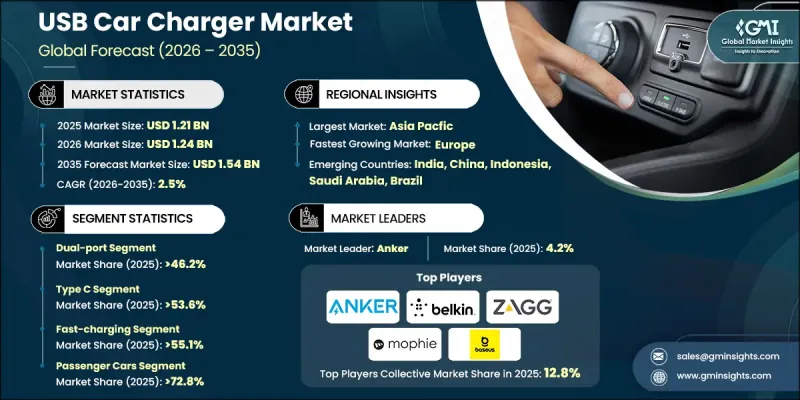
市場前景受車載充電標準的快速發展和對互聯出行日益成長的依賴所影響。 USB-C 技術憑藉其高功率容量、更高的效率以及與現代電子生態系統的廣泛相容性,正逐漸成為主流介面。消費者對更快充電速度、多種輸出選項以及與車輛無縫整合的期望不斷提高,推動了市場需求。此外,電動車的普及、共用交通模式的興起以及聯網汽車系統的廣泛應用也對市場產生了影響。商務傳輸活動持續推動市場擴張,因為車輛需要可靠且高效的充電解決方案來支援持續運作。消費者越來越重視性能導向的充電解決方案,加速了先進快速充電技術的普及。這些因素共同推動了市場的穩定成長,並促使製造商開發符合汽車和出行發展趨勢的產品。
| 市場範圍 | |
|---|---|
| 開始年份 | 2025 |
| 預測年份 | 2026-2035 |
| 起始值 | 12.1億美元 |
| 預測金額 | 15.4億美元 |
| 複合年成長率 | 2.5% |
預計到2025年,雙埠充電器市佔率將達到46.2%,到2035年市場規模將達到7,178億美元。該細分市場之所以備受關注,是因為它能夠支援單輛車內同時進行多路充電。隨著車載互聯需求的不斷成長,人們對便利高效電力分配的需求日益增加,雙埠充電器的吸引力也隨之提升。
預計到2025年,Type-C介面的市佔率將達到53.6%,到2035年市場規模將達到6.494億美元。由於其標準化、增強的功率輸出以及與現代車輛充電架構的兼容性,Type-C介面被認為是成長最快的介面類型。預計在整個預測期內,Type-C介面仍將保持領先地位。
美國USB車載充電器市場預計到2025年將達到3.085億美元,並有望在2035年之前保持強勁成長。這一市場擴張的驅動力在於人們對出行時持續供電的需求不斷成長,以及充電系統與汽車平臺的應用。
目錄
第1章:調查方法
第2章執行摘要
第3章業界考察
- 生態系分析
- 供應商情況
- 利潤率分析
- 成本結構
- 每個階段增加的價值
- 影響價值鏈的因素
- 中斷
- 影響產業的因素
- 促進因素
- 智慧型手機和行動裝置使用量的增加
- 對車載導航系統的依賴性日益增強
- 高速無線充電技術的進步
- 攜帶式和多設備充電器的需求日益成長
- 產業潛在風險與挑戰
- 來自低成本本地製造商的競爭加劇。
- 新車向整合充電系統過渡
- 市場機遇
- 新興經濟體汽車擁有率不斷上升
- 商用車輛和車隊車輛的擴張
- 採用 USB Type-C 連接埠和高功率充電
- 無線和整合充電解決方案的成長
- 促進因素
- 成長潛力分析
- 監理情勢
- 北美洲
- 美國:NHTSA、FCC 和 UL 安全法規
- 加拿大:運輸部和CSA電氣安全標準
- 歐洲
- 英國:UKCA 標誌和電氣安全法規
- 德國:TUV認證和DIN電氣標準
- 法國:符合CE標誌和歐盟EMC指令
- 義大利:ISO 9001品管標準與歐盟電氣安全標準
- 亞太地區
- 中國:CCC認證和GB電氣標準
- 日本:PSE認證與《電器材料安全法》
- 印度:BIS認證和汽車配件標準
- 拉丁美洲
- 巴西:INMETRO認證和電氣合規標準
- 墨西哥:NOM電氣安全標準
- 阿根廷:IRAM 和 ISO 品質標準
- 中東和非洲
- 阿拉伯聯合大公國:ESMA 和 IEC 電氣標準
- 南非:NRCS電氣安全和EMC標準
- 其他中東和非洲國家:基於IEC的電氣安全框架
- 北美洲
- 波特的分析
- PESTEL 分析
- 科技與創新趨勢
- 當前技術趨勢
- 新興技術
- 成本細分分析
- 專利分析
- 永續性和環境方面
- 永續計劃
- 減少廢棄物策略
- 生產中的能源效率
- 具有環保意識的舉措
- 未來市場展望及機遇
- 用例
- 經濟影響和投資收益(ROI) 評估
- 資料管治、隱私與網路安全框架
第4章 競爭情勢
- 介紹
- 企業市佔率分析
- 北美洲
- 歐洲
- 亞太地區
- 拉丁美洲
- 中東和非洲
- 主要市場公司的競爭分析
- 競爭定位矩陣
- 戰略展望矩陣
- 主要進展
- 併購
- 夥伴關係與合作
- 新產品發布
- 業務拓展計劃及資金籌措
第5章 市場估計與預測:依港口分類,2022-2035年
- 單埠
- 雙埠
- 多埠
第6章 市場估算與預測:依連接器類型分類,2022-2035年
- USB 2.0
- USB 3.0
- Type C
第7章 市場估計與預測:依技術分類,2022-2035年
- 標準充電
- 快速充電
- 無線充電
第8章 市場估算與預測:依銷售管道分類,2022-2035年
- OEM
- 售後市場
第9章 市場估價與預測:依車輛類型分類,2022-2035年
- 搭乘用車
- 商用車輛
第10章 市場估價與預測:依地區分類,2022-2035年
- 北美洲
- 美國
- 加拿大
- 歐洲
- 德國
- 英國
- 法國
- 義大利
- 西班牙
- 俄羅斯
- 北歐國家
- 葡萄牙
- 克羅埃西亞
- 比荷盧經濟聯盟
- 亞太地區
- 中國
- 印度
- 日本
- 澳洲
- 韓國
- 新加坡
- 泰國
- 印尼
- 越南
- 拉丁美洲
- 巴西
- 墨西哥
- 阿根廷
- 哥倫比亞
- 中東和非洲
- 南非
- 沙烏地阿拉伯
- 阿拉伯聯合大公國
- 土耳其
第11章:公司簡介
- 世界玩家
- Anker
- Belkin
- RAVPower
- Aukey
- Baseus
- ZAGG
- UGREEN
- Scosche Industries
- Samsung Electronics
- Xiaomi Corporation
- 本地球員
- Nitecore
- iOttie
- Tronsmart
- Energizer Holdings
- Vinsic
- Ravelli
- Philips Automotive
- Beltronics
- Choetech
- Joyroom
- Emerging/Disruptor Players
- Baseus Technology
- ORICO
- BlitzWolf
- Remax
- UGree
The Global USB Car Charger Market was valued at USD 1.21 billion in 2025 and is estimated to grow at a CAGR of 2.5% to reach USD 1.54 billion by 2035.
The market outlook is shaped by the rapid evolution of in-vehicle charging standards and the growing dependence on connected mobility. USB-C technology is increasingly positioned as the dominant interface due to its higher power capacity, improved efficiency, and broad compatibility across modern electronic ecosystems. Demand is being supported by rising expectations for faster charging speeds, multiple output options, and seamless integration within vehicle interiors. The market is further influenced by the expansion of electric mobility, the growing presence of shared transportation models, and the increasing use of connected vehicle systems. Commercial transportation activity continues to contribute to market expansion as vehicles require reliable and efficient charging solutions to support continuous operation. Consumers are placing greater emphasis on performance-driven charging solutions, which is accelerating the adoption of advanced fast-charging technologies. These combined factors are reinforcing steady market growth and encouraging manufacturers to align product development with evolving automotive and mobility trends.
| Market Scope | |
|---|---|
| Start Year | 2025 |
| Forecast Year | 2026-2035 |
| Start Value | $1.21 Billion |
| Forecast Value | $1.54 Billion |
| CAGR | 2.5% |
The dual-port segment accounted for 46.2% share in 2025 and is projected to reach USD 717.8 billion by 2035. This segment is gaining traction due to its ability to support concurrent charging needs within a single vehicle environment. Increased demand for convenience and efficient power distribution continues to strengthen the appeal of dual-port configurations, particularly as in-vehicle connectivity requirements increase.
The Type-C segment held 53.6% share in 2025 and is expected to reach USD 649.4 million by 2035. This connector format is recognized as the fastest-growing segment, driven by its standardization, enhanced power delivery, and compatibility with modern vehicle charging architectures. Type-C is expected to remain the leading connector category throughout the forecast period.
United States USB Car Charger Market reached USD 308.5 million in 2025 and is anticipated to record strong growth through 2035. Market expansion is supported by rising demand for continuous power access during travel and increased integration of charging systems within vehicle platforms. Automotive design priorities centered on convenience, connectivity, and standardized interior features are further supporting adoption across both private and commercial vehicles.
Key companies operating in the Global USB Car Charger Market include Belkin, Anker, Baseus, Ugreen, Scosche Industries, Aukey, ZAGG, RAVPower, and Mophie. Companies active in the USB Car Charger Market are strengthening their competitive positions through continuous product innovation and technology upgrades. Many players are focusing on fast-charging compatibility, compact form factors, and enhanced safety features to meet evolving consumer expectations. Strategic partnerships with automotive accessory distributors and e-commerce platforms are being used to expand market reach. Brands are also investing in design differentiation and quality certifications to build trust and visibility. Geographic expansion into high-growth mobility markets remains a priority, while efficient supply chain management and cost optimization help maintain competitive pricing.
Table of Contents
Chapter 1 Methodology
- 1.1 Research approach
- 1.2 Quality commitments
- 1.2.1 GMI AI policy & data integrity commitment
- 1.3 Research trail & confidence scoring
- 1.3.1 Research trail components
- 1.3.2 Scoring components
- 1.4 Data collection
- 1.4.1 Partial list of primary sources
- 1.5 Data mining sources
- 1.5.1 Paid sources
- 1.6 Base estimates and calculations
- 1.6.1 Base year calculation
- 1.7 Forecast
- 1.8 Research transparency addendum
Chapter 2 Executive Summary
- 2.1 Industry 360° synopsis, 2022 - 2035
- 2.2 Key market trends
- 2.2.1 Regional
- 2.2.2 Port
- 2.2.3 Connector
- 2.2.4 Technology
- 2.2.5 Sales Channel
- 2.2.6 Vehicle
- 2.3 TAM Analysis, 2026-2035
- 2.4 CXO perspectives: Strategic imperatives
- 2.4.1 Executive decision points
- 2.4.2 Critical success factors
- 2.5 Future outlook & strategic recommendations
Chapter 3 Industry Insights
- 3.1 Industry ecosystem analysis
- 3.1.1 Supplier landscape
- 3.1.2 Profit margin analysis
- 3.1.3 Cost structure
- 3.1.4 Value addition at each stage
- 3.1.5 Factor affecting the value chain
- 3.1.6 Disruptions
- 3.2 Industry impact forces
- 3.2.1 Growth drivers
- 3.2.1.1 Proliferation of smartphones and mobile device usage
- 3.2.1.2 Increased reliance on in-car navigation systems
- 3.2.1.3 Advancements in fast and wireless charging technology
- 3.2.1.4 Rising demand for portable and multi-device chargers
- 3.2.2 Industry pitfalls & challenges
- 3.2.2.1 Rising competition from low-cost local manufacturers
- 3.2.2.2 Shift to integrated charging in newer vehicles
- 3.2.3 Market opportunities
- 3.2.3.1 Rising Vehicle Penetration in Emerging Economies
- 3.2.3.2 Expansion of Commercial and Fleet Vehicles
- 3.2.3.3 Adoption of USB Type-C and High-Power Charging
- 3.2.3.4 Growth of Wireless and Integrated Charging Solutions
- 3.2.1 Growth drivers
- 3.3 Growth potential analysis
- 3.4 Regulatory landscape
- 3.4.1 North America
- 3.4.1.1 United States: NHTSA, FCC, and UL Safety Regulations
- 3.4.1.2 Canada: Transport Canada and CSA Electrical Safety Standards
- 3.4.2 Europe
- 3.4.2.1 United Kingdom: UKCA Marking and Electrical Safety Regulations
- 3.4.2.2 Germany: TUV Certification and DIN Electrical Standards
- 3.4.2.3 France: CE Marking and EU EMC Directive Compliance
- 3.4.2.4 Italy: ISO 9001 Quality and EU Electrical Safety Standards
- 3.4.3 Asia Pacific
- 3.4.3.1 China: CCC Certification and GB Electrical Standards
- 3.4.3.2 Japan: PSE Certification and Electrical Appliance Safety Law
- 3.4.3.3 India: BIS Certification and Automotive Accessory Standards
- 3.4.4 Latin America
- 3.4.4.1 Brazil: INMETRO Certification and Electrical Compliance Standards
- 3.4.4.2 Mexico: NOM Electrical Safety Standards
- 3.4.4.3 Argentina: IRAM and ISO Quality Standards
- 3.4.5 Middle East & Africa
- 3.4.5.1 United Arab Emirates: ESMA and IEC Electrical Standards
- 3.4.5.2 South Africa: NRCS Electrical Safety and EMC Standards
- 3.4.5.3 Other MEA Countries: IEC-Based Electrical Safety Frameworks
- 3.4.1 North America
- 3.5 Porter’s analysis
- 3.6 PESTEL analysis
- 3.7 Technology and innovation landscape
- 3.7.1 Current technological trends
- 3.7.2 Emerging technologies
- 3.8 Cost breakdown analysis
- 3.9 Patent analysis
- 3.10 Sustainability and environmental aspects
- 3.10.1 Sustainable practices
- 3.10.2 Waste reduction strategies
- 3.10.3 Energy efficiency in production
- 3.10.4 Eco-friendly Initiatives
- 3.11 Future market outlook & opportunities
- 3.12 Use cases
- 3.13 Economic impact & ROI assessment
- 3.14 Data governance, privacy & cybersecurity frameworks
Chapter 4 Competitive Landscape, 2025
- 4.1 Introduction
- 4.2 Company market share analysis
- 4.2.1 North America
- 4.2.2 Europe
- 4.2.3 Asia Pacific
- 4.2.4 LATAM
- 4.2.5 MEA
- 4.3 Competitive analysis of major market players
- 4.4 Competitive positioning matrix
- 4.5 Strategic outlook matrix
- 4.6 Key developments
- 4.6.1 Mergers & acquisitions
- 4.6.2 Partnerships & collaborations
- 4.6.3 New Product Launches
- 4.6.4 Expansion Plans and funding
Chapter 5 Market Estimates & Forecast By Port, 2022 - 2035 ($Bn, Units)
- 5.1 Key trends
- 5.2 Single-port
- 5.3 Dual-port
- 5.4 Multi-port
Chapter 6 Market Estimates & Forecast, By Connector, 2022 - 2035 ($Bn, Units)
- 6.1 Key trends
- 6.2 USB 2.0
- 6.3 USB 3.0
- 6.4 Type C
Chapter 7 Market Estimates & Forecast, By Technology, 2022 - 2035 ($Bn, Units)
- 7.1 Key trends
- 7.2 Standard charging
- 7.3 Fast charging
- 7.4 Wireless charging
Chapter 8 Market Estimates & Forecast, By Sales Channel, 2022 - 2035 ($Bn, Units)
- 8.1 Key trends
- 8.2 OEM
- 8.3 Aftermarket
Chapter 9 Market Estimates & Forecast, By Vehicle, 2022 - 2035 ($Bn, Units)
- 9.1 Key trends
- 9.2 Passenger cars
- 9.3 Commercial vehicles
Chapter 10 Market Estimates & Forecast, By Region, 2022 - 2035 ($Bn, Units)
- 10.1 Key trends
- 10.2 North America
- 10.2.1 US
- 10.2.2 Canada
- 10.3 Europe
- 10.3.1 Germany
- 10.3.2 UK
- 10.3.3 France
- 10.3.4 Italy
- 10.3.5 Spain
- 10.3.6 Russia
- 10.3.7 Nordics
- 10.3.8 Portugal
- 10.3.9 Croatia
- 10.3.10 Benelux
- 10.4 Asia Pacific
- 10.4.1 China
- 10.4.2 India
- 10.4.3 Japan
- 10.4.4 Australia
- 10.4.5 South Korea
- 10.4.6 Singapore
- 10.4.7 Thailand
- 10.4.8 Indonesia
- 10.4.9 Vietnam
- 10.5 Latin America
- 10.5.1 Brazil
- 10.5.2 Mexico
- 10.5.3 Argentina
- 10.5.4 Colombia
- 10.6 MEA
- 10.6.1 South Africa
- 10.6.2 Saudi Arabia
- 10.6.3 UAE
- 10.6.4 Turkey
Chapter 11 Company Profiles
- 11.1 Global Players
- 11.1.1 Anker
- 11.1.2 Belkin
- 11.1.3 RAVPower
- 11.1.4 Aukey
- 11.1.5 Baseus
- 11.1.6 ZAGG
- 11.1.7 UGREEN
- 11.1.8 Scosche Industries
- 11.1.9 Samsung Electronics
- 11.1.10 Xiaomi Corporation
- 11.2 Regional Players
- 11.2.1 Nitecore
- 11.2.2 iOttie
- 11.2.3 Tronsmart
- 11.2.4 Energizer Holdings
- 11.2.5 Vinsic
- 11.2.6 Ravelli
- 11.2.7 Philips Automotive
- 11.2.8 Beltronics
- 11.2.9 Choetech
- 11.2.10 Joyroom
- 11.3 Emerging / Disruptor Players
- 11.3.1 Baseus Technology
- 11.3.2 ORICO
- 11.3.3 BlitzWolf
- 11.3.4 Remax
- 11.3.5 UGree

 汽車USB供電系統全球市場規模、佔有率、趨勢和成長分析報告(2026-2034年)
 汽車USB供電系統市場機會、成長促進因素、產業趨勢分析及2026-2035年預測
 2026年全球數據卡和USB加密狗市場報告2026年全球手排汽車充電器市場報告2026年全球資料產品市場中心市場報告
 汽車USB供電系統市場規模、佔有率和成長分析(按資訊類型、應用、車輛類型、分銷管道和地區分類)-產業預測(2026-2033年)
 汽車USB供電系統市場-全球產業規模、佔有率、趨勢、機會和預測,按類型、應用、分銷管道、地區和競爭格局分類,2020-2030年預測汽車香氛輸送系統市場機會、成長促進因素、產業趨勢分析及預測(2025-2034年)
 汽車USB充電模組:全球市佔率及排名、總收入及需求預測(2025-2031年)可攜式交流充電槍:全球市場佔有率和排名、總收入和需求預測(2025-2031 年)