

 |
市場調查報告書
商品編碼
1959324
吸汗墊市場機會、成長要素、產業趨勢分析及2026年至2035年預測。Sweat Pad Market Opportunity, Growth Drivers, Industry Trend Analysis, and Forecast 2026 - 2035 |
||||||

2025 年全球吸汗墊市場價值為 25 億美元,預計到 2035 年將達到 43 億美元,年複合成長率為 5.5%。
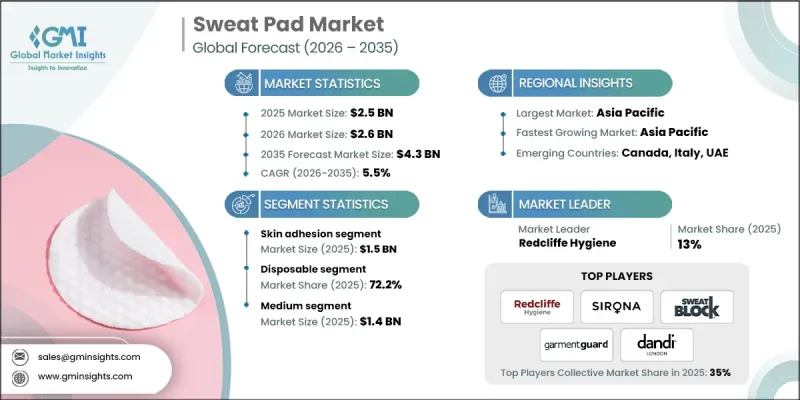
隨著個人衛生和整裝儀容意識的不斷提高,汗液管理已成為已開發國家和新興國家日常整裝儀容的重要組成部分。消費者在職場和社交場合停留的時間越來越長,因此他們越來越關注舒適度、衣物保護和異味控制。快節奏的生活方式、更長的工作時間和頻繁的人際接觸,都促使人們更需要保持全天乾淨自信的整裝儀容。隨著自我護理成為日常生活的一部分,人們對簡單、隱密且有效的衛生解決方案的需求日益成長。吸汗墊恰好滿足了這些需求,它能提供額外的保護,提升舒適度和自信,且不會干擾日常活動。人們對健康和整裝儀容日益成長的重視,持續推動控汗產品的普及,引領市場走向長期穩定的成長。
| 市場範圍 | |
|---|---|
| 開始年份 | 2025 |
| 預測年份 | 2026-2035 |
| 起始值 | 25億美元 |
| 預測金額 | 43億美元 |
| 複合年成長率 | 5.5% |
預計到2025年,皮膚接觸式吸汗墊的市場規模將達到15億美元。這類產品的需求主要源自於消費者對高效能和個人化衛生解決方案日益成長的需求。消費者越來越傾向於選擇既能提供可靠防護,又能兼顧活動便利性和舒適性的產品。皮膚接觸式設計使其具有穩定性和隱蔽性,適用於各種日常活動。材料和親膚黏合劑技術的不斷進步,進一步推動了此類產品的普及,並擴大了該細分市場的吸引力。
預計到2025年,一次性吸汗墊將佔據72.2%的市場。一次性吸汗墊因其使用方便、省時省力而廣受歡迎,尤其適合忙碌的生活方式。其輕巧的結構和隱藏的設計使其可以悄無聲息地佩戴在衣物下,是日常穿著的實用之選。一次性產品的便利性持續推動各消費族群對這類產品的強勁需求。
預計到2025年,美國吸汗墊市佔率將達到87.2%,市場規模將達到4.1億美元。職場整裝儀容意識的提高、日益嚴格的整裝儀容標準以及大規模的勞動力市場是推動市場成長的主要因素。都市生活方式、積極的日常作息以及實體店和線上零售通路產品的廣泛普及,也持續加速著吸汗墊的普及。
目錄
第1章:調查方法和範圍
第2章執行摘要
第3章業界考察
- 生態系分析
- 供應商情況
- 利潤率
- 每個階段增加的價值
- 影響價值鏈的因素
- 影響產業的因素
- 促進因素
- 個人衛生意識的提高
- 人們對多汗症的認知不斷提高
- 城市生活與職業整裝儀容
- 產業潛在風險與挑戰
- 環境永續性議題
- 親密與舒適的挑戰
- 機會
- 永續且可生物分解的產品系列
- 專業產品板塊
- 促進因素
- 成長潛力分析
- 未來市場趨勢
- 科技與創新趨勢
- 當前技術趨勢
- 新興技術
- 價格趨勢
- 按地區
- 依產品類型
- 監理情勢
- 標準和合規要求
- 區域法規結構
- 認證標準
- 波特的分析
- PESTEL 分析
第4章 競爭情勢
- 介紹
- 企業市佔率分析
- 按地區
- 公司矩陣分析
- 主要市場公司的競爭分析
- 競爭定位矩陣
- 主要進展
- 併購
- 夥伴關係與合作
- 新產品發布
- 擴張計劃
第5章 市場估算與預測:依產品類型分類,2022-2035年
- 皮膚黏附
- 與織物的黏合
第6章 市場估計與預測:依應用領域分類,2022-2035年
- 一次性的
- 可重複使用的
第7章 市場估計與預測:依價格區間分類,2022-2035年
- 價格低廉(10 美元以下)
- 中價位(10-20美元)
- 高價位(超過 20 美元)
第8章 市場估算與預測:依通路分類,2022-2035年
- 離線
- 超級市場
- 專賣店
- 其他(百貨公司等)
- 線上
- 電子商務
- 品牌官方網站
第9章 市場估計與預測:依地區分類,2022-2035年
- 北美洲
- 美國
- 加拿大
- 歐洲
- 德國
- 英國
- 法國
- 義大利
- 西班牙
- 亞太地區
- 中國
- 日本
- 印度
- 澳洲
- 韓國
- 拉丁美洲
- 巴西
- 墨西哥
- 阿根廷
- 中東和非洲
- 南非
- 沙烏地阿拉伯
- 阿拉伯聯合大公國
第10章:公司簡介
- Bliss Natural
- Candesant Biomedical
- Changzhou Bestcare Products
- Dandi London
- Garment Guard
- Kleinert's
- Protecht DryPlus
- Quanzhou Union Paper
- Redcliffe Hygiene
- Shandong Harmowell Trade
- Shandong Sincere Hygiene Product
- Sirona Hygiene
- SlickFix
- Sweat Guard
- SweatBlock
The Global Sweat Pad Market was valued at USD 2.5 billion in 2025 and is estimated to grow at a CAGR of 5.5% to reach USD 4.3 billion by 2035.
Increasing awareness of personal hygiene and appearance has made sweat management an important part of everyday grooming across both developed and emerging economies. Consumers are becoming more conscious of comfort, clothing protection, and odor control as they spend longer hours in professional and social environments. Faster lifestyles, extended workdays, and frequent public interaction have heightened the need to maintain a clean and confident appearance throughout the day. As self-care becomes increasingly embedded in daily routines, demand is rising for simple, discreet, and effective hygiene solutions. Sweat pads address these expectations by offering added protection that supports comfort and confidence without disrupting daily activities. The broader cultural emphasis on wellness and personal presentation continues to reinforce the adoption of sweat management products, positioning the market for consistent long-term growth.
| Market Scope | |
|---|---|
| Start Year | 2025 |
| Forecast Year | 2026-2035 |
| Start Value | $2.5 Billion |
| Forecast Value | $4.3 Billion |
| CAGR | 5.5% |
In 2025, the skin-adhering sweat pads accounted for USD 1.5 billion. Demand for this format is supported by growing interest in performance-oriented and personalized hygiene solutions. Consumers increasingly prefer products that provide reliable protection while allowing freedom of movement and comfort. Skin-adhering designs offer stability and discretion, making them suitable for varied daily activities. Ongoing improvements in materials and skin-friendly adhesion technologies are further supporting adoption and expanding the appeal of this segment.
The disposable segment held 72.2% share in 2025. Disposable sweat pads are favored for their ease of use and time-saving nature, aligning well with busy lifestyles. Their lightweight construction and low-profile design allow them to be worn discreetly under clothing, making them a practical choice for everyday wear. The convenience of single-use products continues to drive strong demand across consumer groups.
U.S. Sweat Pad Market held 87.2% share and generated USD 410 million in 2025. Market growth is supported by heightened awareness of workplace appearance, strong grooming standards, and a large working population. Urban lifestyles, active routines, and widespread product availability across physical and digital retail channels continue to accelerate adoption.
Key companies operating in the Global Sweat Pad Market include SweatBlock, Sirona Hygiene, Kleinert's, Redcliffe Hygiene, Candesant Biomedical, Bliss Natural, Protecht DryPlus, Dandi London, Garment Guard, SlickFix, Sweat Guard, Changzhou Bestcare Products, Shandong Harmowell Trade, Quanzhou Union Paper, and Shandong Sincere Hygiene Product. Companies in the sweat pad market focus on innovation, product comfort, and brand visibility to strengthen their market position. Many invest in advanced materials that enhance absorbency while remaining gentle on the skin. Expanding product portfolios to address diverse consumer needs supports wider adoption. Strong emphasis on discreet design and ease of use improves everyday appeal. Brands also leverage digital marketing and direct-to-consumer platforms to increase awareness and engagement. Strategic retail partnerships improve accessibility, while competitive pricing supports volume growth.
Table of Contents
Chapter 1 Methodology and Scope
- 1.1 Market scope and definition
- 1.2 Research design
- 1.2.1 Research approach
- 1.2.2 Data collection methods
- 1.3 Data mining sources
- 1.3.1 Global
- 1.3.2 Regional/Country
- 1.4 Base estimates and calculations
- 1.4.1 Base year calculation
- 1.4.2 Key trends for market estimation
- 1.5 Primary research and validation
- 1.5.1 Primary sources
- 1.6 Forecast model
- 1.7 Research assumptions and limitations
Chapter 2 Executive Summary
- 2.1 Industry 360° synopsis
- 2.2 Key market trends
- 2.2.1 Regional
- 2.2.2 Product type
- 2.2.3 Usage
- 2.2.4 Price range
- 2.2.5 Distribution channel
- 2.3 CXO perspectives: Strategic imperatives
- 2.3.1 Key decision points for industry executives
- 2.3.2 Critical success factors for market players
- 2.4 Future outlook and strategic recommendations
Chapter 3 Industry Insights
- 3.1 Industry ecosystem analysis
- 3.1.1 Supplier landscape
- 3.1.2 Profit margin
- 3.1.3 Value addition at each stage
- 3.1.4 Factor affecting the value chain
- 3.2 Industry impact forces
- 3.2.1 Growth drivers
- 3.2.1.1 Rising personal hygiene
- 3.2.1.2 Increase in hyperhidrosis awareness
- 3.2.1.3 Urban lifestyles & professional grooming
- 3.2.2 Industry pitfalls & challenges
- 3.2.2.1 Environmental sustainability concerns
- 3.2.2.2 Adhesion & comfort issues
- 3.2.3 Opportunities
- 3.2.3.1 Sustainable & biodegradable product lines
- 3.2.3.2 Specialized product segments
- 3.2.1 Growth drivers
- 3.3 Growth potential analysis
- 3.4 Future market trends
- 3.5 Technology and innovation landscape
- 3.5.1 Current technological trends
- 3.5.2 Emerging technologies
- 3.6 Price trends
- 3.6.1 By region
- 3.6.2 By product type
- 3.7 Regulatory landscape
- 3.7.1 Standards and compliance requirements
- 3.7.2 Regional regulatory frameworks
- 3.7.3 Certification standards
- 3.8 Porter’s analysis
- 3.9 PESTEL analysis
Chapter 4 Competitive Landscape, 2025
- 4.1 Introduction
- 4.2 Company market share analysis
- 4.2.1 By region
- 4.2.1.1 North America
- 4.2.1.2 Europe
- 4.2.1.3 Asia Pacific
- 4.2.1.4 Latin America
- 4.2.1.5 Middle East and Africa
- 4.2.1 By region
- 4.3 Company matrix analysis
- 4.4 Competitive analysis of major market players
- 4.5 Competitive positioning matrix
- 4.6 Key developments
- 4.6.1 Mergers & acquisitions
- 4.6.2 Partnerships & collaborations
- 4.6.3 New product launches
- 4.6.4 Expansion plans
Chapter 5 Market Estimates and Forecast, By Product Type, 2022 - 2035 (USD Billion) (Thousand Units)
- 5.1 Key trends
- 5.2 Skin adhesion
- 5.3 Cloth adhesion
Chapter 6 Market Estimates and Forecast, By Usage, 2022 - 2035 (USD Billion) (Thousand Units)
- 6.1 Key trends
- 6.2 Disposable
- 6.3 Reusable
Chapter 7 Market Estimates and Forecast, By Price Range, 2022 - 2035 (USD Billion) (Thousand Units)
- 7.1 Key trends
- 7.2 Low (less than 10$)
- 7.3 Mid (10-20$)
- 7.4 High (above 20$)
Chapter 8 Market Estimates and Forecast, By Distribution Channel, 2022 - 2035 (USD Billion) (Thousand Units)
- 8.1 Key trends
- 8.2 Offline
- 8.2.1 Supermarkets
- 8.2.2 Specialty stores
- 8.2.3 Others (Departmental stores, etc.)
- 8.3 Online
- 8.3.1 E-commerce
- 8.3.2 Brand websites
Chapter 9 Market Estimates and Forecast, By Region, 2022 - 2035 (USD Billion) (Thousand Units)
- 9.1 Key trends
- 9.2 North America
- 9.2.1 U.S.
- 9.2.2 Canada
- 9.3 Europe
- 9.3.1 Germany
- 9.3.2 UK
- 9.3.3 France
- 9.3.4 Italy
- 9.3.5 Spain
- 9.4 Asia Pacific
- 9.4.1 China
- 9.4.2 Japan
- 9.4.3 India
- 9.4.4 Australia
- 9.4.5 South Korea
- 9.5 Latin America
- 9.5.1 Brazil
- 9.5.2 Mexico
- 9.5.3 Argentina
- 9.6 Middle East and Africa
- 9.6.1 South Africa
- 9.6.2 Saudi Arabia
- 9.6.3 UAE
Chapter 10 Company Profiles
- 10.1 Bliss Natural
- 10.2 Candesant Biomedical
- 10.3 Changzhou Bestcare Products
- 10.4 Dandi London
- 10.5 Garment Guard
- 10.6 Kleinert's
- 10.7 Protecht DryPlus
- 10.8 Quanzhou Union Paper
- 10.9 Redcliffe Hygiene
- 10.10 Shandong Harmowell Trade
- 10.11 Shandong Sincere Hygiene Product
- 10.12 Sirona Hygiene
- 10.13 SlickFix
- 10.14 Sweat Guard
- 10.15 SweatBlock

