


 |
市場調查報告書
商品編碼
1959320
食品添加劑市場機會、成長要素、產業趨勢分析及2026年至2035年預測Food-grade Excipients Market Opportunity, Growth Drivers, Industry Trend Analysis, and Forecast 2026 - 2035 |
||||||

2025 年全球食品添加劑市場價值為 1,141 億美元,預計到 2035 年將達到 1,764 億美元,年複合成長率為 4.3%。
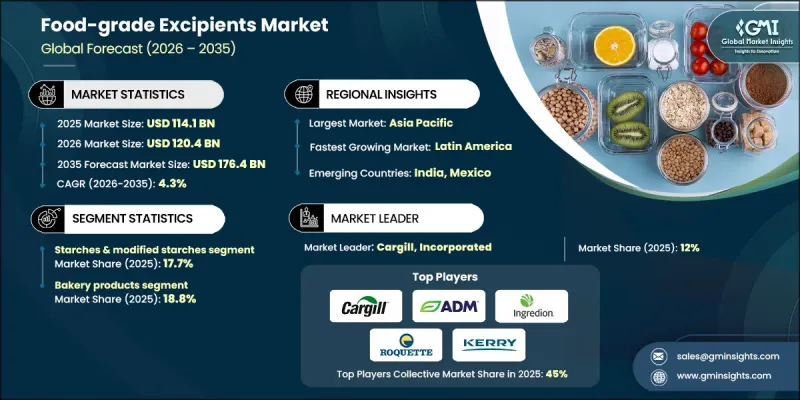
隨著食品製造商、營養補充劑開發商和功能性配料製造商日益重視配方的安全性、穩定性和透明度,市場正處於戰略轉折點。曾經被視為次要因素的配料如今已成為滿足監管要求、提升配方性能和實現產品差異化的關鍵要素。食品添加劑因其在維持結構完整性、改善質地、控制釋放行為和提高加工效率方面的能力而廣受認可。配方科學的進步使輔料能夠實現更好的功能性能,並支持複雜食品體系的設計和創新。業界也表示,他們正致力於潔淨標示定位、成分可追溯性和資訊完全揭露,以增強消費者信任。永續性因素正日益融入採購和生產策略,進而塑造企業在全球市場的競爭地位。
| 市場範圍 | |
|---|---|
| 開始年份 | 2025 |
| 預測年份 | 2026-2035 |
| 起始值 | 1141億美元 |
| 預測金額 | 1764億美元 |
| 複合年成長率 | 4.3% |
預計到2025年,澱粉和改性澱粉市場佔有率將達到17.7%,並在2035年之前以3.1%的複合年成長率成長。該細分市場受益於其廣泛的功能性作用,這些作用能夠改善各種食品體系的結構、黏度和黏合性能。其他添加劑類別也因其在水分管理、配方穩定、改善功能特性以及確保傳統產品和改性產品的均一性方面的能力而繼續保持重要地位。
預計到2025年,烘焙相關應用領域將佔18.8%的市場佔有率,並在2026年至2035年間以4%的複合年成長率成長。食品生產商依靠輔料在加工和儲存過程中保持產品的均勻性、結構穩定性和感官平衡。這些成分也被廣泛用於複製傳統產品的特性,同時保持重組產品的穩定性和整體性能。
預計到2025年,北美食品添加劑市場佔有率將達到27.7%。該地區受益於成熟的法規環境,該環境強調安全性、品質保證和成分透明度。隨著消費者食品偏好的不斷變化,區域製造商越來越依賴高性能添加劑來維持其多樣化產品系列的質地、風味持久性、穩定性和一致性。
目錄
第1章:調查方法和範圍
第2章執行摘要
第3章業界考察
- 生態系分析
- 供應商情況
- 利潤率
- 每個階段增加的價值
- 影響價值鏈的因素
- 中斷
- 影響產業的因素
- 促進因素
- 對加工食品和簡便食品的需求增加
- 植物來源食品產業的成長
- 潔淨標示和天然成分的發展趨勢
- 產業潛在風險與挑戰
- 嚴格的監管要求和核准延誤
- 消費者對合成添加劑的懷疑態度
- 市場機遇
- 用於緩釋應用的微膠囊化
- 生物基和發酵衍生添加劑
- 促進因素
- 成長潛力分析
- 監理情勢
- 波特五力分析
- PESTEL 分析
- 價格趨勢
- 按地區
- 依產品類型
- 未來市場趨勢
- 科技與創新趨勢
- 當前技術趨勢
- 新興技術
- 專利狀態
- 貿易統計(HS編碼)
- 主要進口國
- 主要出口國
- 永續性和環境方面
- 永續計劃
- 減少廢棄物策略
- 生產中的能源效率
- 具有環保意識的舉措
- 考慮碳足跡
第4章 競爭情勢
- 介紹
- 企業市佔率分析
- 按地區
- 北美洲
- 歐洲
- 亞太地區
- 拉丁美洲
- 中東和非洲
- 按地區
- 公司矩陣分析
- 主要市場公司的競爭分析
- 競爭定位矩陣
- 主要進展
- 併購
- 夥伴關係與合作
- 新產品發布
- 業務拓展計劃
第5章 市場估算與預測:依產品類型分類,2022-2035年
- 澱粉和改性澱粉
- 水溶性多醣(樹膠)
- 乳化劑
- 甜味劑和多元醇類
- 纖維素及其衍生物
- 防腐劑和抗菌劑
- 膳食纖維和填充劑
- 色素
- 抗結塊劑
- 酸味劑和pH調節劑
- 蛋白質和酵素
- 其他
第6章 市場估計與預測:依應用領域分類,2022-2035年
- 烘焙產品
- 飲料
- 糖果甜點
- 乳製品和乳製品替代品
- 肉品和肉品替代品
- 醬汁、調味料和佐料
- 零食和簡便食品
- 嬰幼兒食品
- 營養保健品和膳食補充劑
- 冷凍食品
第7章 市場估計與預測:依地區分類,2022-2035年
- 北美洲
- 美國
- 加拿大
- 歐洲
- 德國
- 英國
- 法國
- 西班牙
- 義大利
- 其他歐洲地區
- 亞太地區
- 中國
- 印度
- 日本
- 澳洲
- 韓國
- 亞太其他地區
- 拉丁美洲
- 巴西
- 墨西哥
- 阿根廷
- 其他拉丁美洲地區
- 中東和非洲
- 沙烏地阿拉伯
- 南非
- 阿拉伯聯合大公國
- 其他中東和非洲地區
第8章:公司簡介
- Cargill, Incorporated
- Ingredion Incorporated
- Kerry Group plc
- Archer Daniels Midland Company(ADM)
- DuPont de Nemours, Inc.
- DSM-Firmenich
- Ashland Global Holdings Inc.
- BENEO GmbH(Sudzucker Group)
- Roquette Freres
- Corbion NV
- Jungbunzlauer Suisse AG
- J. Rettenmaier & Sohne GmbH+Co KG(JRS)
- Palsgaard A/S
- CP Kelco(JM Huber Corporation)
- TIC Gums(Ingredion)
- Silvateam Spa
The Global Food-grade Excipients Market was valued at USD 114.1 billion in 2025 and is estimated to grow at a CAGR of 4.3% to reach USD 176.4 billion by 2035.
The market is described as undergoing a strategic shift as food manufacturers, nutraceutical developers, and functional ingredient producers increasingly prioritize formulation safety, stability, and transparency. Ingredients once regarded as secondary inputs are now positioned as critical to meeting regulatory expectations, improving formulation performance, and enabling product differentiation. Food-grade excipients are widely recognized for their ability to support structural integrity, improve texture, regulate release behavior, and enhance processing efficiency. Advances in formulation science are enabling excipients to deliver enhanced functional performance, supporting the design and innovation of complex food systems. The industry is also described as placing strong emphasis on clean-label positioning, ingredient traceability, and full disclosure practices to strengthen consumer confidence. Sustainability considerations are increasingly integrated into sourcing and production strategies, shaping competitive positioning across the global market.
| Market Scope | |
|---|---|
| Start Year | 2025 |
| Forecast Year | 2026-2035 |
| Start Value | $114.1 Billion |
| Forecast Value | $176.4 Billion |
| CAGR | 4.3% |
The starches and modified starches segment held a share of 17.7% in 2025 and is anticipated to grow at a CAGR of 3.1% through 2035. This segment is supported by a broad functional role in enhancing structure, consistency, and binding performance across multiple food systems. Other excipient categories continue to gain relevance due to their ability to manage moisture, stabilize formulations, improve sensory characteristics, and ensure uniformity across both legacy and reformulated products.
The bakery-related applications segment held 18.8% share in 2025 and is expected to grow at a CAGR of 4% during the 2026-2035 period. Food manufacturers rely on excipients to maintain consistency, structural stability, and sensory balance during processing and storage. These ingredients are also widely used to replicate traditional product attributes in reformulated offerings while maintaining stability and overall performance.
North America Food-grade Excipients Market held a 27.7% share in 2025. The region benefits from a mature regulatory environment that emphasizes safety, quality assurance, and ingredient transparency. As dietary preferences continue to evolve, manufacturers in the region increasingly depend on high-performance excipients to maintain texture, flavor delivery, stability, and consistency across diverse product portfolios.
Key companies active in the Global Food-grade Excipients Market include Ingredion Incorporated, Cargill, Incorporated, Roquette Freres, Kerry Group plc, DSM-Firmenich, Archer Daniels Midland Company, Corbion N.V., DuPont de Nemours, Inc., BENEO GmbH, Jungbunzlauer Suisse AG, Ashland Global Holdings Inc., J. Rettenmaier & Sohne GmbH + Co KG, CP Kelco, Palsgaard A/S, TIC Gums, and Silvateam S.p.A. Companies operating in the food-grade excipients market are reinforcing their market positions through targeted investments in research and formulation science. Many players are expanding clean-label and multifunctional excipient portfolios to address evolving regulatory and consumer expectations. Strategic partnerships with food manufacturers and ingredient developers are being used to accelerate innovation and application-specific customization. Firms are also strengthening supply chain transparency and sustainability credentials to support brand trust. Capacity expansion, geographic diversification, and process optimization remain central strategies, while digital quality control and traceability systems are increasingly adopted to improve compliance, efficiency, and customer engagement across global markets.
Table of Contents
Chapter 1 Methodology & Scope
- 1.1 Market scope and definition
- 1.2 Research design
- 1.2.1 Research approach
- 1.2.2 Data collection methods
- 1.3 Data mining sources
- 1.3.1 Global
- 1.3.2 Regional/Country
- 1.4 Base estimates and calculations
- 1.4.1 Base year calculation
- 1.4.2 Key trends for market estimation
- 1.5 Primary research and validation
- 1.5.1 Primary sources
- 1.6 Forecast model
- 1.7 Research assumptions and limitations
Chapter 2 Executive Summary
- 2.1 Industry 360° synopsis
- 2.2 Key market trends
- 2.2.1 Regional
- 2.2.2 Product Type
- 2.2.3 Application
- 2.3 TAM Analysis, 2026-2035
- 2.4 CXO perspectives: Strategic imperatives
- 2.4.1 Executive decision points
- 2.4.2 Critical success factors
- 2.5 Future Outlook and Strategic Recommendations
Chapter 3 Industry Insights
- 3.1 Industry ecosystem analysis
- 3.1.1 Supplier landscape
- 3.1.2 Profit margin
- 3.1.3 Value addition at each stage
- 3.1.4 Factor affecting the value chain
- 3.1.5 Disruptions
- 3.2 Industry impact forces
- 3.2.1 Growth drivers
- 3.2.1.1 Rising demand for processed & convenience foods
- 3.2.1.2 Growth of plant-based food industry
- 3.2.1.3 Clean label & natural ingredient trends
- 3.2.2 Industry pitfalls and challenges
- 3.2.2.1 Stringent regulatory requirements & approval delays
- 3.2.2.2 Consumer skepticism toward synthetic additives
- 3.2.3 Market opportunities
- 3.2.3.1 Microencapsulation for controlled release applications
- 3.2.3.2 Bio-based & fermentation-derived excipients
- 3.2.1 Growth drivers
- 3.3 Growth potential analysis
- 3.4 Regulatory landscape
- 3.4.1 North America
- 3.4.2 Europe
- 3.4.3 Asia Pacific
- 3.4.4 Latin America
- 3.4.5 Middle East & Africa
- 3.5 Porter's analysis
- 3.6 PESTEL analysis
- 3.7 Price trends
- 3.7.1 By region
- 3.7.2 By product type
- 3.8 Future market trends
- 3.9 Technology and Innovation landscape
- 3.9.1 Current technological trends
- 3.9.2 Emerging technologies
- 3.10 Patent Landscape
- 3.11 Trade statistics (HS code)
- 3.11.1 Major importing countries
- 3.11.2 Major exporting countries
- 3.12 Sustainability and environmental aspects
- 3.12.1 Sustainable practices
- 3.12.2 Waste reduction strategies
- 3.12.3 Energy efficiency in production
- 3.12.4 Eco-friendly initiatives
- 3.13 Carbon footprint consideration
Chapter 4 Competitive Landscape, 2025
- 4.1 Introduction
- 4.2 Company market share analysis
- 4.2.1 By region
- 4.2.1.1 North America
- 4.2.1.2 Europe
- 4.2.1.3 Asia Pacific
- 4.2.1.4 LATAM
- 4.2.1.5 MEA
- 4.2.1 By region
- 4.3 Company matrix analysis
- 4.4 Competitive analysis of major market players
- 4.5 Competitive positioning matrix
- 4.6 Key developments
- 4.6.1 Mergers & acquisitions
- 4.6.2 Partnerships & collaborations
- 4.6.3 New Product Launches
- 4.6.4 Expansion Plans
Chapter 5 Market Estimates and Forecast, By Product Type, 2022-2035 (USD Billion) (Kilo Tons)
- 5.1 Key trends
- 5.2 Starches & modified starches
- 5.3 Hydrocolloids (gums)
- 5.4 Emulsifiers
- 5.5 Sweeteners & polyols
- 5.6 Cellulose & cellulose derivatives
- 5.7 Preservatives & antimicrobials
- 5.8 Fibers & bulking agents
- 5.9 Colorants
- 5.10 Anticaking agents
- 5.11 Acidulants & ph regulators
- 5.12 Proteins & enzymes
- 5.13 Others
Chapter 6 Market Estimates and Forecast, By Application, 2022-2035 (USD Billion) (Kilo Tons)
- 6.1 Key trends
- 6.2 Bakery products
- 6.3 Beverages
- 6.4 Confectionery
- 6.5 Dairy & dairy alternatives
- 6.6 Meat & meat alternatives
- 6.7 Sauces, dressings & condiments
- 6.8 Snacks & convenience foods
- 6.9 Infant & baby food
- 6.10 Nutraceuticals & dietary supplements
- 6.11 Frozen foods
Chapter 7 Market Estimates and Forecast, By Region, 2022-2035 (USD Billion) (Kilo Tons)
- 7.1 Key trends
- 7.2 North America
- 7.2.1 U.S.
- 7.2.2 Canada
- 7.3 Europe
- 7.3.1 Germany
- 7.3.2 UK
- 7.3.3 France
- 7.3.4 Spain
- 7.3.5 Italy
- 7.3.6 Rest of Europe
- 7.4 Asia Pacific
- 7.4.1 China
- 7.4.2 India
- 7.4.3 Japan
- 7.4.4 Australia
- 7.4.5 South Korea
- 7.4.6 Rest of Asia Pacific
- 7.5 Latin America
- 7.5.1 Brazil
- 7.5.2 Mexico
- 7.5.3 Argentina
- 7.5.4 Rest of Latin America
- 7.6 Middle East and Africa
- 7.6.1 Saudi Arabia
- 7.6.2 South Africa
- 7.6.3 UAE
- 7.6.4 Rest of Middle East and Africa
Chapter 8 Company Profiles
- 8.1 Cargill, Incorporated
- 8.2 Ingredion Incorporated
- 8.3 Kerry Group plc
- 8.4 Archer Daniels Midland Company (ADM)
- 8.5 DuPont de Nemours, Inc.
- 8.6 DSM-Firmenich
- 8.7 Ashland Global Holdings Inc.
- 8.8 BENEO GmbH (Sudzucker Group)
- 8.9 Roquette Freres
- 8.10 Corbion N.V.
- 8.11 Jungbunzlauer Suisse AG
- 8.12 J. Rettenmaier & Sohne GmbH + Co KG (JRS)
- 8.13 Palsgaard A/S
- 8.14 CP Kelco (J.M. Huber Corporation)
- 8.15 TIC Gums (Ingredion)
- 8.16 Silvateam S.p.a.

 植物性輔料市場-全球產業規模、佔有率、趨勢、機會、預測:按類型、應用、地區和競爭格局分類,2021-2031年
 輔料市場規模、佔有率和趨勢分析報告:按產品、劑型、功能、地區和細分市場分類的預測(2026-2033 年)
 粘合劑和輔料市場報告:按產品類型、應用和地區分類(2026-2034 年)
 粘合劑輔料市場:按類型、劑型、等級和應用分類-2026-2032年全球市場預測增溶輔料市場:依類型、功能、給藥途徑、原料、劑型、劑型及應用分類-2026-2032年全球市場預測多功能塗裝機械市場:依技術、塗料、機器類型、終端用戶產業和應用分類,全球預測(2026-2032)高效率智慧塗裝機械市場:依塗裝類型、自動化程度、機器配置、應用產業和銷售管道,全球預測,2026-2032年高效率無孔塗裝設備市場:依技術、塗裝材料、系統類型、產能範圍、應用及銷售管道,全球預測(2026-2032)
 輔料市場規模、佔有率和成長分析(按原料、類別、產品、化學類型、功能、劑型、給藥途徑、最終用戶、分銷管道和地區分類)—產業預測(2026-2033 年)
 胃膜被覆劑市場報告:2031 年趨勢、預測與競爭分析