


 |
市場調查報告書
商品編碼
1959316
生物基塑化劑市場機會、成長要素、產業趨勢分析及2026年至2035年預測。Biobased Plasticizers Market Opportunity, Growth Drivers, Industry Trend Analysis, and Forecast 2026 - 2035 |
||||||

2025 年全球生物基塑化劑市場價值為 19.4 億美元,預計到 2035 年將達到 35.8 億美元,年複合成長率為 6.5%。
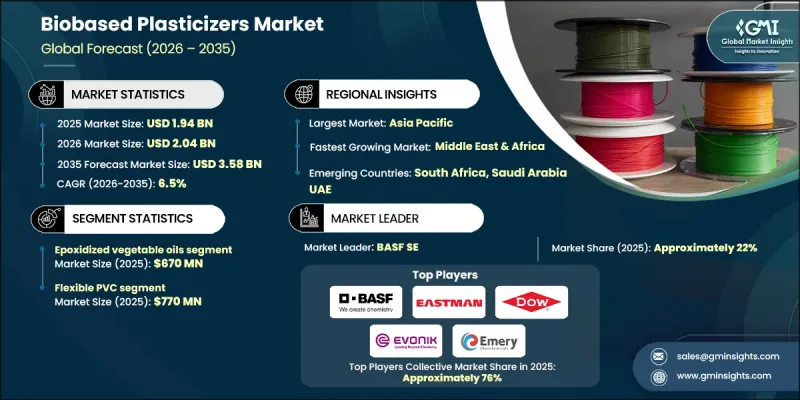
隨著各產業加速向可再生和永續材料解決方案轉型,市場正穩步發展。日益增強的環保意識以及對傳統石油基塑化劑對生態系統影響的擔憂,正推動著以可再生原料生產的生物基替代品的過渡。這些材料與企業的永續性目標和循環經濟框架高度契合,因此在製造業和消費品行業備受關注。隨著企業優先考慮材料的長期安全性、合規性和環境責任,各價值鏈的需求都在不斷增強。對綠色化學的持續投資、加工效率的提高以及可再生添加劑在工業應用中的廣泛應用,都進一步支撐了市場前景。在已開發市場和新興市場不斷發展的材料標準和以永續性發展為導向的籌資策略的支持下,市場成長結構合理,並持續受到合規性的主導。
| 市場範圍 | |
|---|---|
| 開始年份 | 2025 |
| 預測年份 | 2026-2035 |
| 起始值 | 19.4億美元 |
| 預測金額 | 35.8億美元 |
| 複合年成長率 | 6.5% |
監管壓力在市場擴張中持續發揮重要作用。出於對健康和環境的擔憂,世界各國政府和監管機構正在加強對傳統塑化劑的監管。這項政策轉變迫使製造商使用無毒的生物基替代品重新設計產品,而合規性直接促進了產品採用率的提高和長期穩定的市場需求。
預計到2025年,環氧化植物油市場規模將達到6.7億美元,並在2026年至2035年間以6.2%的複合年成長率成長。產品層面的成長主要得益於性能要求與生物基配方之間日益增強的契合度。製造商正積極推廣使用植物油基、檸檬酸基、蓖麻油基和琥珀酸基塑化劑,轉向供應穩定、功能可靠的可再生原料,從而推動整個行業的需求成長。
預計到2025年,柔軟性PVC市場銷售額將達到7.7億美元,市佔率為39.7%,並將在2035年之前以6.3%的複合年成長率成長。該市場是生物基塑化劑最大的消費領域,其成長主要受永續性標準提高和監管要求不斷變化的影響。隨著製造商將符合監管要求且環保的塑化劑解決方案整合到柔軟性材料生產中,應用主導需求持續成長。
預計到2025年,北美生物基塑化劑市場規模將達到3.5億美元,並在整個預測期內保持穩定成長。區域需求主要由逐步但穩定的推廣應用所驅動,並著重於各工業部門對永續性的整合。美國透過提高監管意識和對適應性強、柔軟性的材料的需求,為市場成長做出了貢獻;而墨西哥則透過擴大生產能力和發展出口導向產品,為市場成長提供了支持。該地區的市場發展以創新為主導,並與循環材料策略相契合,從而實現了謹慎且注重適應性的擴張。
目錄
第1章:調查方法
第2章執行摘要
第3章業界考察
- 生態系分析
- 供應商情況
- 利潤率
- 每個階段增加的價值
- 影響價值鏈的因素
- 中斷
- 影響產業的因素
- 促進因素
- 產業潛在風險與挑戰
- 市場機遇
- 成長潛力分析
- 監理情勢
- 波特五力分析
- PESTEL 分析
- 價格趨勢
- 按地區
- 依產品
- 未來市場趨勢
- 科技與創新趨勢
- 當前技術趨勢
- 新興技術
- 專利狀態
- 貿易統計(註:僅提供主要國家的貿易統計)
- 主要進口國
- 主要出口國
- 永續性和環境方面
- 永續計劃
- 減少廢棄物策略
- 生產中的能源效率
- 具有環保意識的舉措
- 碳足跡考量
第4章 競爭情勢
- 介紹
- 企業市佔率分析
- 按地區
- 北美洲
- 歐洲
- 亞太地區
- 拉丁美洲
- 中東和非洲
- 按地區
- 公司矩陣分析
- 主要市場公司的競爭分析
- 競爭定位矩陣
- 主要進展
- 併購
- 夥伴關係與合作
- 新產品發布
- 業務拓展計劃
第5章 市場估算與預測:依產品類型分類,2022-2035年
- 環氧植物油
- 環氧大豆油(ESBO/ESO)
- 環氧亞麻仁油
- 其他環氧化植物油
- 檸檬酸酯
- 檸檬酸三丁酯(TBC)
- 乙醯檸檬酸三丁酯 (ATBC)
- 其他檸檬酸酯
- 蓖麻油基塑化劑
- 琥珀酸酯類塑化劑
- 己二酸和癸二酸
- 甘油基塑化劑
- 甘油/丙三醇
- 醋酸甘油酯
- 聚合物基生物塑化劑
- 其他
第6章 市場估算與預測:依等級分類,2022-2035年
- 食品級
- 醫用級
- 工業級
- 技術級
- 其他
第7章 市場估計與預測:依生物基含量分類,2022-2035年
- 100% 生物基
- 部分生物基(生物基含量超過50%)
- 部分生物基(生物基含量低於50%)
第8章 市場估計與預測:依應用領域分類,2022-2035年
- 軟性聚氯乙烯樹脂
- 包裝材料
- 食品/飲料包裝
- 消費品包裝
- 可堆肥和可生物分解的包裝
- 電線電纜
- 地板材料、屋頂和牆壁材料
- 汽車/運輸設備
- 內裝和儀表板貼膜
- 引擎室部件
- 密封件和墊圈
- 油漆、黏合劑和密封劑
- 其他
第9章 市場估計與預測:依地區分類,2022-2035年
- 北美洲
- 美國
- 加拿大
- 歐洲
- 德國
- 英國
- 法國
- 義大利
- 西班牙
- 其他歐洲地區
- 亞太地區
- 中國
- 印度
- 日本
- 澳洲
- 韓國
- 亞太其他地區
- 拉丁美洲
- 巴西
- 墨西哥
- 阿根廷
- 其他拉丁美洲地區
- 中東和非洲
- 沙烏地阿拉伯
- 南非
- 阿拉伯聯合大公國
- 其他中東和非洲地區
第10章:公司簡介
- Avient Corporation
- BASF SE
- Dow Chemical Company
- Eastman Chemical Company
- Emery Oleochemicals
- Evonik Industries AG
- Jungbunzlauer Suisse AG
- LANXESS AG
- Matrica SpA
- OXEA GmbH
- Valtris Specialty Chemicals
- Zhejiang Jiaao Enprotech
The Global Biobased Plasticizers Market was valued at USD 1.94 billion in 2025 and is estimated to grow at a CAGR of 6.5% to reach USD 3.58 billion by 2035.
The market is progressing steadily as industries increasingly transition toward renewable and sustainable material solutions. Rising environmental awareness and growing concern over the ecological impact of conventional petroleum-based plasticizers are accelerating the shift toward bio-derived alternatives produced from renewable feedstocks. These materials align closely with corporate sustainability targets and circular economy frameworks, making them attractive across manufacturing and consumer-facing industries. Demand is strengthening throughout multiple value chains as companies prioritize long-term material safety, regulatory compliance, and environmental responsibility. The market outlook is further supported by consistent investments in green chemistry, improved processing efficiency, and broader acceptance of renewable additives across industrial applications. Growth remains structured and compliance-driven, supported by evolving material standards and sustainability-focused procurement strategies across developed and emerging economies.
| Market Scope | |
|---|---|
| Start Year | 2025 |
| Forecast Year | 2026-2035 |
| Start Value | $1.94 Billion |
| Forecast Value | $3.58 Billion |
| CAGR | 6.5% |
Regulatory pressure continues to play a significant role in market expansion. Governments and oversight bodies across global regions are tightening restrictions on conventional plasticizers due to health and environmental concerns. These policy shifts are compelling manufacturers to reformulate products using non-toxic biobased alternatives, directly translating regulatory compliance into higher adoption levels and stable long-term demand.
The epoxidized vegetable oils segment reached USD 0.67 billion in 2025 and is projected to grow at a CAGR of 6.2% from 2026 to 2035. Product-level growth is driven by increasing alignment between performance requirements and biobased formulations. Manufacturers are advancing the use of vegetable oil-based, citrate-based, castor oil-derived, and succinic acid-derived plasticizers as part of a broader move toward renewable inputs with consistent availability and reliable functionality, strengthening demand across industrial segments.
The flexible PVC segment generated USD 0.77 billion in 2025 and held a share of 39.7%, with an anticipated CAGR of 6.3% through 2035. This segment represents the largest area of consumption for biobased plasticizers, supported by rising sustainability standards and evolving regulatory expectations. Application-driven demand continues to expand as manufacturers integrate compliant and environmentally aligned plasticizer solutions into flexible material production.
North America Biobased Plasticizers Market generated USD 0.35 billion in 2025 and is expected to experience steady growth over the forecast timeline. Regional demand is supported by gradual but consistent adoption across industrial sectors, emphasizing sustainability integration. The United States contributes through higher regulatory awareness and demand for compliant flexible materials, while Mexico supports growth through expanding manufacturing capacity and export-oriented production. Market development in the region remains innovation-led and aligned with circular material strategies, resulting in measured and compliance-focused expansion.
Key participants in the Global Biobased Plasticizers Market include Dow Chemical, BASF SE, Emery Oleochemicals, Evonik Industries, Eastman Chemical, and other established manufacturers. Companies operating in the biobased plasticizers market are reinforcing their competitive position through product innovation, capacity expansion, and strategic sourcing of renewable raw materials. Many players are investing in advanced formulation technologies to improve performance consistency while maintaining sustainability credentials. Long-term supply agreements and backward integration into bio-based feedstocks are helping stabilize input costs and ensure supply reliability. Firms are also strengthening partnerships with downstream manufacturers to co-develop application-specific solutions.
Table of Contents
Chapter 1 Methodology
- 1.1 Market scope and definition
- 1.2 Research design
- 1.2.1 Research approach
- 1.2.2 Data collection methods
- 1.3 Data mining sources
- 1.3.1 Global
- 1.3.2 Regional/Country
- 1.4 Base estimates and calculations
- 1.4.1 Base year calculation
- 1.4.2 Key trends for market estimation
- 1.5 Primary research and validation
- 1.5.1 Primary sources
- 1.6 Forecast model
- 1.7 Research assumptions and limitations
Chapter 2 Executive Summary
- 2.1 Industry 360° synopsis
- 2.2 Key market trends
- 2.2.1 Regional
- 2.2.2 Product Type
- 2.2.3 Grade
- 2.2.4 Bio-Based Content
- 2.2.5 Application
- 2.3 TAM Analysis, 2026-2035
- 2.4 CXO perspectives: Strategic imperatives
- 2.4.1 Executive decision points
- 2.4.2 Critical success factors
- 2.5 Future Outlook and Strategic Recommendations
Chapter 3 Industry Insights
- 3.1 Industry ecosystem analysis
- 3.1.1 Supplier Landscape
- 3.1.2 Profit Margin
- 3.1.3 Value addition at each stage
- 3.1.4 Factor affecting the value chain
- 3.1.5 Disruptions
- 3.2 Industry impact forces
- 3.2.1 Growth drivers
- 3.2.2 Industry pitfalls and challenges
- 3.2.3 Market opportunities
- 3.3 Growth potential analysis
- 3.4 Regulatory landscape
- 3.4.1 North America
- 3.4.2 Europe
- 3.4.3 Asia Pacific
- 3.4.4 Latin America
- 3.4.5 Middle East & Africa
- 3.5 Porter's analysis
- 3.6 PESTEL analysis
- 3.7 Price trends
- 3.7.1 By region
- 3.7.2 By product
- 3.8 Future market trends
- 3.9 Technology and Innovation landscape
- 3.9.1 Current technological trends
- 3.9.2 Emerging technologies
- 3.10 Patent Landscape
- 3.11 Trade statistics (Note: the trade statistics will be provided for key countries only)
- 3.11.1 Major importing countries
- 3.11.2 Major exporting countries
- 3.12 Sustainability and Environmental Aspects
- 3.12.1 Sustainable Practices
- 3.12.2 Waste Reduction Strategies
- 3.12.3 Energy Efficiency in Production
- 3.12.4 Eco-friendly Initiatives
- 3.13 Carbon Footprint Considerations
Chapter 4 Competitive Landscape, 2025
- 4.1 Introduction
- 4.2 Company market share analysis
- 4.2.1 By region
- 4.2.1.1 North America
- 4.2.1.2 Europe
- 4.2.1.3 Asia Pacific
- 4.2.1.4 LATAM
- 4.2.1.5 MEA
- 4.2.1 By region
- 4.3 Company matrix analysis
- 4.4 Competitive analysis of major market players
- 4.5 Competitive positioning matrix
- 4.6 Key developments
- 4.6.1 Mergers & acquisitions
- 4.6.2 Partnerships & collaborations
- 4.6.3 New Product Launches
- 4.6.4 Expansion Plans
Chapter 5 Market Estimates and Forecast, By Product Type, 2022- 2035 (USD Billion, Kilo Tons)
- 5.1 Key trends
- 5.2 Epoxidized Vegetable Oils
- 5.2.1 Epoxidized Soybean Oil (ESBO/ESO)
- 5.2.2 Epoxidized Linseed Oil
- 5.2.3 Other Epoxidized Vegetable Oils
- 5.3 Citrate Esters
- 5.3.1 Tributyl Citrate (TBC)
- 5.3.2 Acetyl Tributyl Citrate (ATBC)
- 5.3.3 Other Citrate Esters
- 5.4 Castor Oil-Based Plasticizers
- 5.5 Succinic Acid-Based Plasticizers
- 5.6 Adipates & Sebacates
- 5.7 Glycerol-Based Plasticizers
- 5.7.1 Glycerin/Glycerol
- 5.7.2 Glycerin Acetate
- 5.8 Polymeric Bio-Based Plasticizers
- 5.9 Others
Chapter 6 Market Estimates and Forecast, By Grade, 2022 - 2035 (USD Billion, Kilo Tons)
- 6.1 Key trends
- 6.2 Food Grade
- 6.3 Medical Grade
- 6.4 Industrial Grade
- 6.5 Technical Grade
- 6.6 Others
Chapter 7 Market Estimates and Forecast, By Bio-Based Content, 2022 - 2035 (USD Billion, Kilo Tons)
- 7.1 Key trends
- 7.2 100% Bio-Based
- 7.3 Partially Bio-Based (>50% Bio-Based Content)
- 7.4 Partially Bio-Based (<50% Bio-Based Content)
Chapter 8 Market Estimates and Forecast, By Application, 2022 - 2035 (USD Billion, Kilo Tons)
- 8.1 Key trends
- 8.2 Flexible PVC
- 8.3 Packaging Materials
- 8.3.1 Food & Beverage Packaging
- 8.3.2 Consumer Goods Packaging
- 8.3.3 Compostable & Biodegradable Packaging
- 8.4 Wire & Cables
- 8.5 Flooring, Roofing & Wall Coverings
- 8.6 Automotive & Transportation
- 8.6.1 Interior Trim & Dashboard Films
- 8.6.2 Under-Hood Components
- 8.6.3 Seals & Gaskets
- 8.7 Coatings, Adhesives & Sealants
- 8.8 Others
Chapter 9 Market Estimates and Forecast, By Region, 2022 - 2035 (USD Billion, Kilo Tons)
- 9.1 Key trends
- 9.2 North America
- 9.2.1 U.S.
- 9.2.2 Canada
- 9.3 Europe
- 9.3.1 Germany
- 9.3.2 UK
- 9.3.3 France
- 9.3.4 Italy
- 9.3.5 Spain
- 9.3.6 Rest of Europe
- 9.4 Asia Pacific
- 9.4.1 China
- 9.4.2 India
- 9.4.3 Japan
- 9.4.4 Australia
- 9.4.5 South Korea
- 9.4.6 Rest of Asia Pacific
- 9.5 Latin America
- 9.5.1 Brazil
- 9.5.2 Mexico
- 9.5.3 Argentina
- 9.5.4 Rest of Latin America
- 9.6 Middle East & Africa
- 9.6.1 Saudi Arabia
- 9.6.2 South Africa
- 9.6.3 UAE
- 9.6.4 Rest of Middle East & Africa
Chapter 10 Company Profiles
- 10.1 Avient Corporation
- 10.2 BASF SE
- 10.3 Dow Chemical Company
- 10.4 Eastman Chemical Company
- 10.5 Emery Oleochemicals
- 10.6 Evonik Industries AG
- 10.7 Jungbunzlauer Suisse AG
- 10.8 LANXESS AG
- 10.9 Matrica S.p.A.
- 10.10 OXEA GmbH
- 10.11 Valtris Specialty Chemicals
- 10.12 Zhejiang Jiaao Enprotech

 PLA塑膠市場按形態、等級、製造流程、應用和最終用途產業分類-2026-2032年全球預測有機甜菜根粉市場按類型、包裝形式、消費者年齡層、應用和分銷管道分類-全球預測(2026-2032 年)生物基大宗化學品市場(依化學品類型、原料生質能、生產製程及最終用途產業分類)-2026-2032年全球預測
 生物基平台化學品市場機會、成長促進因素、產業趨勢分析及預測(2025-2034年)
 生物基平台化學品市場-全球產業規模、佔有率、趨勢、機會和預測(按產品、地區和競爭細分,2020-2030 年)
 2025-2033年生物基平台化學品市場報告(依化學品、原料、最終用途產業及地區)
 生物基平台化學品市場規模、佔有率和趨勢分析報告:2025-2033 年產品、地區和細分市場預測
 生物為基礎平台用化學品的全球市場,規模,佔有率,趨勢,產業分析報告:各產品,各應用領域,各地區 - 市場預測,2025年~2034年
 生物基平台化學品市場規模、佔有率及成長分析(按來源、類型、產品、最終用途和地區)-2025-2032 年產業預測
 生物基平台化學品:市場佔有率分析、產業趨勢與統計、成長預測(2025-2030 年)