


 |
市場調查報告書
商品編碼
1959298
細菌纖維素市場機會、成長要素、產業趨勢分析及紡織品及生物醫學應用預測(2026-2035年)Bacterial Cellulose in Textiles and Biomedical Market Opportunity, Growth Drivers, Industry Trend Analysis, and Forecast 2026 - 2035 |
||||||

2025 年全球紡織和生物醫學領域的細菌纖維素市場價值為 1,040 萬美元,預計到 2035 年將達到 3,090 萬美元,年複合成長率為 11%。
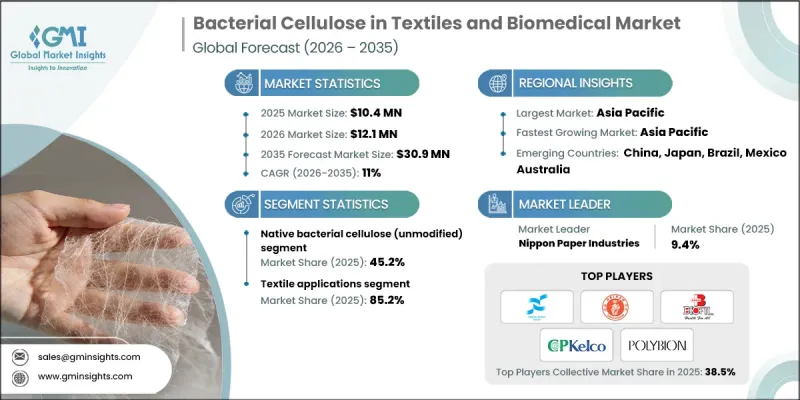
該行業涵蓋多種細菌纖維素形式,包括未改性材料、奈米纖維素變體、複合材料和功能化形式,以及專為醫療傳輸應用而設計的水凝膠系統。據稱,其生產依賴多種製造方法,包括間歇式、機械增強型、連續式和生物最佳化製程。公共部門的各項措施推動了市場趨勢,這些措施旨在促進生物基材料和循環經濟的採用,強調永續性與先進醫療需求之間的緊密聯繫。亞太地區憑藉著強大的基礎設施投資和有利的法規環境,成為該市場的主要區域貢獻者。另一方面,北美市場則因其不斷變化的消費者偏好以及對永續和無需測試材料的創新需求而快速發展。總體而言,該市場被定位為環保纖維與下一代生物醫學解決方案的融合點。
| 市場範圍 | |
|---|---|
| 開始年份 | 2025 |
| 預測期 | 2026-2035 |
| 起始金額 | 1040萬美元 |
| 預測金額 | 3090萬美元 |
| 複合年成長率 | 11% |
預計到2025年,天然細菌纖維素市場佔有率將達到45.2%,並在2035年之前以10.8%的複合年成長率成長。與傳統纖維素原料相比,天然細菌纖維素具有更高的純度、更完整的結構和奈米級纖維排列,因此在許多工業和醫療應用領域備受關注。該材料因其耐用性、透氣性和生物相容性等優點,成為需要此類應用的理想選擇,其商業性應用也不斷擴大。
預計到2025年,紡織品應用領域將佔據85.2%的市場佔有率,並在2035年之前以10.9%的複合年成長率成長。細菌纖維素在紡織相關產品中的應用正在時尚、室內設計和交通出行等領域不斷擴展。與傳統的紡織品和皮革替代品相比,這些材料因其柔軟性、優質的表面外觀和更低的環境影響而備受認可。
預計2026年至2035年,北美紡織品和生物醫學應用領域的細菌纖維素市場將以11%的複合年成長率成長。該地區受益於生物製造技術的進步和對永續材料開發投資的增加。市場前景凸顯了消費者日益增強的環保意識和材料安全意識,促使製造商和設計師將細菌纖維素應用於醫療級產品和生活用品中。
目錄
第1章:調查方法和範圍
第2章執行摘要
第3章業界考察
- 生態系分析
- 供應商情況
- 利潤率
- 每個階段增加的價值
- 影響價值鏈的因素
- 中斷
- 影響產業的因素
- 促進因素
- 產業潛在風險與挑戰
- 市場機遇
- 成長潛力分析
- 監理情勢
- 波特五力分析
- PESTEL 分析
- 價格趨勢
- 按地區
- 依產品類型
- 未來市場趨勢
- 科技與創新趨勢
- 當前技術趨勢
- 新興技術
- 專利狀態
- 貿易統計(HS編碼)
- 主要進口國
- 主要出口國
- 永續性和環境方面
- 永續計劃
- 減少廢棄物策略
- 生產中的能源效率
- 具有環保意識的舉措
- 考慮碳足跡
第4章 競爭情勢
- 介紹
- 企業市佔率分析
- 按地區
- 北美洲
- 歐洲
- 亞太地區
- 拉丁美洲
- 中東和非洲
- 按地區
- 公司矩陣分析
- 主要市場公司的競爭分析
- 競爭定位矩陣
- 主要進展
- 併購
- 夥伴關係與合作
- 新產品發布
- 業務拓展計劃
第5章 市場估算與預測:依產品類型分類,2022-2035年
- 天然細菌纖維素(未改質)
- 細菌奈米纖維素(BNC)
- 細菌纖維素複合材料/功能化細菌纖維素
- 抗菌BC
- 聚合物-BC複合材料
- 奈米顆粒增強型細菌纖維素
- 導電BC(智慧紡織品)
- 基於細菌纖維素的水凝膠和藥物傳遞系統
- 緩釋系統
- 經皮給藥系統
- 刺激響應型水凝膠
第6章 市場估計與預測:依技術類型分類,2022-2035年
- 紡織應用
- 時尚界的純素皮革
- 醫療保健用途
- 為了保護/功能
- 用於化妝品和個人護理
- 生物醫學應用
- 創傷護理
- 組織工程與再生醫學
- 藥物傳輸及經皮吸收系統
- 植入式醫療設備和醫用黏合劑
第7章 市場估計與預測:依地區分類,2022-2035年
- 北美洲
- 美國
- 加拿大
- 歐洲
- 德國
- 英國
- 法國
- 西班牙
- 義大利
- 其他歐洲地區
- 亞太地區
- 中國
- 印度
- 日本
- 澳洲
- 韓國
- 亞太其他地區
- 拉丁美洲
- 巴西
- 墨西哥
- 阿根廷
- 其他拉丁美洲地區
- 中東和非洲
- 沙烏地阿拉伯
- 南非
- 阿拉伯聯合大公國
- 其他中東和非洲地區
第8章:公司簡介
- CPKelco
- Hainan Yeguo Foods
- Nippon Paper Industries
- Polybion
- Biofill
- Nanollose
- Axcelon Biopolymers
- BOWIL Biotech
- fzmb GmbH
- San-Ei Gen FFI
- Kusano Sakko
- S2Medical
- Modern Synthesis
- ScobyTec
- Cellugy
The Global Bacterial Cellulose in Textiles and Biomedical Market was valued at USD 10.4 million in 2025 and is estimated to grow at a CAGR of 11% to reach USD 30.9 million by 2035.
The industry is portrayed as covering a wide range of bacterial cellulose forms, including unmodified materials, nanocellulose variants, composite and functionalized formats, and hydrogel-based systems designed for medical delivery applications. Production is stated to rely on multiple manufacturing approaches, including batch-based, mechanically enhanced, continuous, and biologically optimized processes. The market narrative highlights its strong alignment with sustainability and advanced healthcare needs, supported by public sector initiatives promoting bio-based materials and circular economy adoption. Asia Pacific is identified as the leading regional contributor due to strong infrastructure investment and favorable regulatory environments, while North America is characterized as a rapidly advancing market driven by innovation and changing consumer preferences toward sustainable and cruelty-free materials. Overall, the market is positioned as a convergence point between eco-conscious textiles and next-generation biomedical solutions.
| Market Scope | |
|---|---|
| Start Year | 2025 |
| Forecast Year | 2026-2035 |
| Start Value | $10.4 Million |
| Forecast Value | $30.9 Million |
| CAGR | 11% |
The native bacterial cellulose segment held 45.2% share in 2025 and is projected to grow at a CAGR of 10.8% through 2035. This segment is described as gaining traction across multiple industrial and medical uses due to its purity, structural integrity, and nanoscale fiber arrangement when compared with conventional cellulose sources. The material is positioned as a preferred option for applications requiring durability, breathability, and biocompatibility, supporting its continued commercial adoption.
The textiles segment held 85.2% share in 2025 and is forecast to grow at a CAGR of 10.9% through 2035. The use of bacterial cellulose in textile-related products is described as expanding across fashion, interior design, and mobility-related sectors. These materials are recognized for offering flexibility, premium surface appearance, and reduced environmental impact compared with traditional textile and leather alternatives.
North America Bacterial Cellulose in Textiles and Biomedical Market is estimated to grow at a CAGR of 11% between 2026 and 2035. The region is characterized as benefiting from advancements in biomanufacturing technologies and rising investment in sustainable material development. The market outlook emphasizes increasing consumer awareness regarding environmental responsibility and material safety, which is encouraging manufacturers and designers to incorporate bacterial cellulose into both medical-grade and lifestyle-focused products.
Key companies active in the Global Bacterial Cellulose in Textiles and Biomedical Market are described as including Polybion, Nippon Paper Industries, Nanollose, CPKelco, Modern Synthesis, Cellugy, San-Ei Gen F.F.I., Axcelon Biopolymers, Biofill, ScobyTec, Hainan Yeguo Foods, fzmb GmbH, BOWIL Biotech, Kusano Sakko, and S2Medical. Companies operating in the Bacterial Cellulose in Textiles and Biomedical Market are stated to be strengthening their positions through a combination of capacity expansion, process optimization, and strategic collaborations. Many players are focusing on improving fermentation efficiency and material consistency to support scalable production. Investments in research and development are described as targeting enhanced performance characteristics and broader application suitability. Firms are also reported to be forming partnerships with fashion brands, healthcare providers, and research institutions to accelerate commercialization.
Table of Contents
Chapter 1 Methodology & Scope
- 1.1 Market scope and definition
- 1.2 Research design
- 1.2.1 Research approach
- 1.2.2 Data collection methods
- 1.3 Data mining sources
- 1.3.1 Global
- 1.3.2 Regional/Country
- 1.4 Base estimates and calculations
- 1.4.1 Base year calculation
- 1.4.2 Key trends for market estimation
- 1.5 Primary research and validation
- 1.5.1 Primary sources
- 1.6 Forecast model
- 1.7 Research assumptions and limitations
Chapter 2 Executive Summary
- 2.1 Industry 360° synopsis
- 2.2 Key market trends
- 2.2.1 Product type
- 2.2.2 Application
- 2.2.3 Regional
- 2.3 TAM Analysis, 2026-2035
- 2.4 CXO perspectives: Strategic imperatives
- 2.4.1 Executive decision points
- 2.4.2 Critical success factors
- 2.5 Future Outlook and Strategic Recommendations
Chapter 3 Industry Insights
- 3.1 Industry ecosystem analysis
- 3.1.1 Supplier landscape
- 3.1.2 Profit margin
- 3.1.3 Value addition at each stage
- 3.1.4 Factor affecting the value chain
- 3.1.5 Disruptions
- 3.2 Industry impact forces
- 3.2.1 Growth drivers
- 3.2.2 Industry pitfalls and challenges
- 3.2.3 Market opportunities
- 3.3 Growth potential analysis
- 3.4 Regulatory landscape
- 3.4.1 North America
- 3.4.2 Europe
- 3.4.3 Asia Pacific
- 3.4.4 Latin America
- 3.4.5 Middle East & Africa
- 3.5 Porter's analysis
- 3.6 PESTEL analysis
- 3.7 Price trends
- 3.7.1 By region
- 3.7.2 By product type
- 3.8 Future market trends
- 3.9 Technology and innovation landscape
- 3.9.1 Current technological trends
- 3.9.2 Emerging technologies
- 3.10 Patent Landscape
- 3.11 Trade statistics (HS code)
- 3.11.1 Major importing countries
- 3.11.2 Major exporting countries
- 3.12 Sustainability and environmental aspects
- 3.12.1 Sustainable practices
- 3.12.2 Waste reduction strategies
- 3.12.3 Energy efficiency in production
- 3.12.4 Eco-friendly initiatives
- 3.13 Carbon footprint consideration
Chapter 4 Competitive Landscape, 2025
- 4.1 Introduction
- 4.2 Company market share analysis
- 4.2.1 By region
- 4.2.1.1 North America
- 4.2.1.2 Europe
- 4.2.1.3 Asia Pacific
- 4.2.1.4 LATAM
- 4.2.1.5 MEA
- 4.2.1 By region
- 4.3 Company matrix analysis
- 4.4 Competitive analysis of major market players
- 4.5 Competitive positioning matrix
- 4.6 Key developments
- 4.6.1 Mergers & acquisitions
- 4.6.2 Partnerships & collaborations
- 4.6.3 New Product Launches
- 4.6.4 Expansion Plans
Chapter 5 Market Estimates and Forecast, By Product Type, 2022-2035 (USD Million) (Kilo Tons)
- 5.1 Key trends
- 5.2 Native bacterial cellulose (unmodified)
- 5.3 Bacterial nanocellulose (BNC)
- 5.4 BC composites and functionalized BC
- 5.4.1 Antimicrobial BC
- 5.4.2 Polymer-BC composites
- 5.4.3 Nanoparticle-enhanced BC
- 5.4.4 Conductive BC (smart textiles)
- 5.5 BC-based hydrogels and drug delivery systems
- 5.5.1 Controlled-release systems
- 5.5.2 Transdermal delivery systems
- 5.5.3 Stimuli-responsive hydrogels
Chapter 6 Market Estimates and Forecast, By Technology Type, 2022-2035 (USD Million) (Kilo Tons)
- 6.1 Key trends
- 6.2 Textile applications
- 6.2.1 Vegan leather and fashion materials
- 6.2.2 Medical and healthcare textiles
- 6.2.3 Protective and performance textiles
- 6.2.4 Cosmetic and personal care textiles
- 6.3 Biomedical applications
- 6.3.1 Wound care
- 6.3.2 Tissue engineering and regenerative medicine
- 6.3.3 Drug delivery and transdermal systems
- 6.3.4 Implantable devices and medical adhesives
Chapter 7 Market Estimates and Forecast, By Region, 2022-2035 (USD Million) (Kilo Tons)
- 7.1 Key trends
- 7.2 North America
- 7.2.1 U.S.
- 7.2.2 Canada
- 7.3 Europe
- 7.3.1 Germany
- 7.3.2 UK
- 7.3.3 France
- 7.3.4 Spain
- 7.3.5 Italy
- 7.3.6 Rest of Europe
- 7.4 Asia Pacific
- 7.4.1 China
- 7.4.2 India
- 7.4.3 Japan
- 7.4.4 Australia
- 7.4.5 South Korea
- 7.4.6 Rest of Asia Pacific
- 7.5 Latin America
- 7.5.1 Brazil
- 7.5.2 Mexico
- 7.5.3 Argentina
- 7.5.4 Rest of Latin America
- 7.6 Middle East and Africa
- 7.6.1 Saudi Arabia
- 7.6.2 South Africa
- 7.6.3 UAE
- 7.6.4 Rest of Middle East and Africa
Chapter 8 Company Profiles
- 8.1 CPKelco
- 8.2 Hainan Yeguo Foods
- 8.3 Nippon Paper Industries
- 8.4 Polybion
- 8.5 Biofill
- 8.6 Nanollose
- 8.7 Axcelon Biopolymers
- 8.8 BOWIL Biotech
- 8.9 fzmb GmbH
- 8.10 San-Ei Gen F.F.I.
- 8.11 Kusano Sakko
- 8.12 S2Medical
- 8.13 Modern Synthesis
- 8.14 ScobyTec
- 8.15 Cellugy

 先進縫合技術市場分析及預測(至2035年):依類型、產品、技術、應用、材料類型、製程、最終用戶、功能、模式分類
 傷口縫合及進階創傷護理市場:依產品類型、傷口類型、臨床應用、產品易用性、最終使用者及通路分類-2026-2032年全球市場預測
 全球高級傷口護理市場-產業規模、佔有率、趨勢、機會和預測:按產品、應用、最終用戶、地區和競爭對手分類,2021-2031年
 進階創傷護理市場規模、佔有率和成長分析:按產品類型、應用、最終用戶、分銷管道和地區分類-2026-2033年產業預測
 進階創傷護理市場報告:按產品、應用、最終用戶和地區分類(2026-2034 年)
 進階創傷護理管理市場:按產品類型、類別、傷口類型、最終用戶和地區分類
 先進創傷護理市場規模、佔有率、成長及全球產業分析:按類型、應用和地區分類的洞察,2026-2034 年預測
 2026年全球進階創傷護理市場報告非處方高階創傷護理市場分析及預測至2035年:依類型、產品、技術、應用、材料類型、最終用戶、劑型、設備、製程及部署方式分類全球高階創傷護理市場規模、佔有率、趨勢和成長分析報告(2026-2034年)