

 |
市場調查報告書
商品編碼
1959271
2026-2035年半導體製造領域含氟聚合物的市場機會、成長要素、產業趨勢分析及預測Fluoropolymers in Semiconductor Manufacturing Market Opportunity, Growth Drivers, Industry Trend Analysis, and Forecast 2026 - 2035 |
||||||

2025 年,半導體製造中使用的氟聚合物的全球市場價值為 16 億美元,預計到 2035 年將達到 31 億美元,年複合成長率為 6.9%。
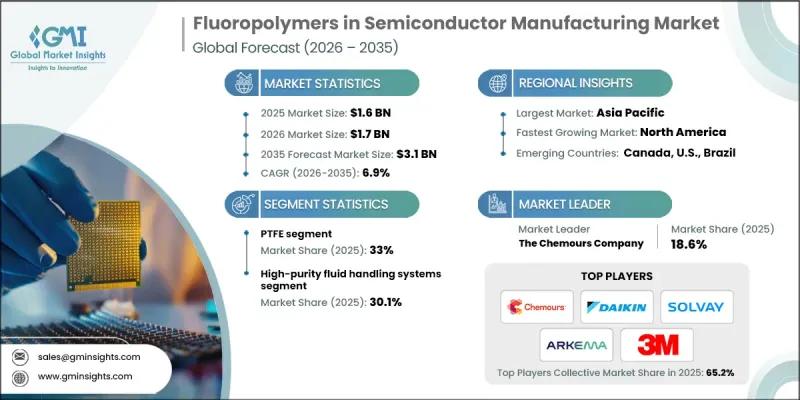
半導體產業高度依賴具有優異耐化學性、熱穩定性和電絕緣性能的含氟聚合物,這些性能對於製造先進裝置至關重要。對更小、更快、更有效率的半導體的需求不斷成長,進一步提升了對能夠承受嚴苛製造環境的材料的需求。亞太地區目前主導市場,這得益於中國、韓國和台灣地區龐大的半導體製造能力以及對製造基礎設施的持續投資。 5G、人工智慧和物聯網 (IoT) 等技術的廣泛應用,進一步推動了對先進半導體元件的需求。北美市場也正經歷快速成長,這主要得益於極紫外線 (EUV) 和高數值孔徑 (NA)微影術技術的日益普及。這些技術需要高性能的含氟聚合物材料,以在奈米尺度上提供化學保護和可靠的性能,從而確保更高的產量比率和裝置效率。
| 市場範圍 | |
|---|---|
| 開始年份 | 2025 |
| 預測年份 | 2026-2035 |
| 起始金額 | 16億美元 |
| 預測金額 | 31億美元 |
| 複合年成長率 | 6.9% |
預計到2025年,聚四氟乙烯(PTFE)市佔率將達到33%,並在2035年之前以7.6%的複合年成長率成長。半導體製造商青睞PTFE,是因為它具有無與倫比的耐化學性、耐高溫性和優異的介電性。 PTFE在絕緣層、墊片和密封應用中發揮著至關重要的作用,它能夠保護半導體裝置免受嚴苛製造流程的影響,同時在關鍵應用中保持穩定的性能。
預計到2025年,高純度流體處理系統市佔率將達到30.1%。這些系統在半導體生產中至關重要,因為超潔淨和精確的環境對於製造無缺陷晶片至關重要。基於氟聚合物的流體處理系統可確保高純度、精確測量和耐化學腐蝕性,使其在日益小型化的半導體技術和高性能晶片製造中發揮關鍵作用。
預計2026年至2035年,北美半導體製造用含氟聚合物市場將以7.8%的複合年成長率成長。這項市場擴張主要得益於新一代生產工具的普及應用,這些工具依賴先進的含氟聚合物材料來實現熱保護、污染控制和製程效率的提升。半導體製造工廠正面臨晶片設計小型化的挑戰,這要求材料即使在嚴苛的條件下也能保持優異的化學和熱性能。最終,這將提高產量比率和裝置的整體可靠性。
目錄
第1章:調查方法和範圍
第2章執行摘要
第3章業界考察
- 生態系分析
- 供應商情況
- 利潤率
- 每個階段增加的價值
- 影響價值鏈的因素
- 中斷
- 影響產業的因素
- 促進因素
- 積極擴張生產能力
- EUV和高數值孔徑微影技術實施現狀
- 先進包裝技術的普及
- 產業潛在風險與挑戰
- PFAS監管限制和合規成本
- 材料認證週期延長
- 市場機遇
- 擴大中國基礎設施節點的容量
- 先進包裝材料的創新
- 促進因素
- 成長潛力分析
- 監理情勢
- 北美洲
- 歐洲
- 亞太地區
- 拉丁美洲
- 中東和非洲
- 波特的分析
- PESTEL 分析
- 價格趨勢
- 按地區
- 不同類型的氟樹脂
- 未來市場趨勢
- 科技與創新趨勢
- 當前技術趨勢
- 新興技術
- 專利狀態
- 貿易統計(HS編碼)
- 主要進口國
- 主要出口國
- 永續性和環境方面
- 永續計劃
- 減少廢棄物策略
- 生產中的能源效率
- 具有環保意識的舉措
- 考慮碳足跡
第4章 競爭情勢
- 介紹
- 企業市佔率分析
- 按地區
- 北美洲
- 歐洲
- 亞太地區
- 拉丁美洲
- 中東和非洲
- 按地區
- 公司矩陣分析
- 主要市場公司的競爭分析
- 競爭定位矩陣
- 主要進展
- 併購
- 夥伴關係與合作
- 新產品發布
- 業務拓展計劃
第5章 市場估算與預測:依氟聚合物類型分類,2022-2035年
- PTFE
- PFA
- FEP
- PVDF
- ETFE
- PCTFE
- 其他
第6章 市場估計與預測:依應用領域分類,2022-2035年
- HTML純度流體處理系統
- 大宗化學品經銷
- 化學品儲存和運輸
- 過濾系統
- 其他
- 化學品供應系統
- 自動分配系統
- 混合攪拌系統
- 其他
- 晶圓處理和運輸
- 晶圓載體盒
- 直接晶圓接觸組件
- 機器人搬運夾具
- 其他
- 濕式製程設備
- 電漿處理組件
- 其他
第7章 市場估計與預測:依地區分類,2022-2035年
- 北美洲
- 美國
- 加拿大
- 歐洲
- 德國
- 英國
- 法國
- 西班牙
- 義大利
- 其他歐洲地區
- 亞太地區
- 中國
- 印度
- 日本
- 澳洲
- 韓國
- 亞太其他地區
- 拉丁美洲
- 巴西
- 墨西哥
- 阿根廷
- 其他拉丁美洲地區
- 中東和非洲
- 沙烏地阿拉伯
- 南非
- 阿拉伯聯合大公國
- 其他中東和非洲地區
第8章:公司簡介
- The Chemours Company
- Daikin Industries, Ltd
- Solvay SA
- Arkema SA
- 3M Company
- Saint-Gobain
- Parker Hannifin Corporation
- Pexco LLC
- Holscot Advanced Polymers Ltd
The Global Fluoropolymers in Semiconductor Manufacturing Market was valued at USD 1.6 billion in 2025 and is estimated to grow at a CAGR of 6.9% to reach USD 3.1 billion by 2035.
The semiconductor industry relies heavily on fluoropolymers due to their exceptional chemical resistance, thermal stability, and electrical insulation properties, which are critical for advanced device fabrication. Increasing demand for smaller, faster, and more efficient semiconductors has intensified the need for materials that can endure extreme processing environments. Asia-Pacific currently dominates the market, driven by the extensive semiconductor manufacturing capacities of China, South Korea, and Taiwan, supported by ongoing investments in fabrication infrastructure. The growing adoption of technologies such as 5G, artificial intelligence, and the Internet of Things is further increasing the requirement for advanced semiconductor components. North America is also witnessing rapid growth as manufacturers implement EUV and high-NA lithography technologies, which demand high-performance fluoropolymer materials capable of providing chemical protection and reliable performance at nanometer scales, ensuring enhanced yield and device efficiency.
| Market Scope | |
|---|---|
| Start Year | 2025 |
| Forecast Year | 2026-2035 |
| Start Value | $1.6 Billion |
| Forecast Value | $3.1 Billion |
| CAGR | 6.9% |
The PTFE (Polytetrafluoroethylene) segment held 33% share in 2025 and is expected to grow at a CAGR of 7.6% through 2035. Semiconductor manufacturers prefer PTFE because of its unmatched chemical resistance, high-temperature tolerance, and excellent dielectric properties. PTFE plays a crucial role in insulating layers, gaskets, and sealing applications, protecting semiconductor devices from harsh processing conditions while maintaining consistent performance across critical applications.
The high-purity fluid handling systems segment accounted for 30.1% share in 2025. These systems are essential in semiconductor production, where ultra-clean and precise environments are necessary to fabricate defect-free chips. Fluoropolymer-based fluid handling systems ensure high purity, precise measurement, and chemical resistance, which are critical for smaller node semiconductor technology and high-performance chip manufacturing.
North America Fluoropolymers in Semiconductor Manufacturing Market is expected to grow at a CAGR of 7.8% between 2026 and 2035. Market expansion is driven by the adoption of next-generation production tools that rely on advanced fluoropolymer materials to enhance thermal protection, contamination control, and process efficiency. Semiconductor fabrication facilities are increasingly miniaturizing chip designs, requiring materials that maintain chemical and thermal performance under extreme conditions, ultimately improving yield and overall device reliability.
Key players operating in the Global Fluoropolymers in Semiconductor Manufacturing Market include 3M Company, Arkema S.A., Daikin Industries, Ltd, Holscot Advanced Polymers Ltd, Pexco LLC, Parker Hannifin Corporation, Saint-Gobain, Solvay S.A., and The Chemours Company. Companies in the fluoropolymers in semiconductor manufacturing market are strengthening their position through innovation and strategic collaborations. Many are investing in research and development to create next-generation fluoropolymer materials with enhanced chemical, thermal, and electrical properties to meet the demands of advanced semiconductor nodes. Firms are expanding production capacities to support growing global semiconductor fabrication, particularly in high-demand regions such as Asia-Pacific and North America. Partnerships with semiconductor equipment manufacturers and strategic alliances with chip makers help integrate fluoropolymer solutions into critical fabrication processes.
Table of Contents
Chapter 1 Methodology & Scope
- 1.1 Market scope and definition
- 1.2 Research design
- 1.2.1 Research approach
- 1.2.2 Data collection methods
- 1.3 Data mining sources
- 1.3.1 Global
- 1.3.2 Regional/Country
- 1.4 Base estimates and calculations
- 1.4.1 Base year calculation
- 1.4.2 Key trends for market estimation
- 1.5 Primary research and validation
- 1.5.1 Primary sources
- 1.6 Forecast model
- 1.7 Research assumptions and limitations
Chapter 2 Executive Summary
- 2.1 Industry 360° synopsis
- 2.2 Key market trends
- 2.2.1 Regional
- 2.2.2 Fluoropolymer type
- 2.2.3 Application
- 2.3 TAM Analysis, 2026-2035
- 2.4 CXO perspectives: Strategic imperatives
- 2.4.1 Executive decision points
- 2.4.2 Critical success factors
- 2.5 Future Outlook and Strategic Recommendations
Chapter 3 Industry Insights
- 3.1 Industry ecosystem analysis
- 3.1.1 Supplier landscape
- 3.1.2 Profit margin
- 3.1.3 Value addition at each stage
- 3.1.4 Factor affecting the value chain
- 3.1.5 Disruptions
- 3.2 Industry impact forces
- 3.2.1 Growth drivers
- 3.2.1.1 Aggressive fab capacity expansion
- 3.2.1.2 EUV & high-NA lithography adoption
- 3.2.1.3 Advanced packaging proliferation
- 3.2.2 Industry pitfalls and challenges
- 3.2.2.1 PFAS regulatory restrictions & compliance costs
- 3.2.2.2 Long material qualification cycles
- 3.2.3 Market opportunities
- 3.2.3.1 China foundational node capacity expansion
- 3.2.3.2 Advanced packaging material innovation
- 3.2.1 Growth drivers
- 3.3 Growth potential analysis
- 3.4 Regulatory landscape
- 3.4.1 North America
- 3.4.2 Europe
- 3.4.3 Asia Pacific
- 3.4.4 Latin America
- 3.4.5 Middle East & Africa
- 3.5 Porter’s analysis
- 3.6 PESTEL analysis
- 3.7 Price trends
- 3.7.1 By region
- 3.7.2 By Fluoropolymer type
- 3.8 Future market trends
- 3.9 Technology and innovation landscape
- 3.9.1 Current technological trends
- 3.9.2 Emerging technologies
- 3.10 Patent Landscape
- 3.11 Trade statistics (HS code)
- 3.11.1 Major importing countries
- 3.11.2 Major exporting countries
- 3.12 Sustainability and environmental aspects
- 3.12.1 Sustainable practices
- 3.12.2 Waste reduction strategies
- 3.12.3 Energy efficiency in production
- 3.12.4 Eco-friendly initiatives
- 3.13 Carbon footprint consideration
Chapter 4 Competitive Landscape, 2025
- 4.1 Introduction
- 4.2 Company market share analysis
- 4.2.1 By region
- 4.2.1.1 North America
- 4.2.1.2 Europe
- 4.2.1.3 Asia Pacific
- 4.2.1.4 LATAM
- 4.2.1.5 MEA
- 4.2.1 By region
- 4.3 Company matrix analysis
- 4.4 Competitive analysis of major market players
- 4.5 Competitive positioning matrix
- 4.6 Key developments
- 4.6.1 Mergers & acquisitions
- 4.6.2 Partnerships & collaborations
- 4.6.3 New Product Launches
- 4.6.4 Expansion Plans
Chapter 5 Market Estimates and Forecast, By Fluoropolymer Type, 2022-2035 (USD Billion) (Kilo Tons)
- 5.1 Key trends
- 5.2 PTFE
- 5.3 PFA
- 5.4 FEP
- 5.5 PVDF
- 5.6 ETFE
- 5.7 PCTFE
- 5.8 Others
Chapter 6 Market Estimates and Forecast, By Application, 2022-2035 (USD Billion) (Kilo Tons)
- 6.1 Key trends
- 6.2 High-purity fluid handling systems
- 6.2.1 Bulk chemical distribution
- 6.2.2 Chemical storage & transport
- 6.2.3 Filtration systems
- 6.2.4 Others
- 6.3 Chemical delivery systems
- 6.3.1 Automated dispensing systems
- 6.3.2 Mix & blend systems
- 6.3.3 Others
- 6.4 Wafer handling & transport
- 6.4.1 Wafer carriers & cassettes
- 6.4.2 Direct wafer contact components
- 6.4.3 Robotic handling fixtures
- 6.4.4 Others
- 6.5 Wet processing equipment
- 6.6 Plasma processing components
- 6.7 Others
Chapter 7 Market Estimates and Forecast, By Region, 2022-2035 (USD Billion) (Kilo Tons)
- 7.1 Key trends
- 7.2 North America
- 7.2.1 U.S.
- 7.2.2 Canada
- 7.3 Europe
- 7.3.1 Germany
- 7.3.2 UK
- 7.3.3 France
- 7.3.4 Spain
- 7.3.5 Italy
- 7.3.6 Rest of Europe
- 7.4 Asia Pacific
- 7.4.1 China
- 7.4.2 India
- 7.4.3 Japan
- 7.4.4 Australia
- 7.4.5 South Korea
- 7.4.6 Rest of Asia Pacific
- 7.5 Latin America
- 7.5.1 Brazil
- 7.5.2 Mexico
- 7.5.3 Argentina
- 7.5.4 Rest of Latin America
- 7.6 Middle East and Africa
- 7.6.1 Saudi Arabia
- 7.6.2 South Africa
- 7.6.3 UAE
- 7.6.4 Rest of Middle East and Africa
Chapter 8 Company Profiles
- 8.1 The Chemours Company
- 8.2 Daikin Industries, Ltd
- 8.3 Solvay S.A.
- 8.4 Arkema S.A.
- 8.5 3M Company
- 8.6 Saint-Gobain
- 8.7 Parker Hannifin Corporation
- 8.8 Pexco LLC
- 8.9 Holscot Advanced Polymers Ltd

 半導體製造設備市場分析及預測(至2035年):依類型、產品、技術、組件、應用、材料類型、裝置、製程、最終用戶及製造階段分類
 掃描電子顯微鏡維修服務市場:按服務類型、應用和最終用戶分類,全球預測(2026-2032年)顯微鏡目鏡筒市場:按類型、材料、分銷管道、應用和最終用戶分類,全球預測,2026-2032年等離子切割系統市場:按設備類型、晶圓尺寸、晶圓厚度、最終用戶和應用分類,全球預測,2026-2032年生物潔淨作業台市場按產品類型、應用和最終用戶分類,全球預測(2026-2032年)冷凍肉切丁機市場按機器類型、自動化程度、產能、終端用戶產業、應用和銷售管道分類,全球預測(2026-2032年)人工智慧市場分析及產量比率(至2035年):按類型、產品類型、服務、技術、組件、應用、部署類型、最終用戶和設備分類以半導體產量比率預測為導向的人工智慧市場分析及預測(至2035年):按類型、產品、服務、技術、組件、應用、製程、部署、最終用戶和解決方案分類半導體供應預測及2035年展望的AI市場分析:依類型、產品類型、服務、技術、組件、應用、最終用戶、部署類型、功能及解決方案分類半導體產業的AI節水市場分析及預測(至2035年):依類型、產品類型、服務、技術、組件、應用、製程、最終用戶及解決方案分類