

 |
市場調查報告書
商品編碼
1936678
醫療半導體市場機會、成長要素、產業趨勢分析及2026年至2035年預測Healthcare Semiconductor Market Opportunity, Growth Drivers, Industry Trend Analysis, and Forecast 2026 - 2035 |
||||||

全球醫療半導體市場預計到 2025 年將達到 609 億美元,到 2035 年將達到 1,617 億美元,年複合成長率為 10.4%。
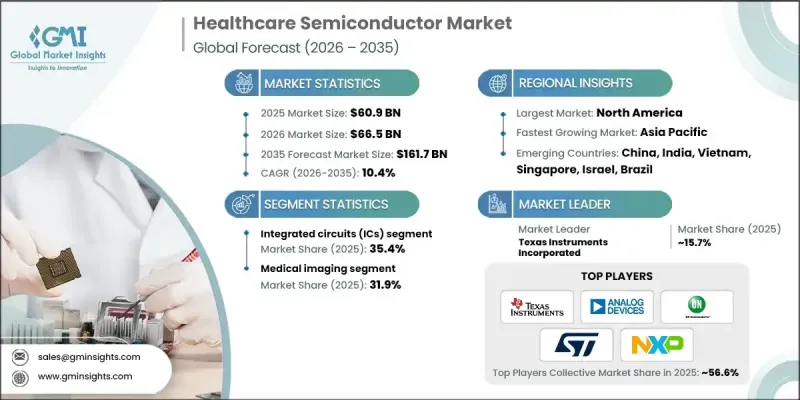
市場成長主要受以下因素驅動:人工智慧 (AI) 和機器學習 (ML) 在醫療保健領域的快速應用、慢性病盛行率的上升以及醫療保健IT基礎設施投資的不斷成長。穿戴式健康設備、遠端患者監護解決方案以及小型化、攜帶式醫療技術的需求也在激增。先進半導體在加速數據處理、提高診斷準確性以及建立智慧醫療系統方面發揮關鍵作用。特別是遠距監護和穿戴式裝置的廣泛應用,正在推動半導體技術的發展,從而實現對患者的持續追蹤、高效的慢性病管理以及改善治療效果。隨著醫療設備日益互聯且功能強大,半導體技術作為人工智慧診斷、遠端醫療解決方案和智慧醫療設備的基礎,至關重要。
| 市場覆蓋範圍 | |
|---|---|
| 開始年份 | 2025 |
| 預測期 | 2026-2035 |
| 起始值 | 609億美元 |
| 預測金額 | 1617億美元 |
| 複合年成長率 | 10.4% |
預計到2025年,積體電路(IC)市佔率將達到35.4%。積體電路仍然是醫療半導體產業的核心,因為它們為醫療設備提供緊湊、高效能的解決方案,從而實現精準診斷、監控以及整個醫療保健系統的無縫連接。這些晶片對於驅動小型、節能的設備至關重要,這些設備可以與醫療物聯網(IoMT)和其他互聯醫療平台整合。
預計到2025年,醫療影像領域將佔據31.9%的市場。半導體技術在醫療影像系統中至關重要,它能夠確保高解析度影像、更快地獲取診斷資訊並改善治療方案的發展。半導體技術的進步推動了節能高效成像設備的研發,這些設備能夠提供精準的診斷,使醫療機構能夠提供更快捷、更可靠的醫療服務。
預計到2025年,北美醫療半導體市佔率將達到35.2%。該地區的成長主要得益於政府的醫療保健政策、對醫療研究的大量投資以及對遠端醫療和數位醫療解決方案的強勁需求。此外,不斷湧現的創新、先進的醫療基礎設施以及日益成長的老齡人口帶來的醫療需求也為市場發展提供了支持。
目錄
第1章調查方法和範圍
第2章執行摘要
第3章業界考察
- 生態系分析
- 供應商情況
- 利潤率
- 成本結構
- 每個階段的附加價值
- 影響價值鏈的因素
- 中斷
- 生態系分析
- 產業影響因素
- 促進要素
- 人工智慧 (AI) 和機器學習 (ML) 在醫療保健領域的興起
- 慢性病發生率呈上升趨勢
- 增加對醫療資訊科技的投資
- 對穿戴式健康設備和遠端患者監護的需求不斷成長
- 小型化和便攜化的發展趨勢
- 挑戰與困難
- 科技快速過時
- 隱私和安全問題
- 市場機遇
- 個人化醫療的進展
- 擴大遠端醫療服務
- 促進要素
- 成長潛力分析
- 監管環境
- 北美洲
- 歐洲
- 亞太地區
- 拉丁美洲
- 中東和非洲
- 波特五力分析
- PESTEL 分析
- 科技與創新趨勢
- 當前技術趨勢
- 新興技術
- 新興經營模式
- 合規要求
- 永續性措施
- 消費者心理分析
- 專利和智慧財產權分析
- 地緣政治和貿易趨勢
第4章 競爭情勢
- 介紹
- 公司市佔率分析
- 按地區
- 北美洲
- 歐洲
- 亞太地區
- 拉丁美洲
- 中東和非洲
- 市場集中度分析
- 按地區
- 主要企業的競爭標竿分析
- 財務績效比較
- 收入
- 利潤率
- 研究與開發
- 產品系列比較
- 產品線的廣度
- 科技
- 創新
- 地理分佈比較
- 全球擴張分析
- 服務網路覆蓋
- 按地區分類的市場滲透率
- 競爭定位矩陣
- 領導企業
- 受讓人
- 追蹤者
- 小眾玩家
- 戰略展望矩陣
- 財務績效比較
- 2021-2024 年主要發展動態
- 併購
- 夥伴關係與合作
- 技術進步
- 擴張與投資策略
- 永續發展計劃
- 數位轉型計劃
- 新興/Start-Ups競賽的趨勢
第5章 按組件分類的市場估算與預測,2022-2035年
- 積體電路(IC)
- 記憶
- MPU
- 邏輯積體電路
- 類比IC
- 微型電腦
- 感應器
- 光學感測器
- 壓力感測器
- 溫度感測器
- 其他
- 離散組件
- 光電裝置
第6章 按應用領域分類的市場估算與預測,2022-2035年
- 醫學影像診斷
- X光系統
- 電腦斷層掃描(CT)掃描儀
- 磁振造影(MRI)系統
- 其他
- 病患監測
- 診斷設備
- 穿戴式裝置
- 智慧型手錶和穿戴式監測器
- 連接式心電圖監測儀
- 其他
- 其他
- 復健設備
- 遠端醫療
- 植入式醫療設備
- 其他
第7章 2022-2035年各地區市場估算與預測
- 北美洲
- 美國
- 加拿大
- 歐洲
- 德國
- 英國
- 法國
- 西班牙
- 義大利
- 荷蘭
- 亞太地區
- 中國
- 印度
- 日本
- 澳洲
- 韓國
- 拉丁美洲
- 巴西
- 墨西哥
- 阿根廷
- 中東和非洲
- 南非
- 沙烏地阿拉伯
- 阿拉伯聯合大公國
第8章 公司簡介
- 主要企業
- Intel Corporation
- Texas Instruments Incorporated
- STMicroelectronics NV
- NXP Semiconductors NV
- Analog Devices, Inc.
- 按地區分類的主要企業
- 北美洲
- Qualcomm Incorporated
- Broadcom Inc.
- Micron Technology, Inc.
- 亞太地區
- ON Semiconductor
- Samsung Electronics Co., Ltd.
- Taiwan Semiconductor Manufacturing Company Limited
- 歐洲
- Infineon Technologies AG
- ams OSRAM AG
- Renesas Electronics Corporation
- 北美洲
- 小眾玩家/顛覆者
- SK hynix Inc.
- NVIDIA Corporation
- Microchip Technology Incorporated
The Global Healthcare Semiconductor Market was valued at USD 60.9 billion in 2025 and is estimated to grow at a CAGR of 10.4% to reach USD 161.7 billion by 2035.
Growth in the market is fueled by the rapid adoption of artificial intelligence (AI) and machine learning (ML) in healthcare, the rising incidence of chronic diseases, and increasing investments in healthcare IT infrastructure. There is also surging demand for wearable health devices, remote patient monitoring solutions, and miniaturized, portable healthcare technology. Advanced semiconductors play a crucial role in enabling faster data processing, enhancing diagnostic accuracy, and supporting intelligent healthcare systems. The expansion of remote monitoring and wearable devices is particularly driving semiconductor adoption, allowing continuous patient tracking, efficient chronic disease management, and improved patient outcomes. As medical devices become more interconnected and high-performance, semiconductors are essential for powering AI-enabled diagnostics, telehealth solutions, and smart medical instrumentation.
| Market Scope | |
|---|---|
| Start Year | 2025 |
| Forecast Year | 2026-2035 |
| Start Value | $60.9 Billion |
| Forecast Value | $161.7 Billion |
| CAGR | 10.4% |
The integrated circuits (ICs) segment accounted for 35.4% share in 2025. Integrated circuits remain central to the healthcare semiconductor landscape as they provide compact, high-performance solutions for medical devices, enabling precise diagnostics, monitoring, and seamless connectivity across healthcare systems. These chips are crucial in supporting smaller, energy-efficient devices that can integrate with the Internet of Medical Things (IoMT) and other connected healthcare platforms.
The medical imaging segment held a 31.9% share in 2025. Semiconductor technologies are critical in medical imaging systems, ensuring high-resolution images, rapid access to diagnostic information, and improved treatment planning. Semiconductor advancements support the development of energy-efficient, high-performance imaging devices capable of accurate diagnostics, enabling healthcare providers to deliver faster and more reliable care.
North America Healthcare Semiconductor Market held a 35.2% share in 2025. The growth in this region is driven by government healthcare initiatives, substantial investments in medical research, and strong demand for telehealth and digital healthcare solutions. The market is further supported by rising innovation, advanced healthcare infrastructure, and the increasing needs of a growing aging population.
Key players operating in the Global Healthcare Semiconductor Market include Intel Corporation, Texas Instruments Incorporated, STMicroelectronics N.V., NXP Semiconductors N.V., Analog Devices, Inc., Qualcomm Incorporated, Infineon Technologies AG, onsemi, Renesas Electronics Corporation, Broadcom Inc., Microchip Technology Incorporated, ams OSRAM AG, NVIDIA Corporation, Samsung Electronics Co., Ltd., SK hynix Inc., Taiwan Semiconductor Manufacturing Company Limited, and Micron Technology, Inc. Companies in the healthcare semiconductor market strengthen their presence through multiple strategic approaches. They heavily invest in research and development to create high-performance, energy-efficient, and miniaturized semiconductors that address evolving healthcare needs. Collaborations with medical device manufacturers and healthcare providers enable seamless integration into advanced diagnostic, wearable, and remote monitoring technologies. Geographic expansion into emerging markets helps tap growing demand for connected healthcare solutions, while innovation in AI and IoT-enabled semiconductor applications enhances product differentiation.
Table of Contents
Chapter 1 Methodology and Scope
- 1.1 Market scope and definition
- 1.2 Research design
- 1.2.1 Research approach
- 1.2.2 Data collection methods
- 1.3 Data mining sources
- 1.3.1 Global
- 1.3.2 Regional/Country
- 1.4 Base estimates and calculations
- 1.4.1 Base year calculation
- 1.4.2 Key trends for market estimation
- 1.5 Primary research and validation
- 1.5.1 Primary sources
- 1.6 Forecast model
- 1.7 Research assumptions and limitations
Chapter 2 Executive summary
- 2.1 Industry 360° synopsis
- 2.2 Key market trends
- 2.2.1 Component trends
- 2.2.2 Application trends
- 2.2.3 Regional trends
- 2.3 TAM Analysis, 2026-2035 (USD Million)
- 2.4 CXO perspectives: Strategic imperatives
- 2.4.1 Executive decision points
- 2.4.2 critical success factors
- 2.5 Future outlook and strategic recommendations
Chapter 3 Industry insights
- 3.1 Industry ecosystem analysis
- 3.1.1 Supplier landscape
- 3.1.2 Profit margin
- 3.1.3 Cost structure
- 3.1.4 Value addition at each stage
- 3.1.5 Factor affecting the value chain
- 3.1.6 Disruptions
- 3.2 Industry ecosystem analysis
- 3.3 Industry impact forces
- 3.3.1 Growth drivers
- 3.3.1.1 Emergence of artificial intelligence (AI) and machine learning (ML) in healthcare
- 3.3.1.2 Rising prevalence of chronic diseases
- 3.3.1.3 Increased investments in healthcare IT
- 3.3.1.4 Rising demand for wearable health devices and remote patient monitoring
- 3.3.1.5 Growing trend toward miniaturization and portability
- 3.3.2 Pitfalls and challenges
- 3.3.2.1 Rapid technological obsolescence
- 3.3.2.2 Privacy and security concerns
- 3.3.3 Market opportunities
- 3.3.3.1 Advancements in personalized medicine
- 3.3.3.2 Expansion of telemedicine services
- 3.3.1 Growth drivers
- 3.4 Growth potential analysis
- 3.5 Regulatory landscape
- 3.5.1 North America
- 3.5.2 Europe
- 3.5.3 Asia Pacific
- 3.5.4 Latin America
- 3.5.5 Middle East & Africa
- 3.6 Porter's analysis
- 3.7 PESTEL analysis
- 3.8 Technology and Innovation landscape
- 3.8.1 Current technological trends
- 3.8.2 Emerging technologies
- 3.9 Emerging Business Models
- 3.10 Compliance Requirements
- 3.11 Sustainability Measures
- 3.12 Consumer Sentiment Analysis
- 3.13 Patent and IP analysis
- 3.14 Geopolitical and trade dynamics
Chapter 4 Competitive landscape, 2025
- 4.1 Introduction
- 4.2 Company market share analysis
- 4.2.1 By region
- 4.2.1.1 North America
- 4.2.1.2 Europe
- 4.2.1.3 Asia Pacific
- 4.2.1.4 Latin America
- 4.2.1.5 Middle East & Africa
- 4.2.2 Market concentration analysis
- 4.2.1 By region
- 4.3 Competitive benchmarking of key players
- 4.3.1 Financial performance comparison
- 4.3.1.1 Revenue
- 4.3.1.2 Profit margin
- 4.3.1.3 R&D
- 4.3.2 Product portfolio comparison
- 4.3.2.1 Product range breadth
- 4.3.2.2 Technology
- 4.3.2.3 Innovation
- 4.3.3 Geographic presence comparison
- 4.3.3.1 Global footprint analysis
- 4.3.3.2 Service network coverage
- 4.3.3.3 Market penetration by region
- 4.3.4 Competitive positioning matrix
- 4.3.4.1 Leaders
- 4.3.4.2 Challengers
- 4.3.4.3 Followers
- 4.3.4.4 Niche players
- 4.3.5 Strategic outlook matrix
- 4.3.1 Financial performance comparison
- 4.4 Key developments, 2021-2024
- 4.4.1 Mergers and acquisitions
- 4.4.2 Partnerships and collaborations
- 4.4.3 Technological advancements
- 4.4.4 Expansion and investment strategies
- 4.4.5 Sustainability initiatives
- 4.4.6 Digital transformation initiatives
- 4.5 Emerging/ startup competitors landscape
Chapter 5 Market Estimates and Forecast, By Component, 2022 - 2035 (USD Million & Units)
- 5.1 Key trends
- 5.2 Integrated circuits (ICs)
- 5.2.1 Memory
- 5.2.2 MPUs
- 5.2.3 Logic ICs
- 5.2.4 Analog ICs
- 5.2.5 MCUs
- 5.3 Sensors
- 5.3.1 Optical sensors
- 5.3.2 Pressure sensors
- 5.3.3 Temperature sensors
- 5.3.4 Others
- 5.4 Discrete components
- 5.5 Optoelectronics
Chapter 6 Market Estimates and Forecast, By Application, 2022 - 2035 (USD Million & Units)
- 6.1 Key trends
- 6.2 Medical imaging
- 6.2.1 X-ray systems
- 6.2.2 Computed tomography (CT) scanners
- 6.2.3 Magnetic resonance imaging (MRI) systems
- 6.2.4 Others
- 6.3 Patient monitoring
- 6.4 Diagnostic equipment
- 6.5 Wearables
- 6.5.1 Smartwatches and wearable monitors
- 6.5.2 Connected ECG monitors
- 6.5.3 Others
- 6.6 Others
- 6.6.1 Rehabilitation devices
- 6.6.2 Telemedicine
- 6.6.3 Implantable medical devices
- 6.6.4 Others
Chapter 7 Market Estimates and Forecast, By Region, 2022 - 2035 (USD Million & Units)
- 7.1 Key trends
- 7.2 North America
- 7.2.1 U.S.
- 7.2.2 Canada
- 7.3 Europe
- 7.3.1 Germany
- 7.3.2 UK
- 7.3.3 France
- 7.3.4 Spain
- 7.3.5 Italy
- 7.3.6 Netherlands
- 7.4 Asia Pacific
- 7.4.1 China
- 7.4.2 India
- 7.4.3 Japan
- 7.4.4 Australia
- 7.4.5 South Korea
- 7.5 Latin America
- 7.5.1 Brazil
- 7.5.2 Mexico
- 7.5.3 Argentina
- 7.6 Middle East and Africa
- 7.6.1 South Africa
- 7.6.2 Saudi Arabia
- 7.6.3 UAE
Chapter 8 Company Profiles
- 8.1 Global Key Players
- 8.1.1 Intel Corporation
- 8.1.2 Texas Instruments Incorporated
- 8.1.3 STMicroelectronics N.V.
- 8.1.4 NXP Semiconductors N.V.
- 8.1.5 Analog Devices, Inc.
- 8.2 Regional key players
- 8.2.1 North America
- 8.2.1.1 Qualcomm Incorporated
- 8.2.1.2 Broadcom Inc.
- 8.2.1.3 Micron Technology, Inc.
- 8.2.2 Asia Pacific
- 8.2.2.1 ON Semiconductor
- 8.2.2.2 Samsung Electronics Co., Ltd.
- 8.2.2.3 Taiwan Semiconductor Manufacturing Company Limited
- 8.2.3 Europe
- 8.2.3.1 Infineon Technologies AG
- 8.2.3.2 ams OSRAM AG
- 8.2.3.3 Renesas Electronics Corporation
- 8.2.1 North America
- 8.3 Niche Players/Disruptors
- 8.3.1 SK hynix Inc.
- 8.3.2 NVIDIA Corporation
- 8.3.3 Microchip Technology Incorporated

 半導體及相關裝置市場:全球產業分析、市場規模、市場佔有率及預測(2026-2033 年),依半導體類型、裝置類型、材料類型、技術、應用、國家及地區分類
 2026-2030年全球半導體市場
 有機半導體市場:全球產業規模、市場佔有率、趨勢、機會和預測(按材料類型、應用和地區分類)、競爭格局(2021-2031 年)
 智慧電網半導體元件市場預測至2034年:按元件、應用、最終用戶和地區分類的全球分析金屬氧化物半導體電路市場報告:趨勢、預測與競爭分析(至2035年)
 直接寫入式半導體市場規模、佔有率和成長分析:按技術/設備類型、材料類型、應用和地區分類-2026-2033年產業預測
 用於替代能源技術的半導體:機會和市場SIM卡、SIM晶片和eSIM市場數據概覽:2026年第二季度
 半導體擴散設備市場規模、佔有率和趨勢分析報告:按產品、技術、應用、晶圓尺寸、地區和細分市場分類(2026-2033 年)人工智慧半導體市場預測至2034年—按類型、應用、最終用戶和地區分類的全球分析